Attorney-Verified  Deed in Lieu of Foreclosure Document for Ohio

Attorney-Verified Deed in Lieu of Foreclosure Document for Ohio

A Deed in Lieu of Foreclosure is a legal document that allows a property owner to voluntarily transfer ownership of their property to the lender in order to avoid foreclosure. This option can provide a smoother resolution for homeowners facing financial difficulties, as it often helps them avoid the lengthy and stressful foreclosure process. If you are considering this option, fill out the form by clicking the button below.

Article Guide

When facing the possibility of foreclosure, many homeowners in Ohio seek alternatives to protect their financial future and minimize the impact on their credit. One such option is the Deed in Lieu of Foreclosure, a legal process that allows a homeowner to voluntarily transfer ownership of their property back to the lender in exchange for the cancellation of the mortgage debt. This process can be a practical solution for those who find themselves unable to keep up with their mortgage payments. By using this form, homeowners can avoid the lengthy and often stressful foreclosure process. The Deed in Lieu of Foreclosure form outlines essential details such as the property description, the parties involved, and any agreements regarding the cancellation of debt. It is crucial to understand that while this option can provide a fresh start, it also requires careful consideration of the potential consequences, including the impact on credit scores and future borrowing capabilities. For many, this form serves as a vital tool in navigating financial difficulties while seeking to retain dignity and control over their circumstances.

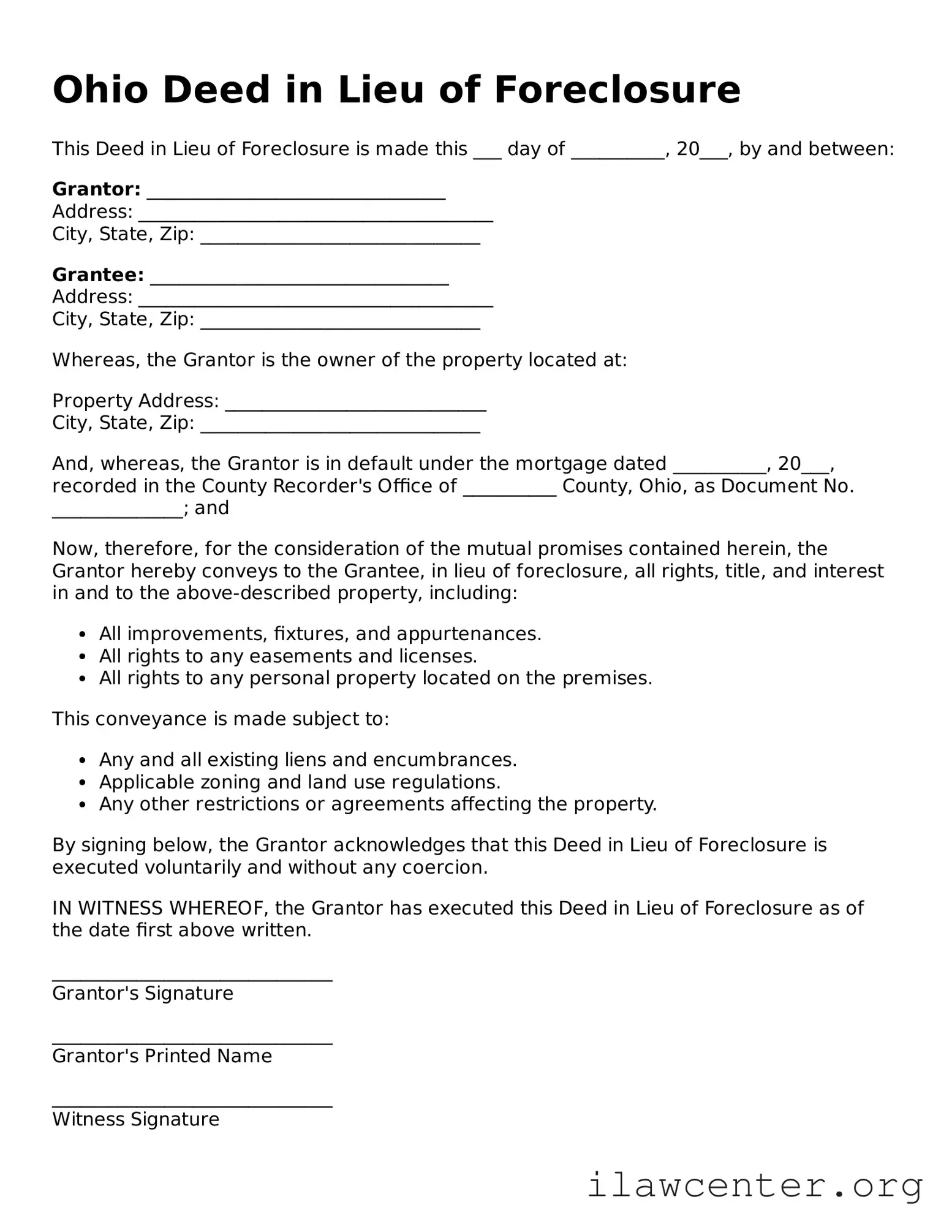
Ohio Deed in Lieu of Foreclosure Preview

Ohio Deed in Lieu of Foreclosure

This Deed in Lieu of Foreclosure is made this ___ day of __________, 20___, by and between:

Grantor: ________________________________
Address: ______________________________________
City, State, Zip: ______________________________

Grantee: ________________________________
Address: ______________________________________
City, State, Zip: ______________________________

Whereas, the Grantor is the owner of the property located at:

Property Address: ____________________________
City, State, Zip: ______________________________

And, whereas, the Grantor is in default under the mortgage dated __________, 20___, recorded in the County Recorder's Office of __________ County, Ohio, as Document No. ______________; and

Now, therefore, for the consideration of the mutual promises contained herein, the Grantor hereby conveys to the Grantee, in lieu of foreclosure, all rights, title, and interest in and to the above-described property, including:

  • All improvements, fixtures, and appurtenances.
  • All rights to any easements and licenses.
  • All rights to any personal property located on the premises.

This conveyance is made subject to:

  • Any and all existing liens and encumbrances.
  • Applicable zoning and land use regulations.
  • Any other restrictions or agreements affecting the property.

By signing below, the Grantor acknowledges that this Deed in Lieu of Foreclosure is executed voluntarily and without any coercion.

IN WITNESS WHEREOF, the Grantor has executed this Deed in Lieu of Foreclosure as of the date first above written.

______________________________
Grantor's Signature

______________________________
Grantor's Printed Name

______________________________
Witness Signature

______________________________
Witness Printed Name

State of Ohio
County of ________________

On this ___ day of __________, 20___, before me, a Notary Public in and for said County and State, personally appeared ____________________________, known to me to be the person whose name is subscribed to the within instrument, and acknowledged that they executed the same.

IN WITNESS WHEREOF, I have hereunto set my hand and affixed my official seal the day and year first above written.

______________________________
Notary Public

PDF Form Characteristics

Fact Name Details
Definition A Deed in Lieu of Foreclosure is a legal document where a borrower voluntarily transfers property ownership to the lender to avoid foreclosure proceedings.
Governing Law In Ohio, the process is governed by the Ohio Revised Code, particularly sections related to real estate transactions and foreclosure procedures.
Eligibility Homeowners facing financial hardship may qualify for a deed in lieu if they have exhausted other options, such as loan modifications or short sales.
Benefits This option can help borrowers avoid the lengthy and costly foreclosure process, potentially allowing for a smoother transition and less impact on credit scores.

Instructions on Utilizing Ohio Deed in Lieu of Foreclosure

Completing the Ohio Deed in Lieu of Foreclosure form is a crucial step for homeowners looking to transfer their property back to the lender. After filling out the form, it will need to be submitted to the appropriate lender and recorded with the local county recorder's office. This process ensures that the deed is legally recognized and that the property ownership is officially updated.

  1. Begin by obtaining the Ohio Deed in Lieu of Foreclosure form from a reliable source or your lender.
  2. Fill in the date at the top of the form, indicating when the deed is being executed.
  3. Provide the name of the current property owner, ensuring that it matches the name on the original mortgage documents.
  4. Enter the name of the lender or mortgage holder who will receive the property.
  5. Include the property address, making sure to specify the street address, city, state, and ZIP code.
  6. Describe the property in detail, including any relevant legal descriptions or parcel numbers, if available.
  7. Sign the form in the designated area. The signature should be that of the current property owner.
  8. Have the signature notarized by a licensed notary public. This step is essential for the validity of the document.
  9. Make copies of the completed and notarized form for your records.
  10. Submit the original deed to the lender and ensure it is recorded with the local county recorder's office.

Important Facts about Ohio Deed in Lieu of Foreclosure

What is a Deed in Lieu of Foreclosure?

A Deed in Lieu of Foreclosure is a legal process where a homeowner voluntarily transfers the title of their property to the lender to avoid foreclosure. This option can be beneficial for homeowners who are struggling to make mortgage payments and want to prevent the negative impact of foreclosure on their credit history.

How does the Deed in Lieu of Foreclosure process work?

The process begins with the homeowner contacting their lender to express interest in a Deed in Lieu of Foreclosure. The lender will then evaluate the homeowner's financial situation and the property’s value. If approved, the homeowner will sign the deed, transferring ownership to the lender. The lender may also agree to release the homeowner from any remaining mortgage debt, depending on the circumstances.

What are the benefits of choosing a Deed in Lieu of Foreclosure?

One of the main benefits is that it can help homeowners avoid the lengthy and stressful foreclosure process. Additionally, a Deed in Lieu may have a less damaging impact on credit scores compared to a foreclosure. It can also provide a quicker resolution, allowing homeowners to move on more swiftly. Furthermore, some lenders may offer relocation assistance as part of the agreement.

Are there any drawbacks to a Deed in Lieu of Foreclosure?

Yes, there are potential drawbacks. Homeowners may still face tax implications, as forgiven mortgage debt can be considered taxable income. Additionally, not all lenders accept Deeds in Lieu, and those that do may have specific requirements that must be met. Homeowners should also be aware that they will lose their home and may not be able to secure another mortgage for some time.

How can a homeowner prepare for a Deed in Lieu of Foreclosure?

Homeowners should gather all relevant financial documents, including income statements, tax returns, and details about their mortgage. It’s also advisable to consult with a financial advisor or attorney to understand the implications fully. Before approaching the lender, homeowners should assess their current financial situation and be prepared to discuss their inability to continue making mortgage payments.

Common mistakes

Filling out the Ohio Deed in Lieu of Foreclosure form can be a daunting task, and many individuals make common mistakes that can complicate the process. One frequent error is failing to provide accurate property information. This includes not only the address but also the legal description of the property. Inaccuracies can lead to delays or even rejection of the deed.

Another mistake involves neglecting to check for outstanding liens or encumbrances. If there are existing debts tied to the property, these must be addressed before the deed can be accepted. Ignoring this step can result in further legal complications down the line.

People often overlook the importance of signatures. The form must be signed by all parties involved, including any co-owners. Without the necessary signatures, the deed may not be valid, and the intended transfer of ownership will not occur.

Additionally, many individuals fail to include a date on the form. While it may seem minor, the date is crucial for establishing the timeline of the transaction. Omitting it can lead to confusion regarding when the deed was executed.

Inaccurate or incomplete notarization is another common pitfall. The deed must be notarized to be legally binding. If the notary public does not complete their section correctly, the document may be deemed invalid.

Some people also forget to provide a clear statement of intent. The purpose of the deed should be explicitly stated to avoid any ambiguity about the transaction. A vague or unclear intent can lead to disputes later on.

Another mistake is not consulting with a legal professional. Many individuals attempt to navigate the process on their own, which can lead to errors that a knowledgeable attorney could easily help avoid. Seeking legal advice can provide clarity and ensure compliance with state laws.

People sometimes underestimate the importance of submitting the deed to the appropriate county recorder’s office. Failing to file the deed properly can leave the property’s status unresolved, leading to future complications.

Additionally, individuals may neglect to keep copies of the completed form. Having a record of all submitted documents is essential for personal records and can be useful in case any issues arise later.

Finally, many people do not follow up after submission. It’s important to verify that the deed has been processed and recorded correctly. A lack of follow-up can result in unexpected surprises regarding property ownership.

Documents used along the form

A Deed in Lieu of Foreclosure is an important document in the process of transferring property ownership to avoid foreclosure. However, several other forms and documents are commonly used alongside it to ensure a smooth transition. Below is a list of these essential documents.

  • Loan Modification Agreement: This document outlines the terms of a revised loan agreement, which may adjust interest rates, payment schedules, or other conditions to make the loan more manageable for the borrower.
  • Notice of Default: A formal notification sent to the borrower indicating that they have defaulted on their mortgage payments. This document is often a precursor to foreclosure proceedings.
  • Release of Mortgage: This document formally releases the lender's claim to the property once the borrower has fulfilled their obligations or transferred ownership through a Deed in Lieu of Foreclosure.
  • Property Inspection Report: A report detailing the condition of the property, which may be required by the lender before accepting the deed in lieu to assess any potential issues or repairs needed.
  • Title Search Report: A document that verifies the ownership history of the property and identifies any liens or encumbrances that may affect the transfer of ownership.
  • Affidavit of Title: A sworn statement by the borrower confirming that they hold clear title to the property and disclosing any claims or liens that may exist.
  • Power of Attorney: A legal document that allows one person to act on behalf of another in legal matters, which may be necessary if the borrower cannot be present to sign the Deed in Lieu of Foreclosure.
  • Settlement Statement: This document outlines the financial details of the transaction, including any costs associated with the deed in lieu process, ensuring transparency for both parties.
  • Release of Liability: A document that releases the borrower from further obligations related to the mortgage after the deed in lieu is executed, providing peace of mind for the borrower.

Each of these documents plays a crucial role in the process surrounding a Deed in Lieu of Foreclosure. Understanding their purposes can help facilitate a smoother transaction and ensure that all parties are adequately protected.

Similar forms

The Deed in Lieu of Foreclosure form is a helpful tool for homeowners facing financial difficulties. It allows them to transfer ownership of their property back to the lender, avoiding the lengthy foreclosure process. However, there are several other documents that serve similar purposes or are related in function. Here’s a list of eight documents that share similarities with the Deed in Lieu of Foreclosure:

  • Loan Modification Agreement: This document alters the terms of an existing loan, potentially lowering monthly payments and making it easier for the homeowner to keep their property.
  • Short Sale Agreement: In a short sale, the lender agrees to accept less than the total amount owed on the mortgage, allowing the homeowner to sell the property and avoid foreclosure.
  • Forebearance Agreement: This temporary arrangement allows homeowners to pause or reduce their mortgage payments for a set period, giving them time to recover financially.
  • Bankruptcy Filing: While not a direct alternative to foreclosure, filing for bankruptcy can provide homeowners with legal protection from creditors, including lenders, and may help them keep their homes.
  • Quitclaim Deed: This document transfers ownership of property without guaranteeing that the title is clear, often used between family members or in divorce settlements.
  • Deed of Trust: This document secures a loan by transferring the property title to a trustee until the borrower pays off the loan, providing a different method of securing a mortgage.
  • Release of Mortgage: This document formally releases the lender's claim on the property once the loan is paid off, similar in outcome to a Deed in Lieu but occurring after the mortgage has been satisfied.
  • Property Settlement Agreement: Often used in divorce cases, this document outlines how property will be divided, which can include transferring ownership of a home to one spouse.

Each of these documents plays a unique role in property ownership and financial management, offering various options for homeowners in distress. Understanding these alternatives can empower individuals to make informed decisions during challenging times.

Dos and Don'ts

When dealing with the Ohio Deed in Lieu of Foreclosure form, it’s important to approach the process with care. Here are five key things to keep in mind:

  • Do ensure that you fully understand the terms of the deed before signing.
  • Don't rush through the paperwork. Take your time to review each section.
  • Do consult with a legal professional if you have any questions or concerns.
  • Don't forget to provide accurate information. Inaccuracies can lead to delays or complications.
  • Do keep copies of all documents for your records after submission.

By following these guidelines, you can navigate the process more smoothly and make informed decisions.

Misconceptions

Understanding the Ohio Deed in Lieu of Foreclosure can be challenging. Here are ten common misconceptions about this legal process:

  1. It eliminates all debt obligations. Many believe that signing a deed in lieu of foreclosure means they no longer owe any money. However, this is not always the case. Depending on the agreement, some debts may still remain.
  2. It is a quick fix for financial problems. While a deed in lieu can expedite the process of relinquishing property, it does not necessarily resolve all financial issues. Other debts may still need to be addressed.
  3. It is the same as foreclosure. A deed in lieu is different from foreclosure. In a foreclosure, the lender takes legal action to reclaim the property. In a deed in lieu, the homeowner voluntarily transfers the property back to the lender.
  4. All lenders accept a deed in lieu. Not every lender will agree to this arrangement. Some may prefer to go through the foreclosure process instead.
  5. It has no impact on credit scores. While a deed in lieu may be less damaging than a foreclosure, it can still negatively affect credit scores. Homeowners should be aware of potential consequences.
  6. It is a simple process with no requirements. There are often specific criteria that must be met for a deed in lieu to be accepted. Homeowners should prepare for an evaluation of their financial situation.
  7. It absolves the homeowner of all liabilities. Even after a deed in lieu, homeowners may still be liable for certain obligations, such as property taxes or homeowners association fees.
  8. Legal representation is unnecessary. While it is possible to navigate the process without an attorney, having legal guidance can help ensure that all rights and obligations are understood.
  9. It is a guaranteed solution. A deed in lieu does not guarantee that the lender will accept the property. Homeowners may face rejection based on their circumstances.
  10. Once signed, there is no going back. While it is true that a deed in lieu is a significant decision, there may be options to negotiate terms or seek alternatives before finalizing the agreement.

Being informed about these misconceptions can help homeowners make better decisions regarding their financial futures.

Key takeaways

When dealing with the Ohio Deed in Lieu of Foreclosure form, understanding the process and implications is crucial. Here are nine key takeaways to consider:

  1. Voluntary Process: A Deed in Lieu of Foreclosure is a voluntary agreement between a homeowner and a lender. It allows the homeowner to transfer property ownership to the lender to avoid foreclosure.
  2. Eligibility Requirements: Not all homeowners qualify. Lenders typically require that the property is not subject to any other liens and that the borrower is unable to make mortgage payments.
  3. Impact on Credit: While a Deed in Lieu may be less damaging than a foreclosure, it still negatively impacts your credit score. Understanding this can help you make informed decisions.
  4. Documentation Needed: Complete documentation is essential. Homeowners must provide financial statements and a hardship letter explaining their situation to the lender.
  5. Release from Debt: Upon acceptance of the Deed in Lieu, the lender typically releases the borrower from the mortgage debt, which can provide a fresh start.
  6. Property Condition: The property should be in good condition. Lenders may refuse the deed if the property has significant damage or neglect.
  7. Legal Advice Recommended: Consulting with a legal professional before proceeding can clarify the implications and ensure all steps are correctly followed.
  8. Tax Implications: Be aware of potential tax consequences. The IRS may consider the forgiven debt as taxable income, so it’s wise to consult a tax advisor.
  9. Alternative Options: Explore other options before deciding on a Deed in Lieu of Foreclosure. Short sales or loan modifications may be more beneficial in some cases.

Understanding these key points can empower homeowners to navigate the complexities of the Deed in Lieu of Foreclosure process with greater confidence.