Attorney-Verified  Divorce Settlement Agreement Document for Ohio

Attorney-Verified Divorce Settlement Agreement Document for Ohio

The Ohio Divorce Settlement Agreement form is a legal document that outlines the terms and conditions agreed upon by both spouses during a divorce. This form addresses important issues such as asset division, child custody, and support obligations. To ensure a smooth process, consider filling out the form by clicking the button below.

Article Guide

When navigating the complexities of divorce, understanding the Ohio Divorce Settlement Agreement form is essential for both parties involved. This document serves as a critical tool in outlining the terms of the divorce, addressing key issues such as the division of marital property, child custody arrangements, and spousal support. It provides a framework for negotiating and formalizing agreements that reflect the unique circumstances of the couple. By clearly detailing the rights and responsibilities of each party, the form helps to minimize future disputes and foster a smoother transition into post-divorce life. Additionally, it plays a vital role in ensuring that any agreements regarding child support and visitation are legally binding and enforceable. Ultimately, the Ohio Divorce Settlement Agreement form is designed to protect the interests of both spouses and their children, promoting a fair resolution that can lead to a more amicable separation.

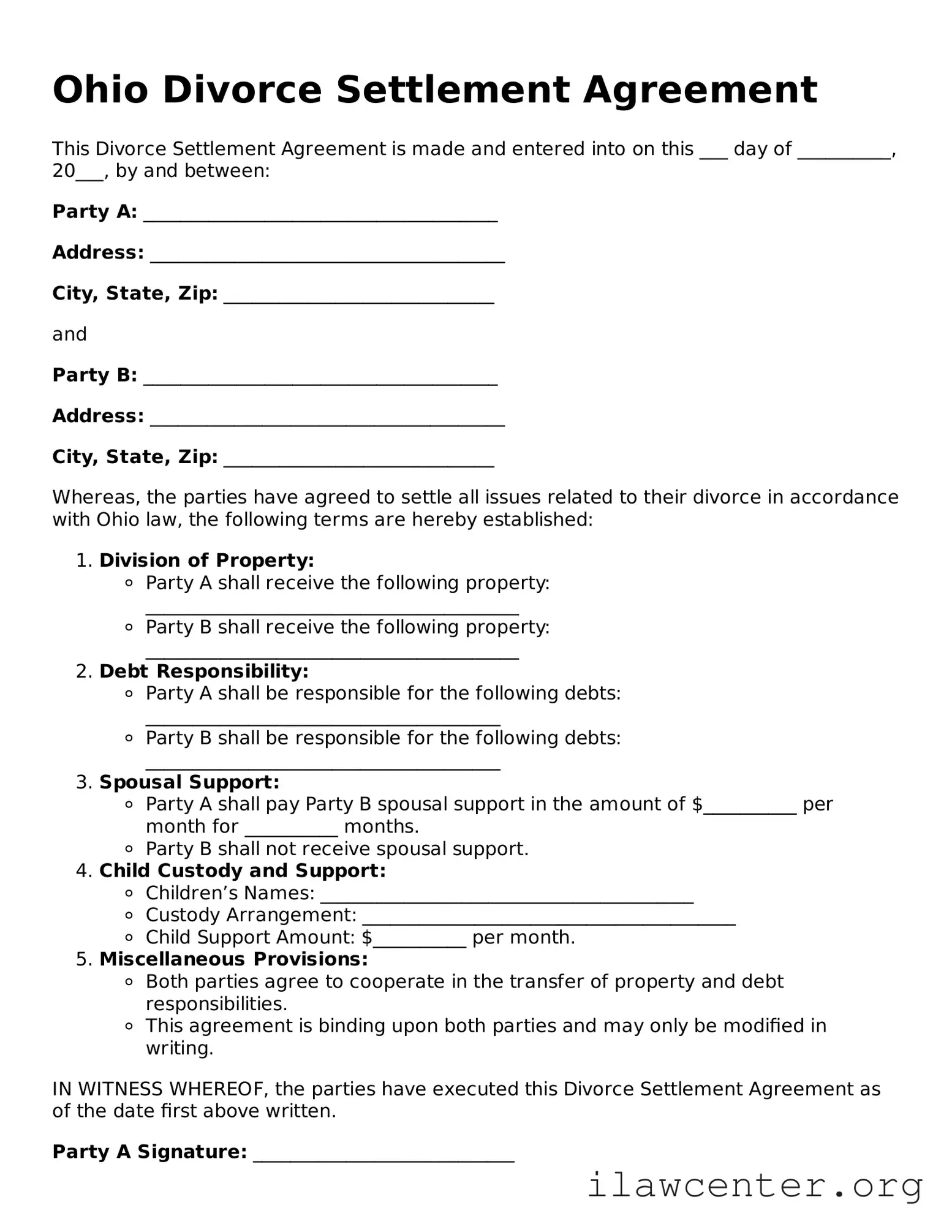
Ohio Divorce Settlement Agreement Preview

Ohio Divorce Settlement Agreement

This Divorce Settlement Agreement is made and entered into on this ___ day of __________, 20___, by and between:

Party A: ______________________________________

Address: ______________________________________

City, State, Zip: _____________________________

and

Party B: ______________________________________

Address: ______________________________________

City, State, Zip: _____________________________

Whereas, the parties have agreed to settle all issues related to their divorce in accordance with Ohio law, the following terms are hereby established:

  1. Division of Property:
    • Party A shall receive the following property: ________________________________________
    • Party B shall receive the following property: ________________________________________
  2. Debt Responsibility:
    • Party A shall be responsible for the following debts: ______________________________________
    • Party B shall be responsible for the following debts: ______________________________________
  3. Spousal Support:
    • Party A shall pay Party B spousal support in the amount of $__________ per month for __________ months.
    • Party B shall not receive spousal support.
  4. Child Custody and Support:
    • Children’s Names: ________________________________________
    • Custody Arrangement: ________________________________________
    • Child Support Amount: $__________ per month.
  5. Miscellaneous Provisions:
    • Both parties agree to cooperate in the transfer of property and debt responsibilities.
    • This agreement is binding upon both parties and may only be modified in writing.

IN WITNESS WHEREOF, the parties have executed this Divorce Settlement Agreement as of the date first above written.

Party A Signature: ____________________________

Date: ____________________________

Party B Signature: ____________________________

Date: ____________________________

PDF Form Characteristics

Fact Name Description
Purpose The Ohio Divorce Settlement Agreement form outlines the terms agreed upon by both parties regarding the division of assets, debts, and other relevant matters during a divorce.
Governing Law This form is governed by Ohio Revised Code, Title 31, which pertains to domestic relations.
Mutual Agreement Both spouses must voluntarily agree to the terms laid out in the settlement agreement for it to be valid.
Filing Requirement The completed form must be filed with the court as part of the divorce proceedings to be enforceable.
Child Custody and Support If applicable, the agreement must address child custody arrangements and child support obligations.
Property Division The form should clearly specify how marital property and debts will be divided between the spouses.
Legal Representation While not mandatory, it is advisable for each party to have legal representation to ensure their rights are protected.
Modification Once signed and approved by the court, the agreement can only be modified through mutual consent or a court order.

Instructions on Utilizing Ohio Divorce Settlement Agreement

Filling out the Ohio Divorce Settlement Agreement form is an important step in the divorce process. This form helps outline the terms of the divorce, including asset division, child custody, and support arrangements. Once completed, this document will need to be submitted to the court as part of your divorce proceedings.

  1. Begin by downloading the Ohio Divorce Settlement Agreement form from the appropriate court website or obtaining a physical copy from the courthouse.
  2. Read through the entire form carefully to understand what information is required.
  3. At the top of the form, fill in the names of both parties involved in the divorce, along with their addresses and contact information.
  4. Provide the case number if you have one. If not, leave this section blank; the court will assign one later.
  5. In the section for marital property, list all assets and debts acquired during the marriage. Be specific about who will receive what.
  6. Detail any child custody arrangements. Specify which parent will have legal and physical custody, and outline visitation rights for the non-custodial parent.
  7. Include any child support or spousal support terms. Clearly state the amount and duration of payments.
  8. Both parties should review the filled-out form for accuracy and completeness. Make sure all necessary sections are filled in.
  9. Sign and date the form in the designated areas. Both parties must sign to indicate agreement to the terms.
  10. Make copies of the completed form for your records before submitting it to the court.
  11. Submit the form to the appropriate court, following any specific filing instructions provided by the court.

Important Facts about Ohio Divorce Settlement Agreement

What is a Divorce Settlement Agreement in Ohio?

A Divorce Settlement Agreement is a legal document that outlines the terms agreed upon by both spouses regarding the division of assets, debts, and other important matters during a divorce. This agreement serves to clarify the rights and responsibilities of each party, ensuring a smoother transition post-divorce.

Is a Divorce Settlement Agreement required in Ohio?

While it is not legally required to have a Divorce Settlement Agreement, it is highly recommended. Having a written agreement helps prevent misunderstandings and disputes in the future. It can also expedite the divorce process by providing clear terms that the court can enforce.

What should be included in the Divorce Settlement Agreement?

Key components of a Divorce Settlement Agreement typically include the division of marital property, allocation of debts, child custody arrangements, visitation schedules, and child support obligations. It may also address spousal support and any other pertinent issues that arise during the divorce process.

How do I create a Divorce Settlement Agreement?

Creating a Divorce Settlement Agreement involves negotiation between both parties to reach an amicable resolution. It is advisable to consult with an attorney to ensure that all legal requirements are met and that the agreement is fair and enforceable. Once both parties agree on the terms, the document should be drafted and signed.

Can I modify the Divorce Settlement Agreement after it is signed?

Yes, modifications to a Divorce Settlement Agreement can be made, but both parties must agree to the changes. It is important to document any modifications in writing and, if necessary, file the revised agreement with the court to ensure it is enforceable.

What happens if one party does not comply with the agreement?

If one party fails to comply with the terms of the Divorce Settlement Agreement, the other party may seek enforcement through the court. The court can enforce the agreement and may impose penalties on the non-compliant party, ensuring that the terms are upheld.

Do I need a lawyer to draft a Divorce Settlement Agreement?

While it is not mandatory to have a lawyer draft a Divorce Settlement Agreement, it is highly advisable. An attorney can provide valuable guidance, help ensure that the agreement complies with Ohio law, and protect your interests throughout the process.

How long does it take to finalize a Divorce Settlement Agreement?

The time it takes to finalize a Divorce Settlement Agreement can vary significantly based on the complexity of the issues involved and the willingness of both parties to negotiate. In some cases, agreements can be reached in a matter of weeks, while more contentious situations may take several months.

Where do I file the Divorce Settlement Agreement in Ohio?

Once the Divorce Settlement Agreement is finalized and signed, it should be filed with the court where the divorce is being processed. This ensures that the agreement is part of the official court record and can be enforced if necessary.

Common mistakes

Filling out the Ohio Divorce Settlement Agreement form can be a daunting task. Many individuals approach this process with good intentions but often make common mistakes that can lead to complications later. One of the most frequent errors is failing to provide complete and accurate information. Omitting details about assets, debts, or income can result in an unfair settlement. It’s crucial to take the time to gather all necessary documents and ensure that every relevant piece of information is included.

Another mistake is not fully understanding the implications of the terms being agreed upon. Many people rush through the form without fully grasping the long-term consequences of their choices. For example, decisions about child custody, visitation rights, and financial support can significantly impact one’s life. It’s advisable to think critically about each provision and how it will affect both parties in the future.

Additionally, some individuals neglect to consult with a legal professional. While it may seem tempting to complete the form independently to save money, this approach can lead to oversights. Legal experts can provide valuable insights and help ensure that the agreement complies with Ohio law. Their guidance can prevent costly mistakes that may arise from misunderstandings of legal terminology or requirements.

People often overlook the importance of being specific in their agreements. Vague language can lead to confusion and disputes down the line. For instance, when detailing child support, it’s essential to specify the amount, payment schedule, and any conditions for adjustments. Clear and precise language helps to prevent misinterpretations and fosters a smoother post-divorce relationship.

Another common error is failing to address the division of debts. While individuals may focus on asset division, ignoring debts can create significant problems later. Both parties should clearly outline how debts will be shared or assigned. This includes credit card debts, mortgages, and any loans. Addressing these issues in the settlement agreement can prevent future financial disputes.

Moreover, some individuals forget to consider tax implications. Certain financial decisions, such as the division of retirement accounts or the sale of property, can have tax consequences. Failing to account for these factors can lead to unexpected financial burdens after the divorce is finalized. Consulting with a financial advisor can help clarify these issues before making any final agreements.

Another mistake involves not updating beneficiary designations. After a divorce, it’s vital to revisit wills, trusts, and insurance policies to ensure that beneficiaries reflect the current situation. Neglecting to make these changes can lead to unintended consequences, such as an ex-spouse receiving assets or benefits that were meant for someone else.

People sometimes also underestimate the importance of reviewing the agreement before signing. Rushing through the final steps can lead to overlooking critical details. Taking the time to read through the entire document ensures that all terms are understood and agreed upon. It’s wise to double-check that all provisions accurately reflect the discussions and agreements made.

Finally, many individuals fail to keep a copy of the signed agreement. After everything is finalized, it’s essential to retain a copy for personal records. This document serves as a reference point for future obligations and rights. Keeping track of important paperwork can simplify future interactions and help maintain clarity in the years to come.

Documents used along the form

When navigating the process of divorce in Ohio, several key documents often accompany the Divorce Settlement Agreement. Each of these forms serves a specific purpose and helps to ensure that all aspects of the divorce are addressed thoroughly. Below is a list of commonly used forms and documents that may be required or beneficial during this process.

  • Petition for Divorce: This document initiates the divorce proceedings. It outlines the reasons for the divorce and requests the court to dissolve the marriage.
  • Summons: Issued alongside the Petition for Divorce, the Summons notifies the other spouse of the divorce filing and provides instructions on how to respond.
  • Financial Affidavit: This form details the financial situation of both parties, including income, expenses, assets, and debts. It is crucial for determining issues like alimony and property division.
  • Child Custody Agreement: If children are involved, this document outlines the arrangements for custody and visitation. It prioritizes the best interests of the children and addresses their needs.
  • Child Support Worksheet: Used to calculate the amount of child support one parent may owe to the other. This form takes into account various factors, including income and the number of children.
  • Decree of Divorce: Once the court finalizes the divorce, this document officially ends the marriage. It includes the terms agreed upon in the Divorce Settlement Agreement.
  • Notice of Final Hearing: This document informs both parties of the date and time of the final hearing where the court will review and approve the Divorce Settlement Agreement.

Understanding these documents can help streamline the divorce process and ensure that all necessary legal requirements are met. Each form plays a vital role in protecting the rights and interests of both parties involved in the divorce.

Similar forms

The Divorce Settlement Agreement is an important document in the process of ending a marriage. Several other legal documents share similarities with this agreement, often serving related purposes in family law. Below is a list of ten such documents, each accompanied by an explanation of how they relate to the Divorce Settlement Agreement.

  • Separation Agreement: This document outlines the terms of a couple's separation before a divorce is finalized. Like the Divorce Settlement Agreement, it addresses issues such as property division and child custody.
  • Child Custody Agreement: This agreement specifically focuses on the arrangements for the care and custody of children. It is similar to the Divorce Settlement Agreement in that it aims to ensure the best interests of the children involved.
  • Child Support Agreement: This document details the financial support one parent will provide to the other for the upbringing of their children. Both agreements work together to ensure the welfare of the children post-divorce.
  • Marital Settlement Agreement: Often used interchangeably with the Divorce Settlement Agreement, this document addresses the division of assets and debts, as well as other matters related to the dissolution of marriage.
  • Property Settlement Agreement: This focuses specifically on how property will be divided between the spouses. It shares similarities with the Divorce Settlement Agreement in its goal of equitable distribution.
  • Spousal Support Agreement: This document outlines the financial support one spouse may provide to the other following a divorce. It is often included in the Divorce Settlement Agreement but can also stand alone.
  • Parenting Plan: This plan details how parents will raise their children after separation or divorce. It is similar to the child custody agreement and is often incorporated into the Divorce Settlement Agreement.
  • Divorce Decree: This is the official court order that finalizes a divorce. It may reference the Divorce Settlement Agreement, making it an integral part of the divorce process.
  • Affidavit of Support: This document may be used in cases involving immigration matters related to marriage. It shares the goal of ensuring support and stability, similar to aspects of the Divorce Settlement Agreement.
  • Modification Agreement: This document is used when changes need to be made to existing agreements, such as child support or custody arrangements. It is similar to the Divorce Settlement Agreement in that it addresses ongoing obligations and rights.

Dos and Don'ts

When filling out the Ohio Divorce Settlement Agreement form, it's important to be thorough and accurate. Here are some essential do's and don'ts to keep in mind:

  • Do read the entire form carefully before starting. Understanding each section will help you provide the necessary information.
  • Do be honest about your assets and debts. Full disclosure is crucial for a fair settlement.
  • Do consult with a lawyer if you have questions. Professional guidance can clarify complex issues.
  • Do keep a copy of the completed form for your records. This can be helpful for future reference.
  • Don't rush through the form. Taking your time can prevent mistakes that might delay the process.
  • Don't leave any sections blank. If something doesn’t apply, write “N/A” to indicate that it has been considered.

By following these guidelines, you can ensure that your Divorce Settlement Agreement is filled out correctly and completely, which can help facilitate a smoother divorce process.

Misconceptions

Understanding the Ohio Divorce Settlement Agreement form is crucial for anyone going through a divorce. However, several misconceptions can lead to confusion. Here are ten common misconceptions:

  1. It is a legally binding document immediately upon signing.

    Many believe that once both parties sign the agreement, it is automatically enforceable. In reality, it must be approved by a judge to become legally binding.

  2. Only one party needs to fill out the form.

    Both parties must participate in the process. Each person should provide input and agree to the terms outlined in the settlement.

  3. The form covers all aspects of the divorce.

    While the form addresses key issues like property division and child custody, it may not cover every detail. Additional agreements may be necessary.

  4. It can be completed without legal assistance.

    Although it is possible to fill out the form independently, consulting with a legal professional can help ensure that all terms are fair and legally sound.

  5. Once filed, it cannot be changed.

    Changes can be made before the judge approves the settlement. After approval, modifications may require a court order.

  6. It only applies to couples with children.

    The Divorce Settlement Agreement is relevant for all divorcing couples, regardless of whether they have children.

  7. It is a simple form that requires minimal information.

    Completing the form accurately requires careful consideration of various factors, including finances and custody arrangements.

  8. Filing the form guarantees a quick divorce.

    The time it takes to finalize a divorce depends on several factors, including court schedules and the complexity of the case.

  9. All debts are automatically divided equally.

    Debts are divided based on the specifics of the case and the agreement. It is essential to address how debts will be handled in the settlement.

  10. Once the agreement is signed, there are no further obligations.

    Parties must adhere to the terms outlined in the agreement. Failing to do so can lead to legal consequences.

Clarifying these misconceptions can help individuals navigate the divorce process more effectively and ensure that their rights are protected.

Key takeaways

When navigating the Ohio Divorce Settlement Agreement form, there are several important points to keep in mind. Understanding these can help ensure that the process goes smoothly and that both parties are satisfied with the outcome.

  • Clarity is Key: Clearly outline all terms of the agreement. This includes details about property division, child custody, and support obligations. Ambiguities can lead to misunderstandings later on.
  • Full Disclosure: Both parties must provide complete and honest information about their assets and debts. Hiding information can result in legal consequences and may affect the validity of the agreement.
  • Consider Future Needs: Think about how the agreement will affect both parties in the long term. Consider factors like changes in income, job stability, and the needs of any children involved.
  • Legal Review: Before finalizing the agreement, it’s wise to have a lawyer review the document. This ensures that all legal requirements are met and that both parties understand their rights and responsibilities.