Attorney-Verified  Employee Handbook Document for Ohio

Attorney-Verified Employee Handbook Document for Ohio

The Ohio Employee Handbook form serves as a crucial document that outlines the policies, procedures, and expectations within a workplace. This form not only helps in maintaining consistency and clarity but also protects both employees and employers by establishing clear guidelines. To ensure compliance and foster a positive work environment, consider filling out the form by clicking the button below.

Article Guide

When managing a workforce, clarity and communication are essential, and an employee handbook serves as a vital tool in achieving these goals. In Ohio, the Employee Handbook form outlines the key policies, expectations, and benefits that employers provide to their employees. This document typically includes sections on workplace conduct, attendance policies, and procedures for reporting grievances. Additionally, it addresses employee rights, such as anti-discrimination policies and workplace safety guidelines. By establishing clear guidelines, the handbook helps to foster a positive work environment and ensures that employees understand their responsibilities and entitlements. Moreover, it can protect employers by providing a reference point in case of disputes or misunderstandings. Understanding the components of the Ohio Employee Handbook form is crucial for both employers and employees, as it lays the foundation for a transparent and well-functioning workplace.

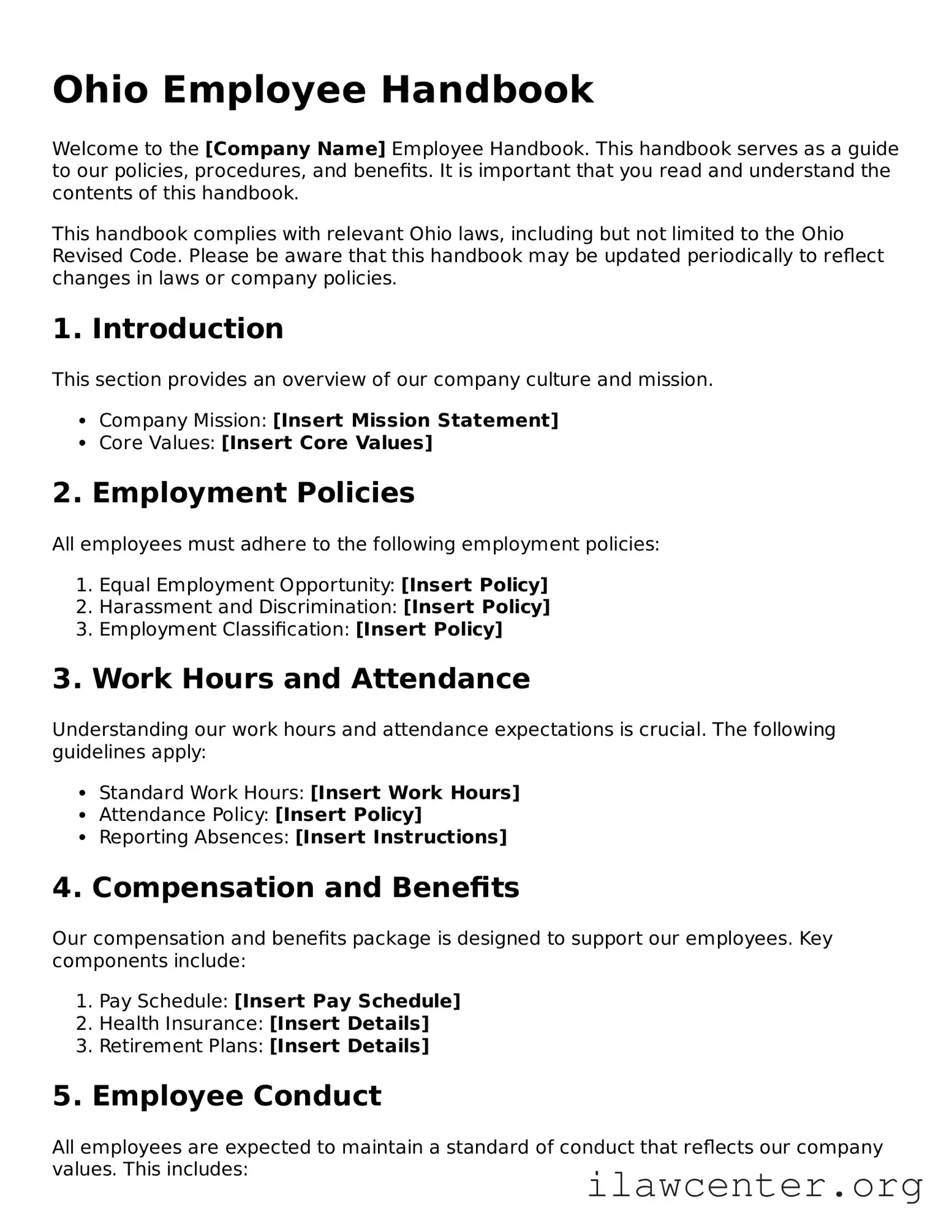
Ohio Employee Handbook Preview

Ohio Employee Handbook

Welcome to the [Company Name] Employee Handbook. This handbook serves as a guide to our policies, procedures, and benefits. It is important that you read and understand the contents of this handbook.

This handbook complies with relevant Ohio laws, including but not limited to the Ohio Revised Code. Please be aware that this handbook may be updated periodically to reflect changes in laws or company policies.

1. Introduction

This section provides an overview of our company culture and mission.

  • Company Mission: [Insert Mission Statement]
  • Core Values: [Insert Core Values]

2. Employment Policies

All employees must adhere to the following employment policies:

  1. Equal Employment Opportunity: [Insert Policy]
  2. Harassment and Discrimination: [Insert Policy]
  3. Employment Classification: [Insert Policy]

3. Work Hours and Attendance

Understanding our work hours and attendance expectations is crucial. The following guidelines apply:

  • Standard Work Hours: [Insert Work Hours]
  • Attendance Policy: [Insert Policy]
  • Reporting Absences: [Insert Instructions]

4. Compensation and Benefits

Our compensation and benefits package is designed to support our employees. Key components include:

  1. Pay Schedule: [Insert Pay Schedule]
  2. Health Insurance: [Insert Details]
  3. Retirement Plans: [Insert Details]

5. Employee Conduct

All employees are expected to maintain a standard of conduct that reflects our company values. This includes:

  • Dress Code: [Insert Policy]
  • Code of Ethics: [Insert Policy]
  • Substance Abuse Policy: [Insert Policy]

6. Safety and Health

Your safety and health are our top priority. Please familiarize yourself with the following:

  1. Workplace Safety Guidelines: [Insert Guidelines]
  2. Emergency Procedures: [Insert Procedures]
  3. Reporting Unsafe Conditions: [Insert Instructions]

7. Acknowledgment

By signing below, you acknowledge that you have received and read the [Company Name] Employee Handbook.

Employee Name: [Insert Employee Name]

Signature: [Insert Signature]

Date: [Insert Date]

PDF Form Characteristics

Fact Name Description
Purpose The Ohio Employee Handbook serves as a guide for employees regarding company policies, procedures, and expectations.
Governing Law The handbook is governed by Ohio employment law, including the Ohio Revised Code.
Content Requirements It should include sections on workplace conduct, benefits, and grievance procedures.
Distribution Employers must provide the handbook to all employees, ensuring they understand its contents.
Updates The handbook should be reviewed and updated regularly to reflect changes in laws or company policies.

Instructions on Utilizing Ohio Employee Handbook

Completing the Ohio Employee Handbook form is a straightforward process. Follow these steps to ensure that you fill it out accurately and completely. After filling out the form, you will submit it to your employer for review and inclusion in your employee records.

  1. Obtain a copy of the Ohio Employee Handbook form from your employer or their website.
  2. Read through the form carefully to understand the required information.
  3. Begin filling out your personal information, including your full name, address, and contact details.
  4. Provide your job title and department as requested on the form.
  5. Complete any sections related to your employment history, if applicable.
  6. Review the sections that may require you to acknowledge receipt and understanding of the handbook.
  7. Sign and date the form at the designated area to confirm your acknowledgment.
  8. Make a copy of the completed form for your records before submission.
  9. Submit the form to your supervisor or human resources department as instructed.

Important Facts about Ohio Employee Handbook

What is the Ohio Employee Handbook form?

The Ohio Employee Handbook form is a document designed to help employers outline their workplace policies, procedures, and expectations. It serves as a guide for employees, ensuring they understand their rights and responsibilities within the organization. This handbook can cover various topics, including workplace conduct, benefits, and safety protocols, creating a clear communication channel between the employer and employees.

Why is it important to have an Employee Handbook?

An Employee Handbook is essential for several reasons. First, it sets clear expectations for employee behavior and performance, which can help prevent misunderstandings. Second, it serves as a reference point for employees, helping them navigate company policies. Lastly, having a well-structured handbook can protect the employer legally by demonstrating that the company has communicated its policies effectively.

Who should create the Employee Handbook?

How often should the Employee Handbook be updated?

What should be included in the Employee Handbook?

How can employees access the Employee Handbook?

Common mistakes

Filling out the Ohio Employee Handbook form can be a straightforward process, but many individuals make common mistakes that can lead to confusion or delays. One frequent error is not reading the instructions carefully. Each section of the form has specific requirements, and overlooking these can result in incomplete submissions.

Another common mistake is providing inaccurate personal information. Employees should double-check their name, address, and Social Security number for accuracy. Errors in these details can complicate payroll and benefits processing.

Some individuals forget to sign and date the form. A signature is often required to confirm that the employee has read and understood the handbook. Without this, the form may be considered invalid.

Inconsistent information can also pose problems. For example, if an employee lists a different job title on the form than what is recorded in the company’s system, it may raise questions. Consistency is key to ensuring that all records align.

Many people neglect to update their forms when their circumstances change. Life events such as a name change, change of address, or marital status can affect benefits and payroll. Keeping the form current is essential for accurate record-keeping.

Some employees may not take the time to thoroughly read the handbook itself. Important policies and procedures are outlined in this document. Not being familiar with these can lead to misunderstandings about workplace expectations.

Another mistake is failing to ask questions when something is unclear. If an employee does not understand a policy or procedure, seeking clarification is important. Ignoring uncertainties can lead to misinterpretations that could affect job performance.

Submitting the form late can also be a concern. Timeliness is often crucial in ensuring that all necessary documentation is processed efficiently. Delays can lead to issues with payroll or employee benefits.

Some individuals may overlook the need for a witness signature, if required. Not having a witness can invalidate the form in certain situations, so it is wise to check if this is necessary.

Lastly, many employees do not keep a copy of the completed form for their records. Retaining a copy can be helpful for future reference, especially if questions arise regarding employment policies.
Documents used along the form

When creating an effective workplace environment, an Ohio Employee Handbook is just one piece of the puzzle. Several other forms and documents complement the handbook, ensuring clarity and compliance within the organization. Here’s a list of common forms and documents that often accompany the Employee Handbook.

  • Job Descriptions: These documents outline the responsibilities, qualifications, and expectations for each position within the organization. They help employees understand their roles and provide a basis for performance evaluations.
  • Onboarding Checklist: This list helps new employees navigate their initial days in the company. It typically includes tasks such as completing paperwork, meeting with HR, and undergoing orientation sessions.
  • Employee Evaluation Forms: These forms are used to assess employee performance periodically. They often include criteria for evaluation and space for feedback from both supervisors and employees.
  • Leave of Absence Policy: This document details the procedures and eligibility for taking leave from work, whether for personal, medical, or family reasons. It ensures employees are aware of their rights and responsibilities.
  • Disciplinary Action Policy: This outlines the steps the company will take in response to employee misconduct. It provides a clear framework for addressing issues and maintaining workplace standards.
  • Confidentiality Agreement: Employees may be required to sign this document to protect sensitive company information. It emphasizes the importance of confidentiality in maintaining the organization’s integrity.
  • Safety Procedures Manual: This manual outlines the safety protocols and emergency procedures that employees must follow. It is crucial for ensuring a safe working environment.
  • Harassment Policy: This document defines what constitutes harassment and outlines the procedures for reporting and addressing such behavior. It is vital for fostering a respectful workplace culture.

By utilizing these additional documents alongside the Ohio Employee Handbook, organizations can create a comprehensive framework that supports both employees and employers. This approach not only clarifies expectations but also promotes a positive and productive workplace culture.

Similar forms

The Employee Handbook serves as an essential resource for employees, outlining company policies, procedures, and expectations. It shares similarities with several other documents that also aim to guide employees and establish workplace norms. Below are nine documents that are similar to the Employee Handbook, along with descriptions of their similarities.

  • Code of Conduct: Like the Employee Handbook, the Code of Conduct outlines acceptable behaviors and ethical standards expected from employees. Both documents aim to promote a positive workplace culture.
  • Onboarding Manual: This document provides new employees with essential information about the company and their roles. Similar to the Employee Handbook, it includes policies and procedures that help employees acclimate to the workplace.
  • Job Descriptions: Job descriptions detail the responsibilities and expectations for specific roles. Both job descriptions and the Employee Handbook clarify what is expected of employees in their positions.
  • Performance Evaluation Guidelines: These guidelines outline the criteria for assessing employee performance. Like the Employee Handbook, they provide employees with an understanding of how their work will be evaluated.
  • Safety Manual: The Safety Manual details safety protocols and procedures within the workplace. Both documents aim to protect employees by providing important information regarding workplace safety and health standards.
  • Training Materials: Training materials offer information and resources for employee development. Similar to the Employee Handbook, they help employees understand their roles and responsibilities within the organization.
  • Leave Policies: Leave policies explain the types of leave available to employees and the procedures for requesting time off. Like the Employee Handbook, these policies help employees understand their rights and responsibilities regarding time away from work.
  • Compensation and Benefits Guide: This guide outlines the compensation structure and benefits offered to employees. Similar to the Employee Handbook, it provides crucial information that helps employees understand their total rewards package.
  • Employee Grievance Procedures: These procedures outline the steps employees can take if they have concerns or complaints. Like the Employee Handbook, they promote a fair and transparent process for addressing workplace issues.

Dos and Don'ts

When filling out the Ohio Employee Handbook form, it is important to follow specific guidelines to ensure accuracy and compliance. Here is a list of things you should and shouldn't do:

  • Do read the entire form carefully before starting.
  • Do use clear and legible handwriting or type your responses.
  • Do provide all requested information accurately.
  • Do double-check your entries for any errors or omissions.
  • Don't leave any sections blank unless instructed otherwise.
  • Don't use abbreviations or slang in your responses.
  • Don't rush through the form; take your time to ensure completeness.
  • Don't submit the form without reviewing it for accuracy.

Following these guidelines will help ensure that the form is completed correctly and efficiently.

Misconceptions

Understanding the Ohio Employee Handbook form can be challenging, and several misconceptions often arise. Here are eight common misconceptions, along with clarifications to help you navigate the topic more effectively.

  1. Misconception 1: The Employee Handbook is optional for all employers.

    While it's true that not every employer is legally required to have an Employee Handbook, having one is highly recommended. It provides clarity on company policies and expectations.

  2. Misconception 2: The handbook must be a legal document.

    The Employee Handbook does not need to be a formal legal document. However, it should include essential policies and procedures that guide employee behavior and company expectations.

  3. Misconception 3: Once created, the handbook never needs to be updated.

    Policies and laws change over time. Regular updates to the handbook are necessary to ensure compliance and relevance to current practices.

  4. Misconception 4: An Employee Handbook covers every possible situation.

    While the handbook should address many policies, it cannot cover every scenario. It serves as a guideline, and managers may need to make decisions based on specific circumstances.

  5. Misconception 5: Employees must sign the handbook to acknowledge receipt.

    Although it's a good practice to have employees sign an acknowledgment form, it's not a legal requirement. However, having a record can help clarify that employees received and understood the policies.

  6. Misconception 6: The handbook can include any policy the employer wants.

    Employers must ensure that all policies comply with local, state, and federal laws. Some policies may be illegal or discriminatory, which can lead to legal issues.

  7. Misconception 7: The Employee Handbook is only for new hires.

    While new hires often receive a copy, the handbook is a resource for all employees. Regularly referencing it can help maintain consistency in understanding company policies.

  8. Misconception 8: All handbooks are the same across different companies.

    Every company has unique values, culture, and policies. Therefore, each Employee Handbook should be tailored to fit the specific needs and circumstances of the organization.

Key takeaways

Filling out and using the Ohio Employee Handbook form is an important step for both employers and employees. Here are some key takeaways to keep in mind:

  • Understand the Purpose: The handbook serves as a guide for employees, outlining company policies, procedures, and expectations.
  • Tailor the Content: Customize the handbook to reflect your company’s culture, values, and specific policies to ensure relevance.
  • Legal Compliance: Ensure that the handbook complies with Ohio labor laws and federal regulations to avoid potential legal issues.
  • Clear Language: Use straightforward and accessible language. Avoid jargon to make the handbook easy for all employees to understand.
  • Regular Updates: Review and update the handbook regularly to keep it current with any changes in laws or company policies.
  • Employee Acknowledgment: Include a section for employees to sign, acknowledging they have read and understood the handbook. This can be crucial for accountability.

By keeping these points in mind, you can create an effective employee handbook that fosters a positive workplace environment and ensures clarity for all team members.