Attorney-Verified  Employment Verification Document for Ohio

Attorney-Verified Employment Verification Document for Ohio

The Ohio Employment Verification form is a crucial document used to confirm an individual's employment status and history within the state. This form is often required by various institutions, including lenders and government agencies, to ensure accurate information is provided. If you need to complete the form, please click the button below to get started.

Article Guide

The Ohio Employment Verification form plays a crucial role in the hiring process, serving as a key document that employers use to confirm the employment status of their employees. This form is essential not only for verifying job titles and dates of employment but also for ensuring compliance with various state and federal regulations. It typically includes sections for employee information, such as name and Social Security number, as well as details about the employer, including company name and contact information. Additionally, the form may require signatures from both the employee and employer, affirming the accuracy of the provided information. Understanding the importance of this document can help both employers and employees navigate the complexities of employment verification, ensuring that all parties are on the same page and that the hiring process runs smoothly.

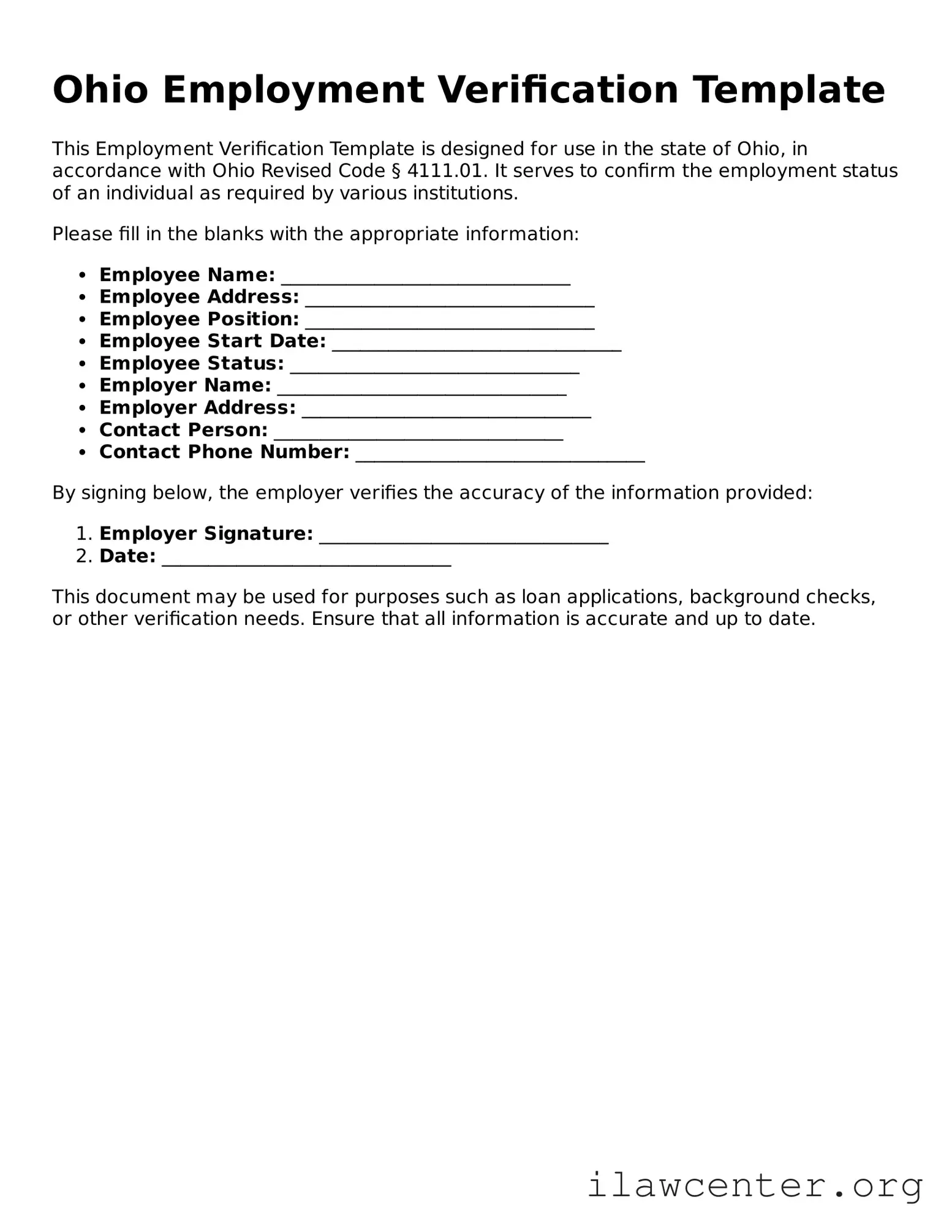
Ohio Employment Verification Preview

Ohio Employment Verification Template

This Employment Verification Template is designed for use in the state of Ohio, in accordance with Ohio Revised Code § 4111.01. It serves to confirm the employment status of an individual as required by various institutions.

Please fill in the blanks with the appropriate information:

  • Employee Name: _______________________________
  • Employee Address: _______________________________
  • Employee Position: _______________________________
  • Employee Start Date: _______________________________
  • Employee Status: _______________________________
  • Employer Name: _______________________________
  • Employer Address: _______________________________
  • Contact Person: _______________________________
  • Contact Phone Number: _______________________________

By signing below, the employer verifies the accuracy of the information provided:

  1. Employer Signature: _______________________________
  2. Date: _______________________________

This document may be used for purposes such as loan applications, background checks, or other verification needs. Ensure that all information is accurate and up to date.

PDF Form Characteristics

Fact Name Details
Purpose The Ohio Employment Verification form is used to confirm an employee's employment status and details with their employer.
Governing Law This form is governed by Ohio Revised Code § 4111.14, which outlines the requirements for employment verification.
Who Uses It Employers and employees use this form for various purposes, including loan applications and background checks.
Submission Process The completed form should be submitted to the requesting party, typically a financial institution or a government agency.

Instructions on Utilizing Ohio Employment Verification

After obtaining the Ohio Employment Verification form, the next step involves accurately filling it out to ensure all necessary information is provided. This process requires attention to detail, as accurate completion is essential for verification purposes.

  1. Begin by entering the employee's full name at the top of the form.
  2. Provide the employee's Social Security number. This is crucial for identification.
  3. Fill in the employee's job title and department.
  4. Indicate the dates of employment, including the start date and, if applicable, the end date.
  5. Complete the employer's name and contact information, including the address and phone number.
  6. Sign and date the form to confirm that the information provided is accurate.
  7. Review the completed form for any errors or omissions before submission.

Once you have filled out the form, it is important to submit it to the appropriate party, whether that be an employer, a government agency, or another entity requiring verification. Ensure that the form is sent securely to protect the employee's information.

Important Facts about Ohio Employment Verification

What is the Ohio Employment Verification form?

The Ohio Employment Verification form is a document used to confirm an individual's employment status. Employers complete this form to provide information about an employee's job title, duration of employment, and salary details. This verification is often required for various purposes, such as loan applications, rental agreements, or background checks. It's a straightforward way to establish an individual's work history and reliability.

Who needs to fill out the Employment Verification form?

Typically, the employer fills out the Employment Verification form when requested by an employee or a third party. This could include banks, landlords, or potential employers. If you are an employee seeking verification, you will need to request this form from your employer. It’s important to communicate clearly about why you need the verification and to ensure that your employer understands the request.

How is the information on the Employment Verification form used?

The information provided on the Employment Verification form serves several purposes. It helps lenders assess the financial stability of an applicant, landlords determine the reliability of potential tenants, and future employers evaluate the qualifications of job candidates. Essentially, this form acts as a bridge between an individual's past employment and their current opportunities, providing crucial data that can influence important decisions.

Is there a fee associated with obtaining an Employment Verification form?

What should I do if my employer refuses to complete the Employment Verification form?

If your employer is hesitant or refuses to complete the Employment Verification form, it’s essential to understand their reasons. Sometimes, it may be due to company policy or privacy concerns. In such cases, you can ask for clarification or see if there is an alternative way to provide verification, such as a pay stub or tax document. If necessary, consider discussing the issue with HR or seeking advice on how to proceed.

Common mistakes

Filling out the Ohio Employment Verification form can seem straightforward, but many individuals make common mistakes that can delay processing or lead to complications. One frequent error is providing incomplete information. It’s crucial to ensure that all required fields are filled out accurately. Missing details, such as the employee's job title or dates of employment, can result in unnecessary back-and-forth communication with the employer.

Another mistake often seen is the use of incorrect or outdated information. When verifying employment, it’s vital to use the most current details. This includes ensuring that the employer's name and address are accurate. If the company has moved or changed its name, using outdated information can lead to confusion and delays.

People also frequently overlook the importance of signatures. The Ohio Employment Verification form typically requires a signature from both the employee and the employer. Failing to obtain the necessary signatures can render the form invalid. This step is essential to verify the authenticity of the information provided.

Lastly, individuals sometimes neglect to double-check for errors before submission. Simple typos or miscalculations can lead to significant issues down the line. Taking a moment to review the entire form can save time and prevent complications. Always ensure that the information is correct and clearly presented to facilitate a smooth verification process.

Documents used along the form

When completing the Ohio Employment Verification form, you may also need to gather additional documents to support your employment verification process. Here are some commonly used forms and documents that can assist you.

  • W-2 Form: This form reports an employee's annual wages and the taxes withheld from their paycheck. It is often used to verify income and employment status.
  • Pay Stubs: Recent pay stubs provide proof of current employment and can show income details over a specific period. They are helpful for verifying ongoing employment.
  • Offer Letter: This document outlines the terms of employment, including job title, salary, and start date. It serves as official confirmation of employment terms.
  • Employment Contract: If applicable, this legally binding document details the rights and responsibilities of both the employer and employee. It can provide insight into the terms of employment.

Having these documents ready can streamline the verification process and ensure that all necessary information is accurately presented. Always check with your employer or the requesting party to confirm which documents are required.

Similar forms

The Employment Verification form is a crucial document used by employers to confirm an individual's employment status, including job title, dates of employment, and salary information. Several other documents serve similar purposes, helping to verify employment or provide evidence of a person's work history. Below are ten documents that share similarities with the Employment Verification form:

  • Pay Stubs: These documents provide proof of income and employment, showing the amount an employee has earned over a specific period.
  • W-2 Forms: Issued by employers, W-2 forms summarize an employee's annual wages and the taxes withheld, serving as a verification of employment and income.
  • Offer Letters: These letters outline the terms of employment, including job title, salary, and start date, confirming an individual's acceptance of a job offer.
  • Employment Contracts: A formal agreement between an employer and employee that details the terms of employment, including job responsibilities and compensation.
  • Reference Letters: Written by former employers or colleagues, these letters attest to a person's work experience and skills, often used in job applications.
  • Job Descriptions: Documents that outline the responsibilities and requirements of a specific position, helping to verify the nature of a person's employment.
  • Tax Returns: Personal tax documents can serve as proof of income and employment history, particularly when filed with the IRS.
  • Social Security Earnings Statement: This statement shows an individual's earnings history and can be used to verify employment over time.
  • Termination Letters: These documents confirm the end of employment, providing details about the reason for termination and the employee's last working day.
  • Company ID Cards: Issued by employers, these cards serve as identification and can indicate that an individual is or was employed by a specific company.

Each of these documents plays a role in confirming an individual's employment status and history, similar to the Employment Verification form. They can be utilized in various situations, such as applying for loans, renting apartments, or seeking new job opportunities.

Dos and Don'ts

When filling out the Ohio Employment Verification form, it's essential to approach the task with care. Here’s a list of things to do and avoid:

  • Do ensure accuracy. Double-check all information to avoid delays.
  • Do provide complete information. Fill out every section fully to prevent any issues.
  • Do sign and date the form. An unsigned form may be considered invalid.
  • Do keep a copy for your records. Having a reference can be helpful in the future.
  • Don't rush through the form. Take your time to ensure everything is correct.
  • Don't leave any questions unanswered. If something doesn’t apply, indicate that clearly.

By following these guidelines, you can ensure a smoother process when submitting your Employment Verification form in Ohio.

Misconceptions

When it comes to employment verification in Ohio, several misconceptions can lead to confusion for both employers and employees. Understanding the facts can help clarify the process and ensure compliance. Here are eight common misconceptions:

  • 1. The Employment Verification Form is Mandatory for All Employers. Many believe that every employer must use this form. In reality, it is not a legal requirement for all employers, though it is a useful tool for verifying employment.
  • 2. Only State Employers Need to Complete This Form. This is incorrect. Both private and public sector employers can use the form to verify employment status, making it relevant for a wide range of organizations.
  • 3. The Form Can Only Be Used for Current Employees. Some think the form is only applicable to current employees. However, it can also be used for former employees to confirm past employment when necessary.
  • 4. There is a Standard Format for the Form. Many assume there is a one-size-fits-all format. In truth, employers can customize the form to fit their needs, as long as it includes the essential information.
  • 5. The Form Must Be Notarized. A common misconception is that the form requires notarization. In fact, notarization is not necessary; a simple signature from the employer suffices.
  • 6. Employees Have No Rights Regarding Their Information. Some believe that once the form is submitted, employees cannot contest the information. Employees do have the right to review and dispute any inaccuracies in their employment verification.
  • 7. The Form is Only Relevant for Background Checks. While many associate the form with background checks, it is also useful for other purposes, such as loan applications or rental agreements.
  • 8. Employers Can Disclose Any Information They Want. There is a belief that employers can freely share any information about an employee. However, employers must adhere to privacy laws and only disclose information that is accurate and relevant.

By addressing these misconceptions, both employers and employees can navigate the employment verification process more effectively. Understanding the true nature of the Ohio Employment Verification form fosters better communication and compliance in the workplace.

Key takeaways

When it comes to filling out and using the Ohio Employment Verification form, there are several important points to keep in mind. Here are some key takeaways:

  • Understand the Purpose: The form is primarily used to verify an individual's employment status, which can be essential for various reasons, such as loan applications or government assistance.
  • Gather Necessary Information: Before starting, ensure you have all required details, including the employee's name, Social Security number, and employment dates.
  • Complete All Sections: Fill out every section of the form accurately. Missing information can lead to delays or complications.
  • Use Clear Language: Write clearly and legibly. If submitting electronically, ensure that all entries are easy to read.
  • Keep it Confidential: Handle the form with care, as it contains sensitive personal information. Share it only with authorized individuals.
  • Know the Submission Process: Familiarize yourself with how and where to submit the form. This may vary depending on the requesting agency or employer.
  • Check for Updates: Stay informed about any changes to the form or the process, as these can occur over time.
  • Retain a Copy: Always keep a copy of the completed form for your records. This can be useful for future reference.