Attorney-Verified  Homeschool Letter of Intent Document for Ohio

Attorney-Verified Homeschool Letter of Intent Document for Ohio

The Ohio Homeschool Letter of Intent is a document that parents must submit to notify their local school district of their intention to homeschool their children. This form is a crucial step in the homeschooling process, ensuring compliance with state regulations. To get started, fill out the form by clicking the button below.

Article Guide

In Ohio, families who choose to homeschool their children must navigate a specific process to ensure compliance with state regulations. One of the key components of this process is the Homeschool Letter of Intent form. This form serves as a formal declaration to the local school district that a parent or guardian intends to educate their child at home. It typically requires essential information such as the names and ages of the children being homeschooled, as well as the educational curriculum that will be used. Additionally, the form may ask for details about the educational qualifications of the parent or guardian. Completing this form accurately and submitting it on time is crucial, as it establishes the family's commitment to providing an educational experience that meets state standards. By understanding the requirements and implications of the Homeschool Letter of Intent, parents can better prepare for their homeschooling journey and ensure that they are fulfilling their legal obligations while fostering a rich learning environment for their children.

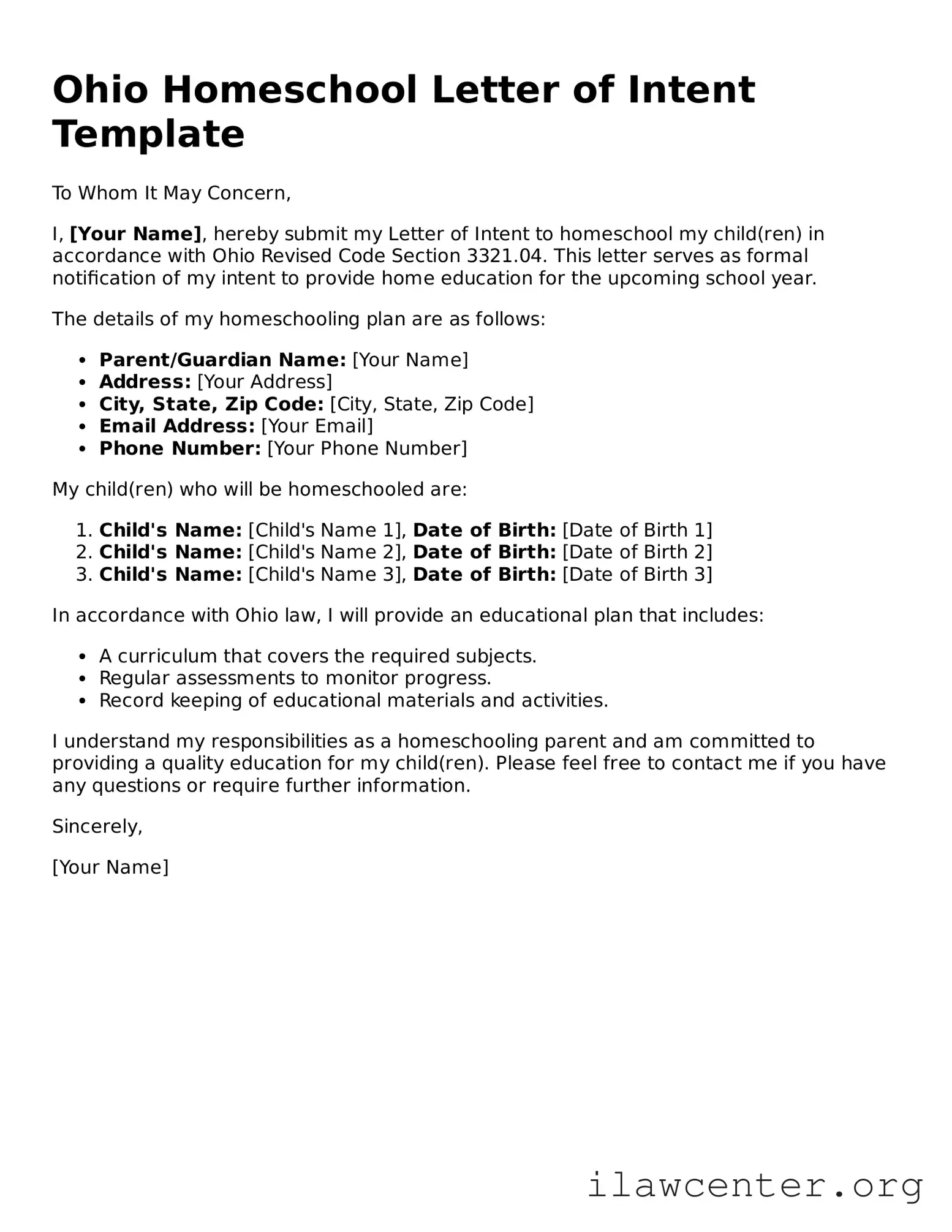
Ohio Homeschool Letter of Intent Preview

Ohio Homeschool Letter of Intent Template

To Whom It May Concern,

I, [Your Name], hereby submit my Letter of Intent to homeschool my child(ren) in accordance with Ohio Revised Code Section 3321.04. This letter serves as formal notification of my intent to provide home education for the upcoming school year.

The details of my homeschooling plan are as follows:

  • Parent/Guardian Name: [Your Name]
  • Address: [Your Address]
  • City, State, Zip Code: [City, State, Zip Code]
  • Email Address: [Your Email]
  • Phone Number: [Your Phone Number]

My child(ren) who will be homeschooled are:

  1. Child's Name: [Child's Name 1], Date of Birth: [Date of Birth 1]
  2. Child's Name: [Child's Name 2], Date of Birth: [Date of Birth 2]
  3. Child's Name: [Child's Name 3], Date of Birth: [Date of Birth 3]

In accordance with Ohio law, I will provide an educational plan that includes:

  • A curriculum that covers the required subjects.
  • Regular assessments to monitor progress.
  • Record keeping of educational materials and activities.

I understand my responsibilities as a homeschooling parent and am committed to providing a quality education for my child(ren). Please feel free to contact me if you have any questions or require further information.

Sincerely,

[Your Name]

PDF Form Characteristics

Fact Name Description
Governing Law The Ohio Homeschool Letter of Intent is governed by Ohio Revised Code Section 3321.04.
Submission Deadline The Letter of Intent must be submitted within one year of beginning homeschooling.
Who Can Submit Parents or guardians of the child must submit the form.
Required Information The form requires the child's name, address, and birth date.
Annual Renewal The Letter of Intent does not need to be renewed annually, but must be submitted for each new child.
Notification to School District After submission, the school district must be notified of the homeschooling decision.
Educational Plan An educational plan must be created and maintained, but it does not need to be submitted with the Letter of Intent.
Record Keeping Parents are responsible for keeping educational records and assessments.
Additional Requirements Parents must provide 900 hours of instruction per school year, including specific subjects.

Instructions on Utilizing Ohio Homeschool Letter of Intent

Once you have decided to homeschool your child in Ohio, the next step is to fill out the Homeschool Letter of Intent form. This form notifies the local school district of your intention to homeschool and provides essential information about your educational plans. Completing this form accurately is crucial for compliance with state regulations.

  1. Obtain the Homeschool Letter of Intent form from your local school district's website or office.
  2. Fill in your name and address in the designated fields. Ensure that your information is current and accurate.
  3. Provide your child's name and date of birth. Double-check the spelling and birthdate for correctness.
  4. Indicate the grade level your child will be in during the upcoming school year.
  5. List the educational curriculum or resources you plan to use. You can mention specific programs or general subjects.
  6. Sign and date the form at the bottom. Your signature confirms your intent to homeschool.
  7. Submit the completed form to your local school district office. You can do this in person or via mail, depending on your preference.

After submitting your form, the school district will process your intent to homeschool. You should receive confirmation or further instructions, so keep an eye on your mail or email for any updates. This is an exciting step in your homeschooling journey!

Important Facts about Ohio Homeschool Letter of Intent

What is the Ohio Homeschool Letter of Intent form?

The Ohio Homeschool Letter of Intent is a document that parents or guardians must submit to notify their local school district of their intention to homeschool their children. This form is a crucial first step in the homeschooling process in Ohio, ensuring that the school district is aware of the educational choice being made.

Who needs to submit the Letter of Intent?

Any parent or guardian who wishes to homeschool their child in Ohio must submit the Letter of Intent. This requirement applies to all children who are of compulsory school age, which is typically between ages 6 and 18. If you are starting homeschooling for the first time or if your child is transitioning from public or private school to homeschooling, this form must be completed.

When should the Letter of Intent be submitted?

The Letter of Intent should be submitted at least 14 days before the start of the homeschooling program. If you are withdrawing your child from a public or private school, it is advisable to submit the form as soon as you decide to homeschool. This helps avoid any potential truancy issues.

What information is required on the Letter of Intent?

The form typically requires basic information such as the names and ages of the children being homeschooled, the address of the homeschooling family, and a statement of intent to provide home education. Some districts may have additional requirements, so it’s important to check with your local school district for any specific guidelines.

Do I need to provide a curriculum with the Letter of Intent?

No, you do not need to submit a curriculum with the Letter of Intent. However, you will need to outline your educational plan later in the process. It’s wise to start researching and planning your curriculum early, as you will need to demonstrate how you will provide an educational experience that meets state requirements.

What happens after I submit the Letter of Intent?

Once the Letter of Intent is submitted, the school district will acknowledge receipt of the form. You will then be responsible for educating your child in accordance with Ohio homeschooling laws. Additionally, you may need to submit an educational plan and provide annual assessments of your child’s progress, depending on your district’s requirements.

Can I change my mind after submitting the Letter of Intent?

Yes, you can change your mind about homeschooling after submitting the Letter of Intent. If you decide to enroll your child back into a public or private school, you should inform the school district. It’s important to ensure that you follow any necessary steps for withdrawal from homeschooling and re-enrollment in a school setting.

Is there a specific format for the Letter of Intent?

Common mistakes

Filling out the Ohio Homeschool Letter of Intent form can be straightforward, but many people make common mistakes that can lead to delays or complications. One frequent error is forgetting to include all required information. It's essential to provide your child's full name, birthdate, and address. Omitting any of these details can result in your application being incomplete.

Another mistake is not signing the form. While it may seem like a small detail, an unsigned form is not valid. Always double-check that you have signed and dated the document before submission. Additionally, some families overlook the importance of notifying their local school district. This step is crucial, as it ensures that the district is aware of your homeschooling plans.

Some parents also fail to keep a copy of the submitted form. Keeping a record is vital for your own reference and future correspondence. If questions arise later, having a copy can save you time and confusion. Moreover, not updating the form when necessary is another common oversight. If your child's information changes, such as a move or a change in educational plans, you need to submit an updated letter.

Another mistake involves not understanding the timeline for submission. The state requires that you submit your Letter of Intent at least 14 days before you begin homeschooling. Missing this deadline can lead to complications. Additionally, some families do not follow up with their school district after submission. It's a good practice to ensure that the district has received and processed your form.

Many people also misinterpret the requirements for educational plans. The form may ask for a brief description of your educational approach. Providing vague or unclear information can raise questions. Be specific about your curriculum and teaching methods. Lastly, some parents mistakenly believe that they can submit the form at any time. The timing of your submission is critical, so be aware of the school year’s start date.

Documents used along the form

When families in Ohio choose to homeschool their children, they must complete the Homeschool Letter of Intent form. This form serves as a formal notification to the local school district of the intent to educate a child at home. However, several other documents are often used in conjunction with this form to ensure compliance with state regulations and to facilitate a smooth homeschooling experience.

  • Curriculum Plan: This document outlines the educational materials and subjects that will be taught throughout the year. It helps parents stay organized and ensures that they cover required academic standards.
  • Attendance Records: Keeping track of daily attendance is crucial. These records demonstrate that the child is receiving an education and can be requested by the school district if necessary.
  • Assessment Reports: Ohio law requires that homeschoolers submit an assessment of their child's academic progress. This can be done through standardized testing or an evaluation by a qualified teacher.
  • Portfolio of Work: A collection of the child's completed assignments, projects, and assessments can serve as a tangible representation of their learning. This portfolio can be helpful during assessments or evaluations.
  • Notification of Withdrawal: If a child is transitioning from public or private school to homeschooling, parents may need to submit a notification of withdrawal to the previous school to officially remove the child from their rolls.
  • IEP Documentation (if applicable): For children with special needs, an Individualized Education Plan (IEP) may be relevant. This document outlines specific educational goals and services that the child requires.

These documents, along with the Homeschool Letter of Intent, create a comprehensive framework for families embarking on their homeschooling journey. They help ensure that educational standards are met while providing a structure for both parents and students in the home education process.

Similar forms

  • Notice of Intent to Homeschool: This document formally informs the local school district of a parent's intention to educate their child at home. Like the Homeschool Letter of Intent, it serves as a notification to authorities.
  • Curriculum Plan: A detailed outline of the educational materials and subjects a parent plans to use. Similar to the Homeschool Letter of Intent, it provides an overview of the educational approach.
  • Educational Assessment Report: This document evaluates a child's progress and learning outcomes. It parallels the Homeschool Letter of Intent by demonstrating accountability in the homeschooling process.
  • Withdrawal Form: When a child is removed from public or private school, this form notifies the institution of the withdrawal. It is similar in that it formally communicates a change in educational setting.
  • Affidavit of Homeschooling: This is a sworn statement affirming a parent’s commitment to homeschool. Like the Homeschool Letter of Intent, it serves as an official declaration of intent.
  • Attendance Record: This document tracks the days and hours of instruction. It is akin to the Homeschool Letter of Intent, as both emphasize the importance of maintaining educational standards.
  • Progress Reports: These documents provide updates on a child's academic performance. Similar to the Homeschool Letter of Intent, they help keep educational stakeholders informed.
  • Learning Objectives: A list of specific goals a child is expected to achieve during the homeschooling year. This is comparable to the Homeschool Letter of Intent in that it outlines educational intentions.
  • Portfolio of Student Work: This collection showcases a child’s completed assignments and projects. Like the Homeschool Letter of Intent, it reflects the educational journey and progress.
  • Homeschooling Agreement: A contract between parents outlining responsibilities and expectations. It shares similarities with the Homeschool Letter of Intent by clarifying the educational framework.

Dos and Don'ts

When filling out the Ohio Homeschool Letter of Intent form, it’s important to follow specific guidelines to ensure a smooth process. Here are nine things to keep in mind:

  • Do provide accurate information about the child, including their full name and date of birth.
  • Do include your contact information, such as your address and phone number.
  • Do submit the form to your local school district by the deadline.
  • Do keep a copy of the completed form for your records.
  • Don't leave any sections of the form blank; fill out all required fields.
  • Don't forget to sign and date the form before submission.
  • Don't use nicknames; always use the child's legal name.
  • Don't submit the form late; adhere to the deadlines set by your district.
  • Don't assume the form is optional; it is required to legally homeschool in Ohio.

Following these guidelines can help ensure that your homeschooling journey starts on the right foot.

Misconceptions

Homeschooling in Ohio can be a rewarding experience for families, but there are several misconceptions about the Homeschool Letter of Intent form that can lead to confusion. Understanding the truth behind these misconceptions is essential for a smooth homeschooling journey. Below is a list of common misunderstandings regarding this form.

  • Misconception 1: The Letter of Intent is optional.
  • In Ohio, submitting a Letter of Intent is a requirement for families who wish to homeschool their children. This form notifies the local school district of your intent to educate your child at home.

  • Misconception 2: The form needs to be submitted at the beginning of the school year only.
  • The Letter of Intent must be submitted before you begin homeschooling, but it can also be submitted at any time during the year if you decide to withdraw your child from a traditional school.

  • Misconception 3: There is a specific format that must be followed for the Letter of Intent.
  • While there are guidelines for what information should be included, the state does not mandate a specific format. Families can create their own letter as long as it contains the necessary details.

  • Misconception 4: You must provide a detailed curriculum plan with the Letter of Intent.
  • A curriculum plan is not required when submitting the Letter of Intent. However, you should have a plan in place for your child's education, as it will be needed later for annual assessments.

  • Misconception 5: The Letter of Intent needs to be notarized.
  • Notarization is not a requirement for the Letter of Intent in Ohio. Simply signing and submitting the form is sufficient.

  • Misconception 6: You cannot change your mind after submitting the Letter of Intent.
  • Families are allowed to change their educational plans. If you decide to return to public schooling or switch to a different homeschooling method, you can submit a new Letter of Intent or notify the school district as needed.

  • Misconception 7: The school district has the right to deny your Letter of Intent.
  • Once the Letter of Intent is properly submitted, the school district cannot deny it. They may ask for clarification or additional information, but they cannot refuse your intent to homeschool.

  • Misconception 8: The Letter of Intent is the only requirement for homeschooling in Ohio.
  • While the Letter of Intent is crucial, it is not the only requirement. Ohio law also mandates annual assessments and notification of the results to the school district, among other obligations.

By clarifying these misconceptions, families can better navigate the homeschooling process in Ohio and ensure they meet all necessary requirements. Understanding these details fosters a more successful homeschooling experience for both parents and children.

Key takeaways

Filling out and using the Ohio Homeschool Letter of Intent form is an important step for families choosing to homeschool their children. Here are some key takeaways to keep in mind:

  • Understand the requirements: Familiarize yourself with Ohio's homeschooling laws to ensure you meet all necessary criteria.
  • Complete the form accurately: Provide all required information on the Letter of Intent, including your child's name, age, and educational plans.
  • Submit on time: Make sure to submit the form to your local school district by the deadline, typically within one year of starting homeschooling.
  • Keep copies: Retain a copy of the submitted Letter of Intent for your records. This can be helpful for future reference.
  • Stay informed: Regularly check for any updates or changes to homeschooling laws in Ohio to ensure ongoing compliance.

By following these guidelines, you can navigate the homeschooling process with confidence and clarity.