Attorney-Verified  Last Will and Testament Document for Ohio

Attorney-Verified Last Will and Testament Document for Ohio

A Last Will and Testament is a legal document that outlines how a person wishes their assets to be distributed after their death. In Ohio, this form ensures that your wishes are honored and provides clarity for your loved ones during a difficult time. Ready to take the next step? Fill out the form by clicking the button below!

Article Guide

Creating a Last Will and Testament is an essential step in ensuring that your wishes are respected after your passing. In Ohio, this legal document serves as a guide for distributing your assets, appointing guardians for minor children, and designating an executor to manage your estate. Understanding the structure and components of the Ohio Last Will and Testament form can empower you to make informed decisions about your legacy. Key elements include the identification of beneficiaries, which allows you to specify who will receive your property, and the inclusion of a revocation clause, which nullifies any previous wills. Additionally, the form requires your signature and the signatures of witnesses to validate your intentions. By taking the time to carefully complete this document, you can provide peace of mind for yourself and your loved ones, knowing that your affairs will be handled according to your desires.

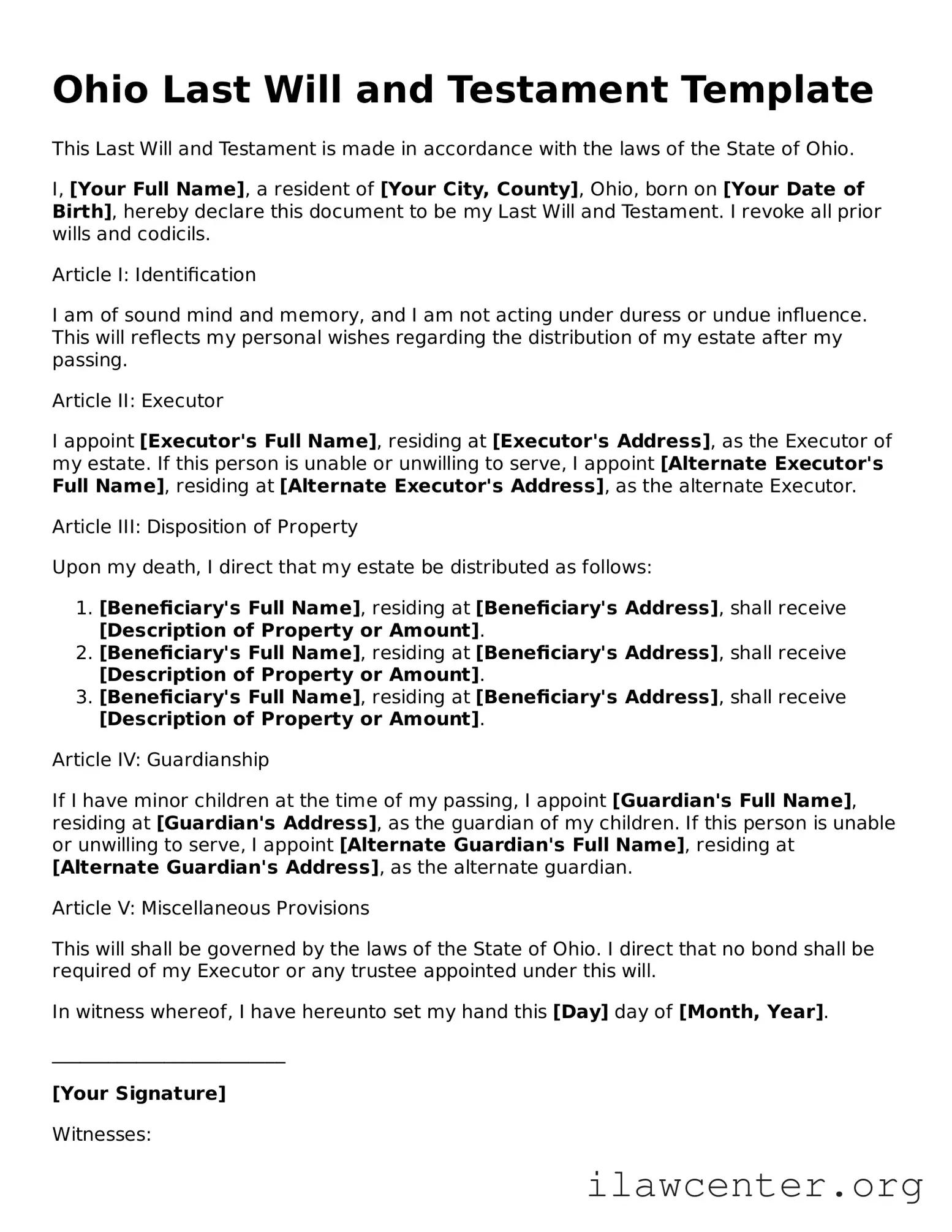
Ohio Last Will and Testament Preview

Ohio Last Will and Testament Template

This Last Will and Testament is made in accordance with the laws of the State of Ohio.

I, [Your Full Name], a resident of [Your City, County], Ohio, born on [Your Date of Birth], hereby declare this document to be my Last Will and Testament. I revoke all prior wills and codicils.

Article I: Identification

I am of sound mind and memory, and I am not acting under duress or undue influence. This will reflects my personal wishes regarding the distribution of my estate after my passing.

Article II: Executor

I appoint [Executor's Full Name], residing at [Executor's Address], as the Executor of my estate. If this person is unable or unwilling to serve, I appoint [Alternate Executor's Full Name], residing at [Alternate Executor's Address], as the alternate Executor.

Article III: Disposition of Property

Upon my death, I direct that my estate be distributed as follows:

  1. [Beneficiary's Full Name], residing at [Beneficiary's Address], shall receive [Description of Property or Amount].
  2. [Beneficiary's Full Name], residing at [Beneficiary's Address], shall receive [Description of Property or Amount].
  3. [Beneficiary's Full Name], residing at [Beneficiary's Address], shall receive [Description of Property or Amount].

Article IV: Guardianship

If I have minor children at the time of my passing, I appoint [Guardian's Full Name], residing at [Guardian's Address], as the guardian of my children. If this person is unable or unwilling to serve, I appoint [Alternate Guardian's Full Name], residing at [Alternate Guardian's Address], as the alternate guardian.

Article V: Miscellaneous Provisions

This will shall be governed by the laws of the State of Ohio. I direct that no bond shall be required of my Executor or any trustee appointed under this will.

In witness whereof, I have hereunto set my hand this [Day] day of [Month, Year].

_________________________

[Your Signature]

Witnesses:

We, the undersigned witnesses, do hereby certify that we witnessed the signing of this Last Will and Testament by [Your Full Name] on this [Day] day of [Month, Year].

_________________________

[Witness 1's Signature]

[Witness 1's Full Name]

[Witness 1's Address]

_________________________

[Witness 2's Signature]

[Witness 2's Full Name]

[Witness 2's Address]

PDF Form Characteristics

Fact Name Description
Governing Law The Ohio Last Will and Testament is governed by Ohio Revised Code Section 2107.
Age Requirement Testators must be at least 18 years old to create a valid will in Ohio.
Signature Requirement The will must be signed by the testator or by another person at the testator's direction.
Witness Requirement Ohio requires at least two witnesses to sign the will for it to be valid.
Holographic Wills Holographic wills (handwritten) are recognized in Ohio if they are signed by the testator.
Revocation A will can be revoked by creating a new will or by physically destroying the original.
Self-Proving Wills Ohio allows for self-proving wills, which simplify the probate process.
Beneficiary Designation Beneficiaries can be individuals, organizations, or charities.
Probate Requirement All wills must go through probate in Ohio to be validated and executed.

Instructions on Utilizing Ohio Last Will and Testament

Completing the Ohio Last Will and Testament form is an important step in ensuring that your wishes regarding your estate are clearly documented. After filling out the form, it will need to be signed and witnessed to be legally valid. Following these steps will help you navigate the process smoothly.

  1. Begin by obtaining the Ohio Last Will and Testament form. You can find it online or at legal supply stores.
  2. At the top of the form, write your full name and address. Make sure this information is accurate.
  3. Clearly state that this document is your Last Will and Testament. You can do this by writing a statement like "This is my Last Will and Testament."
  4. Designate an executor. This is the person who will carry out your wishes. Write their name and contact information.
  5. List your beneficiaries. These are the individuals or organizations who will inherit your assets. Include their names and relationships to you.
  6. Detail how you want your assets to be distributed among your beneficiaries. Be specific about what each person will receive.
  7. Include provisions for any minor children. If you have children, name a guardian for them in your will.
  8. Sign and date the form at the designated area. Make sure to do this in the presence of witnesses.
  9. Have at least two witnesses sign the document. They should also provide their addresses. Witnesses should not be beneficiaries of the will.
  10. Store the completed will in a safe place, such as a safe deposit box or with a trusted family member or attorney.

Important Facts about Ohio Last Will and Testament

What is a Last Will and Testament in Ohio?

A Last Will and Testament is a legal document that outlines how a person's assets and affairs will be handled after their death. In Ohio, this document allows individuals to specify beneficiaries, appoint guardians for minor children, and designate an executor to manage the estate. It is essential for ensuring that a person's wishes are honored and can help avoid disputes among family members.

Do I need a lawyer to create a Last Will and Testament in Ohio?

No, you do not necessarily need a lawyer to create a Last Will and Testament in Ohio. While legal advice can be beneficial, especially for complex estates, individuals can use templates or online services to draft their wills. However, it is crucial to ensure that the will meets all legal requirements to be valid in Ohio.

What are the legal requirements for a valid will in Ohio?

In Ohio, a valid will must be in writing, signed by the testator (the person making the will), and witnessed by at least two individuals who are present at the same time. The witnesses must also sign the will. It is advisable for the testator to be of sound mind and at least 18 years old when creating the will.

Can I change my will after it has been created?

Yes, you can change your will at any time while you are alive. This can be done by creating a new will or by adding a codicil, which is an amendment to the existing will. It is essential to follow the same legal formalities when making changes to ensure that the updated document is valid.

What happens if I die without a will in Ohio?

If you die without a will, your estate will be distributed according to Ohio's intestacy laws. This means that the state will determine how your assets are divided among your heirs, which may not align with your wishes. Additionally, the court may appoint an administrator to manage your estate, which can lead to delays and additional costs.

Can I revoke my will in Ohio?

Yes, you can revoke your will in Ohio. This can be done by creating a new will that explicitly states the previous will is revoked or by physically destroying the original will. It is important to communicate your intentions clearly to avoid confusion among your heirs.

Is it necessary to have my will notarized in Ohio?

No, notarization is not a requirement for a will to be valid in Ohio. However, having a will notarized can provide additional evidence of its authenticity and may simplify the probate process. Some individuals choose to create a self-proving affidavit, which can be notarized and included with the will.

How can I ensure my will is executed properly after my death?

To ensure your will is executed properly, choose a trustworthy executor who understands your wishes and is willing to carry them out. Inform your executor and family members about the location of your will. Additionally, consider discussing your estate plan with a legal professional to address any potential issues.

What should I include in my Last Will and Testament?

Your Last Will and Testament should include your personal information, a declaration that it is your will, details about how your assets should be distributed, the names of beneficiaries, and any specific bequests. If you have minor children, designate guardians for their care. Also, appoint an executor to manage your estate and ensure your wishes are followed.

Can I disinherit someone in my Ohio will?

Yes, you can disinherit someone in your Ohio will. To do so, it is advisable to explicitly state your intentions in the will, making it clear that you do not wish for that person to inherit anything. However, keep in mind that certain family members, such as spouses and children, may have legal rights to a portion of your estate under Ohio law, so it may be wise to consult with a legal expert.
Common mistakes

Creating a Last Will and Testament is a crucial step in ensuring that your wishes are honored after your passing. However, many individuals make common mistakes when filling out the Ohio form. One frequent error is failing to properly identify beneficiaries. It is essential to clearly state who will receive your assets. Ambiguities can lead to disputes among family members, causing unnecessary stress during an already difficult time.

Another common mistake involves not signing the document correctly. In Ohio, a will must be signed by the testator in the presence of at least two witnesses. If these requirements are not met, the will may be deemed invalid. It is important to ensure that all signatures are executed properly to avoid complications later on.

Additionally, people often neglect to update their wills after significant life changes. Events such as marriage, divorce, or the birth of a child can affect your wishes. Failing to revise your will can result in unintended distributions of your estate. Regularly reviewing and updating your will helps ensure that it reflects your current intentions.

Another mistake is not considering the implications of specific bequests. When designating particular items or amounts of money to beneficiaries, it is vital to be clear and precise. Vague language can lead to confusion and disputes among heirs. It is advisable to provide detailed descriptions to avoid misunderstandings.

Lastly, individuals may overlook the importance of appointing an executor. This person will be responsible for carrying out your wishes as outlined in your will. Choosing someone who is trustworthy and capable is crucial. Failing to appoint an executor can lead to delays in the administration of your estate and may complicate the process for your loved ones.

Documents used along the form

When creating a Last Will and Testament in Ohio, it's important to consider additional documents that can support your estate planning goals. These documents help clarify your wishes and ensure that your loved ones are taken care of according to your preferences. Below is a list of commonly used forms and documents that often accompany a Last Will and Testament.

  • Living Will: This document outlines your preferences for medical treatment in the event you become incapacitated. It specifies what types of life-sustaining measures you do or do not want.
  • Durable Power of Attorney: This form allows you to appoint someone to make financial and legal decisions on your behalf if you are unable to do so.
  • Health Care Power of Attorney: Similar to the durable power of attorney, this document designates an individual to make health care decisions for you when you cannot make them yourself.
  • Trust Agreement: A trust can hold assets on behalf of beneficiaries. It allows for more control over how and when assets are distributed, often avoiding probate.
  • Beneficiary Designations: Many financial accounts and insurance policies allow you to name beneficiaries directly. These designations can supersede your will and should be kept updated.
  • Letter of Intent: While not a legally binding document, this letter can provide guidance to your executor about your wishes and any specific instructions you want them to follow.
  • Pet Trust: If you have pets, this document ensures they will be cared for according to your wishes after your passing, including financial provisions for their care.
  • Funeral Planning Documents: These documents outline your preferences for funeral arrangements, including burial or cremation, and can relieve your family of decision-making burdens during a difficult time.
  • Asset Inventory: A detailed list of your assets can help your executor manage your estate efficiently and ensure that nothing is overlooked during the distribution process.

Incorporating these documents into your estate planning can provide clarity and peace of mind. Each serves a unique purpose and can help ensure that your wishes are honored, making it easier for your loved ones during a challenging time.

Similar forms

  • Living Will: A living will outlines a person's preferences regarding medical treatment in case they become unable to communicate their wishes. Like a Last Will and Testament, it serves to express an individual's intentions, but it focuses on health care decisions rather than the distribution of assets after death.
  • Durable Power of Attorney: This document allows a person to appoint someone else to make financial or legal decisions on their behalf. Similar to a Last Will and Testament, it involves the transfer of decision-making authority, but it is effective during a person's lifetime rather than after death.
  • Healthcare Proxy: A healthcare proxy designates an individual to make medical decisions for someone if they are incapacitated. Both documents ensure that a person's wishes are respected, but the healthcare proxy is specifically focused on health care choices.
  • Trust Document: A trust document establishes a legal entity that holds assets for the benefit of specific individuals. Like a Last Will and Testament, it dictates how assets are managed and distributed, but it can take effect during the grantor's lifetime and may avoid probate.
  • Letter of Instruction: This informal document provides guidance to loved ones about personal matters, such as funeral arrangements or digital asset management. While a Last Will and Testament is a formal legal document, a letter of instruction complements it by addressing personal preferences and logistical details.
  • Prenuptial Agreement: A prenuptial agreement outlines how assets will be divided in the event of a divorce. Both documents involve planning for the future and asset distribution, but a prenuptial agreement is specifically focused on marriage and potential separation.
  • Codicil: A codicil is an amendment to an existing will. It allows individuals to make changes without creating an entirely new Last Will and Testament, ensuring that their most current wishes are reflected in their estate plan.
  • Living Trust: A living trust is similar to a Last Will and Testament in that it manages the distribution of assets. However, it operates during the grantor's lifetime and can provide benefits such as avoiding probate and offering more privacy.
  • Executor Appointment: This document names an individual to carry out the terms of a will. Like the Last Will and Testament, it is essential for ensuring that a person's wishes are executed, but it focuses specifically on the appointment of a responsible party.
  • Beneficiary Designation Forms: These forms specify who will receive assets from accounts like life insurance or retirement plans upon death. Similar to a Last Will and Testament, they direct the distribution of assets, but they operate independently of the will and can override its terms.

Dos and Don'ts

When filling out the Ohio Last Will and Testament form, it is important to follow certain guidelines to ensure that the document is valid and accurately reflects your wishes. Below is a list of things to do and avoid.

Things You Should Do:

  • Clearly state your full name and address at the beginning of the document.
  • Designate an executor who will be responsible for carrying out your wishes.
  • List all beneficiaries and specify what each person will receive.
  • Sign and date the will in the presence of two witnesses.
  • Ensure that the witnesses are not beneficiaries of the will.
  • Keep the original signed document in a safe place.
  • Review and update the will periodically to reflect any changes in your circumstances.

Things You Shouldn't Do:

  • Do not use ambiguous language that could lead to confusion.
  • Avoid including personal wishes or instructions that are not related to asset distribution.
  • Do not forget to initial any changes made after the initial signing.
  • Refrain from using a will template that does not comply with Ohio state laws.
  • Do not rely solely on verbal agreements regarding your will.
  • Avoid leaving out important details about your assets and debts.
  • Do not neglect to inform your executor and beneficiaries about the existence of the will.

Misconceptions

Understanding the Ohio Last Will and Testament form is crucial for effective estate planning. However, several misconceptions can lead to confusion. Here are five common misunderstandings:

  1. Only wealthy individuals need a will.

    This is not true. Everyone, regardless of their financial situation, should have a will. A will helps ensure that your wishes are honored and can simplify the distribution of your assets.

  2. Oral wills are legally binding in Ohio.

    Ohio law does not recognize oral wills. A valid will must be written and signed according to specific legal requirements to be enforceable.

  3. Having a will avoids probate.

    While a will outlines your wishes, it does not avoid probate. The probate process is necessary to validate the will and distribute assets accordingly.

  4. Once created, a will never needs to be updated.

    This is a misconception. Life changes, such as marriage, divorce, or the birth of children, may require updates to your will to reflect your current wishes.

  5. All assets automatically go to the beneficiaries listed in the will.

    Not necessarily. Some assets, like those held in a trust or with designated beneficiaries, may not pass through the will. It's important to understand how different assets are treated.

Key takeaways

When it comes to creating a Last Will and Testament in Ohio, there are several important points to keep in mind. Here are ten key takeaways to help you navigate the process effectively:

  1. Understand the purpose: A Last Will and Testament allows you to dictate how your assets will be distributed after your death.
  2. Eligibility: You must be at least 18 years old and of sound mind to create a valid will in Ohio.
  3. Choose an executor: Select a trustworthy person to carry out the terms of your will. This person will be responsible for managing your estate.
  4. Be specific: Clearly outline your wishes regarding the distribution of your property and assets. Vague language can lead to confusion.
  5. Witness requirements: In Ohio, your will must be signed by at least two witnesses who are not beneficiaries of the will.
  6. Consider a self-proving affidavit: This can simplify the probate process by allowing your witnesses to affirm the validity of the will without being present in court.
  7. Revocation: You can revoke or amend your will at any time, as long as you follow the proper legal procedures.
  8. Keep it updated: Life changes, such as marriage, divorce, or the birth of children, may necessitate updates to your will.
  9. Store it safely: Keep your will in a secure location, such as a safe deposit box, and inform your executor where to find it.
  10. Consult a professional: While you can create a will on your own, seeking legal advice can ensure that your will meets all legal requirements and accurately reflects your wishes.

By considering these key points, you can create a Last Will and Testament that effectively communicates your wishes and provides peace of mind for you and your loved ones.