Attorney-Verified  Marital Separation Agreement Document for Ohio

Attorney-Verified Marital Separation Agreement Document for Ohio

A Marital Separation Agreement in Ohio is a legal document that outlines the terms and conditions agreed upon by spouses who choose to live separately while remaining married. This agreement addresses important matters such as property division, child custody, and support obligations. If you're considering separation, take the first step by filling out the form below.

Article Guide

When couples in Ohio decide to separate, a Marital Separation Agreement can play a crucial role in outlining the terms of their separation. This legal document helps define the rights and responsibilities of each spouse during the separation period. It typically covers important aspects such as the division of property, spousal support, child custody, and visitation rights. By clearly stating the expectations and agreements between the parties, this form can help minimize conflict and provide a framework for co-parenting if children are involved. Additionally, it can serve as a valuable reference should the couple decide to move forward with divorce proceedings later on. Understanding the key elements of this agreement is essential for anyone navigating the complexities of marital separation in Ohio.

Ohio Marital Separation Agreement Preview

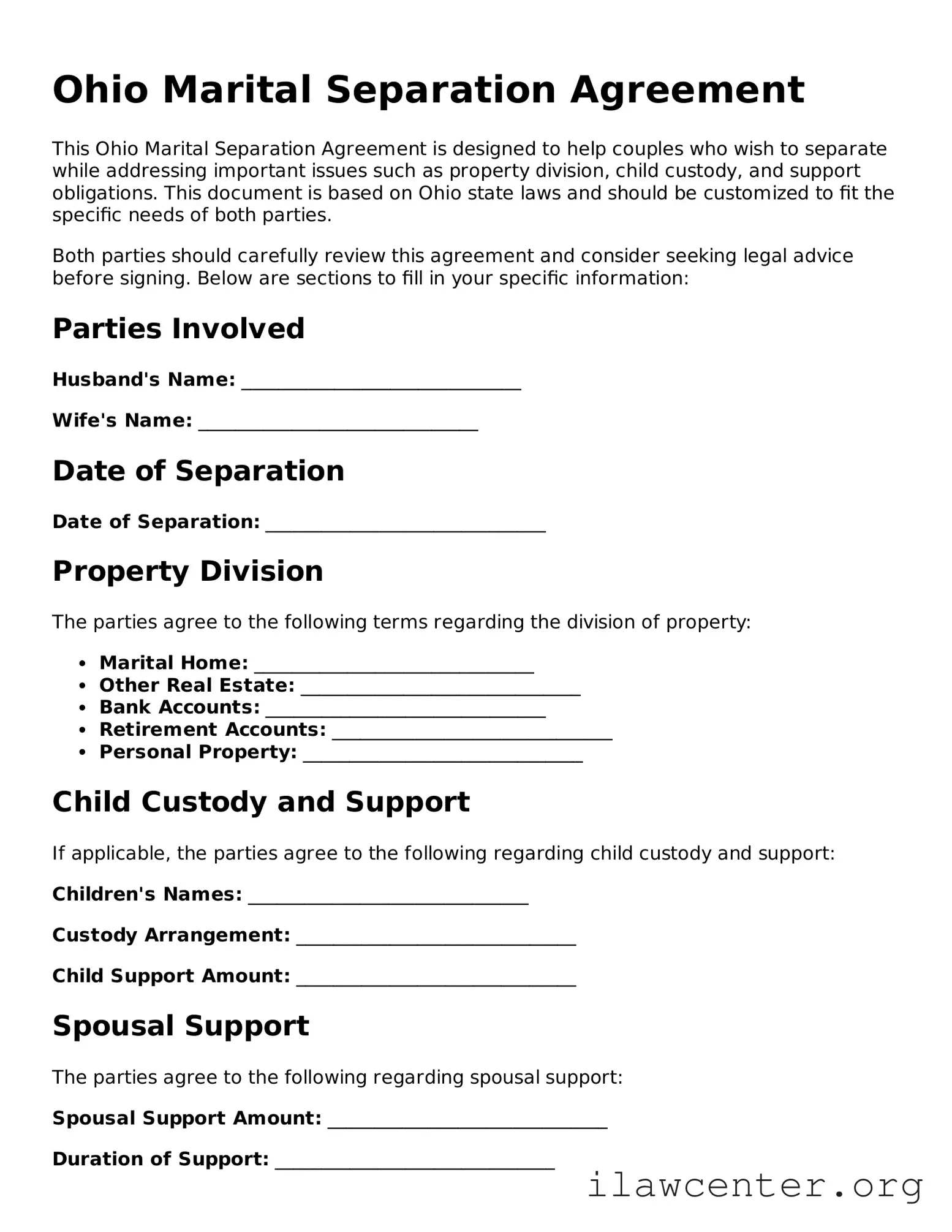
Ohio Marital Separation Agreement

This Ohio Marital Separation Agreement is designed to help couples who wish to separate while addressing important issues such as property division, child custody, and support obligations. This document is based on Ohio state laws and should be customized to fit the specific needs of both parties.

Both parties should carefully review this agreement and consider seeking legal advice before signing. Below are sections to fill in your specific information:

Parties Involved

Husband's Name: ______________________________

Wife's Name: ______________________________

Date of Separation

Date of Separation: ______________________________

Property Division

The parties agree to the following terms regarding the division of property:

  • Marital Home: ______________________________
  • Other Real Estate: ______________________________
  • Bank Accounts: ______________________________
  • Retirement Accounts: ______________________________
  • Personal Property: ______________________________

Child Custody and Support

If applicable, the parties agree to the following regarding child custody and support:

Children's Names: ______________________________

Custody Arrangement: ______________________________

Child Support Amount: ______________________________

Spousal Support

The parties agree to the following regarding spousal support:

Spousal Support Amount: ______________________________

Duration of Support: ______________________________

Miscellaneous Provisions

The parties agree to the following additional terms:

  • Dispute Resolution: ______________________________
  • Amendments: ______________________________
  • Governing Law: State of Ohio

Signatures

By signing below, both parties acknowledge that they understand and agree to the terms outlined in this Marital Separation Agreement.

Husband's Signature: ______________________________ Date: ______________________________

Wife's Signature: ______________________________ Date: ______________________________

This agreement is intended to be a fair and equitable resolution of the issues arising from the marital separation. It is recommended that both parties keep a copy for their records.

PDF Form Characteristics

Fact Name Details
Purpose The Ohio Marital Separation Agreement form outlines the terms of separation between spouses, including asset division, child custody, and support arrangements.
Governing Law This agreement is governed by Ohio Revised Code, specifically sections related to divorce and separation.
Voluntary Agreement Both parties must voluntarily agree to the terms outlined in the separation agreement for it to be valid.
Legal Effect While the agreement is not a divorce decree, it can be enforceable in court once properly executed.
Modification The terms of the agreement can be modified if both parties agree and the changes are documented in writing.

Instructions on Utilizing Ohio Marital Separation Agreement

Once you have the Ohio Marital Separation Agreement form in front of you, it's time to fill it out. This form is an important step in outlining the terms of your separation. Make sure to gather all necessary information and documents before you begin. You’ll be detailing your agreements regarding property, debts, and any other relevant matters.

  1. Begin by entering your full name and your spouse's full name at the top of the form.
  2. Next, provide your current addresses. Include the city, state, and zip code for both parties.
  3. Fill in the date of your marriage. This is typically found on your marriage certificate.
  4. Indicate the date you and your spouse separated. Be specific about the day, month, and year.
  5. List any children you have together. Include their names and birthdates.
  6. Detail your agreements regarding property. Specify what each party will keep, including real estate, vehicles, and personal items.
  7. Address any debts you share. Clearly state how these will be divided between you and your spouse.
  8. If applicable, outline any spousal support or alimony arrangements. Mention the amount and duration, if agreed upon.
  9. Sign and date the form at the bottom. Your spouse should also sign and date it to confirm agreement.
  10. Make copies of the completed form for both parties and any legal representatives.

After filling out the form, ensure that both you and your spouse keep a signed copy. It may be helpful to review the agreement with a legal professional to confirm that all terms are clear and fair. This step can help prevent misunderstandings in the future.

Important Facts about Ohio Marital Separation Agreement

What is a Marital Separation Agreement in Ohio?

A Marital Separation Agreement is a legal document that outlines the terms and conditions agreed upon by spouses who have decided to live separately. This agreement can address various aspects of the marriage, including the division of property, child custody, visitation rights, and spousal support. While it is not a divorce decree, it serves as a framework for how the couple will manage their responsibilities and rights during the separation period.

Is a Marital Separation Agreement legally binding in Ohio?

Yes, a Marital Separation Agreement is legally binding in Ohio, provided that both parties voluntarily agree to its terms and sign the document. It is essential that both spouses fully understand the implications of the agreement before signing. If the agreement is later contested in court, a judge may enforce its terms, as long as they are deemed fair and reasonable. However, it’s advisable to consult with a legal professional to ensure that the agreement complies with Ohio laws.

How do I create a Marital Separation Agreement?

Creating a Marital Separation Agreement typically involves several steps. First, both spouses should openly discuss their expectations and needs. It’s crucial to address key issues such as asset division, child custody arrangements, and financial responsibilities. Once both parties have reached a consensus, the agreement should be drafted in writing. While templates are available online, it is often beneficial to work with a lawyer to ensure that the document is comprehensive and legally sound.

Can a Marital Separation Agreement be modified?

Yes, a Marital Separation Agreement can be modified if both parties agree to the changes. It is important to document any modifications in writing and have both spouses sign the updated agreement. This ensures that the changes are legally recognized. If there are significant life changes, such as a change in income or relocation, it may be necessary to revisit the agreement to ensure it still meets the needs of both parties.

What happens if one spouse does not follow the Marital Separation Agreement?

If one spouse fails to comply with the terms of the Marital Separation Agreement, the other spouse has several options. They can seek legal enforcement of the agreement through the court system. This may involve filing a motion to compel compliance or seeking a modification of the agreement. Courts take these agreements seriously, and violations can lead to legal consequences, including financial penalties or adjustments to custody arrangements.

Common mistakes

Filling out the Ohio Marital Separation Agreement form can be a daunting task, and many individuals make common mistakes that can lead to complications down the road. Understanding these pitfalls can help ensure that the agreement is completed accurately and meets the necessary legal requirements.

One frequent mistake is failing to include all necessary information. It is essential to provide complete details about both parties, including full names, addresses, and any relevant identification numbers. Omitting this information can lead to delays or even invalidate the agreement.

Another common error is not specifying the terms of asset division. Individuals often overlook the importance of clearly outlining how property, debts, and other assets will be divided. Without this clarity, misunderstandings may arise, potentially leading to disputes later on.

Many people also make the mistake of neglecting to address child custody and support if children are involved. It’s crucial to detail custody arrangements and financial responsibilities to avoid future conflicts. Failing to do so can create significant challenges for both parents and children.

Additionally, inadequate consideration of spousal support can be an issue. Some individuals may not fully understand their rights or obligations regarding alimony. It’s important to clearly state whether spousal support will be provided, how much, and for how long.

Another mistake is not having the agreement notarized. While notarization may not be strictly required, it can add an extra layer of authenticity and make the document more credible in the eyes of the court. Skipping this step can lead to complications if the agreement is ever challenged.

People often overlook the importance of reviewing the agreement before signing. Taking the time to read through the entire document can help catch errors or unclear language. Rushing through this process can lead to regrets later on.

Finally, failing to seek legal advice is a significant mistake. Even if individuals feel confident in their understanding of the agreement, consulting with a legal professional can provide valuable insights and ensure that all aspects of the agreement are fair and legally sound.

By being aware of these common mistakes, individuals can better navigate the process of completing the Ohio Marital Separation Agreement form. Taking the time to ensure accuracy and clarity can lead to a smoother transition during what can often be a challenging time.

Documents used along the form

When navigating a marital separation in Ohio, several forms and documents may be necessary to ensure that all aspects of the separation are addressed properly. Below is a list of documents that often accompany the Ohio Marital Separation Agreement form.

  • Divorce Petition: This document initiates the divorce process, outlining the reasons for the divorce and the relief sought by the filing party.
  • Financial Disclosure Statement: Parties must disclose their financial information, including income, expenses, assets, and debts, to promote transparency during negotiations.
  • Child Custody Agreement: If children are involved, this document outlines custody arrangements, visitation schedules, and decision-making responsibilities.
  • Child Support Worksheet: This form calculates the amount of child support to be paid, based on the income of both parents and the needs of the child.
  • Property Settlement Agreement: This document details how marital property and debts will be divided between the parties, ensuring clarity and fairness.
  • Spousal Support Agreement: If one spouse will provide financial support to the other post-separation, this document outlines the terms and duration of that support.
  • Temporary Orders: These are court orders that provide immediate relief regarding custody, support, and property issues while the divorce is pending.
  • Notice of Hearing: This document informs parties of upcoming court dates and hearings related to the separation or divorce proceedings.

Utilizing these documents alongside the Ohio Marital Separation Agreement can help ensure a smoother transition during this challenging time. Each form plays a crucial role in protecting your rights and interests as you move forward.

Similar forms

  • Separation Agreement: Similar to a Marital Separation Agreement, this document outlines the terms of separation between spouses, including division of assets and responsibilities.
  • Divorce Agreement: This document finalizes the terms of a divorce, covering issues like child custody, support, and property division, much like a separation agreement but leading to the dissolution of marriage.
  • Child Custody Agreement: Focused specifically on the arrangements for children, this document details custody, visitation rights, and child support, paralleling the parenting aspects of a separation agreement.
  • Property Settlement Agreement: This agreement deals exclusively with the division of marital property and debts, similar to the asset division clauses found in a separation agreement.
  • Postnuptial Agreement: Created after marriage, this document outlines the financial and property rights of each spouse, akin to the financial provisions in a separation agreement.
  • Prenuptial Agreement: Established before marriage, this document specifies how assets will be divided in the event of separation or divorce, sharing similarities with the asset division in a separation agreement.
  • Spousal Support Agreement: This document focuses solely on the financial support one spouse will provide to another post-separation, reflecting similar support terms in a separation agreement.
  • Non-Marital Cohabitation Agreement: For couples living together without marriage, this agreement addresses property and financial issues, similar to how a separation agreement handles these matters for married couples.
  • Mutual Release Agreement: This document releases both parties from future claims against each other, akin to the liability waivers often included in a separation agreement.
  • Parenting Plan: This detailed plan outlines how parents will raise their children post-separation, similar to the parenting provisions found in a marital separation agreement.

Dos and Don'ts

When filling out the Ohio Marital Separation Agreement form, it is important to approach the process with care. Here are some guidelines to follow and some common pitfalls to avoid.

  • Do read the entire form carefully before starting.
  • Do provide accurate and complete information about both parties.
  • Do include details about property division and financial responsibilities.
  • Do consult with a legal professional if you have questions.
  • Don't leave any sections blank; incomplete forms can lead to delays.
  • Don't use vague language; be clear and specific in your agreements.
  • Don't forget to date and sign the document appropriately.
  • Don't ignore state laws that may impact your separation agreement.

Following these guidelines can help ensure that your Marital Separation Agreement is completed correctly and serves your needs effectively.

Misconceptions

When it comes to the Ohio Marital Separation Agreement, many people hold misconceptions that can lead to confusion and potentially problematic situations. Here’s a look at ten common misunderstandings:

  1. It’s the same as divorce.

    A marital separation agreement is not a divorce. It’s a legal document that outlines the terms of separation while you remain legally married.

  2. It’s not legally binding.

    Many believe that these agreements are just informal arrangements. In reality, they can be legally enforceable if properly drafted and executed.

  3. Only one spouse needs to sign.

    Both spouses must agree to and sign the separation agreement for it to be valid. Consent from both parties is essential.

  4. It covers all future issues.

    While it addresses many aspects of separation, it may not cover every future issue, such as modifications to child support or custody arrangements.

  5. It’s unnecessary if you’re getting divorced.

    Even if divorce is on the horizon, a separation agreement can help clarify terms during the separation period and ease the transition.

  6. It can’t be changed.

    Many think that once signed, the agreement is set in stone. However, it can be modified if both parties agree to the changes.

  7. It’s only for couples with children.

    This agreement is beneficial for any couple separating, regardless of whether children are involved.

  8. It’s the same as a prenuptial agreement.

    These two documents serve different purposes. A prenuptial agreement is made before marriage, while a marital separation agreement is created during or after marriage.

  9. Legal help isn’t necessary.

    While it’s possible to draft one without legal assistance, having a lawyer can ensure that the agreement is comprehensive and fair.

  10. It’s only for couples who intend to divorce.

    Some couples use a separation agreement to take time apart while exploring options, not necessarily leading to divorce.

Understanding these misconceptions can help you navigate the complexities of marital separation in Ohio more effectively. Always consider seeking professional guidance to ensure your agreement meets your needs.

Key takeaways

When filling out and using the Ohio Marital Separation Agreement form, there are several important points to keep in mind:

  • Understand the Purpose: The agreement outlines the terms of separation between spouses, including asset division, child custody, and support obligations.
  • Complete All Sections: Ensure that every section of the form is filled out accurately to avoid delays or complications later on.
  • Consider Legal Advice: Consulting with a lawyer can provide clarity on rights and responsibilities, helping to create a fair agreement.
  • File with the Court: After signing, the agreement should be filed with the appropriate court to ensure it is legally binding.