Attorney-Verified  Motor Vehicle Power of Attorney Document for Ohio

Attorney-Verified Motor Vehicle Power of Attorney Document for Ohio

The Ohio Motor Vehicle Power of Attorney form is a legal document that allows an individual to designate another person to act on their behalf in matters related to motor vehicle transactions. This can include tasks such as signing titles, transferring ownership, and handling registration. For those needing assistance with vehicle-related issues, completing this form is an essential step; click the button below to fill it out.

Article Guide

The Ohio Motor Vehicle Power of Attorney form is an essential legal document that allows individuals to designate another person to act on their behalf in matters related to motor vehicles. This form is particularly useful for those who may be unable to handle their vehicle transactions due to various reasons, such as being out of state or having health constraints. Key aspects of the form include the identification of both the principal, who grants the authority, and the agent, who receives the power to act. The agent can perform tasks such as signing titles, transferring ownership, and handling registrations. Additionally, the form must be signed and dated by the principal to ensure its validity, and it may require notarization to enhance its legal standing. Understanding the specific powers granted and the limitations, if any, is crucial for both parties involved. By utilizing this form, individuals can ensure that their vehicle-related affairs are managed effectively and in accordance with their wishes.

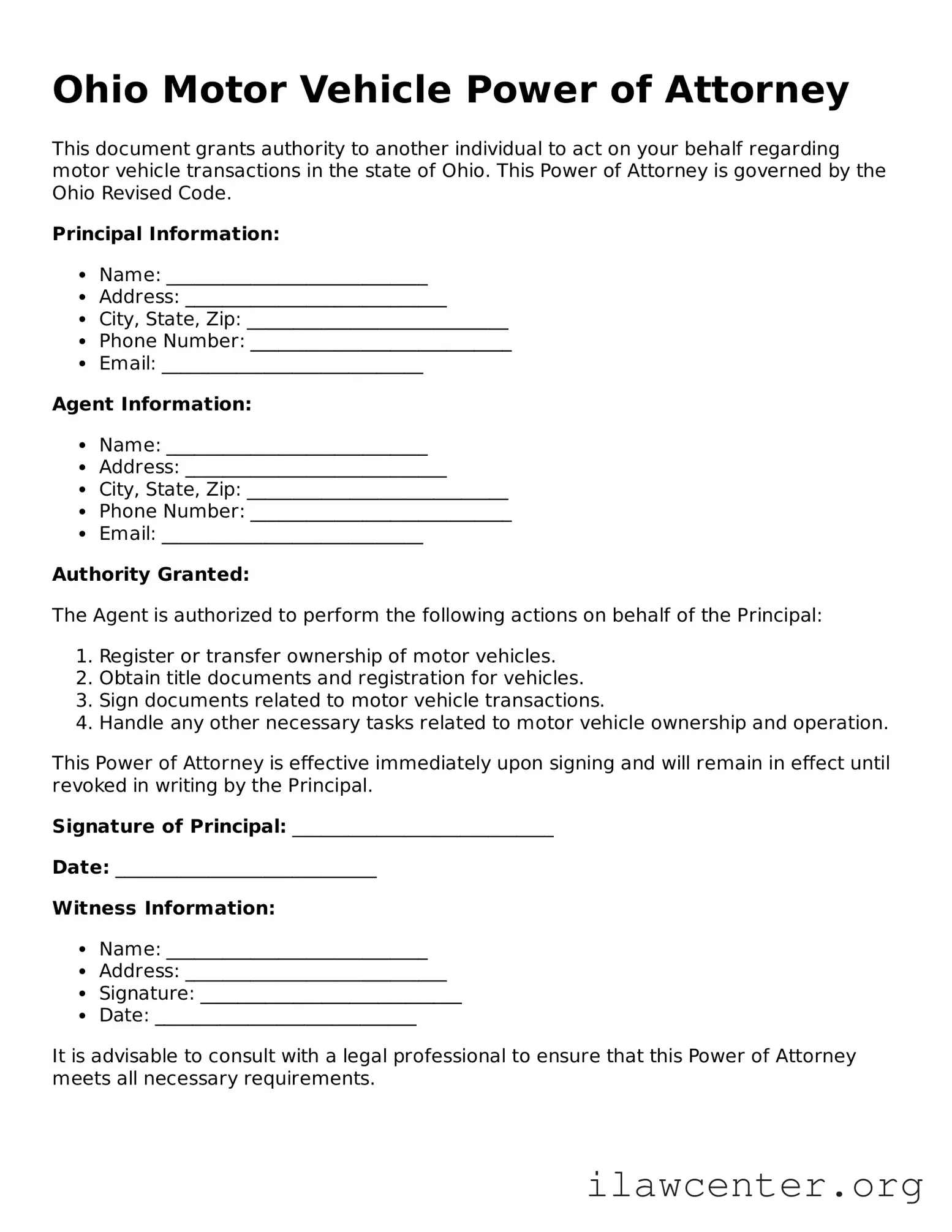
Ohio Motor Vehicle Power of Attorney Preview

Ohio Motor Vehicle Power of Attorney

This document grants authority to another individual to act on your behalf regarding motor vehicle transactions in the state of Ohio. This Power of Attorney is governed by the Ohio Revised Code.

Principal Information:

  • Name: ____________________________
  • Address: ____________________________
  • City, State, Zip: ____________________________
  • Phone Number: ____________________________
  • Email: ____________________________

Agent Information:

  • Name: ____________________________
  • Address: ____________________________
  • City, State, Zip: ____________________________
  • Phone Number: ____________________________
  • Email: ____________________________

Authority Granted:

The Agent is authorized to perform the following actions on behalf of the Principal:

  1. Register or transfer ownership of motor vehicles.
  2. Obtain title documents and registration for vehicles.
  3. Sign documents related to motor vehicle transactions.
  4. Handle any other necessary tasks related to motor vehicle ownership and operation.

This Power of Attorney is effective immediately upon signing and will remain in effect until revoked in writing by the Principal.

Signature of Principal: ____________________________

Date: ____________________________

Witness Information:

  • Name: ____________________________
  • Address: ____________________________
  • Signature: ____________________________
  • Date: ____________________________

It is advisable to consult with a legal professional to ensure that this Power of Attorney meets all necessary requirements.

PDF Form Characteristics

Fact Name Description
Purpose The Ohio Motor Vehicle Power of Attorney form allows an individual to designate another person to handle specific motor vehicle transactions on their behalf.
Governing Law This form is governed by Ohio Revised Code Section 4505.04.
Eligibility Any adult resident of Ohio can create a Power of Attorney for motor vehicle matters.
Signature Requirement The form must be signed by the person granting the power (the principal) and may need to be notarized for certain transactions.
Agent's Authority The agent can perform tasks such as transferring ownership, applying for title, or registering a vehicle.
Duration The Power of Attorney remains effective until the principal revokes it or until the specific task is completed.
Revocation The principal can revoke the Power of Attorney at any time by providing written notice to the agent.
Use Cases This form is commonly used when the principal cannot be present to complete vehicle transactions, such as during a sale or purchase.
Limitations While the agent has authority over motor vehicle matters, they cannot make decisions outside the scope of the Power of Attorney.
Obtaining the Form The Ohio Motor Vehicle Power of Attorney form can be obtained online or from local Bureau of Motor Vehicles (BMV) offices.

Instructions on Utilizing Ohio Motor Vehicle Power of Attorney

Filling out the Ohio Motor Vehicle Power of Attorney form is straightforward. This document allows you to authorize someone to act on your behalf regarding your vehicle. Follow these steps carefully to ensure the form is completed correctly.

  1. Obtain the Ohio Motor Vehicle Power of Attorney form. You can find it online or at your local Bureau of Motor Vehicles (BMV) office.
  2. Begin by entering your name in the designated space at the top of the form. Make sure to include your full legal name.
  3. Next, provide your address. Include your street address, city, state, and zip code.
  4. Identify the person you are granting power of attorney to. Write their full name in the appropriate section.
  5. Provide the address of the person receiving the power of attorney. Ensure that it is complete and accurate.
  6. Specify the details of the vehicle. Include the make, model, year, and Vehicle Identification Number (VIN).
  7. Indicate the specific powers you are granting. Check the boxes that apply to your situation.
  8. Sign and date the form at the bottom. Your signature must match the name you provided at the beginning.
  9. If required, have the form notarized. Check local regulations to see if this step is necessary.
  10. Make copies of the completed form for your records and for the person receiving power of attorney.

Once you have completed these steps, the form is ready for submission or presentation to the appropriate authorities. Ensure that all information is accurate to avoid any issues.

Important Facts about Ohio Motor Vehicle Power of Attorney

What is the Ohio Motor Vehicle Power of Attorney form?

The Ohio Motor Vehicle Power of Attorney form is a legal document that allows you to designate another person to act on your behalf regarding motor vehicle transactions. This can include tasks like transferring ownership, registering a vehicle, or obtaining titles. It is especially useful if you cannot be present for these transactions due to time constraints or other reasons.

Who can be designated as an agent in this form?

You can choose anyone you trust to act as your agent. This can be a family member, friend, or even a professional, such as a lawyer or a dealership representative. Just ensure that the person you select is willing to take on this responsibility and understands your wishes regarding the vehicle transactions.

How do I complete the Ohio Motor Vehicle Power of Attorney form?

To complete the form, you will need to provide your personal information and that of your chosen agent. Fill out the specific powers you wish to grant them, such as selling or transferring the vehicle. Make sure to sign and date the document. It may be helpful to have a witness or notary public present to sign the form, as this can add an extra layer of validity.

Is the Ohio Motor Vehicle Power of Attorney form valid if I change my mind?

If you change your mind, you can revoke the Power of Attorney at any time. To do this, you should create a written notice stating your intention to revoke the previous document. Notify your agent and any institutions or parties that received the original Power of Attorney. This ensures that your new wishes are clear and prevents any confusion in the future.

Common mistakes

Filling out the Ohio Motor Vehicle Power of Attorney form requires careful attention to detail. One common mistake is failing to provide complete information about the principal. The principal's name, address, and driver's license number must be accurate. Omitting any of these details can lead to complications when the document is presented.

Another frequent error is not specifying the powers granted. The form allows for a range of actions, from transferring title to handling registration. Leaving this section vague can result in confusion or limit the agent's authority. It’s essential to clearly outline what the agent can do.

People often overlook the need for signatures. Both the principal and the agent must sign the form. Without these signatures, the document is invalid. Additionally, failing to have the form notarized can also invalidate it. Notarization adds a layer of authenticity that is crucial for legal acceptance.

Inaccurate dates can also pose a problem. The date when the form is signed must be current and correctly noted. An outdated or incorrect date can raise questions about the legitimacy of the document and the authority it grants.

Another mistake involves not considering the agent's qualifications. The agent should be someone trustworthy and capable of handling the responsibilities outlined in the form. Choosing an unqualified person can lead to misuse of the authority granted.

People sometimes forget to keep a copy of the completed form. Retaining a copy is vital for both the principal and the agent. It ensures that everyone involved has access to the same information and can refer back to it if needed.

Moreover, failing to update the form when circumstances change can lead to issues. If the principal's situation changes, such as moving to a new address or needing to appoint a different agent, the form must be revised accordingly.

Finally, not understanding the implications of the Power of Attorney can lead to unintended consequences. It’s crucial for the principal to fully grasp what granting this authority means. Without this understanding, the principal risks losing control over their vehicle-related decisions.

Documents used along the form

When dealing with vehicle transactions in Ohio, the Motor Vehicle Power of Attorney form is a crucial document. However, it is often accompanied by other forms and documents that facilitate various aspects of vehicle ownership, transfer, and registration. Here’s a list of commonly used documents that you might encounter alongside the Power of Attorney.

  • Ohio Title Application (BMV 3774) - This form is used to apply for a new title when buying or transferring a vehicle. It includes details about the vehicle and the buyer.
  • Vehicle Registration Application (BMV 5716) - Required for registering a vehicle in Ohio, this document captures information about the owner and the vehicle.
  • Bill of Sale - A simple yet essential document that proves the sale of a vehicle. It includes the sale price, vehicle details, and signatures from both the buyer and seller.
  • Odometer Disclosure Statement - This form is necessary to disclose the vehicle's mileage at the time of sale, ensuring transparency in the transaction.
  • Affidavit of Inheritance - Used when a vehicle is inherited, this document establishes the new owner's right to the vehicle without a formal title transfer.
  • Power of Attorney for Vehicle Transactions - Similar to the Motor Vehicle Power of Attorney, this document grants authority to another person to handle vehicle-related matters on behalf of the owner.
  • Application for Duplicate Title (BMV 3801) - If a title is lost or damaged, this form allows the owner to request a duplicate title from the Ohio Bureau of Motor Vehicles.
  • Vehicle Inspection Report - Required for certain transactions, this report verifies that a vehicle meets safety and emissions standards.
  • Sales Tax Exemption Certificate - This form may be needed if the transaction qualifies for a sales tax exemption, allowing the buyer to avoid paying taxes on the purchase.

Understanding these documents can streamline the process of vehicle ownership and transfer in Ohio. Being prepared with the right forms not only saves time but also ensures compliance with state regulations, making your experience smoother and more efficient.

Similar forms

The Motor Vehicle Power of Attorney form is an important document that allows one person to authorize another to act on their behalf in matters related to motor vehicles. It shares similarities with several other legal documents. Here’s a closer look at six such documents:

  • General Power of Attorney: This document grants broad authority to an agent to act on behalf of the principal in various matters, not limited to motor vehicles. It can cover financial, legal, and personal decisions.
  • Durable Power of Attorney: Similar to a general power of attorney, this document remains effective even if the principal becomes incapacitated. It ensures that someone can manage the principal's affairs during challenging times.
  • Limited Power of Attorney: This form restricts the agent's authority to specific tasks or time periods. For instance, it might allow someone to handle a single vehicle sale or registration process.
  • Healthcare Power of Attorney: While focusing on medical decisions, this document allows an agent to make healthcare choices for the principal. It emphasizes the importance of trusted representation in critical situations.
  • Real Estate Power of Attorney: This document allows an individual to authorize someone to handle real estate transactions on their behalf. Like the motor vehicle form, it facilitates the transfer of ownership and other related tasks.
  • Financial Power of Attorney: This document specifically focuses on financial matters, allowing an agent to manage the principal’s finances, including bank transactions and bill payments. It shares the same principle of delegation as the motor vehicle form.

Understanding these documents is crucial for effective planning and ensuring that your wishes are respected in various aspects of life.

Dos and Don'ts

When filling out the Ohio Motor Vehicle Power of Attorney form, it's crucial to ensure that the process is done correctly to avoid any future complications. Here’s a list of things to do and things to avoid:

  • Do read the entire form carefully before filling it out.
  • Do provide accurate information for both the principal and the agent.
  • Do sign the form in the presence of a notary public.
  • Do specify the powers you are granting clearly.
  • Do keep a copy of the completed form for your records.
  • Don't leave any sections blank unless instructed to do so.
  • Don't use white-out or erase any information on the form.
  • Don't forget to date the form when you sign it.
  • Don't assume that verbal agreements will suffice; everything should be documented.
  • Don't delay submitting the form once it is completed and notarized.

Following these guidelines will help ensure that the Power of Attorney is valid and that your intentions are clearly communicated. Make sure to act promptly to avoid any unnecessary issues.

Misconceptions

When it comes to the Ohio Motor Vehicle Power of Attorney form, there are several misconceptions that can lead to confusion. Understanding these common myths can help individuals navigate the process more effectively.

  • Misconception 1: The form is only for buying or selling vehicles.
  • Many people believe that the Ohio Motor Vehicle Power of Attorney form is solely for transactions like buying or selling a vehicle. In reality, this form can also grant authority for other tasks, such as registering a vehicle, obtaining title transfers, and handling related paperwork.

  • Misconception 2: The form must be notarized to be valid.
  • Some individuals think that notarization is a requirement for the Power of Attorney to be valid. While notarization can add an extra layer of authenticity, it is not a strict requirement in Ohio. The form can be effective as long as it is properly completed and signed by the principal.

  • Misconception 3: Only a lawyer can create this form.
  • There is a belief that only a lawyer can draft the Ohio Motor Vehicle Power of Attorney form. However, individuals can fill out the form themselves, provided they understand the necessary components and requirements. Templates are often available online to assist with this process.

  • Misconception 4: The authority granted is permanent.
  • Some may assume that once the Power of Attorney is signed, the authority granted is permanent. In fact, the principal can revoke the Power of Attorney at any time, as long as they are mentally competent. Additionally, the authority is limited to the specific tasks outlined in the document.

  • Misconception 5: The form can be used for any type of vehicle.
  • It is a common misunderstanding that the Power of Attorney can be used for all types of vehicles. However, this form is specifically designed for motor vehicles and may not apply to other types of property, such as boats or trailers. Always check the specific requirements for the type of vehicle involved.

Key takeaways

When dealing with the Ohio Motor Vehicle Power of Attorney form, it’s essential to understand its implications and requirements. Here are some key takeaways to keep in mind:

  1. Purpose of the Form: This form allows you to designate someone else to handle specific motor vehicle transactions on your behalf, such as title transfers or registration renewals.
  2. Eligibility: Both the principal (the person granting authority) and the agent (the person receiving authority) must be at least 18 years old and legally capable of entering into a contract.
  3. Specific Authority: Clearly outline the powers you are granting. The form can be customized to limit or expand the agent's authority as needed.
  4. Signature Requirements: The form must be signed by the principal in the presence of a notary public to be legally valid. Ensure this step is not overlooked.
  5. Revocation: You have the right to revoke the Power of Attorney at any time. To do this, provide written notice to your agent and any relevant institutions.

Completing this form correctly is crucial to ensure that your motor vehicle affairs are managed smoothly and according to your wishes. Take action promptly to avoid any potential complications.