Attorney-Verified  Notary Acknowledgement Document for Ohio

Attorney-Verified Notary Acknowledgement Document for Ohio

The Ohio Notary Acknowledgement form is a legal document used to verify the identity of individuals signing a document. This form ensures that the signer is who they claim to be and that they are signing voluntarily. Understanding how to properly fill out this form is essential for anyone involved in legal transactions in Ohio.

Ready to complete your Notary Acknowledgement form? Click the button below to get started!

Article Guide

In Ohio, the Notary Acknowledgement form plays a crucial role in various legal and financial transactions. This form serves as a written statement from a notary public, confirming that a specific person appeared before them and acknowledged signing a document willingly. It is essential for ensuring that the signer's identity is verified and that they understand the contents of the document they are signing. The form typically includes details such as the notary's name, the date of the acknowledgment, and the signature of the notary. Additionally, it may require the signer's name and the type of document being acknowledged. Understanding the importance of this form can help individuals navigate legal processes more smoothly and ensure that their documents hold up in court or other official settings.

Ohio Notary Acknowledgement Preview

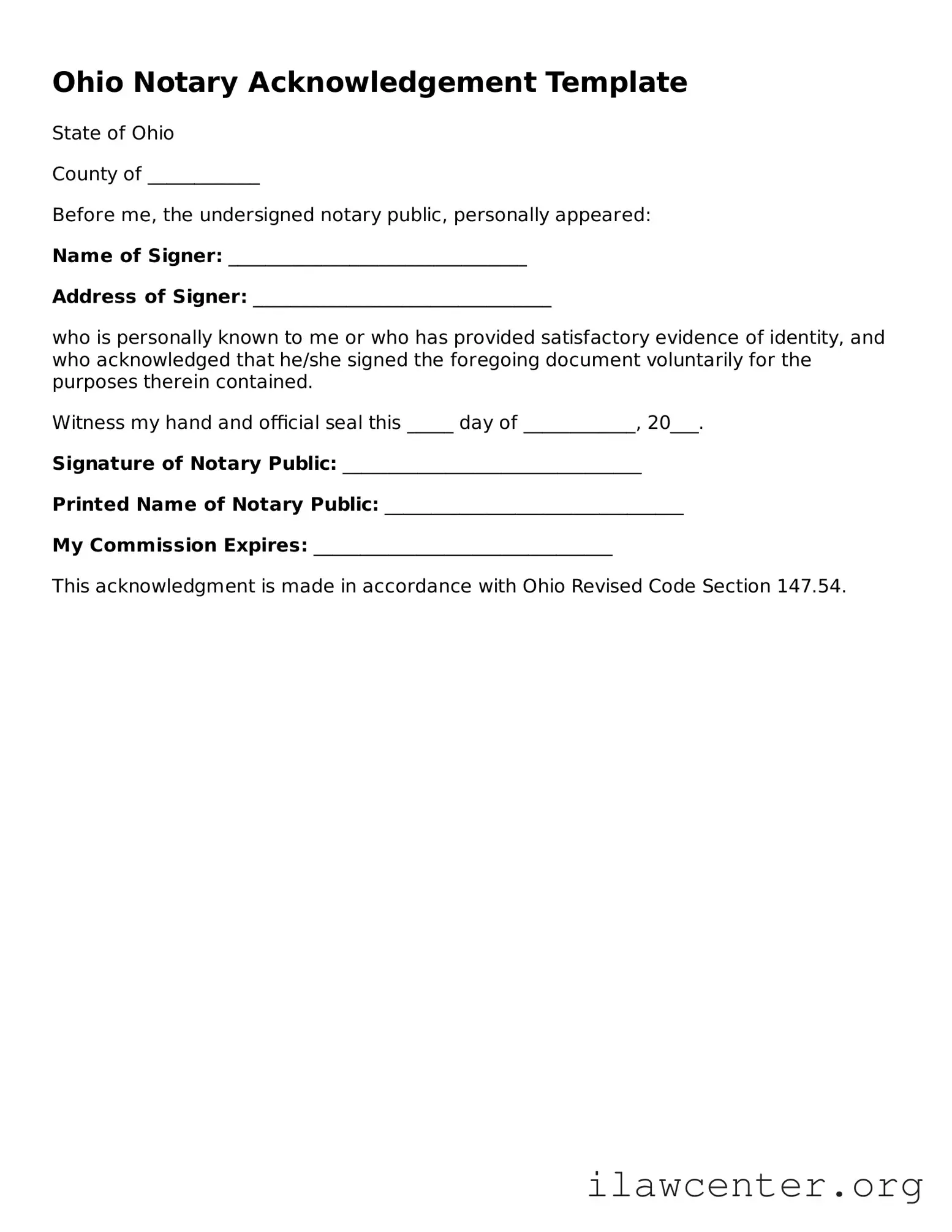
Ohio Notary Acknowledgement Template

State of Ohio

County of ____________

Before me, the undersigned notary public, personally appeared:

Name of Signer: ________________________________

Address of Signer: ________________________________

who is personally known to me or who has provided satisfactory evidence of identity, and who acknowledged that he/she signed the foregoing document voluntarily for the purposes therein contained.

Witness my hand and official seal this _____ day of ____________, 20___.

Signature of Notary Public: ________________________________

Printed Name of Notary Public: ________________________________

My Commission Expires: ________________________________

This acknowledgment is made in accordance with Ohio Revised Code Section 147.54.

PDF Form Characteristics

Fact Name Description
Purpose The Ohio Notary Acknowledgement form is used to verify the identity of a signer and confirm that they signed a document voluntarily.
Governing Law This form is governed by the Ohio Revised Code, specifically Section 147.54.
Signature Requirement The signer must be present in front of the notary at the time of signing.
Notary Information The notary must include their name, title, and seal on the form to make it valid.
Document Types This acknowledgement can be used for various documents, including deeds, contracts, and affidavits.
Expiration The acknowledgment does not expire but must be completed correctly to be valid.

Instructions on Utilizing Ohio Notary Acknowledgement

Once you have your Ohio Notary Acknowledgement form ready, you will need to fill it out correctly. This ensures that the document meets the necessary requirements for notarization. Follow these steps carefully to complete the form.

  1. Start by entering the date at the top of the form. Use the format MM/DD/YYYY.
  2. Next, write the name of the person who is signing the document. This is the individual whose signature will be notarized.
  3. In the next section, provide the address of the signer. Include the street address, city, state, and ZIP code.
  4. Now, indicate the type of document being signed. This could be a contract, deed, or any other legal document.
  5. After that, leave space for the notary's signature. The notary will sign the form once it is completed.
  6. Finally, the notary will need to fill in their details, including their name, title, and commission expiration date.

After completing the form, it is essential to have it signed in the presence of a notary public. The notary will verify the identity of the signer and then complete the acknowledgment process.

Important Facts about Ohio Notary Acknowledgement

What is an Ohio Notary Acknowledgement form?

The Ohio Notary Acknowledgement form is a document used to verify that a signer has willingly signed a document in the presence of a notary public. This form serves as proof that the notary has confirmed the identity of the signer and witnessed the signing process.

Who can act as a notary public in Ohio?

In Ohio, individuals who wish to become a notary public must meet specific requirements. They must be at least 18 years old, be a resident of Ohio or have a place of business in the state, and must not have any felony convictions. After meeting these criteria, they must complete a training course and pass an exam.

What is the purpose of the notary's acknowledgment?

The notary's acknowledgment serves to affirm that the signer personally appeared before the notary, confirmed their identity, and signed the document. This acknowledgment helps prevent fraud and ensures that the signer is entering into the agreement willingly and knowingly.

How is the Ohio Notary Acknowledgement form completed?

To complete the form, the signer must appear before the notary public. The notary will then verify the signer's identity, ask them to sign the document, and fill out the acknowledgment form. The notary will include their signature, seal, and the date of the acknowledgment on the form.

Do I need to provide identification to the notary?

Yes, the signer must provide valid identification to the notary public. Acceptable forms of ID typically include a driver's license, state ID, passport, or any government-issued identification that includes a photo and signature.

Is there a fee for notarization in Ohio?

Yes, notaries in Ohio are allowed to charge a fee for their services. The maximum fee for a standard notarization is set by state law. However, notaries may choose to waive this fee at their discretion.

Can the Notary Acknowledgement form be used for any type of document?

Generally, the Ohio Notary Acknowledgement form can be used for various documents, including contracts, deeds, and other legal agreements. However, it is essential to ensure that the document being notarized is appropriate for acknowledgment and does not require a different type of notarization.

How long is a notary acknowledgment valid in Ohio?

The notary acknowledgment itself does not expire, but the underlying document's validity depends on the terms outlined within that document. It is important to follow any specific timelines or requirements stated in the document to ensure its enforceability.
Common mistakes

When filling out the Ohio Notary Acknowledgment form, individuals often make several common mistakes that can lead to delays or complications in the notarization process. Understanding these pitfalls can help ensure that the form is completed correctly and efficiently.

One frequent error is failing to provide the correct information about the signer. The form requires the name of the individual whose signature is being notarized. If this name is misspelled or does not match the identification presented, the notarization may be invalidated. Always double-check the spelling and ensure that the name on the form matches the identification exactly.

Another mistake involves not including the date of the acknowledgment. This date is crucial as it signifies when the notarization took place. Without it, the document may lack the necessary context, leading to confusion or questions about its validity. Be sure to enter the date clearly and accurately.

Additionally, some people overlook the requirement for the notary's signature and seal. The notary must sign and apply their official seal to the form for it to be considered valid. Neglecting this step can render the acknowledgment ineffective. Always confirm that the notary has completed this step before submitting the document.

Furthermore, individuals sometimes forget to indicate the type of identification used by the signer. The form typically requires a description of the ID, including the type and number. This information helps verify the identity of the signer and ensures compliance with legal standards. Be sure to fill this section out thoroughly.

Lastly, not reviewing the entire form before submission can lead to overlooked errors. Even minor mistakes can cause significant issues down the line. Taking a moment to review each section can help catch any errors and ensure that the form is complete and accurate.

Documents used along the form

The Ohio Notary Acknowledgement form is commonly used in various legal and official transactions. It serves as a declaration that a signature on a document was made in the presence of a notary public. Several other forms and documents often accompany this acknowledgment to ensure proper documentation and compliance with legal requirements.

  • Power of Attorney: This document allows one person to grant another the authority to act on their behalf in legal matters. It is often notarized to verify the identity of the parties involved and to ensure the document's authenticity.
  • Affidavit: An affidavit is a written statement confirmed by oath or affirmation, used as evidence in court. Notarization is typically required to validate the identity of the affiant and to affirm that the statement is made under penalty of perjury.
  • Deed: A deed is a legal document that conveys ownership of real property from one party to another. Notarization is crucial for the deed to be considered valid and enforceable, particularly in real estate transactions.
  • Contract: Various contracts, such as those for employment or sales agreements, may require notarization to ensure that all parties have signed the document willingly and understand its terms. This adds an extra layer of protection and legitimacy.
  • Loan Documents: When securing a loan, borrowers often sign multiple documents that may require notarization. This process helps to confirm the identities of the signers and the authenticity of the agreements being made.

These forms and documents play a critical role in various legal processes. Ensuring that they are properly executed and notarized helps to maintain the integrity of legal transactions in Ohio.

Similar forms

The Notary Acknowledgement form serves a specific purpose in verifying the identity of signers and their intent to sign a document. Several other documents share similarities with the Notary Acknowledgement form in terms of their function and usage. Here are ten such documents:

  • Affidavit: This is a written statement confirmed by oath or affirmation. Like a Notary Acknowledgement, it requires a notary to witness the signer’s declaration.
  • Power of Attorney: This document allows one person to act on behalf of another. Notarization is often required to ensure the principal’s identity and intent.
  • Deed: A legal document that conveys ownership of property. Notarization is necessary to confirm the identity of the parties involved in the transaction.
  • Trust Agreement: This document outlines the terms of a trust. Notarization helps verify the identities of those creating the trust and their intentions.
  • Loan Agreement: A contract between a borrower and lender. Notarization may be required to authenticate the signatures of both parties.
  • Marriage License Application: This document often requires notarization to verify the identities of the applicants before marriage.
  • Release of Liability: This document releases one party from liability. Notarization ensures that the signer understands the implications and agrees voluntarily.
  • Wills: A legal document expressing a person's wishes regarding the distribution of their estate. Notarization can add an extra layer of authenticity.
  • Consent Forms: These documents grant permission for certain actions. Notarization helps confirm that the consent was given willingly and by the right person.
  • Certification of Copies: This document verifies that a copy of an original document is accurate. Notarization is used to confirm the identity of the person requesting the certification.

Dos and Don'ts

When filling out the Ohio Notary Acknowledgement form, there are important steps to follow. Here’s a list of things you should and shouldn’t do:

  • Do ensure all information is accurate and complete.
  • Do sign the document in the presence of the notary.
  • Do provide valid identification to the notary.
  • Do use black or blue ink for filling out the form.
  • Don't leave any blank spaces on the form.
  • Don't sign the document before meeting with the notary.
  • Don't forget to check the notary's credentials before proceeding.

Misconceptions

Understanding the Ohio Notary Acknowledgement form is essential for anyone involved in legal documents. However, several misconceptions can lead to confusion. Here are four common misconceptions:

  • Notary Acknowledgements are only for real estate documents. This is not true. While they are commonly used in real estate transactions, notary acknowledgements can be required for various types of documents, including contracts, affidavits, and powers of attorney.
  • A notary public verifies the content of a document. This is a misconception. A notary public does not verify the truthfulness or accuracy of the information in the document. Their role is to confirm the identity of the signer and witness the signing of the document.
  • All states have the same notary requirements. This is incorrect. Each state has its own laws and requirements regarding notary acknowledgements. It is crucial to understand Ohio's specific regulations to ensure compliance.
  • Once a document is notarized, it cannot be challenged. This is misleading. While notarization adds a layer of credibility, it does not prevent a document from being contested in court. The content and validity of the document can still be questioned.

Clarifying these misconceptions can help individuals navigate the notary process with confidence. Always seek guidance if unsure about the requirements or implications of a notary acknowledgement.

Key takeaways

  • Ensure that the form is completed accurately. All required fields must be filled out to avoid any delays or issues.

  • Sign the document in the presence of a notary public. This step is crucial for the acknowledgment to be valid.

  • The notary will verify your identity. Be prepared to provide valid identification, such as a driver's license or passport.

  • Keep a copy of the completed form for your records. This serves as proof of the acknowledgment.

  • Understand that the notary’s role is to witness the signing and confirm your identity. They do not provide legal advice regarding the document itself.