Attorney-Verified  Promissory Note Document for Ohio

Attorney-Verified Promissory Note Document for Ohio

A Promissory Note is a written promise to pay a specified amount of money to a designated person or entity at a defined time or on demand. In Ohio, this form serves as a crucial document for both lenders and borrowers, outlining the terms of the loan agreement. To get started on your own Promissory Note, fill out the form by clicking the button below.

Article Guide

In the realm of financial transactions, a promissory note serves as a crucial instrument that outlines the terms of a loan agreement between a borrower and a lender. Specifically, the Ohio Promissory Note form is designed to meet the legal requirements set forth by Ohio law, ensuring that both parties are protected throughout the lending process. This form typically includes essential components such as the principal amount borrowed, the interest rate, repayment schedule, and any applicable penalties for late payments. Additionally, it may detail the rights and obligations of each party, providing clarity and preventing misunderstandings. By incorporating provisions for default and remedies, the Ohio Promissory Note form helps to establish a clear framework for resolving disputes should they arise. Understanding these major aspects is vital for anyone engaging in a lending transaction in Ohio, as it not only safeguards the interests of both parties but also promotes transparency and trust in financial dealings.

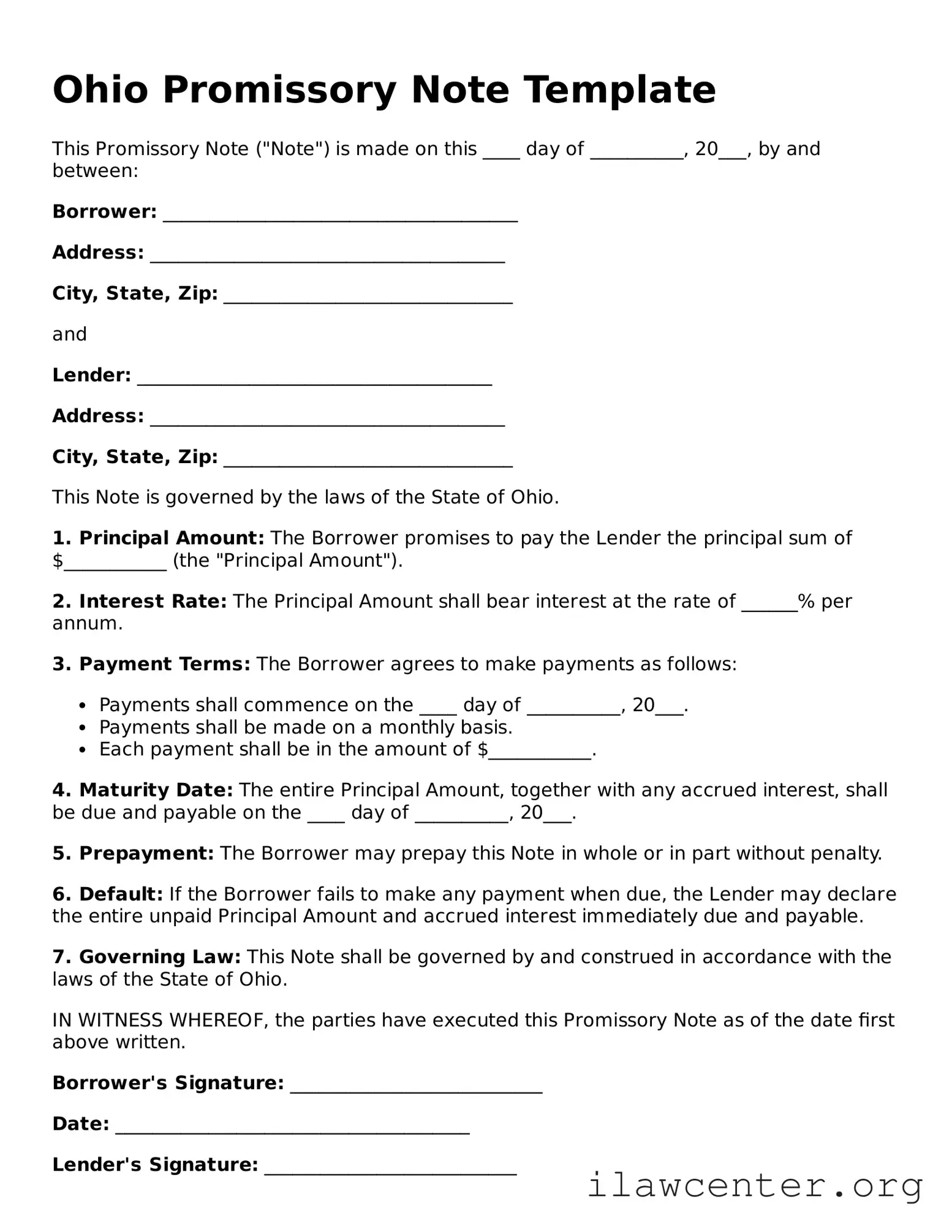
Ohio Promissory Note Preview

Ohio Promissory Note Template

This Promissory Note ("Note") is made on this ____ day of __________, 20___, by and between:

Borrower: ______________________________________

Address: ______________________________________

City, State, Zip: _______________________________

and

Lender: ______________________________________

Address: ______________________________________

City, State, Zip: _______________________________

This Note is governed by the laws of the State of Ohio.

1. Principal Amount: The Borrower promises to pay the Lender the principal sum of $___________ (the "Principal Amount").

2. Interest Rate: The Principal Amount shall bear interest at the rate of ______% per annum.

3. Payment Terms: The Borrower agrees to make payments as follows:

  • Payments shall commence on the ____ day of __________, 20___.
  • Payments shall be made on a monthly basis.
  • Each payment shall be in the amount of $___________.

4. Maturity Date: The entire Principal Amount, together with any accrued interest, shall be due and payable on the ____ day of __________, 20___.

5. Prepayment: The Borrower may prepay this Note in whole or in part without penalty.

6. Default: If the Borrower fails to make any payment when due, the Lender may declare the entire unpaid Principal Amount and accrued interest immediately due and payable.

7. Governing Law: This Note shall be governed by and construed in accordance with the laws of the State of Ohio.

IN WITNESS WHEREOF, the parties have executed this Promissory Note as of the date first above written.

Borrower's Signature: ___________________________

Date: ______________________________________

Lender's Signature: ___________________________

Date: ______________________________________

PDF Form Characteristics

Fact Name Details
Definition An Ohio Promissory Note is a written promise to pay a specific amount of money to a designated person or entity at a specified time or on demand.
Governing Law The Ohio Promissory Note is governed by the Ohio Revised Code, particularly sections related to contracts and negotiable instruments.
Parties Involved Typically, the parties involved are the borrower (maker) and the lender (payee).
Payment Terms The note must clearly outline the payment terms, including the amount, interest rate, and due date.
Interest Rate Ohio law allows for a specified interest rate, which must be clearly stated in the note.
Default Clauses It is common to include clauses that outline what happens in the event of a default on the payment.
Signatures The note must be signed by the maker to be legally binding.
Notarization While notarization is not always required, it is recommended to enhance the enforceability of the note.

Instructions on Utilizing Ohio Promissory Note

After obtaining the Ohio Promissory Note form, you will need to provide specific information to ensure it is filled out correctly. This document will require details about the parties involved, the amount of money being borrowed, and the repayment terms. Once completed, the form should be signed by all parties to make it legally binding.

  1. Begin by entering the date at the top of the form.
  2. Identify the borrower by writing their full name and address in the designated section.
  3. Next, provide the lender's full name and address in the corresponding area.
  4. Clearly state the principal amount being borrowed. This is the total sum that the borrower agrees to repay.
  5. Specify the interest rate, if applicable. If there is no interest, indicate that the loan is interest-free.
  6. Outline the repayment terms. Include details such as the payment schedule (e.g., monthly, quarterly) and the final due date.
  7. If there are any late fees or penalties for missed payments, make sure to include that information.
  8. Provide space for both the borrower and lender to sign and date the document at the bottom.

After completing these steps, review the form for accuracy. Ensure that all information is correct and that both parties have signed it. Once confirmed, the document can be exchanged between the borrower and lender, establishing the agreement.

Important Facts about Ohio Promissory Note

What is an Ohio Promissory Note?

An Ohio Promissory Note is a written promise made by one party, known as the borrower, to pay a specific amount of money to another party, known as the lender, at a designated time or on demand. This document outlines the terms of the loan, including the principal amount, interest rate, repayment schedule, and any other conditions agreed upon by both parties. It serves as a legal record of the debt and can be enforced in court if necessary.

What are the essential components of an Ohio Promissory Note?

Essential components of an Ohio Promissory Note include the names and addresses of both the borrower and the lender, the principal amount being borrowed, the interest rate (if applicable), the repayment terms, and the date the note is created. Additionally, it may include provisions for late fees, prepayment options, and any collateral securing the loan. Clear and concise language is important to avoid misunderstandings in the future.

How is an Ohio Promissory Note executed?

To execute an Ohio Promissory Note, both the borrower and the lender must sign the document. While notarization is not strictly required, it is highly recommended. Having the note notarized adds an extra layer of authenticity and can help prevent disputes regarding the validity of the signatures. Once signed, the borrower should keep a copy for their records, while the lender retains the original document.

What happens if the borrower fails to repay the loan?

If the borrower fails to repay the loan as outlined in the Promissory Note, the lender has the right to take legal action to recover the owed amount. This may involve filing a lawsuit in a court of law. If the lender prevails, the court may issue a judgment against the borrower, allowing the lender to collect the debt through various means, such as wage garnishment or bank levies. It is crucial for both parties to understand their rights and responsibilities as outlined in the note to avoid potential legal issues.

Common mistakes

When filling out the Ohio Promissory Note form, individuals often overlook critical details that can lead to complications later. One common mistake is failing to include the correct names of the parties involved. Accurate identification is essential. If the lender and borrower are not clearly named, it can create confusion about who is responsible for repayment.

Another frequent error is neglecting to specify the loan amount clearly. The amount should be written in both numerical and written form to avoid any misunderstandings. Omitting this detail or making it unclear can lead to disputes about how much is owed.

People also tend to ignore the importance of including a repayment schedule. A vague or nonexistent repayment plan can result in disagreements down the line. Clearly outlining when payments are due, as well as the amount of each payment, helps ensure that both parties are on the same page.

Additionally, individuals sometimes forget to address the interest rate. If an interest rate is applicable, it must be explicitly stated in the document. Leaving this out can lead to legal issues, especially if the lender expects interest to be paid without it being documented.

Finally, many individuals fail to sign and date the Promissory Note properly. A signature is a crucial part of the agreement, as it signifies acceptance of the terms. Without a date, the enforceability of the note may be questioned, potentially complicating the collection process.

Documents used along the form

When entering into a lending agreement in Ohio, a Promissory Note is often accompanied by various other forms and documents to ensure clarity and legal protection for both parties involved. Below is a list of common documents that might be used alongside the Ohio Promissory Note.

  • Loan Agreement: This document outlines the terms and conditions of the loan, including the amount borrowed, interest rate, repayment schedule, and any collateral involved. It serves as a more detailed contract between the lender and borrower.
  • Security Agreement: If the loan is secured by collateral, this agreement specifies the assets that back the loan. It details the rights of the lender in the event of default.
  • Personal Guarantee: This document may be required if a business is borrowing money. It holds an individual personally responsible for repaying the loan if the business fails to do so.
  • Disclosure Statement: Lenders often provide this document to inform borrowers about the costs and terms of the loan. It ensures transparency and helps borrowers make informed decisions.
  • Loan Amortization Schedule: This schedule breaks down each payment over the life of the loan, showing how much goes toward interest and how much goes toward principal repayment.
  • Default Notice: Should the borrower fail to make payments, this document notifies them of the default and outlines the lender's rights and potential actions.
  • Release of Liability: Once the loan is fully paid, this document releases the borrower from any further obligations under the Promissory Note and confirms that the debt has been settled.

Understanding these additional documents can greatly enhance the borrowing experience and help both parties navigate their rights and responsibilities effectively. Always consider consulting with a legal professional when dealing with financial agreements to ensure that all documents are correctly prepared and executed.

Similar forms

  • Loan Agreement: A loan agreement outlines the terms of a loan between a lender and a borrower. Like a promissory note, it specifies the amount borrowed, interest rates, and repayment terms.
  • Mortgage: A mortgage is a type of loan specifically for purchasing real estate. It includes a promissory note as part of the documentation, detailing the borrower's promise to repay the loan.
  • Lease Agreement: A lease agreement allows a tenant to use property for a specified time in exchange for rent. It shares similarities with a promissory note in that it often includes payment terms and obligations.
  • Personal Guarantee: A personal guarantee is a promise made by an individual to repay another person's debt if they default. It resembles a promissory note by confirming a commitment to pay.
  • Installment Agreement: An installment agreement allows a borrower to pay back a debt in smaller, scheduled payments. It functions similarly to a promissory note by outlining the repayment structure.
  • Secured Note: A secured note is a promissory note backed by collateral. It includes similar terms regarding repayment but adds the assurance of collateral to protect the lender.
  • Bond: A bond is a fixed income investment where an investor loans money to an entity for a defined period. Like a promissory note, it includes details about the amount borrowed and repayment terms.
  • Debt Settlement Agreement: A debt settlement agreement is a contract between a debtor and creditor to settle a debt for less than the amount owed. It includes terms for repayment, similar to those found in a promissory note.

Dos and Don'ts

When filling out the Ohio Promissory Note form, it is essential to approach the task with care. Here are some important do's and don'ts to keep in mind:

  • Do read the entire form carefully before starting.
  • Do provide accurate information, including names, addresses, and amounts.
  • Do sign and date the document where required.
  • Do keep a copy of the completed note for your records.
  • Don't leave any sections blank unless instructed.
  • Don't use whiteout or erasers; if you make a mistake, cross it out and initial it.

By following these guidelines, you can ensure that your Ohio Promissory Note is filled out correctly and is legally binding.

Misconceptions

When it comes to the Ohio Promissory Note form, there are several misconceptions that can lead to confusion. Understanding these misconceptions can help ensure that both lenders and borrowers are on the same page. Here’s a list of common misunderstandings:

  • All promissory notes are the same. Many people believe that a promissory note is a one-size-fits-all document. In reality, the terms and conditions can vary widely based on the specific agreement between the parties involved.
  • A promissory note must be notarized. While notarization can add an extra layer of security, it is not a legal requirement for a promissory note to be valid in Ohio. The key is that both parties must agree to the terms.
  • Only loans between banks and individuals require a promissory note. This is not true. Promissory notes can be used for personal loans, business transactions, and even informal agreements between friends or family members.
  • A promissory note cannot be transferred. Some people think that once a promissory note is created, it cannot be sold or transferred to another party. However, notes can be assigned or sold, making them a flexible financial instrument.
  • All promissory notes accrue interest. Not every promissory note includes interest. Some may be interest-free, depending on the agreement between the lender and borrower.
  • Promissory notes are only for large sums of money. This is a misconception. Promissory notes can be used for any amount, big or small, making them accessible for various financial situations.
  • A promissory note is a legally binding contract. While a promissory note does create a legal obligation, it is important to note that the enforceability can depend on the clarity of the terms and the circumstances surrounding the agreement.
  • You don’t need to keep a copy of the promissory note. It’s crucial for both parties to retain a copy of the signed document. This serves as proof of the agreement and can be essential in case of disputes.
  • Once a promissory note is signed, it cannot be changed. Although changes can be difficult, parties can amend a promissory note if both agree to the new terms. Documentation of any changes should be made in writing.

By clarifying these misconceptions, individuals can navigate the process of creating and managing promissory notes more effectively. Always consider seeking legal advice when drafting or entering into any financial agreement to ensure all terms are clear and enforceable.

Key takeaways

When filling out and using the Ohio Promissory Note form, several important considerations should be kept in mind. The following key takeaways can help ensure that the process is clear and effective.

  • The Ohio Promissory Note serves as a written promise to repay a loan, outlining the terms of the agreement.
  • It is essential to include the full names and addresses of both the borrower and the lender to establish clear identification.
  • The principal amount of the loan must be specified, as it represents the total sum borrowed by the borrower.
  • Interest rates, if applicable, should be clearly stated to avoid misunderstandings regarding repayment amounts.
  • The repayment schedule should be detailed, including due dates and the frequency of payments (e.g., monthly, quarterly).
  • Both parties should sign and date the document to validate the agreement and signify mutual consent.
  • It is advisable to retain a copy of the completed Promissory Note for personal records and future reference.
  • Consideration of state laws and regulations regarding promissory notes can help ensure compliance and enforceability.
  • Seeking legal advice may be beneficial, especially for larger loans or complex agreements, to protect the interests of both parties.

By understanding these key points, individuals can navigate the process of creating and utilizing the Ohio Promissory Note effectively.