Attorney-Verified  Small Estate Affidavit Document for Ohio

Attorney-Verified Small Estate Affidavit Document for Ohio

The Ohio Small Estate Affidavit is a legal document that allows individuals to claim a deceased person's assets without going through the lengthy probate process. This form is designed for estates valued under a specific threshold, making it easier for heirs to settle affairs quickly and efficiently. If you’re ready to streamline the process, fill out the form by clicking the button below.

Article Guide

In Ohio, navigating the complexities of estate management can often feel overwhelming, especially during a time of loss. However, for smaller estates, the Ohio Small Estate Affidavit form offers a streamlined process that simplifies the transfer of assets without the need for formal probate proceedings. This form is designed for estates with a total value of $100,000 or less, allowing heirs to claim property, bank accounts, and other assets more efficiently. By utilizing this affidavit, individuals can avoid the lengthy and often costly probate process, making it an appealing option for many families. The form requires specific information, such as the decedent's details, a list of assets, and the names of heirs, ensuring that all parties involved are properly identified. Additionally, it must be signed under oath, affirming the accuracy of the information provided. Understanding the nuances of this form can empower individuals to take control of their loved one's estate with confidence and clarity.

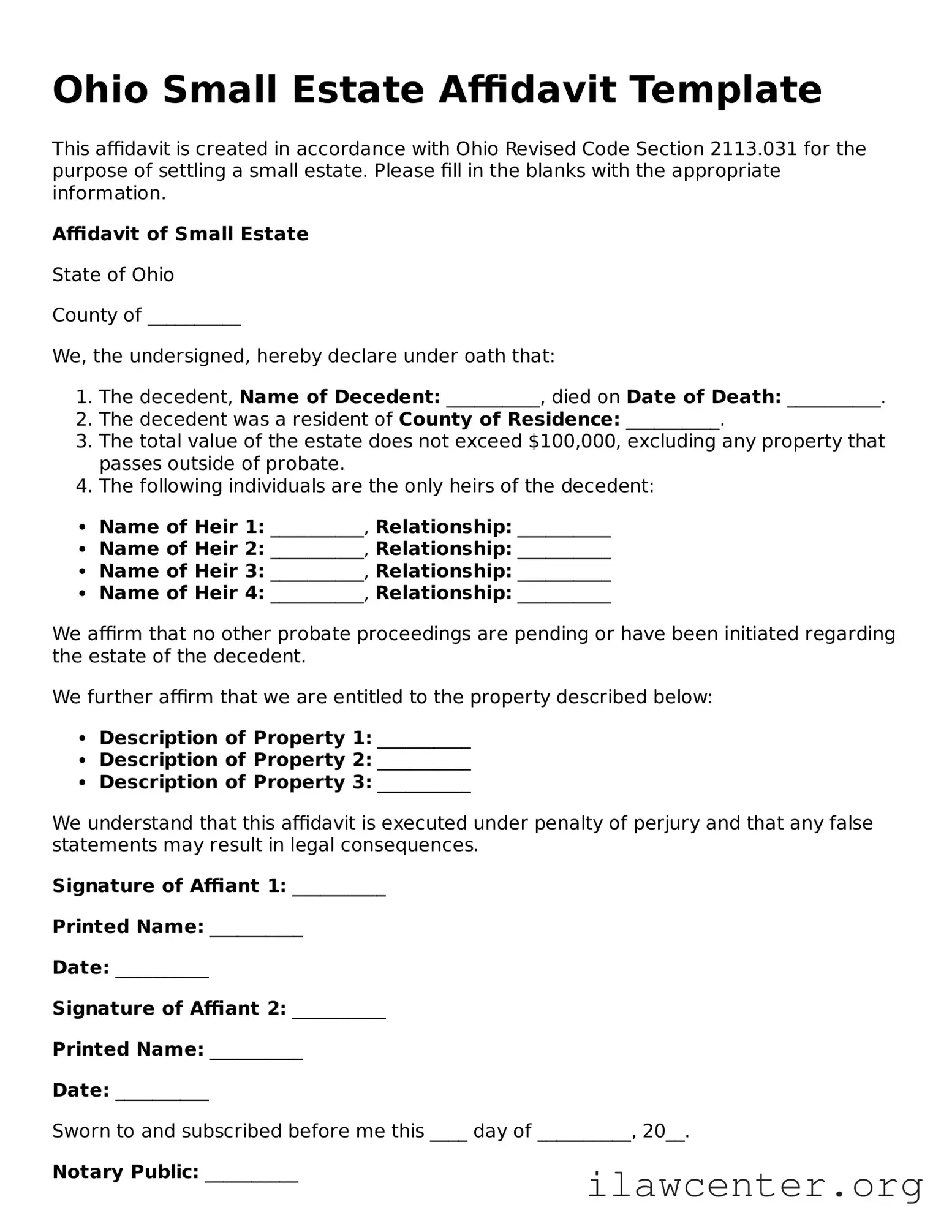
Ohio Small Estate Affidavit Preview

Ohio Small Estate Affidavit Template

This affidavit is created in accordance with Ohio Revised Code Section 2113.031 for the purpose of settling a small estate. Please fill in the blanks with the appropriate information.

Affidavit of Small Estate

State of Ohio

County of __________

We, the undersigned, hereby declare under oath that:

  1. The decedent, Name of Decedent: __________, died on Date of Death: __________.
  2. The decedent was a resident of County of Residence: __________.
  3. The total value of the estate does not exceed $100,000, excluding any property that passes outside of probate.
  4. The following individuals are the only heirs of the decedent:
  • Name of Heir 1: __________, Relationship: __________
  • Name of Heir 2: __________, Relationship: __________
  • Name of Heir 3: __________, Relationship: __________
  • Name of Heir 4: __________, Relationship: __________

We affirm that no other probate proceedings are pending or have been initiated regarding the estate of the decedent.

We further affirm that we are entitled to the property described below:

  • Description of Property 1: __________
  • Description of Property 2: __________
  • Description of Property 3: __________

We understand that this affidavit is executed under penalty of perjury and that any false statements may result in legal consequences.

Signature of Affiant 1: __________

Printed Name: __________

Date: __________

Signature of Affiant 2: __________

Printed Name: __________

Date: __________

Sworn to and subscribed before me this ____ day of __________, 20__.

Notary Public: __________

My Commission Expires: __________

PDF Form Characteristics

Fact Name Description
Purpose The Ohio Small Estate Affidavit allows individuals to settle the estate of a deceased person without going through the lengthy probate process, provided the estate meets certain criteria.
Eligibility To qualify for this affidavit, the total value of the estate must be less than $100,000, excluding real estate.
Governing Law This process is governed by Ohio Revised Code Section 2113.031, which outlines the requirements and procedures for using a Small Estate Affidavit.
Filing Requirements The affidavit must be completed and signed by the person claiming the assets, and it may require notarization to ensure authenticity.
Asset Distribution Once the affidavit is filed, the claimant can collect the deceased's assets directly from banks or other institutions without needing a court order.
Limitations While the Small Estate Affidavit simplifies the process, it cannot be used if there is a will that has not been probated or if there are disputes among heirs.

Instructions on Utilizing Ohio Small Estate Affidavit

Filling out the Ohio Small Estate Affidavit form is a straightforward process that allows individuals to handle the estate of a deceased person without going through probate. Once the form is completed, it can be submitted to the appropriate court or authority to initiate the next steps in managing the estate.

  1. Obtain the Ohio Small Estate Affidavit form. You can find it online or request a physical copy from your local probate court.
  2. Fill in the decedent's full name and date of death at the top of the form.
  3. Provide your name, address, and relationship to the decedent in the designated sections.
  4. List the names and addresses of all heirs and beneficiaries in the appropriate section.
  5. Detail the assets of the estate, including their estimated values, in the specified area.
  6. Indicate any debts or liabilities of the estate that need to be addressed.
  7. Sign and date the affidavit at the bottom of the form, ensuring that your signature is witnessed if required.
  8. Make copies of the completed form for your records and for any heirs or beneficiaries.
  9. Submit the original affidavit to the probate court along with any required fees or additional documents.

Important Facts about Ohio Small Estate Affidavit

What is the Ohio Small Estate Affidavit?

The Ohio Small Estate Affidavit is a legal document that allows individuals to claim the assets of a deceased person without going through the formal probate process. This affidavit can be used when the total value of the estate is below a certain threshold, which is currently set at $100,000 for personal property and $200,000 for real property. By using this affidavit, heirs can expedite the transfer of assets, making the process more efficient and less costly.

Who is eligible to use the Small Estate Affidavit?

To be eligible to use the Small Estate Affidavit in Ohio, the person filing must be an heir or a beneficiary of the deceased. Additionally, the estate must meet the value requirements mentioned earlier. It is essential that the deceased has not left behind a will or, if there is a will, that it does not appoint a personal representative to manage the estate. Understanding these criteria is crucial to ensure the affidavit can be properly utilized.

What information is required to complete the affidavit?

Completing the Small Estate Affidavit requires specific information. This includes the name and address of the deceased, the date of death, and a list of the assets that are being claimed. You will also need to provide details about the heirs and their relationship to the deceased. Accurate information is vital, as any discrepancies may lead to delays or complications in the process.

How do I file the Small Estate Affidavit?

Filing the Small Estate Affidavit involves submitting the completed form to the appropriate probate court in the county where the deceased lived. It’s advisable to make copies of the affidavit and any supporting documents for your records. While there is no filing fee for the affidavit itself, some counties may have other associated costs, so checking with the local court is recommended.

What happens after the affidavit is filed?

Once the Small Estate Affidavit is filed, the court will review the information provided. If everything is in order, the court will typically approve the affidavit. After approval, the heirs can present the affidavit to banks, financial institutions, or other entities holding the deceased’s assets to claim them. This process can be completed relatively quickly, allowing heirs to access the assets without lengthy probate proceedings.

Can the Small Estate Affidavit be contested?

Common mistakes

Filling out the Ohio Small Estate Affidavit form can be straightforward, but many people make common mistakes that can delay the process. One frequent error is providing incorrect information about the deceased. It’s crucial to ensure that the name, date of birth, and date of death are accurate. Even a small typo can lead to complications.

Another common mistake involves the asset valuation. Individuals often underestimate or overestimate the value of the estate’s assets. This can cause issues when determining eligibility for the small estate process. It’s important to assess the value of each asset carefully and realistically.

Some people forget to include all relevant assets in the affidavit. Even if certain assets seem minor, they should still be disclosed. The law requires a complete account of the estate, and missing information can lead to delays or even denial of the affidavit.

Failure to sign the affidavit correctly is another mistake. The form must be signed by the appropriate parties, and any missing signatures can invalidate the document. Make sure that everyone who needs to sign does so in the right place.

Many individuals also overlook the need for notarization. The Ohio Small Estate Affidavit must be notarized to be legally binding. Skipping this step can result in the affidavit being rejected by the court.

In some cases, people do not provide sufficient identification or proof of relationship to the deceased. The affidavit requires that you demonstrate your connection to the estate. This documentation is essential for the court to accept the affidavit.

Another mistake is submitting the affidavit without checking for errors. Rushing through the form can lead to mistakes that could have been easily corrected. Taking the time to review the document thoroughly can save time and hassle later.

People sometimes fail to understand the specific requirements of the small estate process in Ohio. Each state has its own rules, and being unaware of these can lead to mistakes. Familiarizing yourself with Ohio’s requirements is essential before starting the process.

Some individuals also misinterpret the role of the affidavit. It is not a will replacement, and using it incorrectly can create confusion about the distribution of assets. Understanding its purpose is key to using the affidavit properly.

Finally, many forget to keep copies of the completed affidavit and any supporting documents. Having these records can be helpful in case any questions arise later. It’s always a good practice to maintain organized documentation throughout the process.

Documents used along the form

When dealing with the Ohio Small Estate Affidavit form, several other documents may be necessary to streamline the process of settling a small estate. These forms help clarify the estate's assets, debts, and the distribution of property among heirs. Below is a list of commonly used forms that complement the Small Estate Affidavit.

  • Death Certificate: This official document verifies the passing of the deceased and is essential for initiating the probate process. It provides proof of death for all legal proceedings related to the estate.
  • Will: If the deceased left a will, it outlines their wishes regarding asset distribution. The will must be presented along with the Small Estate Affidavit to ensure the estate is settled according to the deceased's intentions.
  • List of Assets: A comprehensive inventory of the deceased's assets, including real estate, bank accounts, and personal property, helps clarify what is included in the estate. This list supports the claims made in the Small Estate Affidavit.
  • List of Debts: This document details any outstanding debts or liabilities owed by the deceased. It is important to address these debts before distributing assets to heirs.
  • Affidavit of Heirship: This sworn statement identifies the legal heirs of the deceased. It can be particularly useful if there is no will or if the heirs are not clearly defined.
  • Tax Returns: Copies of the deceased's final tax returns may be required to settle any tax obligations. This documentation ensures that all financial responsibilities are met before the estate is closed.

Having these documents prepared and organized can significantly ease the process of settling an estate in Ohio. Each form plays a vital role in ensuring that the estate is handled legally and efficiently, protecting the interests of all parties involved.

Similar forms

The Small Estate Affidavit form is a useful tool for settling the estate of a deceased person when the estate's total value falls below a certain threshold. Here are eight documents that are similar to the Small Estate Affidavit form, along with a brief explanation of how they relate:

  • Will: A will outlines how a person's assets should be distributed after their death. Like the Small Estate Affidavit, it helps in the transfer of assets but is generally used for larger estates.
  • Probate Petition: This document initiates the probate process, allowing for the legal distribution of a deceased person's assets. The Small Estate Affidavit can serve as a simpler alternative when probate is not required.
  • Letters Testamentary: Issued by a court, these letters authorize an executor to manage the deceased’s estate. The Small Estate Affidavit allows for the transfer of assets without the need for an executor.
  • Trust Document: A trust outlines how assets are to be managed and distributed during a person's lifetime and after their death. Both documents facilitate asset transfer, but trusts can be more complex and are often used for larger estates.
  • Affidavit of Heirship: This document establishes the heirs of a deceased person. Similar to the Small Estate Affidavit, it helps in proving who is entitled to inherit assets.
  • Deed of Distribution: This document transfers property from an estate to the heirs. Like the Small Estate Affidavit, it serves to finalize the distribution of assets after death.
  • Release of Estate Claim: This document is used by heirs to relinquish their claims to an estate. The Small Estate Affidavit can similarly facilitate the transfer of assets without extensive claims or disputes.
  • Power of Attorney: While primarily used during a person's lifetime to authorize someone to act on their behalf, it can also relate to estate matters. The Small Estate Affidavit allows for a streamlined process in managing and distributing assets after death.

Dos and Don'ts

When filling out the Ohio Small Estate Affidavit form, it’s important to follow certain guidelines to ensure everything is completed correctly. Here are some dos and don'ts to keep in mind:

  • Do gather all necessary documents before starting the form.
  • Do provide accurate information about the deceased and their assets.
  • Do have the form notarized once completed.
  • Do check for any specific county requirements that may apply.
  • Don't leave any sections blank; fill in all required fields.
  • Don't submit the form without double-checking for errors.

By following these guidelines, you can help ensure a smoother process when handling a small estate in Ohio.

Misconceptions

The Ohio Small Estate Affidavit is a useful tool for settling the estates of individuals who have passed away, particularly when their assets are below a certain threshold. However, several misconceptions exist regarding its use and requirements. Below is a list of common misunderstandings:

  • Only wealthy individuals can use the Small Estate Affidavit. Many believe that this form is reserved for high-value estates, but it is actually designed for estates with a total value of $100,000 or less, excluding real estate.
  • The Small Estate Affidavit can be used for any type of asset. Some think that all assets can be claimed using this affidavit. However, certain assets, such as those held in a trust or jointly owned properties, are not eligible.
  • Filing a Small Estate Affidavit eliminates the need for probate. While this affidavit simplifies the process, it does not completely eliminate the need for probate in every situation. Certain circumstances may still require formal probate proceedings.
  • Anyone can file a Small Estate Affidavit. This form can only be filed by individuals who are either the surviving spouse, a child, or a person entitled to inherit under Ohio law. Others may not have the legal standing to file.
  • The Small Estate Affidavit is the same as a will. Many confuse the two. A will outlines how a person wishes their estate to be distributed after death, while the Small Estate Affidavit is a tool for claiming assets without going through the full probate process.
  • The affidavit must be filed with the court. Some believe that the Small Estate Affidavit needs to be submitted to a court. In reality, it is typically presented to the financial institutions or entities holding the deceased's assets.
  • All debts must be paid before using the Small Estate Affidavit. While it is advisable to address debts, the affidavit allows for the distribution of assets without the complete settlement of all debts, as long as the estate can cover them.
  • There is no time limit for filing the Small Estate Affidavit. This is not true. There is a timeframe within which the affidavit should be filed after the person's death, typically within a few months, depending on specific circumstances.

Understanding these misconceptions can help individuals navigate the process more effectively and ensure that they are utilizing the Small Estate Affidavit correctly.

Key takeaways

Filling out and using the Ohio Small Estate Affidavit form can simplify the process of settling an estate. Here are some key takeaways to keep in mind:

  • Eligibility Criteria: Ensure that the estate qualifies as a small estate. In Ohio, this typically means the total value of the estate is less than $100,000, excluding certain assets.
  • Required Information: Gather necessary details such as the decedent’s information, a list of assets, and the names of beneficiaries. Accurate information is crucial for a smooth process.
  • Notarization: The affidavit must be signed in front of a notary public. This adds a layer of authenticity and is often required for acceptance by financial institutions.
  • Distribution of Assets: Once the affidavit is filed, beneficiaries can use it to claim their share of the estate. This can include bank accounts, real estate, and personal property.

Understanding these points can help streamline the estate settlement process and ensure that everything is handled properly.