Fillable Operating Agreement Document

Fillable Operating Agreement Document

An Operating Agreement is a vital document that outlines the management structure and operational procedures of a limited liability company (LLC). This agreement serves as a blueprint for how the business will be run, detailing the rights and responsibilities of its members. To get started on establishing your LLC's framework, fill out the form by clicking the button below.

Article Guide

When starting a business, particularly a limited liability company (LLC), creating an Operating Agreement is a crucial step that can help define the structure and operations of the company. This document serves as an internal guideline for the members of the LLC, outlining essential aspects such as ownership percentages, management responsibilities, and decision-making processes. It also addresses how profits and losses will be distributed among members, ensuring clarity and reducing potential conflicts. Furthermore, the Operating Agreement can specify procedures for adding new members or handling the departure of existing ones, thus providing a roadmap for the future of the business. By establishing rules for meetings and voting, it helps to ensure that all members have a voice in the company's direction. Additionally, this agreement can protect the limited liability status of the LLC, reinforcing the separation between personal and business assets. Overall, an Operating Agreement is not just a formality; it is a vital tool that fosters transparency and cooperation among members, setting the foundation for a successful business venture.

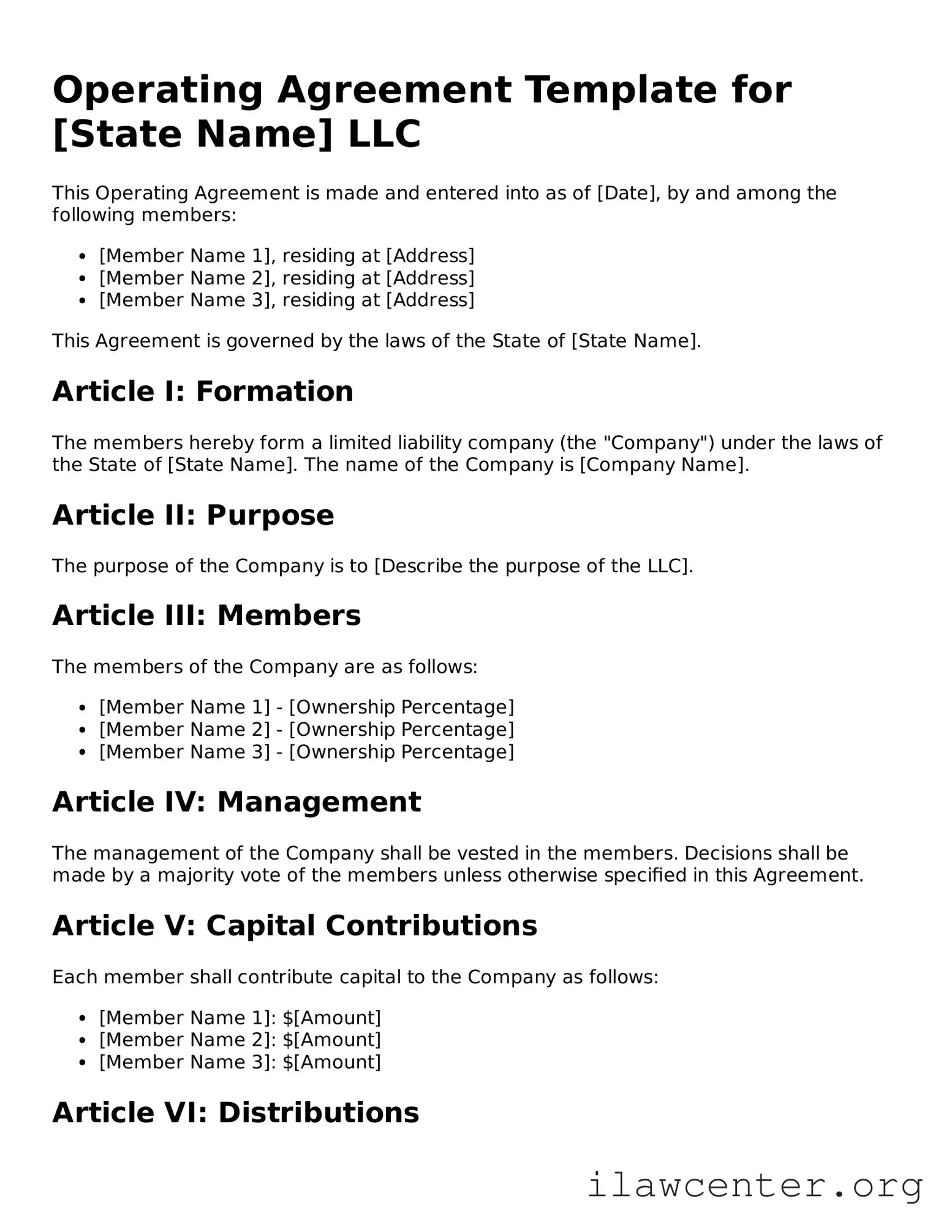
Operating Agreement Preview

Operating Agreement Template for [State Name] LLC

This Operating Agreement is made and entered into as of [Date], by and among the following members:

  • [Member Name 1], residing at [Address]
  • [Member Name 2], residing at [Address]
  • [Member Name 3], residing at [Address]

This Agreement is governed by the laws of the State of [State Name].

Article I: Formation

The members hereby form a limited liability company (the "Company") under the laws of the State of [State Name]. The name of the Company is [Company Name].

Article II: Purpose

The purpose of the Company is to [Describe the purpose of the LLC].

Article III: Members

The members of the Company are as follows:

  • [Member Name 1] - [Ownership Percentage]
  • [Member Name 2] - [Ownership Percentage]
  • [Member Name 3] - [Ownership Percentage]

Article IV: Management

The management of the Company shall be vested in the members. Decisions shall be made by a majority vote of the members unless otherwise specified in this Agreement.

Article V: Capital Contributions

Each member shall contribute capital to the Company as follows:

  • [Member Name 1]: $[Amount]
  • [Member Name 2]: $[Amount]
  • [Member Name 3]: $[Amount]

Article VI: Distributions

Distributions of profits and losses shall be allocated to the members in proportion to their ownership percentages.

Article VII: Books and Records

The Company shall maintain complete and accurate books and records of the Company's business and affairs.

Article VIII: Amendments

This Agreement may be amended only by a written agreement signed by all members.

Article IX: Miscellaneous

This Agreement constitutes the entire agreement among the members and supersedes all prior agreements or understandings, whether written or oral.

IN WITNESS WHEREOF, the undersigned members have executed this Operating Agreement as of the date first above written.

______________________________
[Member Name 1]

______________________________
[Member Name 2]

______________________________
[Member Name 3]

PDF Form Characteristics

Fact Name Description
Purpose An Operating Agreement outlines the management structure and operational procedures of a limited liability company (LLC).
State-Specific Forms Operating Agreements may vary by state, with each state having its own requirements and guidelines governing LLCs.
Governing Laws The laws governing Operating Agreements typically include the state's LLC Act, which provides the legal framework for the formation and operation of LLCs.
Importance Having a well-drafted Operating Agreement is crucial, as it helps prevent disputes among members and clarifies the roles and responsibilities within the LLC.

Instructions on Utilizing Operating Agreement

Completing the Operating Agreement form is an essential step in formalizing the structure and rules of your business. Follow these steps carefully to ensure all necessary information is accurately provided.

  1. Begin by entering the name of your business at the top of the form.
  2. Provide the principal address of the business. This should be a physical location, not a P.O. Box.
  3. List the names and addresses of all members involved in the business.
  4. Specify the ownership percentage for each member. Ensure that the total equals 100%.
  5. Outline the management structure. Indicate whether the business will be member-managed or manager-managed.
  6. Detail the voting rights of each member. Clarify how decisions will be made within the company.
  7. Include provisions for profit and loss distribution. Clearly state how profits and losses will be shared among members.
  8. Address the procedures for adding or removing members. This should include any required approvals or conditions.
  9. Sign and date the document. Ensure all members do the same to validate the agreement.

Once the form is filled out, review it for accuracy. Make sure all members have a copy for their records. It is advisable to consult a legal professional to ensure compliance with state laws and regulations.

Important Facts about Operating Agreement

What is an Operating Agreement?

An Operating Agreement is a key document for limited liability companies (LLCs). It outlines the management structure and operating procedures of the LLC. This agreement details the roles of members, how profits and losses will be distributed, and the procedures for making important decisions. Having an Operating Agreement helps clarify expectations and can prevent disputes among members.

Why is an Operating Agreement important?

An Operating Agreement is important because it provides a clear framework for how the LLC will operate. It protects the limited liability status of the members by showing that the LLC is a separate entity. Additionally, it can help resolve conflicts by providing guidelines for decision-making and member responsibilities. Without this agreement, state laws will govern the LLC, which may not align with the members' intentions.

Who should create an Operating Agreement?

What should be included in an Operating Agreement?

Can an Operating Agreement be changed?

Is an Operating Agreement required by law?

Common mistakes

Filling out an Operating Agreement form can be a crucial step for business owners, especially those forming a Limited Liability Company (LLC). However, many people make common mistakes that can lead to complications down the road. Understanding these pitfalls can help ensure a smoother process.

One frequent error is not clearly defining roles and responsibilities. When members do not specify who is responsible for what, it can lead to confusion and conflict. Clarity in roles helps streamline operations and prevents misunderstandings among members.

Another mistake is failing to outline the decision-making process. Without a clear procedure for how decisions are made, disagreements can arise. It’s essential to establish whether decisions require a simple majority, a supermajority, or unanimous consent to avoid potential disputes.

People often overlook the importance of including provisions for member changes. Life circumstances can change, and members may leave or new ones may join. Having a clear process for handling these transitions can save time and reduce tension in the future.

Some individuals neglect to address profit and loss distribution. Not specifying how profits and losses will be shared can lead to dissatisfaction among members. Clearly outlining this aspect helps set expectations and fosters fairness.

Additionally, not considering state-specific laws can be a significant oversight. Each state has its own regulations regarding LLCs, and failing to comply with these can result in legal issues. Researching state requirements ensures that the Operating Agreement meets all necessary legal standards.

Another common mistake is leaving out a dispute resolution process. Conflicts are inevitable in any business. By including a method for resolving disputes—such as mediation or arbitration—members can address issues constructively without resorting to litigation.

Lastly, neglecting to review and update the agreement can lead to outdated provisions that no longer reflect the business's needs. Regularly revisiting the Operating Agreement ensures that it remains relevant and effective as the business evolves.

By avoiding these mistakes, individuals can create a solid foundation for their LLC. A well-prepared Operating Agreement not only clarifies expectations but also helps prevent conflicts, making it an essential tool for any business partnership.

Documents used along the form

An Operating Agreement is a crucial document for any limited liability company (LLC), outlining the management structure and operational guidelines. However, several other forms and documents often accompany it to ensure comprehensive governance and compliance. Below is a list of commonly used documents that complement the Operating Agreement.

  • Articles of Organization: This is the foundational document filed with the state to legally establish an LLC. It includes basic information such as the company name, address, and registered agent.
  • Member Consent Forms: These forms are used to document the agreement of members on significant decisions or actions, ensuring that all members are on the same page.
  • Bylaws: While not always required for LLCs, bylaws outline the rules for how the company will operate, including details about meetings, voting, and member responsibilities.
  • Membership Certificates: These certificates serve as proof of ownership in the LLC, indicating the member's percentage of ownership and any rights associated with it.
  • Initial Capital Contribution Agreement: This document specifies the initial investment made by each member, detailing the amount contributed and the agreed-upon ownership percentages.
  • Meeting Minutes: Keeping records of meetings is essential for transparency. Meeting minutes document decisions made during meetings and can serve as a reference for future discussions.
  • Tax Identification Number (TIN) Application: This form is necessary for obtaining a TIN from the IRS, which is needed for tax purposes and to open a business bank account.
  • Operating Procedures Manual: This manual outlines the day-to-day operations and procedures of the LLC, providing guidance for members and employees.
  • Annual Reports: Many states require LLCs to file annual reports that provide updated information about the company, including changes in membership or management.

Having these documents in place not only supports the proper functioning of your LLC but also helps protect the interests of all members. Each document plays a unique role in establishing a solid foundation for your business and ensuring compliance with state regulations.

Similar forms

  • Partnership Agreement: This document outlines the terms and conditions of a partnership between two or more individuals. Like an Operating Agreement, it specifies the roles, responsibilities, and profit-sharing arrangements among partners, ensuring that all parties understand their obligations and rights.

  • Bylaws: Bylaws govern the internal management of a corporation. Similar to an Operating Agreement, they establish rules for decision-making, roles of officers, and meeting procedures, ensuring smooth operations and clarity in governance.

  • Shareholders' Agreement: This document is designed for corporations with multiple shareholders. It is akin to an Operating Agreement in that it sets forth the rights and obligations of shareholders, including how shares can be bought or sold, thereby protecting everyone's interests.

  • Joint Venture Agreement: When two or more parties collaborate on a specific project, a Joint Venture Agreement is created. Much like an Operating Agreement, it delineates each party’s contributions, responsibilities, and how profits or losses will be shared, ensuring all parties are on the same page.

  • Limited Liability Company (LLC) Formation Documents: These documents are essential for establishing an LLC. They include details similar to those found in an Operating Agreement, such as the management structure, member roles, and financial arrangements, providing a foundational framework for the business.

Dos and Don'ts

When filling out an Operating Agreement form, attention to detail is crucial. Here’s a list of ten things to keep in mind to ensure a smooth process.

  • Do read the entire form carefully before starting.
  • Do provide accurate information about all members involved.
  • Do include the purpose of the business clearly.
  • Do specify the management structure of the business.
  • Do outline the procedures for adding or removing members.
  • Don't leave any sections blank; incomplete forms can cause delays.
  • Don't use vague language; clarity is essential.
  • Don't forget to include the effective date of the agreement.
  • Don't overlook the need for signatures from all members.
  • Don't ignore state-specific requirements that may apply.

By following these guidelines, you can help ensure that your Operating Agreement is completed correctly and effectively supports your business operations.

Misconceptions

Operating agreements are essential documents for LLCs, yet several misconceptions can lead to confusion. Here are four common misunderstandings:

  • Operating agreements are only necessary for large LLCs. Many believe that only larger businesses need an operating agreement. In reality, every LLC, regardless of size, benefits from having one. It outlines the management structure and operational procedures.
  • Verbal agreements are sufficient. Some think that a verbal agreement among members is enough. However, without a written document, disputes can arise, and it becomes challenging to enforce any agreements. A written operating agreement provides clarity and legal protection.
  • Operating agreements are set in stone. Many assume that once an operating agreement is created, it cannot be changed. In fact, operating agreements can be amended as the business evolves. Regular reviews ensure that the agreement remains relevant.
  • Only lawyers can draft operating agreements. While legal assistance can be beneficial, it is not mandatory. Business owners can draft their own operating agreements using templates or guides. However, ensuring compliance with state laws is crucial.

Key takeaways

When creating and utilizing an Operating Agreement for your business, it’s essential to understand its importance and the key elements involved. Here are some critical takeaways:

  • Define the structure: The Operating Agreement outlines the ownership structure and management responsibilities of the business. This clarity helps prevent conflicts among members.
  • Establish rules: It sets forth the rules for how the business will operate, including procedures for decision-making, profit distribution, and handling disputes.
  • Protect personal assets: By clearly stating the business’s operational guidelines, the Operating Agreement helps protect members' personal assets from business liabilities.
  • Facilitate funding: Investors often require an Operating Agreement before they commit funds, as it demonstrates a clear plan for governance and operations.
  • Adaptability: The agreement can be amended as the business grows or changes, allowing for flexibility in response to new circumstances or goals.
  • Legal compliance: Many states require an Operating Agreement for LLCs, making it a crucial document for legal compliance and legitimacy.

Understanding these key points will help ensure that your Operating Agreement serves its purpose effectively, providing a solid foundation for your business operations.