Attorney-Verified  Bill of Sale Document for Oregon

Attorney-Verified Bill of Sale Document for Oregon

The Oregon Bill of Sale form is a legal document that serves as proof of a transaction between a buyer and a seller for personal property. This form outlines the details of the sale, including the items sold, the sale price, and the date of the transaction. For a smooth and secure transaction, consider filling out the form by clicking the button below.

Article Guide

When engaging in the sale or transfer of personal property in Oregon, having a Bill of Sale form is essential. This document serves as a written record of the transaction, providing both the buyer and seller with important details about the sale. It typically includes information such as the names and addresses of both parties, a description of the item being sold, the sale price, and the date of the transaction. Additionally, the Bill of Sale may outline any warranties or conditions related to the item, ensuring that both parties are clear about their rights and responsibilities. While not always legally required, using a Bill of Sale can help protect against future disputes and provides a clear proof of ownership. Understanding the components of this form can make the process smoother and more transparent for everyone involved.

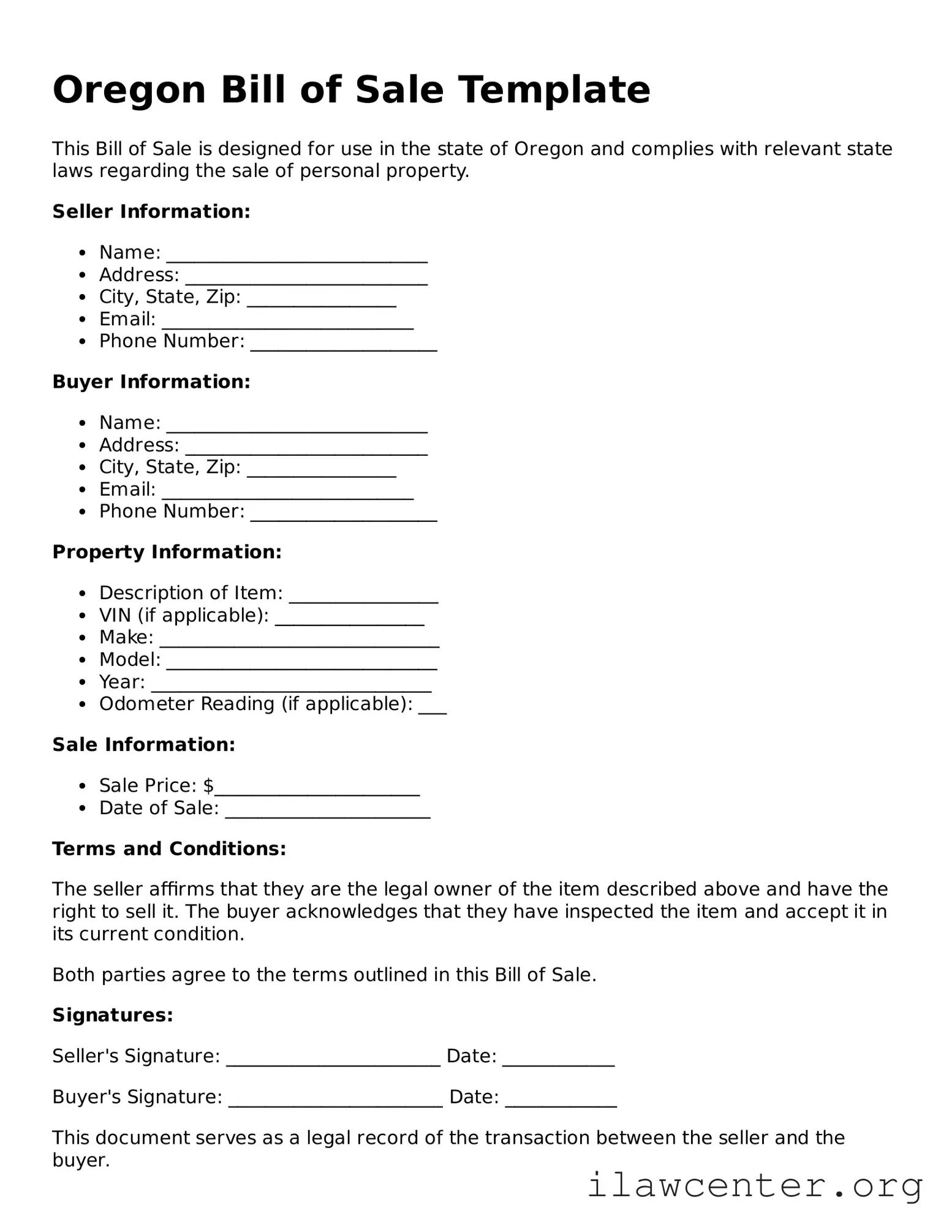
Oregon Bill of Sale Preview

Oregon Bill of Sale Template

This Bill of Sale is designed for use in the state of Oregon and complies with relevant state laws regarding the sale of personal property.

Seller Information:

  • Name: ____________________________
  • Address: __________________________
  • City, State, Zip: ________________
  • Email: ___________________________
  • Phone Number: ____________________

Buyer Information:

  • Name: ____________________________
  • Address: __________________________
  • City, State, Zip: ________________
  • Email: ___________________________
  • Phone Number: ____________________

Property Information:

  • Description of Item: ________________
  • VIN (if applicable): ________________
  • Make: ______________________________
  • Model: _____________________________
  • Year: ______________________________
  • Odometer Reading (if applicable): ___

Sale Information:

  • Sale Price: $______________________
  • Date of Sale: ______________________

Terms and Conditions:

The seller affirms that they are the legal owner of the item described above and have the right to sell it. The buyer acknowledges that they have inspected the item and accept it in its current condition.

Both parties agree to the terms outlined in this Bill of Sale.

Signatures:

Seller's Signature: _______________________ Date: ____________

Buyer's Signature: _______________________ Date: ____________

This document serves as a legal record of the transaction between the seller and the buyer.

PDF Form Characteristics

Fact Name Description
Purpose The Oregon Bill of Sale form is used to document the transfer of ownership of personal property from one party to another.
Types of Property This form can be used for various types of personal property, including vehicles, boats, and equipment.
Governing Law The Bill of Sale in Oregon is governed by Oregon Revised Statutes, specifically ORS 93.805 to 93.840.
Notarization Notarization is not required for a Bill of Sale in Oregon, but it can provide additional proof of the transaction.
Information Required The form typically requires details about the buyer, seller, and the property being sold, including identification numbers.
Sales Tax Sales tax is generally not applicable to the sale of personal property in Oregon, as the state does not impose a sales tax.
Use in Title Transfer The Bill of Sale can be used as part of the process for transferring the title of a vehicle or other registered property.
Record Keeping Both the buyer and seller should keep a copy of the Bill of Sale for their records, as it serves as proof of the transaction.

Instructions on Utilizing Oregon Bill of Sale

Completing the Oregon Bill of Sale form is a straightforward process that ensures both parties have a clear record of the transaction. After filling out the form, it is important to keep a copy for your records and provide one to the buyer or seller, as applicable.

  1. Begin by entering the date of the transaction at the top of the form.
  2. Fill in the names and addresses of both the seller and the buyer. Ensure that the information is accurate and complete.
  3. Provide a description of the item being sold. This may include details such as the make, model, year, and identification number, if applicable.
  4. Indicate the sale price of the item. Clearly state the amount in both numerical and written form to avoid any confusion.
  5. Include any additional terms or conditions of the sale, if necessary. This might cover warranties or any agreements made between the parties.
  6. Both the seller and buyer should sign and date the form at the designated areas. Signatures confirm that both parties agree to the terms outlined.
  7. Make copies of the completed form for both the seller and the buyer to retain for their records.

Important Facts about Oregon Bill of Sale

What is an Oregon Bill of Sale form?

An Oregon Bill of Sale form is a legal document that records the transfer of ownership of personal property from one party to another. This form is often used for vehicles, boats, and other significant items. It serves as proof of the transaction and can be important for both the buyer and seller in case of future disputes.

When do I need to use a Bill of Sale in Oregon?

You should use a Bill of Sale whenever you sell or purchase personal property, especially for high-value items. In Oregon, it is commonly required for vehicle transactions to register the vehicle in the buyer's name. It can also be useful for documenting sales of boats, trailers, or other significant personal items.

What information is required on the Oregon Bill of Sale form?

The Bill of Sale should include essential details such as the names and addresses of both the buyer and seller, a description of the item being sold, the sale price, and the date of the transaction. It's also advisable to include the vehicle identification number (VIN) for vehicles, as well as any warranties or conditions related to the sale.

Is the Bill of Sale required to be notarized in Oregon?

No, notarization is not a requirement for a Bill of Sale in Oregon. However, having the document notarized can provide an extra layer of protection and authenticity. It may help in case of disputes or if you need to prove the transaction in the future.

Can I create my own Bill of Sale, or do I need a specific form?

What should I do after completing the Bill of Sale?

Once you have completed the Bill of Sale, both the buyer and seller should keep a copy for their records. If the transaction involves a vehicle, the buyer will need to present the Bill of Sale to the Oregon Department of Transportation when registering the vehicle. It's also wise to keep a record of any payment methods or receipts related to the sale.

What if there are issues after the sale?

If issues arise after the sale, such as disputes over the condition of the item or payment, the Bill of Sale can serve as a critical piece of evidence. Review the terms outlined in the document. If necessary, consider seeking legal advice to resolve the matter effectively.

Common mistakes

Filling out the Oregon Bill of Sale form may seem straightforward, but many people make common mistakes that can lead to complications down the line. One frequent error is neglecting to include the correct vehicle identification number (VIN). This number is crucial as it uniquely identifies the vehicle. A missing or incorrect VIN can create confusion and may even invalidate the sale.

Another common mistake is failing to provide accurate information about the buyer and seller. It’s essential to include full names, addresses, and contact information. Incomplete or incorrect details can lead to disputes or difficulties in transferring ownership. Always double-check that the information is current and correctly spelled.

Many individuals also overlook the importance of documenting the sale price. Leaving this section blank or providing an inaccurate amount can create issues, particularly if the buyer or seller needs to prove the transaction for tax purposes. It’s best to clearly state the agreed-upon price to avoid any misunderstandings later.

People sometimes forget to sign the form. This may seem minor, but without signatures from both parties, the Bill of Sale is not legally binding. Ensure that both the buyer and seller sign and date the document to validate the transaction.

In addition, some individuals fail to include any necessary disclosures about the vehicle’s condition. If there are known issues or if the vehicle is being sold “as is,” this should be clearly stated. Omitting this information can lead to legal disputes after the sale is completed.

Another mistake involves not keeping a copy of the Bill of Sale. After the transaction, both parties should retain a copy for their records. This document serves as proof of the sale and can be important for future reference, especially if any issues arise.

Lastly, people often rush through the process without reading the form thoroughly. Each section is designed to capture specific information, and overlooking even a small detail can lead to significant problems. Take the time to read and understand the form before submitting it.

Documents used along the form

When completing a transaction involving the sale of a vehicle or personal property in Oregon, several documents may accompany the Bill of Sale form. Each of these documents serves a specific purpose and helps ensure a smooth transfer of ownership. Here are some commonly used forms:

  • Title Transfer Form: This document officially transfers ownership of the vehicle from the seller to the buyer. It must be completed and submitted to the Oregon Department of Transportation.
  • Oregon Vehicle Registration Application: If the buyer intends to register the vehicle in their name, this application is necessary. It provides essential information about the vehicle and the new owner.
  • Odometer Disclosure Statement: This form records the vehicle's mileage at the time of sale. It is important for preventing odometer fraud and is often required for vehicles under a certain age.
  • Release of Liability: This document protects the seller from future liabilities related to the vehicle after the sale. It informs the state that the seller is no longer responsible for the vehicle.
  • Payment Receipt: A simple receipt that confirms the payment made by the buyer. This serves as proof of the transaction and can be useful for both parties.

Using these documents alongside the Oregon Bill of Sale can help clarify the terms of the sale and protect both the buyer and seller. Ensuring that all necessary paperwork is completed can lead to a more straightforward and secure transaction.

Similar forms

The Bill of Sale form is a crucial document used in various transactions, primarily to transfer ownership of personal property. Several other documents serve similar purposes, each tailored to specific situations. Below is a list of ten documents that share similarities with the Bill of Sale, along with explanations of how they are alike.

  • Purchase Agreement: This document outlines the terms and conditions of a sale, detailing the items being sold, the purchase price, and the responsibilities of both the buyer and seller. Like a Bill of Sale, it formalizes the transaction and serves as proof of the agreement.
  • Title Transfer Document: Often used for vehicles, this document officially transfers ownership from one party to another. Similar to a Bill of Sale, it provides legal evidence of the change in ownership.
  • Lease Agreement: This document outlines the terms under which one party rents property from another. Although it focuses on rental rather than sale, it establishes rights and responsibilities, akin to the transfer of ownership in a Bill of Sale.
  • Gift Receipt: When property is given as a gift, a gift receipt can serve a similar function to a Bill of Sale by documenting the transfer of ownership without a monetary exchange.
  • Inventory List: In business transactions, an inventory list details items being sold or transferred. While it may not serve as a legal document on its own, it can accompany a Bill of Sale to provide clarity on what is included in the sale.
  • Service Agreement: This document outlines the terms of services provided between parties. While it differs in focus, it shares the purpose of establishing a formal understanding, much like a Bill of Sale does for property transfer.
  • Quitclaim Deed: Used primarily in real estate, this document transfers interest in property without guaranteeing that the title is clear. It is similar to a Bill of Sale in that it conveys ownership but does so in a specific context related to real estate.
  • Contract for Deed: This is an agreement where the seller finances the purchase of property. It functions similarly to a Bill of Sale by outlining the terms of the transfer and the obligations of both parties.
  • Sales Receipt: This document serves as proof of purchase for goods or services. It is similar to a Bill of Sale in that it confirms the transaction and can be used for record-keeping purposes.
  • Exchange Agreement: This document outlines the terms of an exchange of goods or services between parties. Like a Bill of Sale, it formalizes the transaction and provides a record of the agreement.

Each of these documents plays a vital role in ensuring that transactions are clear and legally recognized, similar to the function of a Bill of Sale.

Dos and Don'ts

When filling out the Oregon Bill of Sale form, it is important to ensure accuracy and completeness. Here are five things to keep in mind:

  • Do provide accurate information about the buyer and seller, including full names and addresses.
  • Do include a detailed description of the item being sold, such as make, model, year, and VIN for vehicles.
  • Do ensure both parties sign the document to validate the transaction.
  • Don't leave any sections blank; fill in all required fields to avoid confusion later.
  • Don't forget to keep a copy of the signed Bill of Sale for your records.

Misconceptions

The Oregon Bill of Sale form is an important document used for various transactions, particularly when buying or selling personal property. However, there are several misconceptions about this form that can lead to confusion. Here are eight common misunderstandings:

  • It is only needed for vehicle sales. Many people believe that a Bill of Sale is only necessary when selling cars or motorcycles. In reality, it can be used for any personal property transaction, including boats, trailers, and even furniture.
  • It must be notarized. Some individuals think that a Bill of Sale must be signed in front of a notary public. While notarization can add an extra layer of authenticity, it is not a legal requirement in Oregon for the Bill of Sale to be valid.
  • It is a legally binding contract. A Bill of Sale is often seen as a contract, but it primarily serves as a receipt for the transaction. It documents the transfer of ownership rather than outlining the terms and conditions of a contract.
  • Both parties must sign the form. While it is best practice for both the buyer and seller to sign the Bill of Sale, only the seller's signature is required for the document to be considered valid in Oregon.
  • It is not necessary for low-value items. Some people think that a Bill of Sale is only necessary for high-value transactions. However, having a Bill of Sale for any sale, regardless of the item's value, can help protect both parties in case of disputes.
  • The form is the same for all transactions. There is a misconception that one generic Bill of Sale form can be used for all types of transactions. Different types of property may require specific details to be included, so it is important to use the correct form for the item being sold.
  • It is not needed if there is a receipt. While a receipt can serve as proof of purchase, a Bill of Sale provides additional details about the transaction, such as the description of the item and the terms of the sale, making it a more comprehensive document.
  • It can be created after the sale. Some individuals believe that they can create a Bill of Sale after the transaction has taken place. It is best to complete the Bill of Sale at the time of the sale to ensure all details are accurately captured and agreed upon.

Understanding these misconceptions can help individuals navigate the process of buying and selling personal property in Oregon more effectively. Having the correct information ensures that both buyers and sellers are protected and informed throughout their transactions.

Key takeaways

When engaging in a transaction involving the sale of personal property in Oregon, utilizing the Bill of Sale form is essential. Here are key takeaways to consider:

  • Purpose of the Bill of Sale: This document serves as proof of the transfer of ownership from the seller to the buyer.
  • Essential Information: Include the names and addresses of both the seller and the buyer, as well as a detailed description of the item being sold.
  • Consideration: Clearly state the sale price or any other form of compensation agreed upon for the transaction.
  • Signatures: Both parties should sign the document to validate the transaction. This step is crucial for legal recognition.
  • Notarization: While not always required, having the Bill of Sale notarized can provide an additional layer of security and authenticity.
  • Multiple Copies: It’s wise for both the buyer and seller to keep a copy of the Bill of Sale for their records.
  • State-Specific Requirements: Familiarize yourself with any specific requirements that may apply to the sale of certain items, such as vehicles or firearms.
  • Use for Future Transactions: The Bill of Sale can serve as a template for future sales, making the process smoother and more efficient.

Understanding these key aspects will help ensure a smooth transaction and protect both parties involved in the sale.