Attorney-Verified  Divorce Settlement Agreement Document for Oregon

Attorney-Verified Divorce Settlement Agreement Document for Oregon

The Oregon Divorce Settlement Agreement form is a legal document that outlines the terms of a divorce settlement between two parties. This form serves to clarify issues such as property division, spousal support, and child custody arrangements. Completing this form is a crucial step in finalizing a divorce, ensuring that both parties are in agreement on the essential terms.

To fill out the form, please click the button below.

Article Guide

When navigating the emotional and often complex process of divorce, having a clear and comprehensive Divorce Settlement Agreement is essential for both parties involved. This legal document outlines the terms agreed upon by spouses regarding various aspects of their separation, including the division of assets and debts, child custody arrangements, and spousal support. By detailing how property will be divided and responsibilities will be shared, the agreement helps to minimize conflict and provides a roadmap for moving forward. Additionally, it can address issues such as child visitation schedules and financial responsibilities, ensuring that both parties have a mutual understanding of their obligations. Completing this form accurately is crucial, as it serves not only as a record of the agreement but also as a binding contract that can be enforced in court if necessary. Understanding the key components of the Oregon Divorce Settlement Agreement form can empower individuals to approach their divorce with clarity and confidence, paving the way for a smoother transition into the next chapter of their lives.

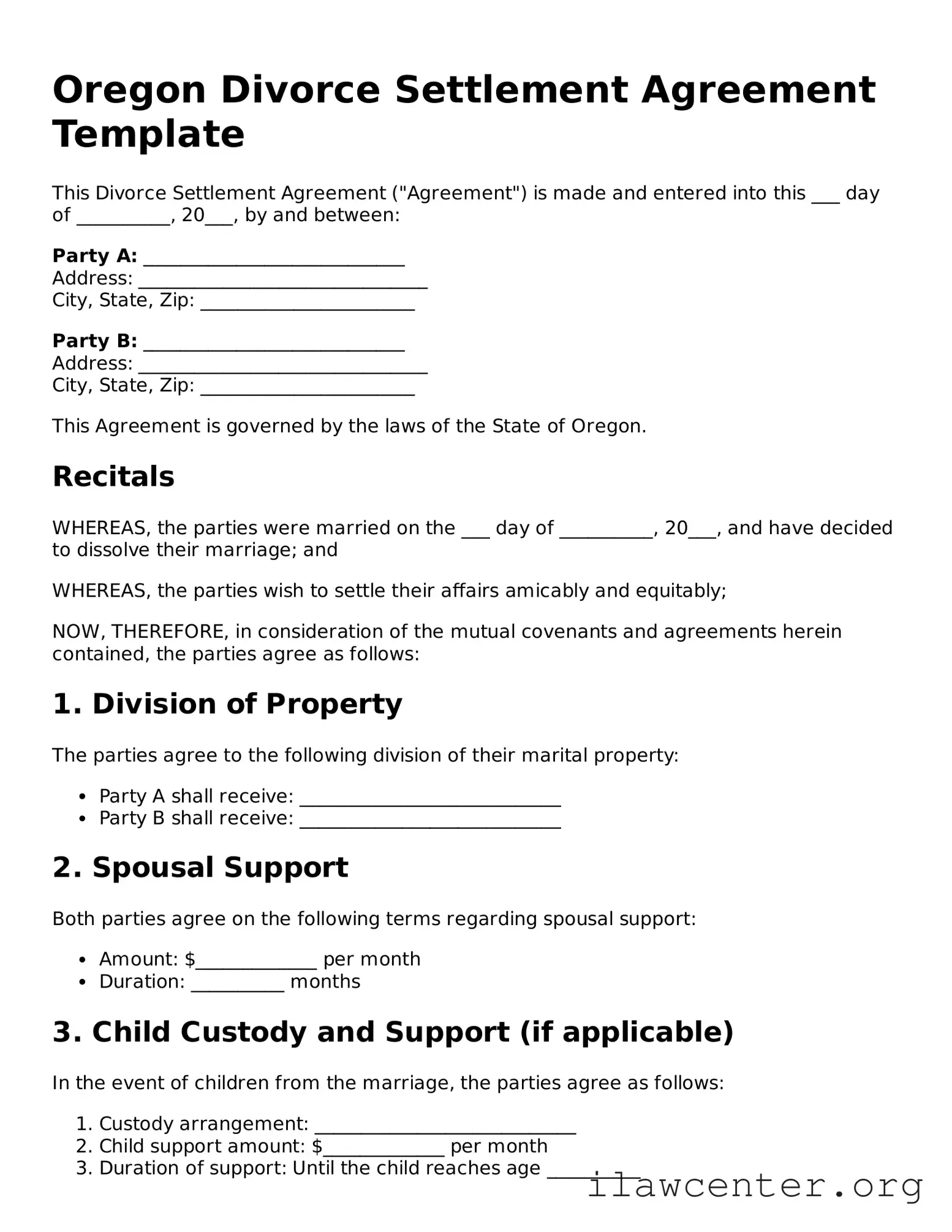
Oregon Divorce Settlement Agreement Preview

Oregon Divorce Settlement Agreement Template

This Divorce Settlement Agreement ("Agreement") is made and entered into this ___ day of __________, 20___, by and between:

Party A: ____________________________
Address: _______________________________
City, State, Zip: _______________________

Party B: ____________________________
Address: _______________________________
City, State, Zip: _______________________

This Agreement is governed by the laws of the State of Oregon.

Recitals

WHEREAS, the parties were married on the ___ day of __________, 20___, and have decided to dissolve their marriage; and

WHEREAS, the parties wish to settle their affairs amicably and equitably;

NOW, THEREFORE, in consideration of the mutual covenants and agreements herein contained, the parties agree as follows:

1. Division of Property

The parties agree to the following division of their marital property:

  • Party A shall receive: ____________________________
  • Party B shall receive: ____________________________

2. Spousal Support

Both parties agree on the following terms regarding spousal support:

  • Amount: $_____________ per month
  • Duration: __________ months

3. Child Custody and Support (if applicable)

In the event of children from the marriage, the parties agree as follows:

  1. Custody arrangement: ____________________________
  2. Child support amount: $_____________ per month
  3. Duration of support: Until the child reaches age __________

4. Debts

The parties agree to the following division of debts:

  • Party A shall be responsible for: ____________________________
  • Party B shall be responsible for: ____________________________

5. Miscellaneous

This Agreement represents the entire understanding between the parties regarding the matters herein and supersedes all prior negotiations, representations, or agreements.

IN WITNESS WHEREOF, the parties hereto have executed this Divorce Settlement Agreement as of the date first above written.

Party A Signature: ____________________________
Date: ____________________________

Party B Signature: ____________________________
Date: ____________________________

Witness Signature: ____________________________
Date: ____________________________

PDF Form Characteristics

Fact Name Description
Governing Law The Oregon Divorce Settlement Agreement is governed by Oregon state law, specifically ORS Chapter 107.
Purpose This form outlines the terms of the divorce settlement, including asset division, alimony, and child custody arrangements.
Filing Requirement The completed agreement must be filed with the court as part of the divorce proceedings.
Mutual Agreement Both parties must agree to the terms specified in the settlement for it to be valid.
Modification Once signed and filed, the agreement can only be modified by a court order or mutual consent of both parties.
Child Support Any child support terms must comply with Oregon's child support guidelines to be enforceable.
Legal Representation While not required, it is highly recommended that each party consult with an attorney before signing the agreement.
Notarization Notarization of the agreement is not required but can add an extra layer of authenticity.
Enforcement The agreement becomes enforceable once it is approved by the court and incorporated into the final divorce decree.

Instructions on Utilizing Oregon Divorce Settlement Agreement

Filling out the Oregon Divorce Settlement Agreement form is an important step in finalizing your divorce. This form helps outline the agreements made between both parties regarding property, debts, and other relevant matters. Once you have completed the form, you will be able to submit it to the court for approval, moving you closer to finalizing your divorce.

  1. Begin by gathering all necessary information. This includes details about your marriage, assets, debts, and any children involved.
  2. Start with the top section of the form. Fill in your name and your spouse’s name as they appear on legal documents.
  3. Provide the date of your marriage and the date of separation. Make sure these dates are accurate, as they are crucial for the agreement.
  4. Next, list all marital assets. Include properties, bank accounts, vehicles, and any other valuable items. Be specific about ownership and value.
  5. Detail any marital debts. This could include credit card debts, loans, or mortgages. Clearly indicate who will be responsible for each debt after the divorce.
  6. If you have children, include a section on child custody and support. Specify the custody arrangement and the amount of child support to be paid.
  7. Review the section on spousal support, if applicable. Indicate whether spousal support will be paid, how much, and for how long.
  8. Check for any additional provisions that may be relevant to your situation, such as health insurance or tax implications.
  9. Once all sections are filled out, review the entire form for accuracy and completeness. Make any necessary corrections.
  10. Both parties should sign and date the form. This signifies that both agree to the terms outlined in the document.
  11. Make copies of the completed form for your records before submitting it to the court.

Important Facts about Oregon Divorce Settlement Agreement

What is an Oregon Divorce Settlement Agreement?

An Oregon Divorce Settlement Agreement is a legal document that outlines the terms of a divorce between two parties. It covers various aspects, including asset division, child custody, visitation rights, and spousal support. This agreement is crucial for ensuring both parties understand their rights and responsibilities following the divorce.

Who needs to complete this form?

Both spouses involved in the divorce must complete the Oregon Divorce Settlement Agreement. It is essential for couples who have reached an agreement on how to divide their assets and responsibilities. If you have children, this form will also address custody and support arrangements.

How do I fill out the form?

To fill out the form, start by clearly identifying both parties and providing necessary details about your marriage. Next, outline the terms of asset division, child custody, and support obligations. Be thorough and specific to avoid misunderstandings later. It may be beneficial to consult a legal professional for guidance.

Is this form legally binding?

Yes, once both parties sign the Oregon Divorce Settlement Agreement, it becomes a legally binding contract. This means that both parties are obligated to follow the terms outlined in the agreement. If one party fails to comply, the other can seek legal enforcement through the court.

What if we can't agree on the terms?

If you and your spouse cannot reach an agreement, you may need to consider mediation or legal intervention. Mediation can help facilitate discussions and lead to a mutually acceptable settlement. If mediation fails, the court may need to make decisions regarding asset division, custody, and support.

Can I modify the agreement after it is signed?

Yes, modifications to the Oregon Divorce Settlement Agreement can be made after it is signed, but both parties must agree to the changes. It is advisable to document any modifications formally and file them with the court to ensure they are enforceable.

Where do I submit the completed form?

The completed Oregon Divorce Settlement Agreement should be submitted to the court handling your divorce case. Ensure that you follow any specific filing procedures required by the court. Keep copies of the submitted documents for your records.

What happens if one party does not comply with the agreement?

If one party fails to comply with the terms of the agreement, the other party can take legal action. This may involve filing a motion with the court to enforce the agreement. Courts take these matters seriously, and non-compliance can lead to legal consequences.

Common mistakes

Filling out the Oregon Divorce Settlement Agreement form can be a daunting task. Many individuals approach this process with the hope of reaching a fair and amicable resolution. However, several common mistakes can hinder this goal. Understanding these pitfalls can help ensure a smoother experience.

One frequent error is incomplete information. When individuals leave sections blank or fail to provide necessary details, it can lead to delays in the divorce process. Each party must fully disclose their assets, debts, and any agreements reached. Omitting information can create misunderstandings and complicate negotiations.

Another common mistake is not being specific enough in terms of asset division. For example, simply stating that "all property will be divided" is vague. Instead, it’s essential to clearly outline which assets go to whom. This clarity helps prevent future disputes and ensures both parties understand their rights and responsibilities.

Some individuals also overlook the importance of considering tax implications. Certain assets, like retirement accounts, can have significant tax consequences when divided. Failing to account for these implications may lead to an unequal division of property. It’s wise to consult a financial advisor to understand how taxes could affect the settlement.

Another mistake is not addressing future needs. The settlement should consider not just the current situation but also potential future changes. For instance, if one party will have primary custody of children, it’s crucial to include provisions for child support and any adjustments that may be necessary as circumstances evolve.

Additionally, some individuals may rush through the process without fully understanding the terms they are agreeing to. It’s tempting to finalize the agreement quickly, especially if emotions are running high. However, taking the time to review and comprehend every aspect of the settlement can prevent regret later on.

Lastly, failing to seek professional guidance can be a significant misstep. While it’s possible to fill out the form independently, having a lawyer or mediator review the agreement can provide valuable insights. Professionals can help ensure that the settlement is fair, legally sound, and in the best interest of all parties involved.

Documents used along the form

When navigating the process of divorce in Oregon, several important documents accompany the Divorce Settlement Agreement. Each of these documents plays a crucial role in ensuring that the divorce proceedings are handled fairly and legally. Below is a list of commonly used forms and documents that may be needed alongside the Divorce Settlement Agreement.

  • Petition for Dissolution of Marriage: This is the initial document filed to start the divorce process. It outlines the basic information about the marriage and the reasons for the divorce.
  • Summons: This document notifies the other spouse that a divorce has been filed. It includes information about their rights and responsibilities during the divorce process.
  • Financial Affidavit: Both parties typically complete this form to disclose their financial situation. It includes details about income, expenses, assets, and debts.
  • Child Support Worksheet: If children are involved, this worksheet helps calculate the appropriate amount of child support based on the income of both parents and the needs of the children.
  • Parenting Plan: This document outlines the custody arrangement and visitation schedule for children. It addresses how decisions regarding the children's upbringing will be made.
  • Affidavit of Service: This form proves that the other spouse has been officially served with divorce papers. It is essential for ensuring that the divorce process can proceed legally.
  • Response to Petition: If the other spouse wishes to contest the divorce or any terms, they must file a response. This document outlines their position regarding the divorce and any disagreements.
  • Property Settlement Agreement: This is often included in the Divorce Settlement Agreement but can be a standalone document detailing how marital property will be divided.
  • Order of Dissolution: Once the divorce is finalized, this court order officially ends the marriage. It may also include terms related to property division, support, and custody.
  • Motion for Temporary Orders: If immediate decisions are needed regarding support or custody before the divorce is finalized, this motion can request temporary orders from the court.

Understanding these documents is essential for anyone going through a divorce in Oregon. Each form serves a specific purpose and contributes to a smoother process, helping to ensure that all parties are treated fairly and that the legal requirements are met. By being well-informed, individuals can navigate this challenging time with greater confidence and clarity.

Similar forms

The Divorce Settlement Agreement is an important document that outlines the terms of a divorce. It serves as a comprehensive record of the decisions made by both parties. Several other documents share similarities with this agreement, as they also address the division of assets, responsibilities, and other critical aspects of personal relationships. Below are five documents that are similar to the Divorce Settlement Agreement:

  • Separation Agreement: This document is created when couples decide to live apart but are not yet divorced. It outlines the terms of the separation, including child custody, support, and property division, similar to a divorce settlement.
  • Child Custody Agreement: This agreement specifically focuses on the arrangements for the care and custody of children. Like a divorce settlement, it details the responsibilities of each parent and aims to serve the best interests of the children involved.
  • Property Settlement Agreement: This document is used to divide marital property between spouses. It is similar to a divorce settlement in that it specifies how assets and debts will be allocated, ensuring clarity and fairness in the division process.
  • Marital Settlement Agreement: Often used interchangeably with the Divorce Settlement Agreement, this document outlines the terms of the divorce, including alimony, child support, and property division, making it a crucial part of the divorce process.
  • Postnuptial Agreement: This agreement is created after marriage and addresses how assets will be divided in the event of a divorce. While it is established before any separation occurs, it serves a similar purpose to a divorce settlement by clarifying financial responsibilities and rights.

Dos and Don'ts

When filling out the Oregon Divorce Settlement Agreement form, it’s important to be thorough and accurate. Here are some dos and don'ts to consider:

  • Do read the entire form carefully before starting.
  • Do provide accurate and complete information.
  • Do discuss the terms with your spouse if possible.
  • Do keep copies of all documents for your records.
  • Do consult a lawyer if you have questions about the process.
  • Don't leave any sections blank; fill in all required fields.
  • Don't rush through the form; take your time to ensure accuracy.
  • Don't include personal opinions or emotions in the document.
  • Don't forget to sign and date the form before submission.

Following these guidelines can help ensure that your Divorce Settlement Agreement is processed smoothly.

Misconceptions

Understanding the Oregon Divorce Settlement Agreement form can be challenging. Many people hold misconceptions that can lead to confusion or mistakes. Here are seven common misconceptions explained:

  1. It’s only for couples with children. Many believe that the Divorce Settlement Agreement is necessary only for those with kids. In reality, it is essential for all couples seeking a divorce, regardless of whether children are involved. This document outlines how assets and debts will be divided.
  2. It doesn’t need to be notarized. Some think that a signature is enough. However, in Oregon, having the Divorce Settlement Agreement notarized can add an extra layer of authenticity and may be required by the court.
  3. It’s a simple form that requires no legal advice. While the form may seem straightforward, it is wise to seek legal advice. An attorney can help ensure that all aspects are covered and that your rights are protected.
  4. Once signed, it cannot be changed. Many people assume that the agreement is set in stone once both parties sign. However, modifications can be made if both parties agree to the changes and the court approves them.
  5. Only one spouse needs to fill it out. A common belief is that only one person should complete the form. In truth, both spouses should collaborate to ensure that the agreement accurately reflects their shared decisions.
  6. It’s only relevant during the divorce process. Some individuals think that the agreement is only important during the divorce. In fact, it can have long-lasting implications for future financial arrangements and obligations.
  7. All assets are automatically split 50/50. Many assume that assets will always be divided equally. However, the division can vary based on numerous factors, including individual contributions and the specific circumstances of the marriage.

By understanding these misconceptions, individuals can better navigate the divorce process and ensure that their rights and interests are adequately represented.

Key takeaways

When filling out and using the Oregon Divorce Settlement Agreement form, it's essential to keep several key points in mind. These takeaways can help ensure that the process goes smoothly and that all necessary information is accurately documented.

  • Complete All Sections: Ensure that every section of the form is filled out completely. Missing information can delay the divorce process.
  • Be Clear and Specific: Clearly outline the terms of your agreement, including property division, child custody, and support arrangements. Ambiguities can lead to misunderstandings later.
  • Review for Accuracy: Double-check all entries for accuracy before submission. Errors can complicate the approval of your settlement.
  • Seek Legal Advice if Needed: If you have questions or concerns about any part of the agreement, consider consulting a legal professional. This can provide peace of mind and ensure compliance with Oregon law.