Attorney-Verified  Durable Power of Attorney Document for Oregon

Attorney-Verified Durable Power of Attorney Document for Oregon

A Durable Power of Attorney in Oregon is a legal document that allows an individual to designate someone else to make decisions on their behalf, particularly in financial or medical matters, should they become incapacitated. This form remains effective even if the person who created it loses their ability to make decisions. To ensure your wishes are honored, consider filling out the form by clicking the button below.

Article Guide

The Oregon Durable Power of Attorney form is an essential legal document that allows individuals to designate a trusted person to make decisions on their behalf in the event they become incapacitated. This form is particularly important for managing financial and medical matters, ensuring that your wishes are respected even when you are unable to communicate them. By appointing an agent through this document, you empower someone you trust to handle your affairs, whether it's paying bills, managing investments, or making healthcare decisions. The form remains effective even if you lose the ability to make decisions, which is a key feature of its "durable" nature. It is vital to choose your agent wisely, as they will have significant authority over your financial and personal matters. Additionally, the Oregon Durable Power of Attorney form includes provisions that allow you to specify the extent of your agent's powers, providing you with control over what decisions they can make on your behalf. Understanding how to properly complete and execute this form can help ensure that your preferences are honored in times of need.

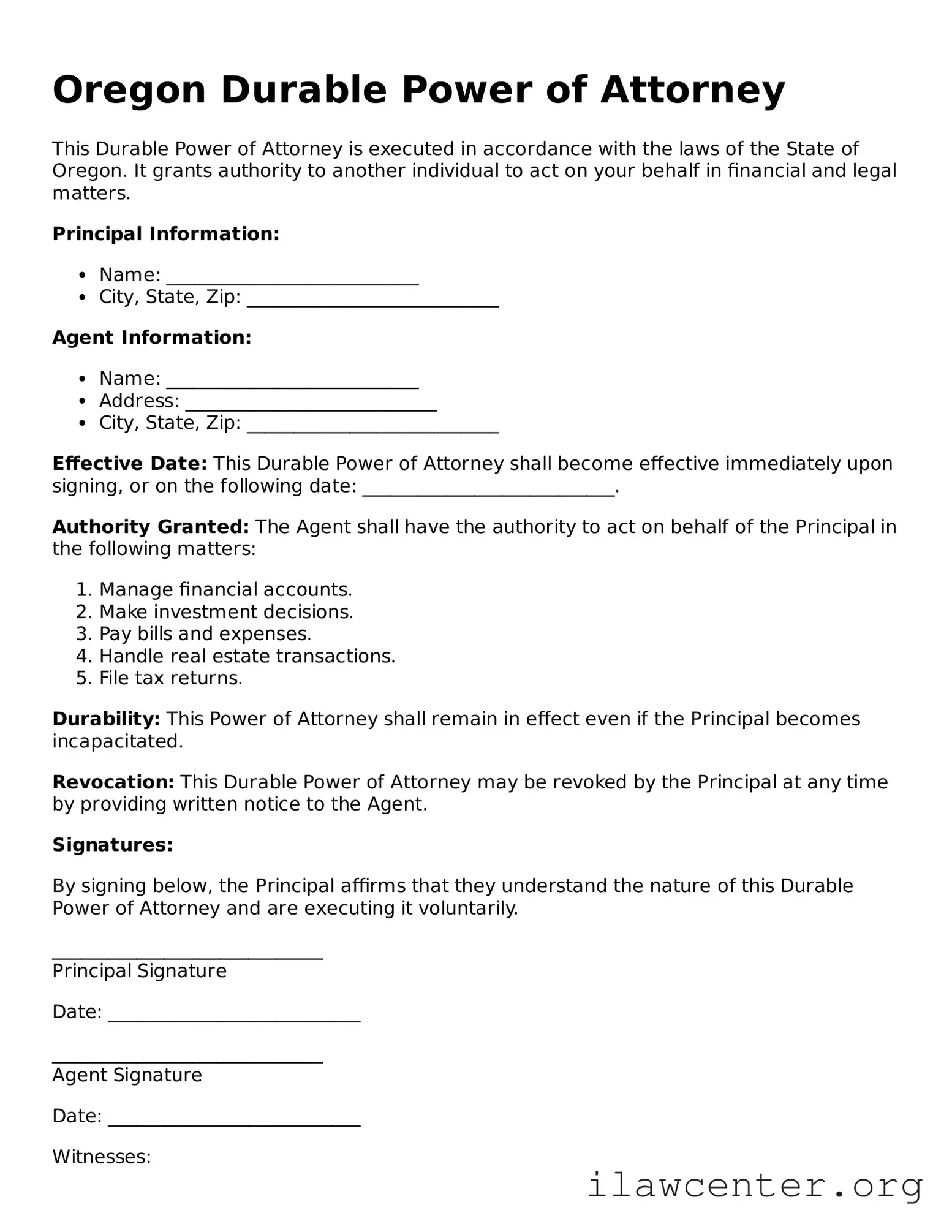
Oregon Durable Power of Attorney Preview

Oregon Durable Power of Attorney

This Durable Power of Attorney is executed in accordance with the laws of the State of Oregon. It grants authority to another individual to act on your behalf in financial and legal matters.

Principal Information:

  • Name: ___________________________
  • City, State, Zip: ___________________________

Agent Information:

  • Name: ___________________________
  • Address: ___________________________
  • City, State, Zip: ___________________________

Effective Date: This Durable Power of Attorney shall become effective immediately upon signing, or on the following date: ___________________________.

Authority Granted: The Agent shall have the authority to act on behalf of the Principal in the following matters:

  1. Manage financial accounts.
  2. Make investment decisions.
  3. Pay bills and expenses.
  4. Handle real estate transactions.
  5. File tax returns.

Durability: This Power of Attorney shall remain in effect even if the Principal becomes incapacitated.

Revocation: This Durable Power of Attorney may be revoked by the Principal at any time by providing written notice to the Agent.

Signatures:

By signing below, the Principal affirms that they understand the nature of this Durable Power of Attorney and are executing it voluntarily.

_____________________________
Principal Signature

Date: ___________________________

_____________________________
Agent Signature

Date: ___________________________

Witnesses:

1. ___________________________
Signature of Witness

Date: ___________________________

2. ___________________________
Signature of Witness

Date: ___________________________

This document must be signed in the presence of two witnesses or a notary public to be valid in the State of Oregon.

PDF Form Characteristics

Fact Name Description
Definition An Oregon Durable Power of Attorney allows an individual (the principal) to designate another person (the agent) to make financial decisions on their behalf.
Durability This type of power of attorney remains effective even if the principal becomes incapacitated.
Governing Law The Oregon Durable Power of Attorney is governed by Oregon Revised Statutes, specifically ORS 126.007 to ORS 126.049.
Agent Authority The agent can manage the principal's financial affairs, including banking, real estate transactions, and tax matters, unless limited by the document.
Revocation The principal can revoke the durable power of attorney at any time, as long as they are mentally competent.
Witnesses and Notarization The form must be signed by the principal in the presence of a notary public or two witnesses to be valid.

Instructions on Utilizing Oregon Durable Power of Attorney

Filling out the Oregon Durable Power of Attorney form is an important step in designating someone to manage your financial and legal matters in the event that you become unable to do so yourself. After completing the form, it is essential to ensure that it is signed and witnessed appropriately to validate its effectiveness.

  1. Obtain the Oregon Durable Power of Attorney form. This can typically be found online or at legal offices.
  2. Begin by filling in your full name and address in the designated section at the top of the form.
  3. Next, identify the person you wish to appoint as your agent. Provide their full name, address, and relationship to you.
  4. Clearly outline the powers you wish to grant to your agent. This may include financial decisions, real estate transactions, or other legal matters.
  5. If you want to limit the duration of the powers, specify the time period in which the agent can act on your behalf.
  6. Review the completed form for accuracy and completeness. Ensure all necessary sections are filled out correctly.
  7. Sign the form in the presence of a notary public. This step is crucial for the document’s validity.
  8. Have the notary public sign and seal the document to finalize the process.
  9. Provide copies of the signed and notarized form to your agent and any relevant institutions, such as banks or healthcare providers.

Important Facts about Oregon Durable Power of Attorney

What is a Durable Power of Attorney in Oregon?

A Durable Power of Attorney (DPOA) is a legal document that allows you to appoint someone else to make decisions on your behalf regarding financial and legal matters. The term "durable" means that the authority granted continues even if you become incapacitated. This ensures that your affairs can be managed without interruption, providing peace of mind for you and your loved ones.

How do I create a Durable Power of Attorney in Oregon?

Creating a Durable Power of Attorney in Oregon involves a few key steps. First, you need to choose a trusted individual to act as your agent. Next, you can obtain the DPOA form, which is available online or through legal resources. Fill out the form with the necessary details, including your name, the agent's name, and the specific powers you wish to grant. Finally, sign the document in front of a notary public to ensure it is legally binding. It’s advisable to keep copies for your records and share them with your agent and family members.

What powers can I grant to my agent through a Durable Power of Attorney?

You can grant a wide range of powers to your agent through a Durable Power of Attorney. These may include managing bank accounts, paying bills, filing taxes, buying or selling property, and making investment decisions. It’s important to be specific about the powers you wish to grant. You can choose to give your agent broad authority or limit their powers to specific tasks. Always consider your personal needs and consult with a legal professional if you have questions about what powers to include.

Can I revoke or change my Durable Power of Attorney in Oregon?

Yes, you can revoke or change your Durable Power of Attorney at any time, as long as you are mentally competent. To revoke the DPOA, you should create a written document stating your intent to revoke and notify your agent and any institutions that may have a copy of the original document. If you want to change your agent or the powers granted, you will need to create a new DPOA form. It’s essential to ensure that the new document clearly states that it supersedes any previous DPOA to avoid confusion.

Common mistakes

Filling out the Oregon Durable Power of Attorney form is a crucial task that requires careful attention to detail. One common mistake is failing to specify the powers granted. Without clear instructions, the appointed agent may not have the authority to act in the principal's best interest. It’s essential to outline specific powers, such as handling financial matters or making healthcare decisions, to avoid confusion later.

Another frequent error is not signing the document correctly. In Oregon, the principal must sign the form in the presence of a notary public or two witnesses. Omitting this step can render the document invalid. Ensure that all required signatures are present to uphold the document's legality.

People often neglect to date the form. A date is vital as it indicates when the powers become effective. Without a date, there may be disputes regarding when the authority was granted, potentially leading to complications in executing the principal’s wishes.

Inadequate identification of the agent is another mistake. The form should clearly state the agent's full name and contact information. Vague descriptions can create confusion and may lead to challenges in identifying who has the authority to act on behalf of the principal.

Some individuals fail to review the document thoroughly before submission. Overlooking small details, such as typos or incorrect information, can have significant consequences. It’s advisable to read the entire form carefully to ensure all information is accurate and complete.

Another common oversight is not considering alternate agents. Life is unpredictable, and the primary agent may not always be available to fulfill their duties. Designating an alternate ensures that someone can step in if necessary, maintaining continuity in decision-making.

People may also forget to inform their agents about the Durable Power of Attorney. It is crucial to communicate with the appointed agent regarding their responsibilities and the principal's wishes. This conversation can prevent misunderstandings and ensure that the agent is prepared to act when needed.

Lastly, failing to update the form when circumstances change can lead to significant issues. Changes in relationships, health, or financial situations may necessitate a revision of the Durable Power of Attorney. Regularly reviewing and updating the document ensures it reflects the principal’s current wishes and conditions.

Documents used along the form

When setting up a Durable Power of Attorney in Oregon, there are several other important forms and documents that may be beneficial to consider. These documents can help ensure that your wishes are clearly communicated and legally recognized in various situations.

  • Advance Directive: This document outlines your healthcare preferences in case you become unable to communicate your wishes. It typically includes instructions about medical treatments and appoints a healthcare representative.
  • Living Will: Similar to an Advance Directive, a Living Will specifically addresses your desires regarding end-of-life care and the types of medical interventions you would or would not want.
  • HIPAA Authorization: This form allows designated individuals access to your medical records and information. It ensures that your healthcare providers can share your information with those you trust.
  • Revocation of Power of Attorney: If you ever need to cancel or change your Durable Power of Attorney, this document formally revokes the previous authority granted to your agent.
  • Financial Power of Attorney: While a Durable Power of Attorney can cover financial matters, this specific document may be used for financial transactions only, granting authority to manage your finances.
  • Property Transfer Documents: If you wish to transfer ownership of property or assets, these documents are necessary to legally facilitate the transfer and ensure that your intentions are clear.
  • Will: A Will outlines how you want your assets distributed after your passing. It can also designate guardians for any minor children, providing peace of mind for families.
  • Trust Documents: If you have established a trust, these documents detail how your assets will be managed during your lifetime and distributed after your death, offering more control over your estate.
  • Guardianship Documents: If you have dependents, these documents help establish a legal guardian to care for them should you become unable to do so.

Each of these documents plays a crucial role in ensuring that your wishes are respected and that your loved ones are supported in times of need. It's wise to consider these forms alongside your Durable Power of Attorney to create a comprehensive plan for your future.

Similar forms

The Durable Power of Attorney (DPOA) is an important legal document that allows one person to make decisions on behalf of another. It is similar to several other documents, each serving a specific purpose related to authority and decision-making. Here are seven documents that share similarities with the DPOA:

  • General Power of Attorney: Like the DPOA, this document grants someone the authority to act on another person's behalf. However, it typically becomes invalid if the principal becomes incapacitated, unlike the durable version.
  • Health Care Proxy: This document allows someone to make medical decisions for another person if they are unable to do so themselves. It is similar to the DPOA but specifically focuses on health care decisions.
  • Living Will: A living will outlines a person's wishes regarding medical treatment in situations where they cannot communicate their desires. While it does not appoint an agent, it complements the health care proxy by providing specific instructions.
  • Financial Power of Attorney: This document specifically gives someone the authority to manage financial matters. It can be durable or non-durable, similar to the DPOA, but focuses solely on financial issues.
  • Trust Document: A trust allows a person to manage their assets for the benefit of another. While it does not appoint an agent like the DPOA, both documents involve delegating authority over assets.
  • Guardianship or Conservatorship: These legal arrangements appoint someone to make decisions for an individual who is unable to do so due to incapacity. They are similar to a DPOA in that they involve decision-making authority but are typically established through a court process.
  • Authorization for Release of Information: This document allows one person to access another's private information, such as medical records. While it does not grant decision-making authority, it shares the theme of delegating access to personal matters.

Understanding these documents can help individuals make informed decisions about how they want to manage their affairs and who they trust to act on their behalf.

Dos and Don'ts

When filling out the Oregon Durable Power of Attorney form, it is important to follow specific guidelines to ensure the document is valid and effective. Here are four things to consider:

  • Do: Clearly identify the principal and the agent. Include full names and addresses to avoid any confusion.
  • Do: Specify the powers granted to the agent. Be explicit about what decisions the agent can make on behalf of the principal.
  • Don't: Leave sections blank. Incomplete forms may lead to challenges in the future.
  • Don't: Forget to sign and date the document. A signature is essential for the form to be legally recognized.

Misconceptions

Understanding the Oregon Durable Power of Attorney (DPOA) form is crucial for effective estate planning. However, several misconceptions can lead to confusion. Here are five common misunderstandings about this important document:

  1. Misconception 1: A Durable Power of Attorney only applies to financial matters.

    This is not entirely true. While the DPOA often covers financial decisions, it can also grant authority over healthcare decisions, depending on how it is drafted. It's essential to specify the powers you wish to include.

  2. Misconception 2: A DPOA is only necessary for the elderly or those with health issues.

    Many people believe that a DPOA is only for older adults. In reality, anyone can benefit from having a DPOA in place, regardless of age. Unexpected events can happen at any time, making it wise to prepare in advance.

  3. Misconception 3: The DPOA becomes invalid if the principal becomes incapacitated.

    This is a key feature of a Durable Power of Attorney. Unlike a regular power of attorney, a DPOA remains effective even if the principal becomes incapacitated. This is what makes it "durable."

  4. Misconception 4: A DPOA can only be created by an attorney.

    While legal assistance can be beneficial, it is not required to create a DPOA. Individuals can draft their own DPOA using templates or forms available online, as long as they meet the state's requirements.

  5. Misconception 5: A DPOA can be used to make decisions after the principal's death.

    This is incorrect. A Durable Power of Attorney ceases to be effective once the principal passes away. After death, the authority to make decisions typically transfers to the executor of the estate.

By clarifying these misconceptions, individuals can better understand the role of a Durable Power of Attorney in their estate planning. It's always advisable to consult with a professional to ensure that your DPOA meets your specific needs and complies with Oregon law.

Key takeaways

Filling out and using the Oregon Durable Power of Attorney form is an important process for individuals looking to appoint someone to make financial or legal decisions on their behalf. Here are key takeaways to consider:

  • The form allows you to designate an agent who will act on your behalf if you become unable to make decisions.
  • It is essential to choose someone trustworthy, as they will have significant authority over your financial matters.
  • The Durable Power of Attorney remains effective even if you become incapacitated, making it a crucial document for long-term planning.
  • You can specify the powers granted to your agent, which can include managing bank accounts, paying bills, and making investment decisions.
  • Be sure to sign the form in front of a notary public to ensure its legality and validity.
  • Review the document periodically to ensure it still reflects your wishes and circumstances.
  • Keep copies of the signed document in a safe place and provide copies to your agent and any relevant financial institutions.
  • Understand that you can revoke or change the Durable Power of Attorney at any time, as long as you are mentally competent.