Attorney-Verified  Employee Handbook Document for Oregon

Attorney-Verified Employee Handbook Document for Oregon

The Oregon Employee Handbook form serves as a crucial document that outlines workplace policies, employee rights, and employer expectations. It provides clarity and structure, helping to foster a positive work environment. For those looking to create or update their handbook, filling out the form is essential; click the button below to get started.

Article Guide

Creating an employee handbook is a vital step for any business in Oregon. This document serves as a guide for employees, outlining important policies, procedures, and expectations. It typically includes sections on workplace conduct, attendance policies, benefits, and safety protocols. Additionally, it addresses issues such as harassment, discrimination, and disciplinary procedures, ensuring that all employees understand their rights and responsibilities. A well-crafted handbook not only helps in maintaining a positive work environment but also protects the company by providing clear guidelines. Having an Oregon Employee Handbook form can simplify this process, offering a structured approach to compiling all necessary information. By using this form, employers can ensure compliance with state laws while fostering a transparent and informed workplace culture.

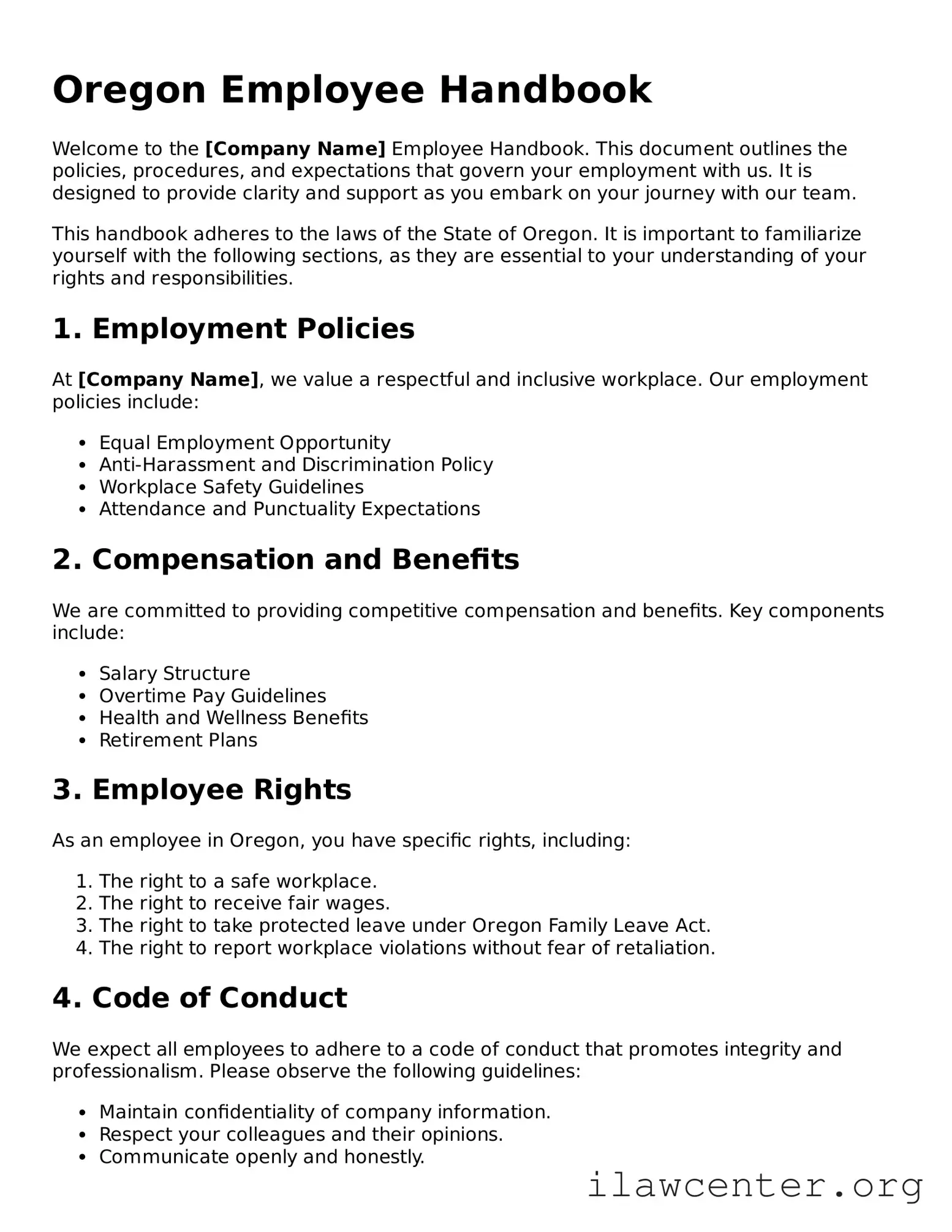
Oregon Employee Handbook Preview

Oregon Employee Handbook

Welcome to the [Company Name] Employee Handbook. This document outlines the policies, procedures, and expectations that govern your employment with us. It is designed to provide clarity and support as you embark on your journey with our team.

This handbook adheres to the laws of the State of Oregon. It is important to familiarize yourself with the following sections, as they are essential to your understanding of your rights and responsibilities.

1. Employment Policies

At [Company Name], we value a respectful and inclusive workplace. Our employment policies include:

  • Equal Employment Opportunity
  • Anti-Harassment and Discrimination Policy
  • Workplace Safety Guidelines
  • Attendance and Punctuality Expectations

2. Compensation and Benefits

We are committed to providing competitive compensation and benefits. Key components include:

  • Salary Structure
  • Overtime Pay Guidelines
  • Health and Wellness Benefits
  • Retirement Plans

3. Employee Rights

As an employee in Oregon, you have specific rights, including:

  1. The right to a safe workplace.
  2. The right to receive fair wages.
  3. The right to take protected leave under Oregon Family Leave Act.
  4. The right to report workplace violations without fear of retaliation.

4. Code of Conduct

We expect all employees to adhere to a code of conduct that promotes integrity and professionalism. Please observe the following guidelines:

  • Maintain confidentiality of company information.
  • Respect your colleagues and their opinions.
  • Communicate openly and honestly.

5. Acknowledgment of Receipt

By signing below, you acknowledge that you have received, read, and understood the [Company Name] Employee Handbook.

Employee Name: [Employee Name]

Date: [Date]

PDF Form Characteristics

Fact Name Description
Purpose The Oregon Employee Handbook serves as a guide for employees regarding workplace policies and expectations.
Governing Laws This handbook is governed by Oregon state employment laws, including the Oregon Revised Statutes (ORS) and applicable federal laws.
Mandatory Policies Employers are required to include specific policies, such as anti-discrimination and harassment policies, in the handbook.
Employee Rights The handbook outlines employee rights under Oregon law, including rights related to wages, safety, and leave.
Updates Employers must regularly update the handbook to reflect changes in laws or company policies.
Distribution Employers should provide a copy of the handbook to each employee upon hire and ensure they acknowledge receipt.
Review Process Employees are encouraged to review the handbook periodically to stay informed about company policies.
Legal Compliance Failure to comply with the guidelines outlined in the handbook may result in legal consequences for the employer.

Instructions on Utilizing Oregon Employee Handbook

Filling out the Oregon Employee Handbook form is an important step in understanding your rights and responsibilities as an employee. Once you have completed the form, it will be reviewed, and you will receive further instructions based on the information provided.

  1. Start by downloading the Oregon Employee Handbook form from the official website or your employer's intranet.
  2. Open the form using a PDF reader or a word processing program.
  3. Read through the instructions carefully to ensure you understand what information is required.
  4. Begin filling in your personal information, such as your name, address, and contact details.
  5. Provide your job title and the department you work in.
  6. Fill out the date of hire and any other employment-related dates as requested.
  7. Review the policies outlined in the handbook and indicate your acknowledgment by signing where indicated.
  8. Double-check all entries for accuracy and completeness before submission.
  9. Save the completed form to your device or print it out if required.
  10. Submit the form according to your employer's instructions, either electronically or in person.

Important Facts about Oregon Employee Handbook

What is the purpose of the Oregon Employee Handbook form?

The Oregon Employee Handbook form serves as a vital resource for both employers and employees. It outlines the rights, responsibilities, and expectations within the workplace. By providing clear guidelines, this handbook helps to ensure that employees understand company policies, procedures, and benefits. It also fosters a positive work environment by promoting transparency and consistency in how rules are applied across the organization.

Who is required to have an Employee Handbook in Oregon?

In Oregon, while not all employers are legally mandated to have an employee handbook, it is highly recommended for businesses of all sizes. Having a handbook can help protect employers from potential disputes by clearly communicating workplace policies. Employers should consider creating one if they have employees, as it can serve as a reference point for both parties regarding workplace expectations and legal compliance.

What key topics should be included in the Oregon Employee Handbook?

An effective employee handbook should cover a variety of important topics. These typically include workplace conduct, attendance policies, anti-discrimination and harassment policies, benefits information, and procedures for reporting grievances. Additionally, it may address issues such as leave policies, workplace safety, and disciplinary actions. Including these topics helps ensure that employees are informed and aware of their rights and responsibilities.

How often should the Employee Handbook be updated?

Common mistakes

When individuals fill out the Oregon Employee Handbook form, several common mistakes can undermine the effectiveness of the document. One frequent error is failing to read the instructions thoroughly. The form often contains specific guidelines that clarify how to complete each section. Skipping this step can lead to incomplete or inaccurate information, which may complicate matters later.

Another mistake is neglecting to provide accurate personal information. This includes essential details such as name, address, and contact information. If these details are incorrect, it can create confusion regarding employment status and benefits. Moreover, inaccuracies may delay important communications from the employer.

People also sometimes overlook the importance of updating the form when circumstances change. For instance, if an employee changes their address or marital status, they must ensure that the Employee Handbook form reflects these changes. Failing to do so can result in outdated information, which may affect eligibility for certain benefits or compliance with company policies.

Finally, many individuals forget to sign and date the form. A signature serves as an acknowledgment of understanding the handbook's contents and policies. Without it, the form may be considered incomplete, leading to potential misunderstandings about the employee's rights and responsibilities within the organization.

Documents used along the form

When creating a comprehensive employee handbook in Oregon, it's important to consider additional documents that can enhance clarity and compliance. These forms help establish clear expectations and protect both the employer and the employee. Here’s a list of commonly used forms and documents that often accompany the Oregon Employee Handbook.

  • Job Description Form: This document outlines the specific responsibilities, duties, and qualifications for each position within the organization. It helps employees understand their roles and can be crucial for performance evaluations.
  • Employee Acknowledgment Form: After reviewing the employee handbook, employees sign this form to confirm they have read and understood the policies. This acknowledgment can serve as a valuable record in case of disputes.
  • Non-Disclosure Agreement (NDA): An NDA protects sensitive company information by ensuring that employees do not share proprietary knowledge with outside parties. This document is especially important for businesses that deal with confidential data.
  • Time-Off Request Form: This form allows employees to formally request time off for vacations, personal matters, or medical needs. It helps maintain organization and ensures that requests are documented and reviewed by management.

Utilizing these additional documents alongside the Oregon Employee Handbook can foster a transparent and organized workplace. They contribute to a clear understanding of policies and procedures, ultimately benefiting both employees and employers.

Similar forms

  • Company Policies Manual: This document outlines the rules and regulations governing employee behavior and company operations, similar to how the Employee Handbook provides guidelines for workplace conduct.
  • Onboarding Guide: An onboarding guide serves as a resource for new employees, detailing the initial training and orientation processes, much like the Employee Handbook introduces company culture and expectations.
  • Code of Conduct: The Code of Conduct specifies acceptable behavior and ethical standards within the workplace, paralleling the Employee Handbook’s emphasis on professional standards.
  • Benefits Overview: This document explains employee benefits, such as health insurance and retirement plans, similar to how the Employee Handbook may summarize available benefits and policies.
  • Job Descriptions: Job descriptions detail the responsibilities and qualifications for each position, akin to the Employee Handbook’s clarification of roles and expectations within the organization.
  • Performance Evaluation Criteria: This document outlines how employee performance is assessed, which aligns with the Employee Handbook’s guidance on performance expectations and growth opportunities.
  • Safety Manual: A safety manual provides information on workplace safety protocols and emergency procedures, similar to how the Employee Handbook addresses employee safety and health policies.
  • Leave Policy Document: This document details the types of leave available to employees, such as sick leave or family leave, much like the Employee Handbook covers various leave policies and procedures.
  • Disciplinary Procedures Document: This document outlines the process for addressing employee misconduct, similar to the Employee Handbook's section on disciplinary actions and consequences.
  • Training and Development Policy: This policy describes the opportunities for employee growth and skill development, paralleling the Employee Handbook’s focus on professional development resources.

Dos and Don'ts

When filling out the Oregon Employee Handbook form, it is essential to approach the task with care. Below is a list of things you should and shouldn't do to ensure the process is smooth and effective.

  • Do read the entire handbook thoroughly before filling out the form.
  • Do provide accurate personal information, including your name and contact details.
  • Do ask questions if any part of the form is unclear.
  • Do ensure that all required sections of the form are completed.
  • Do keep a copy of the completed form for your records.
  • Don't rush through the form without understanding its contents.
  • Don't leave any sections blank unless instructed to do so.
  • Don't provide false information, as this can lead to serious consequences.
  • Don't forget to sign and date the form before submission.

Misconceptions

When it comes to employee handbooks in Oregon, several misconceptions can lead to confusion among employers and employees alike. Understanding these myths is crucial for creating a clear and effective handbook. Below are seven common misconceptions:

  1. Employee handbooks are optional for all businesses.

    While it's true that not every business is legally required to have an employee handbook, having one is highly recommended. A well-crafted handbook can help clarify policies, set expectations, and protect both the employer and the employees.

  2. Handbooks must be lengthy and complex.

    Many believe that an effective handbook must be a thick document filled with legal jargon. In reality, clarity and conciseness are key. A straightforward handbook that outlines essential policies can be just as effective.

  3. Once created, handbooks don’t need to be updated.

    Another common misconception is that an employee handbook is a one-time project. In fact, it should be reviewed and updated regularly to reflect changes in laws, company policies, or workplace culture.

  4. All handbooks must include the same policies.

    Some people think that every employee handbook must contain identical policies. However, each handbook should be tailored to the specific needs and culture of the organization, addressing unique circumstances and practices.

  5. Handbooks protect employers from all legal issues.

    While a well-written handbook can provide some legal protection, it does not shield employers from all potential claims. Employers must still adhere to labor laws and ensure that their practices align with the policies outlined in the handbook.

  6. Employees must read and sign the handbook to be bound by its policies.

    It is a common belief that employees are only subject to handbook policies if they have read and signed it. However, employees can still be held accountable for policies even if they haven't formally acknowledged them, especially if they were made aware of the policies.

  7. Handbooks can include any policy the employer wants.

    Some assume that employers can freely include any policy they desire in the handbook. However, all policies must comply with federal, state, and local laws. Including illegal or discriminatory policies can lead to serious legal repercussions.

By dispelling these misconceptions, employers can create more effective employee handbooks that serve their intended purpose while fostering a positive workplace environment.

Key takeaways

When it comes to filling out and using the Oregon Employee Handbook form, there are several important points to keep in mind. Here are five key takeaways:

  1. Understand the Purpose: The Employee Handbook serves as a guide for both employers and employees. It outlines company policies, procedures, and expectations.
  2. Customize the Content: Tailor the handbook to reflect your organization's specific culture, values, and operational procedures. A one-size-fits-all approach may not be effective.
  3. Include Essential Policies: Ensure that the handbook covers critical areas such as workplace conduct, anti-discrimination policies, and safety protocols. This information is vital for maintaining a positive work environment.
  4. Regular Updates: Review and update the handbook regularly to keep it current with changes in laws, regulations, and company policies. An outdated handbook can lead to misunderstandings.
  5. Distribute and Acknowledge: Provide each employee with a copy of the handbook and obtain their acknowledgment of receipt. This step helps ensure that everyone understands the policies and their responsibilities.

By following these guidelines, employers can create a comprehensive and effective Employee Handbook that supports a healthy workplace culture.