Attorney-Verified  General Power of Attorney Document for Oregon

Attorney-Verified General Power of Attorney Document for Oregon

A General Power of Attorney form in Oregon allows an individual to grant another person the authority to act on their behalf in a variety of financial and legal matters. This document can be essential for managing affairs when one is unable to do so personally. To take the first step in designating your agent, fill out the form by clicking the button below.

Article Guide

The Oregon General Power of Attorney form serves as a crucial legal document that allows individuals to appoint a trusted person, often referred to as an agent or attorney-in-fact, to make decisions on their behalf. This form is particularly significant in situations where a person may be unable to manage their own affairs due to illness, absence, or incapacity. The powers granted through this document can encompass a wide range of financial and legal matters, including managing bank accounts, signing contracts, and handling real estate transactions. Importantly, the authority given can be broad or limited, depending on the specific needs and preferences of the principal—the person granting the power. Furthermore, the Oregon General Power of Attorney form requires the principal's signature and, in many cases, must be notarized to ensure its validity. Understanding the implications of this form is essential, as it not only facilitates the management of personal affairs but also addresses potential concerns regarding the agent's authority and the principal's wishes. This article will explore the essential components of the form, the process of its execution, and the safeguards that can be put in place to protect the interests of all parties involved.

Oregon General Power of Attorney Preview

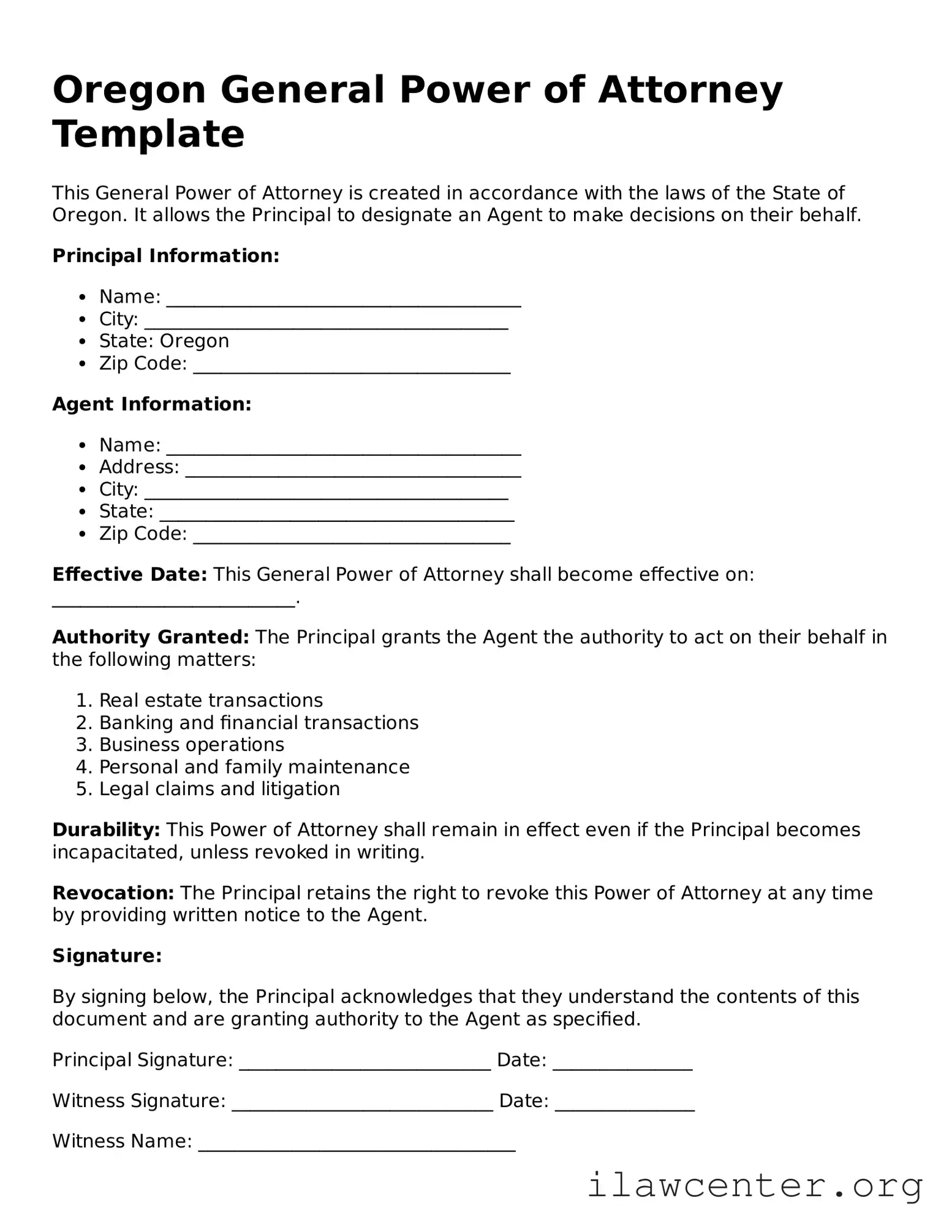
Oregon General Power of Attorney Template

This General Power of Attorney is created in accordance with the laws of the State of Oregon. It allows the Principal to designate an Agent to make decisions on their behalf.

Principal Information:

  • Name: ______________________________________
  • City: _______________________________________
  • State: Oregon
  • Zip Code: __________________________________

Agent Information:

  • Name: ______________________________________
  • Address: ____________________________________
  • City: _______________________________________
  • State: ______________________________________
  • Zip Code: __________________________________

Effective Date: This General Power of Attorney shall become effective on: __________________________.

Authority Granted: The Principal grants the Agent the authority to act on their behalf in the following matters:

  1. Real estate transactions
  2. Banking and financial transactions
  3. Business operations
  4. Personal and family maintenance
  5. Legal claims and litigation

Durability: This Power of Attorney shall remain in effect even if the Principal becomes incapacitated, unless revoked in writing.

Revocation: The Principal retains the right to revoke this Power of Attorney at any time by providing written notice to the Agent.

Signature:

By signing below, the Principal acknowledges that they understand the contents of this document and are granting authority to the Agent as specified.

Principal Signature: ___________________________ Date: _______________

Witness Signature: ____________________________ Date: _______________

Witness Name: __________________________________

Notary Acknowledgment:

State of Oregon, County of ______________________

Subscribed and sworn to before me this ______ day of ______________, 20__.

Notary Public Signature: ________________________

My commission expires: _________________________

PDF Form Characteristics

Fact Name Details
Definition A General Power of Attorney allows an individual to appoint someone to manage their financial and legal affairs.
Governing Law The Oregon General Power of Attorney is governed by Oregon Revised Statutes, specifically ORS 94.600 to 94.630.
Durability This form can be made durable, meaning it remains effective even if the principal becomes incapacitated.
Principal and Agent The person granting authority is the principal, while the individual receiving authority is the agent or attorney-in-fact.
Signature Requirements The principal must sign the document, and it may need to be notarized for certain transactions.
Revocation The principal can revoke the General Power of Attorney at any time, as long as they are competent.
Scope of Authority The authority granted can be broad or limited, depending on the principal's specifications in the document.
Limitations Some actions, such as making medical decisions, may require a separate document, like a Health Care Power of Attorney.

Instructions on Utilizing Oregon General Power of Attorney

After obtaining the Oregon General Power of Attorney form, it is essential to complete it accurately to ensure that your wishes are clearly expressed. This form allows you to designate someone to act on your behalf in various matters. Follow these steps to fill out the form correctly.

  1. Obtain the Form: Download the Oregon General Power of Attorney form from a reliable source or request a hard copy from a legal professional.
  2. Read the Instructions: Familiarize yourself with the instructions provided with the form to understand each section's requirements.
  3. Identify the Principal: Fill in your full legal name and address in the designated section. This identifies you as the person granting the power.
  4. Choose the Agent: Enter the full legal name and address of the person you are appointing as your agent. This person will have the authority to act on your behalf.
  5. Specify Powers: Clearly indicate which powers you are granting to your agent. You may choose specific powers or grant general authority.
  6. Set Effective Date: Decide whether the power of attorney will be effective immediately or at a future date. Indicate your choice on the form.
  7. Sign the Form: Sign and date the form in the presence of a notary public. This step is crucial for the document's validity.
  8. Notarization: Have the form notarized to ensure it meets legal requirements. The notary will verify your identity and witness your signature.
  9. Distribute Copies: Provide copies of the completed and notarized form to your agent and any relevant institutions or individuals.

Important Facts about Oregon General Power of Attorney

What is a General Power of Attorney in Oregon?

A General Power of Attorney is a legal document that allows one person, known as the principal, to grant another person, known as the agent or attorney-in-fact, the authority to make decisions and act on their behalf. This can include managing financial matters, handling real estate transactions, and making other important decisions when the principal is unable to do so themselves.

Who can be appointed as an agent in a General Power of Attorney?

Any competent adult can be appointed as an agent in a General Power of Attorney. This includes family members, friends, or professionals such as attorneys or financial advisors. It is crucial to choose someone trustworthy, as they will have significant control over your affairs.

Does a General Power of Attorney need to be notarized in Oregon?

Yes, in Oregon, a General Power of Attorney must be signed in the presence of a notary public to be valid. Notarization ensures that the document is authentic and that the principal has willingly signed it without any coercion.

Can I limit the powers granted in a General Power of Attorney?

Yes, you can specify certain powers in the General Power of Attorney document. If you only want your agent to manage specific financial accounts or make particular decisions, you can clearly outline those limitations. This allows you to retain control over certain aspects of your affairs.

What happens if I become incapacitated and have a General Power of Attorney in place?

If you become incapacitated, the agent named in your General Power of Attorney can step in to manage your affairs as specified in the document. This can help ensure that your financial and personal matters are handled according to your wishes during a difficult time.

Can I revoke a General Power of Attorney in Oregon?

Yes, you can revoke a General Power of Attorney at any time as long as you are mentally competent. To revoke it, you should create a written document stating your intention to revoke the previous Power of Attorney and provide copies to your agent and any relevant financial institutions or parties.

Is a General Power of Attorney effective immediately?

A General Power of Attorney can be effective immediately upon signing, or you can choose to make it effective at a later date or upon a specific event, such as your incapacitation. This decision should be clearly stated in the document.

What is the difference between a General Power of Attorney and a Durable Power of Attorney?

A General Power of Attorney becomes invalid if the principal becomes incapacitated, while a Durable Power of Attorney remains in effect even if the principal is no longer able to make decisions. If you want your agent to continue acting on your behalf during periods of incapacity, a Durable Power of Attorney is the better choice.

Do I need a lawyer to create a General Power of Attorney in Oregon?

While it is not legally required to have a lawyer draft a General Power of Attorney, consulting with one can provide clarity and ensure that the document meets your specific needs and complies with Oregon laws. If you feel confident in your understanding of the process, you can create the document yourself.
Common mistakes

Filling out a General Power of Attorney form in Oregon can be a straightforward process, but mistakes can lead to significant complications. One common error is failing to specify the powers granted. The form allows for broad or limited authority, and without clear instructions, the agent may not be able to act effectively on your behalf.

Another frequent mistake is not signing the document correctly. In Oregon, the principal must sign the form in the presence of a notary public or two witnesses. Skipping this step can render the document invalid. Ensure that you understand the requirements for signing and witnessing to avoid this pitfall.

Many people also overlook the importance of naming a successor agent. Life is unpredictable, and your primary agent may become unavailable due to illness or other reasons. By failing to designate a backup, you risk leaving your affairs unmanaged during critical times.

Additionally, individuals sometimes forget to date the form. A missing date can create confusion regarding when the powers were granted, potentially leading to disputes. Always include the date to maintain clarity and validity.

Another mistake involves not reviewing the form after completion. It’s essential to double-check for any errors or omissions. A simple typo or incorrect information can lead to challenges in executing the document later on.

Some people neglect to communicate their intentions with their agent. It’s vital to have an open discussion about your wishes and the responsibilities you are entrusting them with. This ensures that the agent understands your preferences and can act accordingly.

Many also fail to consider the implications of granting broad powers. While it may seem convenient, it can also lead to potential misuse. Carefully consider which powers to grant and whether limitations are necessary to protect your interests.

Another common oversight is not keeping the document in a safe yet accessible place. After completing the form, it should be stored securely but also made available to your agent and relevant family members. This ensures that it can be easily located when needed.

Some individuals mistakenly believe that a Power of Attorney remains effective indefinitely. In Oregon, it’s essential to understand that certain powers may expire or become invalid under specific conditions. Regularly review the document to ensure it remains aligned with your current wishes.

Lastly, many people forget to update their General Power of Attorney as life circumstances change. Marriages, divorces, or the passing of an agent can all necessitate revisions to the document. Regular updates ensure that your Power of Attorney remains relevant and effective.

Documents used along the form

When preparing a General Power of Attorney in Oregon, there are several other documents that can complement this form. Each serves a unique purpose and can help ensure that your wishes are clearly communicated and legally recognized.

  • Durable Power of Attorney: This document allows you to appoint someone to manage your financial affairs even if you become incapacitated. It remains effective until your death or revocation.
  • Advance Directive: Also known as a living will, this document outlines your preferences for medical treatment in case you are unable to communicate your wishes. It can include instructions on life-sustaining measures and other health care decisions.
  • Healthcare Power of Attorney: This form designates someone to make medical decisions on your behalf if you are unable to do so. It is specifically focused on health care and can work alongside an advance directive.
  • Will: A will outlines how you want your assets distributed after your death. It can also name guardians for any minor children and is an essential part of estate planning.

Utilizing these documents alongside your General Power of Attorney can help ensure that all aspects of your personal and financial affairs are managed according to your preferences. Each document plays a vital role in protecting your interests and providing peace of mind.

Similar forms

The General Power of Attorney form is similar to several other legal documents that grant authority to an individual to act on behalf of another. Below is a list of documents that share similarities with the General Power of Attorney, along with brief explanations of how they relate:

  • Durable Power of Attorney: This document remains in effect even if the principal becomes incapacitated, unlike a standard General Power of Attorney that may become void under such circumstances.
  • Limited Power of Attorney: This form grants authority for specific tasks or decisions, whereas a General Power of Attorney provides broader powers.
  • Healthcare Power of Attorney: This document specifically allows someone to make medical decisions on behalf of another person, similar to how a General Power of Attorney allows for financial and legal decisions.
  • Living Will: While not a power of attorney, a living will outlines medical preferences. It often works alongside a Healthcare Power of Attorney.
  • Financial Power of Attorney: This document focuses solely on financial matters, similar to the financial aspects covered by a General Power of Attorney.
  • Revocation of Power of Attorney: This document cancels any previous power of attorney, including a General Power of Attorney, ensuring that the principal’s current wishes are respected.
  • Trust Agreement: A trust can manage assets for beneficiaries, and a trustee may have powers similar to those granted in a General Power of Attorney.
  • Authorization to Release Information: This document allows one person to access another's private information, akin to the authority granted in a General Power of Attorney.
  • Business Power of Attorney: This form allows someone to act on behalf of a business, paralleling the authority given in a General Power of Attorney for personal matters.

Dos and Don'ts

When filling out the Oregon General Power of Attorney form, it's essential to approach the process with care. This document grants someone else the authority to make decisions on your behalf, so accuracy and clarity are vital. Here are some dos and don'ts to keep in mind:

  • Do read the entire form carefully before starting to fill it out.
  • Do ensure that you are of sound mind and understand the implications of granting power of attorney.
  • Do select a trustworthy individual as your agent, someone who will act in your best interests.
  • Do specify the powers you wish to grant clearly and precisely.
  • Don't leave any sections blank; incomplete forms can lead to confusion or invalidation.
  • Don't rush through the process; take your time to ensure all information is accurate.

By following these guidelines, you can help ensure that your General Power of Attorney form is filled out correctly and serves its intended purpose effectively.

Misconceptions

Understanding the Oregon General Power of Attorney form is essential for anyone considering using it. However, several misconceptions can lead to confusion. Here is a list of ten common misunderstandings about this important legal document.

  1. It is only for financial matters.

    Many believe that a General Power of Attorney can only be used for financial decisions. In reality, it can also grant authority over healthcare and other personal matters, depending on how it is drafted.

  2. It remains valid after the principal becomes incapacitated.

    This is not true. A General Power of Attorney typically becomes invalid if the person who created it (the principal) becomes incapacitated, unless it is specifically designated as a durable power of attorney.

  3. All powers are granted automatically.

    While a General Power of Attorney provides broad authority, the principal must explicitly list any limitations or specific powers they wish to grant. Not all powers are assumed.

  4. It can be used indefinitely.

    Some people think that a General Power of Attorney lasts forever. In fact, it can be revoked at any time by the principal, as long as they are still competent to do so.

  5. It must be notarized to be valid.

    While notarization is highly recommended for a General Power of Attorney to ensure its acceptance, it is not always a legal requirement. Some jurisdictions may allow for witnesses instead.

  6. Only lawyers can create a General Power of Attorney.

    This is a common myth. Individuals can create their own General Power of Attorney using templates or forms, provided they understand the necessary components and requirements.

  7. It is the same as a healthcare power of attorney.

    A General Power of Attorney and a healthcare power of attorney serve different purposes. The former generally covers financial and legal matters, while the latter specifically addresses medical decisions.

  8. It can be used to make decisions after death.

    Once the principal passes away, the General Power of Attorney ceases to have any effect. It cannot be used to make decisions regarding the estate or other matters after death.

  9. It is a one-size-fits-all document.

    Each General Power of Attorney should be tailored to the specific needs and circumstances of the principal. Generic forms may not address unique situations or requirements.

  10. It can only be revoked in writing.

    While revoking a General Power of Attorney in writing is the safest approach, it can also be revoked verbally, provided that the principal is competent to communicate their wishes.

By addressing these misconceptions, individuals can make more informed decisions about using the Oregon General Power of Attorney form and ensure it meets their needs effectively.

Key takeaways

When filling out and using the Oregon General Power of Attorney form, it is essential to understand its implications and requirements. Here are some key takeaways to keep in mind:

  • The Oregon General Power of Attorney allows you to designate someone to make decisions on your behalf.
  • Choose a trustworthy agent, as they will have significant authority over your financial and legal matters.
  • The form must be signed in the presence of a notary public to be valid.
  • It is important to specify the powers you are granting clearly to avoid confusion later.
  • You can revoke the power of attorney at any time, as long as you are mentally competent.
  • Ensure the document is stored safely, and provide copies to your agent and relevant institutions.
  • Understand that the power of attorney becomes effective immediately unless you specify a different start date.
  • Consulting with a legal professional can provide clarity and ensure that your wishes are accurately represented.