Attorney-Verified  Homeschool Letter of Intent Document for Oregon

Attorney-Verified Homeschool Letter of Intent Document for Oregon

The Oregon Homeschool Letter of Intent form is a document that parents or guardians must submit to officially notify the state of their decision to homeschool their children. This form serves as a crucial step in the homeschooling process, ensuring compliance with state regulations. To begin your homeschooling journey, fill out the form by clicking the button below.

Article Guide

In Oregon, families considering homeschooling their children must submit a Homeschool Letter of Intent form to their local school district. This essential document serves as a formal notification to the district that a parent or guardian intends to provide home-based education. The form requires basic information, including the names and ages of the children being homeschooled, as well as the address of the home where the education will take place. Additionally, it is important for parents to indicate the educational philosophy they plan to follow, which can range from structured curricula to more relaxed, child-led learning approaches. By completing this form, parents take a significant step toward ensuring that their children's educational needs are met outside of traditional school settings. The process is designed to be straightforward, allowing families to embark on their homeschooling journey with clarity and purpose.

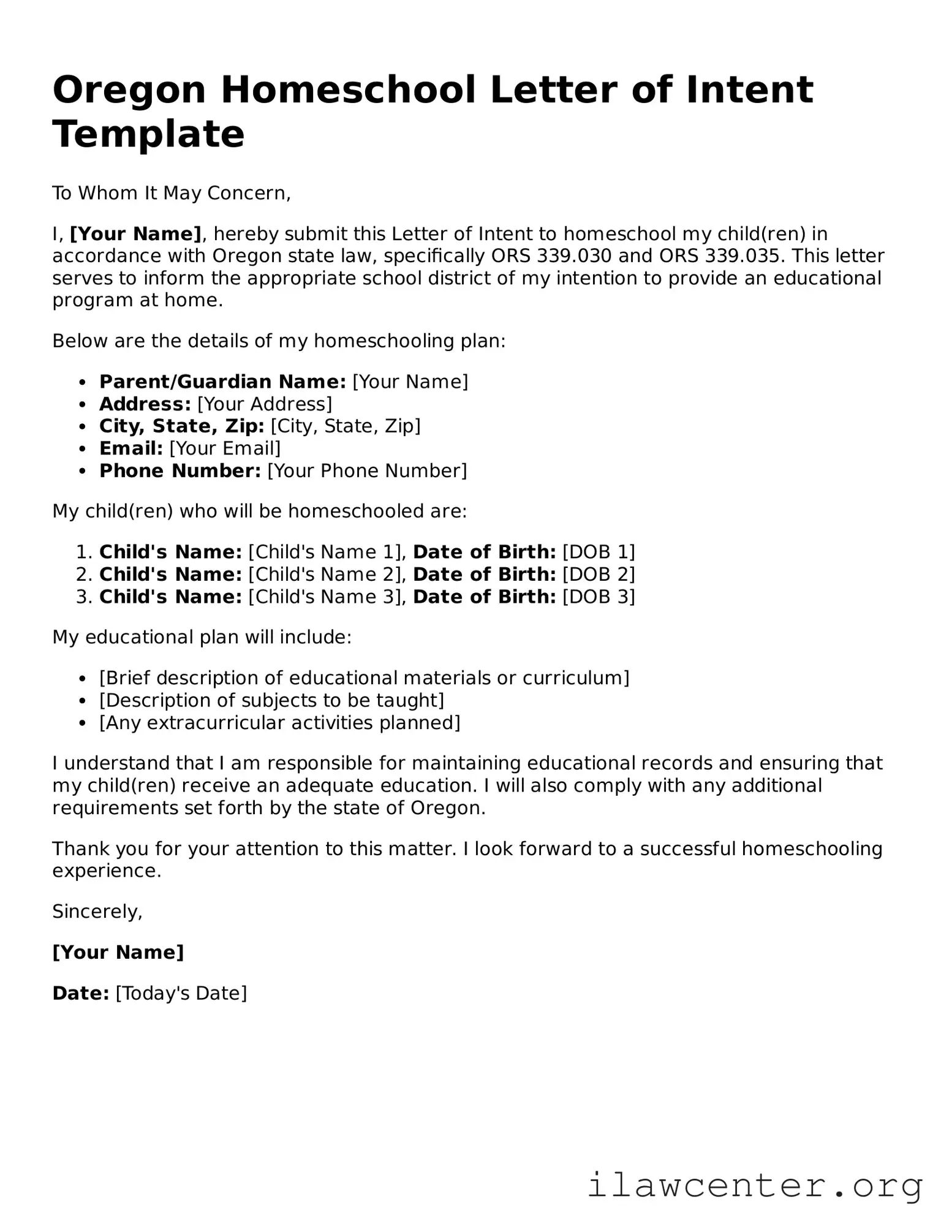
Oregon Homeschool Letter of Intent Preview

Oregon Homeschool Letter of Intent Template

To Whom It May Concern,

I, [Your Name], hereby submit this Letter of Intent to homeschool my child(ren) in accordance with Oregon state law, specifically ORS 339.030 and ORS 339.035. This letter serves to inform the appropriate school district of my intention to provide an educational program at home.

Below are the details of my homeschooling plan:

  • Parent/Guardian Name: [Your Name]
  • Address: [Your Address]
  • City, State, Zip: [City, State, Zip]
  • Email: [Your Email]
  • Phone Number: [Your Phone Number]

My child(ren) who will be homeschooled are:

  1. Child's Name: [Child's Name 1], Date of Birth: [DOB 1]
  2. Child's Name: [Child's Name 2], Date of Birth: [DOB 2]
  3. Child's Name: [Child's Name 3], Date of Birth: [DOB 3]

My educational plan will include:

  • [Brief description of educational materials or curriculum]
  • [Description of subjects to be taught]
  • [Any extracurricular activities planned]

I understand that I am responsible for maintaining educational records and ensuring that my child(ren) receive an adequate education. I will also comply with any additional requirements set forth by the state of Oregon.

Thank you for your attention to this matter. I look forward to a successful homeschooling experience.

Sincerely,

[Your Name]

Date: [Today's Date]

PDF Form Characteristics

Fact Name Description
Purpose The Oregon Homeschool Letter of Intent form notifies the state of a parent's intent to homeschool their child.
Governing Law The form is governed by Oregon Revised Statutes (ORS) 339.030 and 339.035.
Submission Deadline The letter must be submitted to the local education service district within 10 days of starting the homeschool program.
Required Information Parents must provide the child's name, age, and address, along with the parent's contact information.
Annual Requirement The Letter of Intent must be submitted each year to continue homeschooling.
Changes in Information If there are any changes in the child's status or educational plan, parents must update the form accordingly.
Record Keeping Parents are advised to keep a copy of the submitted Letter of Intent for their records.
Educational Plan While not required with the Letter of Intent, parents should develop an educational plan for their child.
Support Resources Oregon provides resources and support for homeschooling families through various organizations.

Instructions on Utilizing Oregon Homeschool Letter of Intent

Once you have decided to homeschool your child in Oregon, the next step involves completing the Homeschool Letter of Intent form. This form serves as a notification to the local school district of your intent to provide home-based education. After submitting the form, you will be able to proceed with your homeschooling journey.

  1. Obtain the Oregon Homeschool Letter of Intent form from your local school district's website or office.
  2. Fill in your name and address in the designated fields at the top of the form.
  3. Provide the name and birthdate of the child you intend to homeschool.
  4. Indicate the educational year for which you are submitting the intent.
  5. Sign and date the form to certify your intent to homeschool.
  6. Submit the completed form to your local school district office. This can often be done via mail, email, or in person, depending on the district's policies.

Important Facts about Oregon Homeschool Letter of Intent

What is the Oregon Homeschool Letter of Intent?

The Oregon Homeschool Letter of Intent is a formal document that parents or guardians must submit to their local school district to notify them of their intention to homeschool their children. This letter serves as a declaration of the family's choice to educate their child outside of the traditional public school system.

Who needs to submit the Letter of Intent?

Any parent or guardian who wishes to homeschool their child in Oregon must submit the Letter of Intent. This requirement applies to children who are between the ages of 6 and 18 and are not enrolled in a public or private school.

When should the Letter of Intent be submitted?

The Letter of Intent should be submitted to the local school district before the start of the homeschooling process. It is recommended to file the letter at least 10 days prior to the beginning of the school year. If a child is being withdrawn from a public school, the letter should be submitted as soon as possible to ensure a smooth transition.

What information must be included in the Letter of Intent?

The Letter of Intent must include the names and ages of the children being homeschooled, the address of the family, and a statement indicating the intent to homeschool. Some districts may request additional information, such as the educational plan or curriculum being used.

Is there a specific format for the Letter of Intent?

While there is no official form that must be used, the Letter of Intent should be clear and concise. It is advisable to include all required information and to format the letter in a professional manner. Some families choose to use templates available online to ensure they meet all necessary criteria.

What happens after the Letter of Intent is submitted?

Once the Letter of Intent is submitted, the local school district will typically acknowledge receipt of the letter. There is no approval process for homeschooling in Oregon, but families are encouraged to maintain communication with the district. It is also important to keep records of educational progress, as these may be requested in the future.

Are there any penalties for not submitting the Letter of Intent?

Failure to submit the Letter of Intent may result in the child being considered truant. This could lead to legal complications or intervention by the school district. It is essential for parents to adhere to the requirements to avoid any potential issues.

Can the Letter of Intent be revoked?

Yes, parents can revoke their Letter of Intent at any time. If a family decides to enroll their child in a public or private school after previously homeschooling, they should notify the local school district of the change in educational status.

Where can I find more information about homeschooling in Oregon?

Additional information about homeschooling in Oregon can be found on the Oregon Department of Education website. Local homeschooling groups and organizations may also provide valuable resources and support for families considering or currently engaged in homeschooling.
Common mistakes

Filling out the Oregon Homeschool Letter of Intent form can be straightforward, but several common mistakes can lead to complications. One frequent error is failing to provide complete information. The form requires specific details about the student, such as their full name, date of birth, and address. Omitting any of this information can delay the processing of the intent.

Another mistake is not adhering to the submission timeline. The state of Oregon requires that the Letter of Intent be submitted within a certain timeframe before the start of the school year. Missing this deadline can result in the inability to legally homeschool for that year. Parents should always check the calendar and plan accordingly.

Some individuals mistakenly think that the form does not need to be signed. In fact, the Letter of Intent must be signed by the parent or guardian. A missing signature renders the form invalid, which can lead to misunderstandings with local educational authorities.

Additionally, many people overlook the requirement to update the form if any changes occur. If there are changes in the student's address, educational plans, or guardianship, the state must be notified. Failing to do so can create legal issues down the line.

Lastly, individuals often forget to keep a copy of the submitted form. Having a record is crucial in case there are any questions or disputes regarding the homeschooling status. A simple oversight can complicate matters when proof of intent is needed.

Documents used along the form

When you decide to homeschool in Oregon, submitting the Homeschool Letter of Intent is just the first step. Several other forms and documents may be necessary to ensure a smooth homeschooling experience. Below is a list of important documents that often accompany the Homeschool Letter of Intent.

  • Educational Plan: This document outlines the curriculum and educational goals for your child. It helps you clarify what subjects you will cover and how you will assess your child's progress.
  • Attendance Records: Keeping track of your child’s attendance is essential. This record shows how many days your child has been educated at home, which can be helpful for both your records and any future assessments.
  • Progress Reports: These reports detail your child’s academic achievements and areas needing improvement. Regularly documenting progress can help you adjust your teaching methods as needed.
  • Portfolio of Work: Compiling a portfolio of your child's work can be beneficial. It showcases their learning journey and can serve as evidence of educational progress, especially if required by local authorities.
  • Assessment Results: Some families choose to have their children take standardized tests or assessments. Keeping these results can provide insight into your child’s academic standing and help guide future educational decisions.

By preparing these documents, you can create a comprehensive homeschooling plan that meets both your educational goals and any requirements set by the state. Staying organized will help you navigate the homeschooling process with confidence.

Similar forms

  • Withdrawal Letter: This document is used by parents to formally notify their child's school of their decision to withdraw from traditional schooling. Similar to the Homeschool Letter of Intent, it serves as an official communication, outlining the parents' intent to pursue an alternative educational path.
  • Educational Plan: An educational plan details the curriculum and learning objectives parents will follow while homeschooling. Like the Homeschool Letter of Intent, it reflects the family's commitment to providing an organized and structured education for their child.
  • Attendance Record: This document tracks the days and hours a child is educated at home. It parallels the Homeschool Letter of Intent by demonstrating compliance with state regulations regarding educational attendance.
  • Curriculum Outline: A curriculum outline provides a comprehensive overview of the subjects and materials to be used throughout the homeschooling year. Similar to the Homeschool Letter of Intent, it shows a clear plan for the child's education.
  • Progress Report: This report summarizes a child's academic achievements and areas for improvement. It aligns with the Homeschool Letter of Intent by keeping stakeholders informed about the educational progress being made at home.
  • Portfolio of Work: A portfolio showcases a child's completed assignments and projects. Like the Homeschool Letter of Intent, it serves as evidence of the educational activities undertaken during the homeschooling period.
  • Statement of Educational Philosophy: This document outlines the parents' beliefs and values regarding education. It complements the Homeschool Letter of Intent by providing insight into the educational approach the family intends to take.
  • Notice of Intent to Homeschool: This is often a formal notification sent to local school authorities, similar in purpose to the Homeschool Letter of Intent. It indicates the family's decision to homeschool and may be required by law in some states.
  • Assessment Results: These results come from standardized tests or evaluations that measure a child's educational progress. They relate to the Homeschool Letter of Intent by providing accountability and demonstrating adherence to educational standards.

Dos and Don'ts

When filling out the Oregon Homeschool Letter of Intent form, it's important to follow specific guidelines to ensure a smooth process. Below is a list of things you should and shouldn't do:

  • Do provide accurate information about your child, including their full name and date of birth.
  • Do include your contact information, such as your address and phone number.
  • Do submit the form to your local school district by the deadline.
  • Do keep a copy of the completed form for your records.
  • Don't leave any required fields blank; this can delay processing.
  • Don't submit the form late, as this may affect your homeschooling status.
  • Don't provide false information; this can lead to serious consequences.
  • Don't forget to check for any additional requirements specific to your district.

Following these guidelines will help ensure that your homeschooling journey begins on the right foot.

Misconceptions

Many people have misconceptions about the Oregon Homeschool Letter of Intent form. Understanding these misconceptions can help parents navigate the homeschooling process more effectively. Here are four common misunderstandings:

  • Misconception 1: The Letter of Intent is a complex legal document.
  • In reality, the form is straightforward and easy to complete. Parents simply need to provide basic information about their child and their educational plans.

  • Misconception 2: Submitting the Letter of Intent means you must follow a strict curriculum.
  • This is not the case. Parents have the freedom to choose the curriculum that best suits their child's needs. The form does not dictate how education must be delivered.

  • Misconception 3: You cannot change your educational approach after submitting the form.
  • Parents can adjust their homeschooling methods at any time. The Letter of Intent is simply a notification to the state, not a binding contract.

  • Misconception 4: The Letter of Intent must be submitted at the beginning of the school year.
  • This is a common myth. Parents can submit the form at any time during the year, allowing for flexibility in starting or transitioning to homeschooling.

Key takeaways

Filling out and using the Oregon Homeschool Letter of Intent form is an important step for families choosing to homeschool. Here are some key takeaways to keep in mind:

  • Understand the Requirements: Familiarize yourself with Oregon's homeschooling laws. You must submit the Letter of Intent to your local education district.
  • Provide Accurate Information: Fill in all required fields completely and accurately. This includes your child's name, age, and your contact information.
  • Submit on Time: Ensure you submit the form by the deadline. This is typically within 10 days of beginning your homeschool program.
  • Keep a Copy: Always retain a copy of the completed Letter of Intent for your records. This can be useful for future reference.
  • Update When Necessary: If there are any changes in your homeschooling situation, such as a change of address or a new child being homeschooled, submit an updated form.
  • Stay Informed: Regularly check for any updates to homeschooling laws or requirements in Oregon to ensure compliance.
  • Utilize Resources: Take advantage of local homeschooling groups and resources. They can offer support and guidance throughout your homeschooling journey.