Attorney-Verified  Motor Vehicle Bill of Sale Document for Oregon

Attorney-Verified Motor Vehicle Bill of Sale Document for Oregon

The Oregon Motor Vehicle Bill of Sale form is a crucial document used to officially transfer ownership of a vehicle from one party to another in the state of Oregon. This form serves as a receipt for the transaction and provides essential details about the vehicle and the parties involved. To ensure a smooth transfer, it's important to fill out this form accurately—click the button below to get started.

Article Guide

When buying or selling a vehicle in Oregon, having the right paperwork is essential for a smooth transaction. One of the key documents involved in this process is the Oregon Motor Vehicle Bill of Sale form. This form serves as a legal record of the sale, detailing crucial information such as the vehicle's make, model, year, and Vehicle Identification Number (VIN). It also captures the buyer's and seller's names and addresses, ensuring that both parties are clearly identified. Additionally, the form includes spaces for the sale price and the date of the transaction, which are important for both legal and tax purposes. While it may seem straightforward, completing this form accurately is vital to protect both the buyer and seller from potential disputes down the line. Understanding how to fill out the Oregon Motor Vehicle Bill of Sale form properly can help facilitate a hassle-free transfer of ownership and provide peace of mind for everyone involved.

Oregon Motor Vehicle Bill of Sale Preview

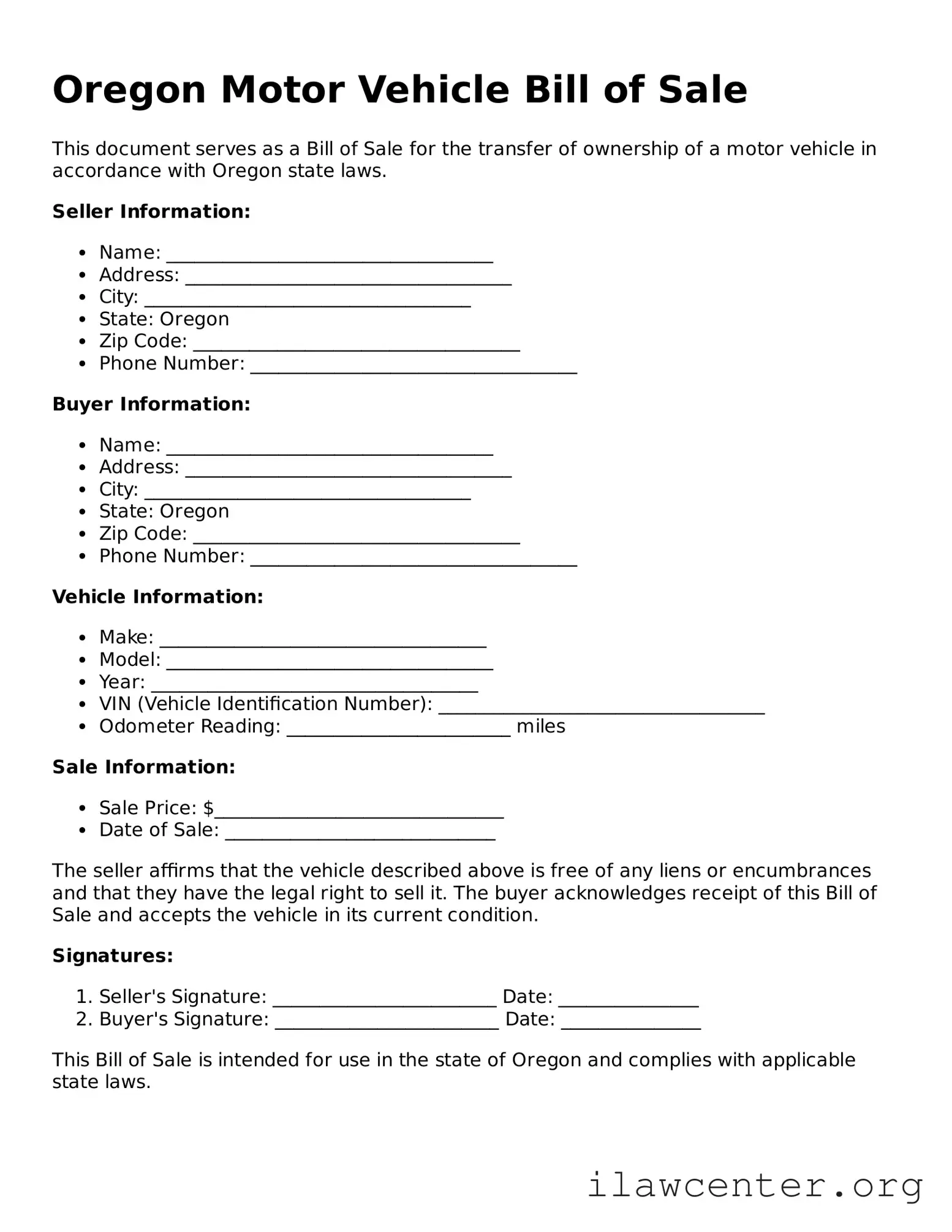
Oregon Motor Vehicle Bill of Sale

This document serves as a Bill of Sale for the transfer of ownership of a motor vehicle in accordance with Oregon state laws.

Seller Information:

  • Name: ___________________________________
  • Address: ___________________________________
  • City: ___________________________________
  • State: Oregon
  • Zip Code: ___________________________________
  • Phone Number: ___________________________________

Buyer Information:

  • Name: ___________________________________
  • Address: ___________________________________
  • City: ___________________________________
  • State: Oregon
  • Zip Code: ___________________________________
  • Phone Number: ___________________________________

Vehicle Information:

  • Make: ___________________________________
  • Model: ___________________________________
  • Year: ___________________________________
  • VIN (Vehicle Identification Number): ___________________________________
  • Odometer Reading: ________________________ miles

Sale Information:

  • Sale Price: $_______________________________
  • Date of Sale: _____________________________

The seller affirms that the vehicle described above is free of any liens or encumbrances and that they have the legal right to sell it. The buyer acknowledges receipt of this Bill of Sale and accepts the vehicle in its current condition.

Signatures:

  1. Seller's Signature: ________________________ Date: _______________
  2. Buyer's Signature: ________________________ Date: _______________

This Bill of Sale is intended for use in the state of Oregon and complies with applicable state laws.

PDF Form Characteristics

Fact Name Details
Purpose The Oregon Motor Vehicle Bill of Sale form is used to document the sale of a motor vehicle between a buyer and a seller.
Required Information The form must include the vehicle's make, model, year, VIN, sale price, and the names and addresses of both the buyer and seller.
Governing Law The form is governed by the Oregon Revised Statutes, specifically ORS 803.095.
Signature Requirement Both the buyer and seller must sign the form to validate the transaction.
Transfer of Ownership Completion of the form facilitates the transfer of ownership and is often required for vehicle registration.
Record Keeping It is advisable for both parties to keep a copy of the signed Bill of Sale for their records.

Instructions on Utilizing Oregon Motor Vehicle Bill of Sale

Filling out the Oregon Motor Vehicle Bill of Sale form is a straightforward process that requires careful attention to detail. Once you have completed the form, you will be ready to proceed with the transfer of ownership for the vehicle. Ensure that all information is accurate to avoid any complications later on.

  1. Begin by entering the date of the sale at the top of the form.
  2. Fill in the seller's name and address. Make sure to provide complete and accurate information.
  3. Next, enter the buyer's name and address in the designated section.
  4. Provide the vehicle details, including the make, model, year, and Vehicle Identification Number (VIN).
  5. Indicate the sale price of the vehicle clearly.
  6. Both the seller and buyer should sign the form to validate the transaction.
  7. Finally, make a copy of the completed form for your records before handing it over to the buyer.

Important Facts about Oregon Motor Vehicle Bill of Sale

What is the Oregon Motor Vehicle Bill of Sale form?

The Oregon Motor Vehicle Bill of Sale form is a legal document that records the sale of a motor vehicle between a buyer and a seller. This form serves as proof of the transaction and includes important details such as the vehicle's make, model, year, and Vehicle Identification Number (VIN), along with the names and addresses of both parties involved in the sale.

Why is a Bill of Sale necessary in Oregon?

A Bill of Sale is necessary in Oregon to provide legal evidence of the transfer of ownership of a vehicle. It protects both the buyer and the seller by documenting the terms of the sale. This form can also be useful for tax purposes and is often required when registering the vehicle in the new owner's name.

What information is required on the Oregon Motor Vehicle Bill of Sale?

The form requires specific information including the names and addresses of both the buyer and the seller, the vehicle's make, model, year, VIN, and the sale price. Additionally, the date of the sale and any relevant odometer reading should be included. Both parties must sign the document to validate the transaction.

Can I create my own Bill of Sale for a vehicle in Oregon?

Yes, you can create your own Bill of Sale as long as it includes all necessary information and meets the legal requirements set by the state of Oregon. However, using a standardized form can help ensure that all essential details are included and reduce the risk of errors.

Is a Bill of Sale required to register a vehicle in Oregon?

While a Bill of Sale is not strictly required to register a vehicle in Oregon, it is highly recommended. The Department of Motor Vehicles (DMV) may ask for it as proof of ownership, especially if the vehicle was purchased from a private seller. Having this document can simplify the registration process.

How do I obtain an Oregon Motor Vehicle Bill of Sale form?

You can obtain the Oregon Motor Vehicle Bill of Sale form from the Oregon DMV website or at any DMV office. Additionally, various online legal resources may offer downloadable versions of the form. Ensure that you are using the most current version to comply with state regulations.

What should I do after completing the Bill of Sale?

After completing the Bill of Sale, both the buyer and seller should keep a copy for their records. The seller should also provide the buyer with any additional documents required for vehicle registration, such as the title and any maintenance records. It’s advisable for the buyer to register the vehicle promptly to avoid any potential issues with ownership.
Common mistakes

Filling out the Oregon Motor Vehicle Bill of Sale form can be a straightforward process, but many individuals make common mistakes that can lead to complications down the road. One frequent error is failing to provide accurate information about the vehicle. This includes details such as the Vehicle Identification Number (VIN), make, model, and year. Inaccuracies can create confusion and may even result in legal disputes regarding ownership.

Another mistake often encountered is neglecting to include the purchase price. This amount is crucial for both the buyer and seller, as it establishes the value of the transaction for tax purposes. Leaving this field blank can lead to complications when registering the vehicle or when filing taxes.

Many individuals also overlook the importance of signatures. Both the seller and buyer must sign the Bill of Sale to validate the transaction. Without these signatures, the document may not hold up in legal situations, and ownership could be questioned.

Additionally, some people forget to date the form. The date of the transaction is essential for record-keeping and can affect the timeline of ownership transfer. A missing date can create ambiguity about when the sale occurred.

Another common issue arises from not providing the correct contact information. Including full names, addresses, and phone numbers for both parties is vital. This information is necessary for future correspondence and can help resolve any issues that may arise after the sale.

It is also important to note that some individuals fail to check for liens on the vehicle. A lien is a legal claim against the vehicle, and if one exists, it must be resolved before the sale can be finalized. Not addressing this can lead to unexpected financial obligations for the buyer.

Moreover, some people do not keep a copy of the Bill of Sale for their records. Retaining a copy is essential for both parties. It serves as proof of the transaction and can be useful for future reference, especially if disputes arise.

Lastly, individuals sometimes rush through the process without reading the entire form. Taking the time to carefully review each section can prevent mistakes and ensure that all necessary information is accurately provided. A thorough approach can save both parties from potential headaches in the future.

Documents used along the form

The Oregon Motor Vehicle Bill of Sale form is an important document for anyone buying or selling a vehicle in Oregon. However, several other forms and documents often accompany this transaction to ensure everything is processed smoothly and legally. Here’s a list of related documents that you may need.

  • Oregon Vehicle Title: This document proves ownership of the vehicle. The seller must sign the title over to the buyer during the sale.
  • Oregon DMV Application for Title and Registration: After purchasing a vehicle, the buyer needs to fill out this application to officially register the vehicle in their name.
  • Oregon Vehicle Registration Renewal Form: If the vehicle is already registered, this form is used to renew the registration annually.
  • Oregon Emissions Compliance Certificate: Some areas in Oregon require this certificate to confirm that the vehicle meets state emissions standards.
  • Oregon Bill of Sale for Trailers: If the vehicle includes a trailer, a separate bill of sale for the trailer may be necessary.
  • Oregon Notarized Affidavit of Ownership: If the title is lost, this affidavit can help establish ownership when transferring the vehicle.
  • Oregon DMV Release of Liability: This form notifies the DMV that the seller is no longer responsible for the vehicle after the sale.
  • Vehicle History Report: Buyers may request this report to check for any past accidents or title issues before completing the purchase.
  • Oregon DMV Affidavit of Transfer: This document can be used when a vehicle is gifted or transferred without a sale.

Having these documents prepared and organized can help streamline the process of buying or selling a vehicle in Oregon. Always ensure that you have the necessary paperwork to avoid any complications during the transaction.

Similar forms

  • Real Estate Bill of Sale: This document transfers ownership of property, similar to how a Motor Vehicle Bill of Sale transfers ownership of a vehicle. Both require details about the buyer, seller, and the item being sold.
  • Boat Bill of Sale: Just like the Motor Vehicle Bill of Sale, this document is used for the sale of boats. It includes information about the vessel, the seller, and the buyer, ensuring a clear transfer of ownership.
  • Aircraft Bill of Sale: This document serves a similar purpose for airplanes. It outlines the transaction details, including the aircraft's identification and the parties involved, mirroring the structure of a motor vehicle sale.
  • Equipment Bill of Sale: When heavy machinery or equipment changes hands, this document records the sale. It includes specifics about the equipment, the buyer, and the seller, paralleling the vehicle sale process.
  • Mobile Home Bill of Sale: This form is used when selling a mobile home. It includes pertinent details about the home and the parties, similar to the Motor Vehicle Bill of Sale, ensuring proper documentation of the sale.
  • Personal Property Bill of Sale: This document covers a broader range of items, from furniture to collectibles. Like the Motor Vehicle Bill of Sale, it provides a record of the transaction and identifies the parties involved.
  • Business Asset Bill of Sale: When businesses sell assets, this document formalizes the transaction. It specifies the assets being sold and the parties involved, akin to the motor vehicle sales process.
  • Gift Bill of Sale: This document is used when an item is given as a gift rather than sold. It still includes the necessary details about the item and the parties, ensuring clarity in ownership transfer.
  • Franchise Bill of Sale: When a franchise changes ownership, this document is essential. It outlines the terms of the sale and the involved parties, similar to the Motor Vehicle Bill of Sale in its purpose of documenting ownership transfer.

Dos and Don'ts

When filling out the Oregon Motor Vehicle Bill of Sale form, it is important to follow specific guidelines to ensure accuracy and compliance. Below are six recommendations that outline what you should and shouldn't do.

  • Do provide accurate vehicle information, including the make, model, year, and VIN.
  • Do include the purchase price clearly and legibly.
  • Do ensure both the buyer and seller sign the form.
  • Do keep a copy of the completed form for your records.
  • Don't leave any fields blank; fill out all required sections.
  • Don't use whiteout or other correction fluid on the form.

Following these guidelines will help facilitate a smooth transaction and ensure that all necessary information is accurately recorded.

Misconceptions

  • Misconception 1: A bill of sale is only necessary for new vehicles.
  • This is not true. A bill of sale is important for both new and used vehicles. It serves as proof of the transaction and can protect both the buyer and seller in case of disputes.

  • Misconception 2: The bill of sale does not need to be notarized.
  • While notarization is not always required, having a notarized bill of sale can add an extra layer of protection. It verifies the identities of both parties and the authenticity of the transaction.

  • Misconception 3: You can use any format for a bill of sale.
  • While you can technically write your own bill of sale, using the official Oregon Motor Vehicle Bill of Sale form is recommended. This form includes all necessary information and complies with state requirements.

  • Misconception 4: A bill of sale is only for private sales.
  • This is incorrect. A bill of sale can be used for both private and dealer sales. It helps document the transaction regardless of who is selling the vehicle.

  • Misconception 5: The bill of sale is not important for registration.
  • The bill of sale is crucial for vehicle registration in Oregon. It provides proof of ownership and is often required by the Department of Motor Vehicles when transferring title.

Key takeaways

When filling out and using the Oregon Motor Vehicle Bill of Sale form, keep these key points in mind:

  • The form serves as a legal document to record the sale of a vehicle.
  • Both the buyer and seller must complete their respective sections on the form.
  • Include accurate vehicle details, such as the VIN, make, model, and year.
  • Document the sale price clearly to avoid future disputes.
  • Both parties should sign and date the form to validate the transaction.
  • Keep a copy of the completed Bill of Sale for your records.
  • This document may be required for registration and title transfer at the DMV.
  • Consider having the Bill of Sale notarized for additional security.
  • Verify that there are no liens on the vehicle before completing the sale.