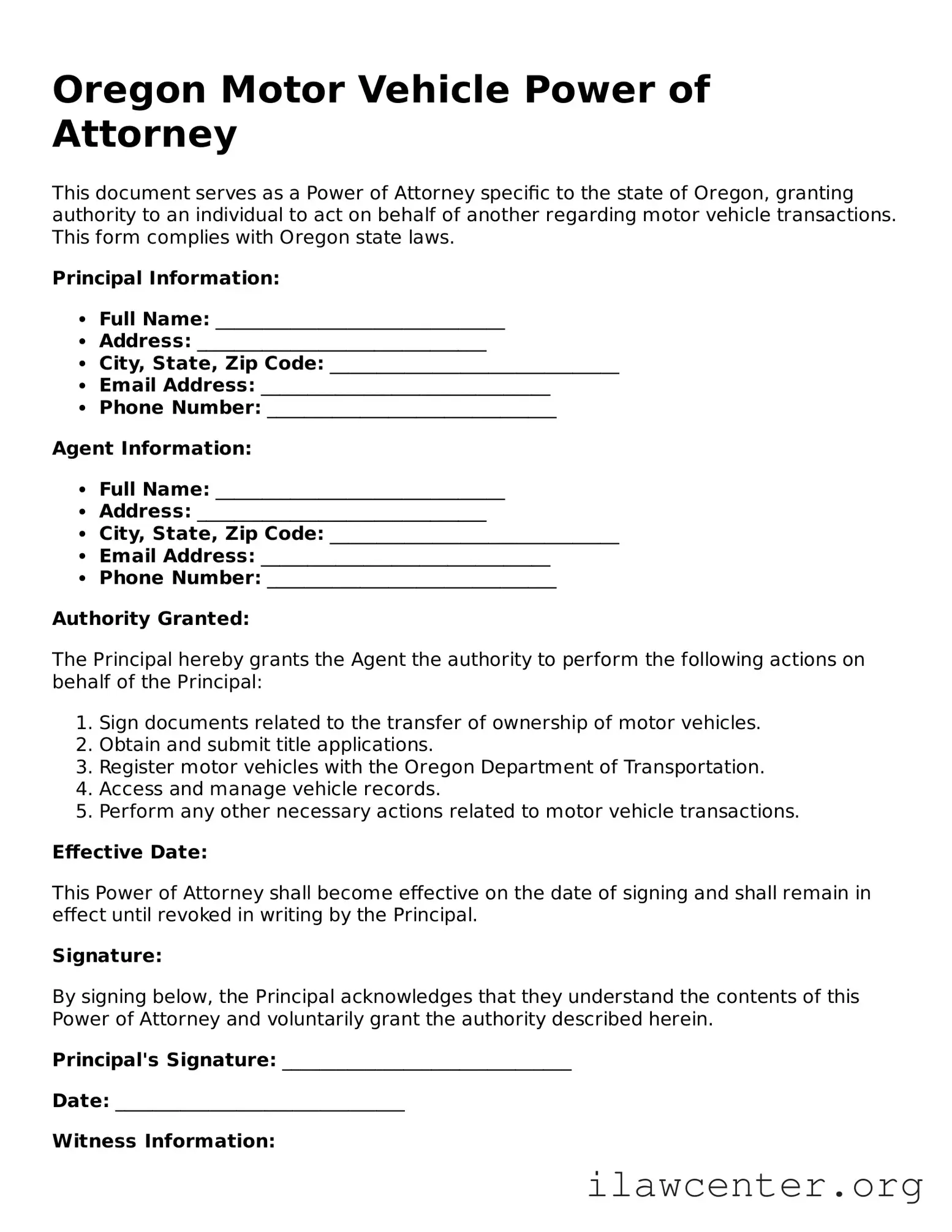
What is the Oregon Motor Vehicle Power of Attorney form?
The Oregon Motor Vehicle Power of Attorney form is a legal document that allows one person, known as the principal, to authorize another person, referred to as the attorney-in-fact, to act on their behalf in matters related to motor vehicles. This can include tasks such as transferring ownership, registering a vehicle, or obtaining a title. It is essential for anyone who needs to delegate these responsibilities, especially if they cannot be present to handle them personally.
Who can be designated as an attorney-in-fact in this form?
Any competent adult can be designated as an attorney-in-fact. This includes family members, friends, or professionals such as attorneys or financial advisors. It is crucial that the person chosen is trustworthy and capable of handling the responsibilities outlined in the power of attorney. The principal must have confidence in their ability to act in their best interest.
How do I complete the Oregon Motor Vehicle Power of Attorney form?
To complete the form, you will need to provide specific information, including the names and addresses of both the principal and the attorney-in-fact, as well as details about the vehicle in question. The form must be signed and dated by the principal. In some cases, notarization may be required to ensure its validity. It is advisable to review the form carefully to ensure all information is accurate and complete.
Is the Oregon Motor Vehicle Power of Attorney form valid in other states?
The validity of the Oregon Motor Vehicle Power of Attorney form in other states can vary. Generally, each state has its own requirements and forms for power of attorney documents. If you plan to use the Oregon form outside of Oregon, it is wise to check the specific laws of the state where you intend to use it. Some states may recognize the Oregon form, while others may require a new document that complies with their laws.
What happens if I need to revoke the power of attorney?
If the principal decides to revoke the power of attorney, they must do so in writing. This revocation must be signed and dated by the principal and communicated to the attorney-in-fact and any relevant third parties, such as the Department of Motor Vehicles. It is important to ensure that the revocation is clear and unambiguous to prevent any confusion regarding the authority of the attorney-in-fact.
Are there any limitations on what the attorney-in-fact can do?
Yes, the powers granted to the attorney-in-fact can be limited by the principal in the power of attorney document. The principal can specify which actions the attorney-in-fact is authorized to take. For instance, they may allow the attorney-in-fact to sell a vehicle but not to purchase one. It is essential for the principal to clearly outline these limitations to avoid any potential misuse of authority.