Attorney-Verified  Non-compete Agreement Document for Oregon

Attorney-Verified Non-compete Agreement Document for Oregon

A Non-compete Agreement is a legal document that restricts an employee from working for a competitor or starting a similar business within a certain timeframe and geographic area after leaving their job. In Oregon, specific guidelines govern these agreements to ensure they are fair and enforceable. Understanding the nuances of this form is essential for both employers and employees.

Ready to fill out the Oregon Non-compete Agreement form? Click the button below to get started!

Article Guide

In the state of Oregon, the Non-compete Agreement form serves as a crucial tool for employers seeking to protect their business interests while balancing the rights of employees. This form outlines the conditions under which an employee agrees not to engage in similar work for a competitor after leaving their current position. Key aspects of the agreement include the duration of the non-compete clause, the geographic area it covers, and the specific roles or industries affected. Oregon law stipulates that for such agreements to be enforceable, they must be reasonable in scope and duration, ensuring that they do not unduly restrict an employee's ability to find work. Additionally, the form must be provided to the employee at the time of hiring or when a significant change in employment occurs. Understanding these components is essential for both employers and employees, as they navigate the complex landscape of employment law in Oregon.

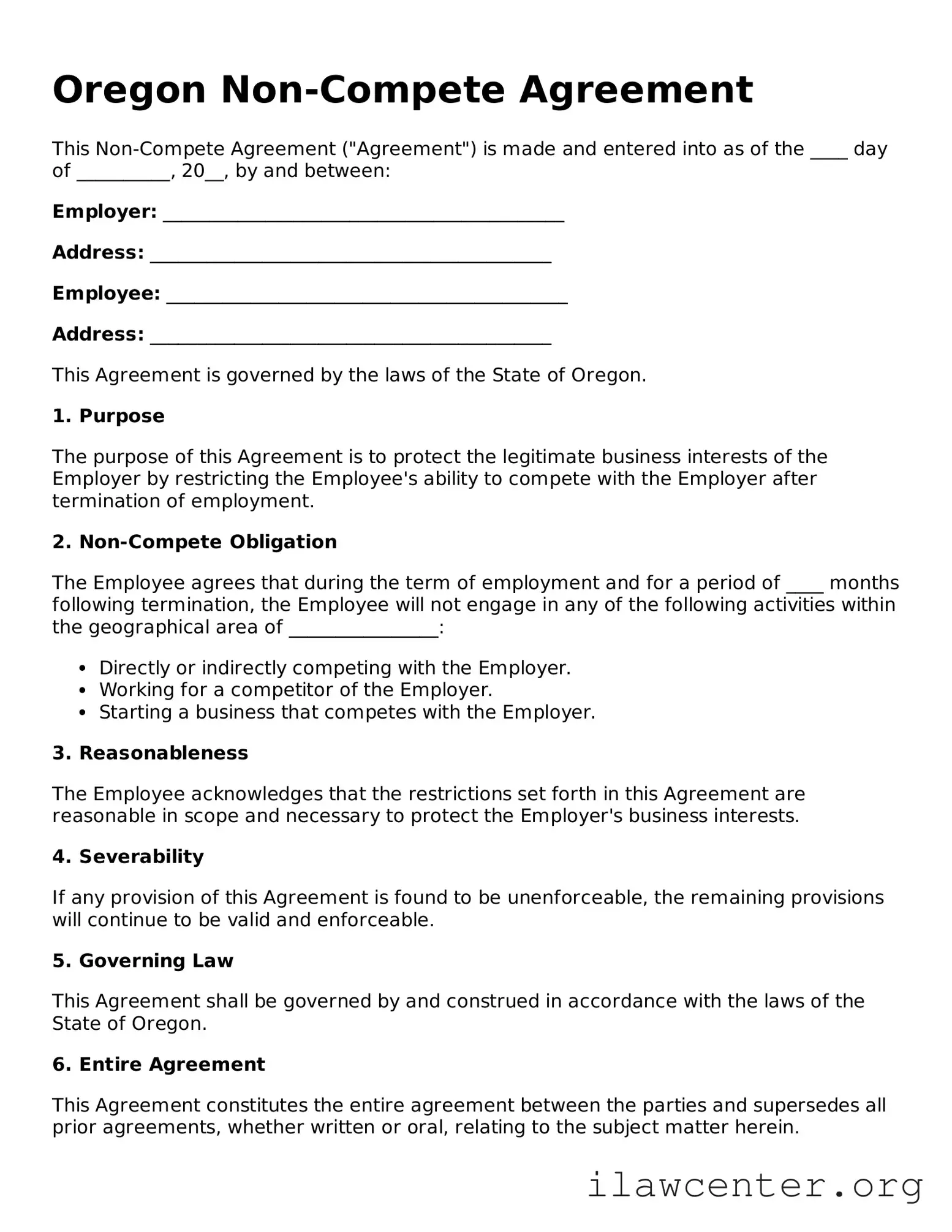
Oregon Non-compete Agreement Preview

Oregon Non-Compete Agreement

This Non-Compete Agreement ("Agreement") is made and entered into as of the ____ day of __________, 20__, by and between:

Employer: ___________________________________________

Address: ___________________________________________

Employee: ___________________________________________

Address: ___________________________________________

This Agreement is governed by the laws of the State of Oregon.

1. Purpose

The purpose of this Agreement is to protect the legitimate business interests of the Employer by restricting the Employee's ability to compete with the Employer after termination of employment.

2. Non-Compete Obligation

The Employee agrees that during the term of employment and for a period of ____ months following termination, the Employee will not engage in any of the following activities within the geographical area of ________________:

  • Directly or indirectly competing with the Employer.
  • Working for a competitor of the Employer.
  • Starting a business that competes with the Employer.

3. Reasonableness

The Employee acknowledges that the restrictions set forth in this Agreement are reasonable in scope and necessary to protect the Employer's business interests.

4. Severability

If any provision of this Agreement is found to be unenforceable, the remaining provisions will continue to be valid and enforceable.

5. Governing Law

This Agreement shall be governed by and construed in accordance with the laws of the State of Oregon.

6. Entire Agreement

This Agreement constitutes the entire agreement between the parties and supersedes all prior agreements, whether written or oral, relating to the subject matter herein.

IN WITNESS WHEREOF, the parties have executed this Non-Compete Agreement as of the date first above written.

Employer Signature: ____________________________

Date: ________________

Employee Signature: ____________________________

Date: ________________

PDF Form Characteristics

Fact Name Description
Governing Law The Oregon Non-compete Agreement is governed by Oregon Revised Statutes, specifically ORS 653.295.
Duration Limit In Oregon, a non-compete agreement cannot exceed 18 months in duration.
Geographic Scope The agreement must specify a reasonable geographic area where the restrictions apply.
Consideration Requirement For the agreement to be enforceable, there must be adequate consideration, such as a job offer or promotion.
Employee Rights Employees have the right to request a copy of the non-compete agreement before signing it.
Industry Exceptions Certain industries, like technology and healthcare, may have specific rules or exceptions regarding non-compete agreements.
Judicial Enforcement Oregon courts may refuse to enforce non-compete agreements that are overly broad or unreasonable in scope.

Instructions on Utilizing Oregon Non-compete Agreement

Completing the Oregon Non-compete Agreement form is an important step in establishing the terms of a non-compete arrangement. After filling out the form, it will need to be reviewed and signed by both parties involved. This ensures that all parties understand their rights and obligations under the agreement.

  1. Begin by obtaining the Oregon Non-compete Agreement form from a reliable source.
  2. Read through the form carefully to understand its sections and requirements.
  3. Fill in the names of the parties involved in the agreement at the top of the form.
  4. Provide the effective date of the agreement, which is the date when the non-compete terms will begin.
  5. Specify the duration of the non-compete period, detailing how long the agreement will remain in effect.
  6. Clearly outline the geographic area where the non-compete restrictions will apply.
  7. Include a description of the activities that will be restricted under the agreement.
  8. Review all filled sections for accuracy and completeness.
  9. Have both parties sign and date the form to validate the agreement.
  10. Keep a copy of the signed agreement for your records.

Important Facts about Oregon Non-compete Agreement

What is a Non-compete Agreement in Oregon?

A Non-compete Agreement is a contract between an employer and an employee that restricts the employee from working for a competitor or starting a competing business for a specified period after leaving the company. In Oregon, these agreements must meet certain criteria to be enforceable, including a legitimate business interest and reasonable duration and geographic scope.

What are the requirements for a Non-compete Agreement to be enforceable in Oregon?

In Oregon, for a Non-compete Agreement to be enforceable, it must be in writing and signed by both parties. Additionally, the agreement must be based on a legitimate business interest, such as protecting trade secrets or maintaining customer relationships. The duration of the restriction cannot exceed 18 months, and the geographic area must be reasonable and not overly broad.

Can an employer enforce a Non-compete Agreement if it was signed after employment began?

Yes, an employer can enforce a Non-compete Agreement signed after employment began, but specific conditions apply. The agreement must provide additional consideration, such as a promotion or bonus, to be valid. Simply requiring an employee to sign a Non-compete Agreement without any additional benefit may not be sufficient for enforcement.

What happens if an employee violates a Non-compete Agreement?

If an employee violates a Non-compete Agreement, the employer may take legal action to enforce the agreement. This could include seeking an injunction to prevent the employee from working for a competitor or pursuing damages for any losses incurred due to the violation. The outcome will depend on the specific terms of the agreement and the circumstances surrounding the case.

Are there any exceptions to Non-compete Agreements in Oregon?

Yes, there are exceptions. For instance, Non-compete Agreements cannot be enforced against employees who are laid off or terminated without cause. Additionally, certain professions, such as those in healthcare, may have different rules regarding the enforceability of Non-compete Agreements. It is important to consult the specific regulations that apply to each profession.

How can an employee challenge a Non-compete Agreement?

An employee can challenge a Non-compete Agreement by arguing that it does not meet the enforceability criteria set forth by Oregon law. This may include demonstrating that the agreement lacks a legitimate business interest, is overly broad in duration or geographic scope, or that it was signed without sufficient consideration. Legal counsel can provide guidance on the best approach for challenging the agreement.

Is it advisable for employees to seek legal advice before signing a Non-compete Agreement?

Yes, it is advisable for employees to seek legal advice before signing a Non-compete Agreement. Understanding the terms and potential implications of the agreement is crucial. A legal professional can help clarify rights and obligations, ensuring that employees make informed decisions before entering into such contracts.
Common mistakes

When filling out the Oregon Non-compete Agreement form, individuals often overlook important details that can lead to misunderstandings or legal complications. One common mistake is failing to specify the duration of the non-compete clause. Without a clear timeline, the agreement may be deemed unenforceable. It is crucial to define how long the restrictions will apply after leaving the job.

Another frequent error is neglecting to outline the geographic scope of the non-compete. Simply stating “anywhere” can create confusion. Instead, it is better to specify particular regions or areas where the restrictions will apply. This clarity helps both parties understand the limits of the agreement.

People sometimes underestimate the importance of consideration. A non-compete agreement must offer something of value in return for the restrictions placed on the employee. If this element is missing, the agreement may not hold up in court. Clearly stating what the employee receives—such as training or access to proprietary information—can help validate the agreement.

Additionally, individuals often forget to review the terms of their employment contract before signing the non-compete. If the employment agreement contains conflicting terms, it can lead to disputes down the line. It is wise to ensure that the non-compete aligns with other contractual obligations.

Misunderstanding the enforceability of the agreement is another common pitfall. Not all non-compete clauses are enforceable in Oregon, especially if they are overly broad or unreasonable. It is essential to be aware of the state laws governing non-compete agreements to avoid signing something that may not be valid.

Some individuals fail to seek legal advice before signing the agreement. Consulting with an attorney can provide valuable insights and help identify any problematic clauses. This step can save time and resources in the future, making it a wise choice.

Finally, people often rush through the process without thoroughly reading the entire document. Each section deserves attention, as seemingly minor details can have significant implications. Taking the time to review the agreement carefully can prevent future misunderstandings and legal issues.

Documents used along the form

When drafting or reviewing an Oregon Non-compete Agreement, several other documents may be relevant to ensure comprehensive protection of interests. Below is a list of forms and documents that often accompany a Non-compete Agreement.

  • Employment Agreement: This document outlines the terms of employment, including job responsibilities, compensation, and duration. It often includes clauses related to confidentiality and non-solicitation.
  • Confidentiality Agreement: Also known as a Non-disclosure Agreement (NDA), this form protects sensitive information shared between the employer and employee during and after employment.
  • Non-solicitation Agreement: This document prevents an employee from soliciting clients or employees of the company for a specified period after leaving the organization.
  • Severance Agreement: This agreement outlines the terms under which an employee may receive severance pay upon termination. It often includes clauses related to non-compete and confidentiality.
  • Intellectual Property Assignment Agreement: This form ensures that any intellectual property created by an employee during their tenure belongs to the employer.
  • Offer Letter: An offer letter details the terms of employment being offered to a candidate, including position, salary, and any contingencies related to the Non-compete Agreement.
  • Release of Claims: This document is signed by an employee to waive any potential claims against the employer, often required in conjunction with severance packages.

Understanding these documents is crucial for both employers and employees. They work together to create a clear framework for the employment relationship and protect the interests of all parties involved.

Similar forms

  • Non-disclosure Agreement (NDA): This document prevents individuals from sharing confidential information learned during their employment. Like a non-compete, it protects business interests.
  • Employment Contract: This outlines the terms of employment, including duties, compensation, and any restrictions on future employment, similar to a non-compete agreement.
  • Severance Agreement: Often includes clauses that restrict future employment with competitors, protecting the employer’s interests after termination.
  • Confidentiality Agreement: Similar to an NDA, it ensures that sensitive information remains private, which is crucial for business operations.
  • Partnership Agreement: This document can include non-compete clauses to prevent partners from starting competing businesses during and after the partnership.
  • Consulting Agreement: Often includes non-compete provisions to protect the client’s business interests while the consultant provides services.
  • Franchise Agreement: This can restrict franchisees from competing against the franchisor during and after the franchise period.
  • Trade Secret Agreement: Protects proprietary information and can include non-compete clauses to prevent misuse of trade secrets.
  • Independent Contractor Agreement: May contain non-compete terms to limit the contractor's ability to work with competitors after the contract ends.
  • Shareholder Agreement: Can include non-compete clauses to protect the business from competition by shareholders after they exit the company.

Dos and Don'ts

When filling out the Oregon Non-compete Agreement form, it’s crucial to approach the task with care. Here’s a list of things you should and shouldn’t do to ensure the process goes smoothly and effectively.

  • Do read the entire agreement thoroughly before signing.
  • Do consult with a legal professional if you have questions or concerns.
  • Do ensure that all terms are clear and understandable.
  • Do keep a copy of the signed agreement for your records.
  • Don't rush through the form; take your time to understand each section.
  • Don't ignore any clauses that seem vague or overly restrictive.
  • Don't forget to check for any state-specific requirements that may apply.
  • Don't sign the agreement if you feel pressured or uncertain about its implications.

Misconceptions

Non-compete agreements can be confusing, especially in Oregon. Here are eight common misconceptions about the Oregon Non-compete Agreement form, along with clarifications for each.

  1. All employees must sign a non-compete agreement.

    Not true. Employers can choose whether to require non-compete agreements, but they are not mandatory for all employees.

  2. Non-compete agreements are always enforceable.

    This is a misconception. In Oregon, non-compete agreements must meet specific criteria to be enforceable, including a maximum duration of 18 months.

  3. Non-compete agreements apply to any job.

    Incorrect. Oregon law restricts non-compete agreements to specific types of employees, typically those with access to sensitive information or trade secrets.

  4. Signing a non-compete means you can never work in your field again.

    This is misleading. A non-compete may limit where and how you can work, but it does not permanently bar you from your profession.

  5. Non-compete agreements are the same as non-disclosure agreements.

    These are different. A non-compete restricts employment opportunities, while a non-disclosure agreement protects confidential information.

  6. Employers can change the terms of a non-compete agreement at any time.

    This is false. Any changes must be agreed upon by both parties and typically require new consideration.

  7. Non-compete agreements are only for high-level executives.

    This is not entirely accurate. Non-compete agreements can be applied to various employees, depending on the nature of their work and access to proprietary information.

  8. Oregon law does not protect employees from unfair non-compete agreements.

    This is incorrect. Oregon has specific laws in place to protect employees, including limitations on the enforceability of non-compete agreements.

Key takeaways

When filling out and using the Oregon Non-compete Agreement form, it's essential to keep several key points in mind. These takeaways can help ensure that the agreement is effective and compliant with state laws.

  • Understand the Purpose: A non-compete agreement restricts an employee from working for competitors or starting a competing business for a specified period after leaving a job.
  • Know the Legal Framework: Oregon law has specific requirements for non-compete agreements to be enforceable, including a maximum duration and geographic scope.
  • Limit Duration: The agreement can typically last no longer than 18 months. Ensure the time frame is reasonable based on the industry.
  • Define Geographic Scope: Clearly outline the geographic area where the restrictions apply. A vague description may render the agreement unenforceable.
  • Consider Consideration: For the agreement to be valid, the employee must receive something of value in exchange, such as a job offer or promotion.
  • Be Clear and Specific: Use straightforward language to avoid ambiguity. Clearly define what constitutes a competing business.
  • Review and Revise: Regularly review the agreement to ensure it remains relevant and compliant with any changes in law or business practices.
  • Consult Legal Counsel: It’s wise to seek legal advice when drafting or enforcing a non-compete agreement to ensure it meets all legal requirements.
  • Communicate with Employees: Clearly explain the terms of the agreement to employees before they sign. Transparency can prevent misunderstandings later.