Attorney-Verified  Promissory Note Document for Oregon

Attorney-Verified Promissory Note Document for Oregon

A Promissory Note is a legal document in Oregon that outlines a borrower's promise to repay a loan to a lender under specific terms. This form serves as a written record of the loan agreement, detailing the amount borrowed, interest rates, and repayment schedule. To get started on your loan agreement, fill out the form by clicking the button below.

Article Guide

The Oregon Promissory Note form serves as a crucial document in financial transactions, particularly when one party borrows money from another. This form outlines the terms of the loan, including the principal amount, interest rate, and repayment schedule. It also specifies the rights and responsibilities of both the borrower and the lender, ensuring clarity and protection for both sides. In Oregon, this form must be completed accurately to be legally binding, and it may include additional provisions tailored to specific agreements. Understanding the key components of the Promissory Note is essential for anyone involved in lending or borrowing, as it helps prevent misunderstandings and provides a clear framework for repayment. Whether you are a seasoned investor or a first-time borrower, familiarity with this form can lead to smoother financial dealings and peace of mind.

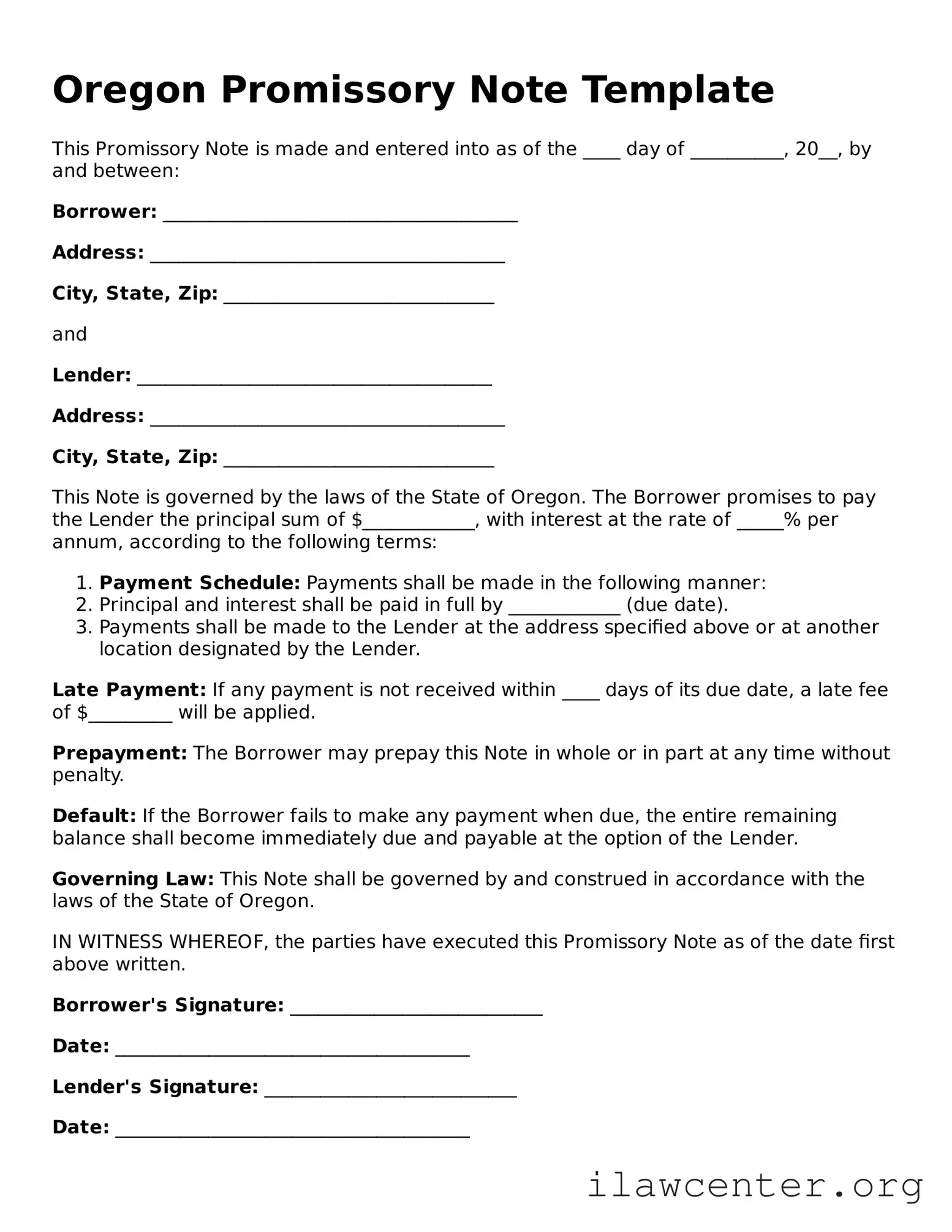
Oregon Promissory Note Preview

Oregon Promissory Note Template

This Promissory Note is made and entered into as of the ____ day of __________, 20__, by and between:

Borrower: ______________________________________

Address: ______________________________________

City, State, Zip: _____________________________

and

Lender: ______________________________________

Address: ______________________________________

City, State, Zip: _____________________________

This Note is governed by the laws of the State of Oregon. The Borrower promises to pay the Lender the principal sum of $____________, with interest at the rate of _____% per annum, according to the following terms:

  1. Payment Schedule: Payments shall be made in the following manner:
  2. Principal and interest shall be paid in full by ____________ (due date).
  3. Payments shall be made to the Lender at the address specified above or at another location designated by the Lender.

Late Payment: If any payment is not received within ____ days of its due date, a late fee of $_________ will be applied.

Prepayment: The Borrower may prepay this Note in whole or in part at any time without penalty.

Default: If the Borrower fails to make any payment when due, the entire remaining balance shall become immediately due and payable at the option of the Lender.

Governing Law: This Note shall be governed by and construed in accordance with the laws of the State of Oregon.

IN WITNESS WHEREOF, the parties have executed this Promissory Note as of the date first above written.

Borrower's Signature: ___________________________

Date: ______________________________________

Lender's Signature: ___________________________

Date: ______________________________________

PDF Form Characteristics

Fact Name Description
Definition An Oregon Promissory Note is a written promise to pay a specific amount of money to a designated person or entity at a specified time.
Governing Law The Oregon Promissory Note is governed by the Oregon Uniform Commercial Code (UCC), specifically ORS Chapter 73.
Parties Involved The note involves two main parties: the borrower (maker) and the lender (payee).
Interest Rate The interest rate can be fixed or variable, depending on the agreement between the parties.
Payment Terms Payment terms should clearly outline the due dates and any installment amounts, if applicable.
Default Conditions Default conditions should be specified, detailing what constitutes a default and the consequences thereof.
Notarization While notarization is not required, it is recommended to enhance the note's enforceability.
Transferability Promissory notes in Oregon can be transferred or assigned to another party unless restricted by the terms of the note.
Legal Remedies If the borrower defaults, the lender may pursue legal remedies, including seeking a judgment for the owed amount.
State-Specific Requirements Oregon does not require specific language in the promissory note, but clarity and completeness are essential for enforceability.

Instructions on Utilizing Oregon Promissory Note

After obtaining the Oregon Promissory Note form, it's essential to fill it out accurately to ensure clarity and enforceability. Follow these steps to complete the form correctly.

  1. Identify the Parties: Begin by entering the names and addresses of both the borrower and the lender at the top of the form.
  2. Specify the Loan Amount: Clearly state the total amount of money being borrowed. This should be written in both numbers and words to avoid any confusion.
  3. Set the Interest Rate: If applicable, indicate the interest rate that will be charged on the loan. Make sure to specify whether it is fixed or variable.
  4. Outline the Repayment Terms: Detail how and when the borrower will repay the loan. Include the payment frequency (e.g., monthly, quarterly) and the final due date.
  5. Include Late Fees: If there are any late fees for missed payments, specify the amount or percentage that will be charged.
  6. Signatures: Both the borrower and the lender must sign and date the form. This indicates that both parties agree to the terms outlined in the note.

Once the form is completed and signed, ensure that both parties keep a copy for their records. This will provide a clear reference for the terms of the loan in the future.

Important Facts about Oregon Promissory Note

What is a Promissory Note in Oregon?

A Promissory Note is a written promise to pay a specified amount of money to a designated person or entity at a future date or on demand. In Oregon, this document serves as a legal agreement between a borrower and a lender, outlining the terms of the loan, including the principal amount, interest rate, repayment schedule, and any applicable fees. It is crucial for both parties to understand their rights and obligations as defined in the note.

What information is required to complete an Oregon Promissory Note?

To properly complete an Oregon Promissory Note, several key pieces of information must be included. This includes the names and addresses of both the borrower and the lender, the total loan amount, the interest rate (if any), the payment schedule, and the due date for the final payment. Additionally, any specific terms regarding late fees or prepayment options should be clearly stated. Ensuring that all relevant details are included helps prevent misunderstandings in the future.

Is a Promissory Note legally binding in Oregon?

Yes, a Promissory Note is considered a legally binding contract in Oregon, provided it meets certain criteria. For the note to be enforceable, it must contain clear terms and be signed by both parties. It is advisable for both the borrower and lender to keep a copy of the signed note for their records. In the event of a dispute, this document can serve as crucial evidence in court.

Can a Promissory Note be modified after it is signed?

Yes, a Promissory Note can be modified after it is signed, but both parties must agree to the changes. It is important to document any modifications in writing and have both parties sign the amended agreement. This ensures that the updated terms are clear and legally enforceable. Verbal agreements regarding changes are generally not sufficient and can lead to confusion or disputes later on.

What happens if the borrower defaults on the Promissory Note?

If the borrower defaults on the Promissory Note, the lender has several options for recourse. Typically, the lender may initiate legal proceedings to recover the owed amount. This could involve filing a lawsuit or seeking a judgment against the borrower. Additionally, the lender may pursue other remedies outlined in the note, such as late fees or acceleration of the loan. It is essential for both parties to understand the implications of default and to communicate openly to resolve issues before they escalate.

Common mistakes

When filling out the Oregon Promissory Note form, individuals often overlook critical details that can lead to complications. One common mistake is failing to include the correct names of the parties involved. The lender's and borrower's names must be clearly stated to avoid any confusion regarding who is responsible for repayment.

Another frequent error is neglecting to specify the loan amount. This figure should be precise and unambiguous. Ambiguities regarding the amount can lead to disputes later on. It is essential to double-check that the amount written in words matches the numerical figure.

People sometimes forget to outline the interest rate. Without this information, the terms of repayment may become unclear. A clearly defined interest rate protects both the lender and borrower by setting expectations upfront.

Additionally, failing to indicate the repayment schedule is a common oversight. The note should specify when payments are due, whether they are monthly, quarterly, or otherwise. This clarity helps both parties manage their financial obligations effectively.

Another mistake is not including a default clause. This clause outlines the consequences if the borrower fails to make payments. Without it, the lender may face challenges in enforcing the agreement if the borrower defaults.

Some individuals neglect to sign the document. A signature is crucial as it signifies agreement to the terms laid out in the note. Without a signature, the document may not be considered legally binding.

People may also fail to date the note. A date provides a timeline for the agreement and can be critical in determining when payments are due or when a default occurs. Always ensure the date is current and accurately reflects when the agreement was made.

Another mistake involves not providing a clear description of the collateral, if applicable. If the loan is secured by collateral, it should be detailed in the note. This protects the lender's interests and clarifies what is at stake.

Omitting witness signatures can also be problematic. Depending on the situation, having a witness can lend additional credibility to the agreement. Always check whether a witness is required for your specific circumstances.

Finally, individuals sometimes fail to keep copies of the signed document. Retaining a copy is vital for both parties. It ensures that everyone has access to the terms of the agreement and can refer back to it if necessary.

Documents used along the form

When creating a financial agreement in Oregon, a Promissory Note is often accompanied by various other documents. These documents help clarify the terms of the loan and provide additional legal protections for both parties involved.

  • Loan Agreement: This document outlines the terms of the loan, including the interest rate, repayment schedule, and any conditions that must be met by either party.
  • Security Agreement: If the loan is secured by collateral, this agreement specifies what assets are being used as security and the terms surrounding that security.
  • Disclosure Statement: This document provides important information about the loan, including fees, terms, and any potential risks associated with the borrowing.
  • Guaranty Agreement: If a third party agrees to guarantee the loan, this document details their obligations and responsibilities in case of default by the borrower.
  • Amortization Schedule: This schedule breaks down the repayment plan, showing how much will be paid in principal and interest over time.
  • Default Notice: This document outlines the steps that will be taken if the borrower fails to meet the repayment terms, including potential legal actions.
  • Payment Receipt: A record of each payment made under the terms of the Promissory Note, which can serve as proof of payment history.
  • Release of Liability: If the loan is paid off, this document releases the borrower from any further obligations and acknowledges that the debt has been settled.
  • Modification Agreement: If any changes need to be made to the original terms of the Promissory Note, this document formally outlines those modifications.

Using these documents in conjunction with the Oregon Promissory Note can help ensure that all parties understand their rights and responsibilities. Clear documentation can prevent misunderstandings and provide a solid foundation for the loan agreement.

Similar forms

The Promissory Note is a key financial document, but it shares similarities with several other important documents. Here are nine documents that are similar to a Promissory Note:

  • Loan Agreement: Like a Promissory Note, a loan agreement outlines the terms of borrowing money, including repayment schedules and interest rates.
  • Mortgage: A mortgage secures a loan with real property. It includes terms of repayment and can be considered a form of a Promissory Note when it involves a promise to repay.
  • Installment Agreement: This document specifies the terms under which a borrower will make payments over time, similar to the structure of a Promissory Note.
  • Credit Agreement: A credit agreement defines the terms under which credit is extended, including repayment obligations, much like a Promissory Note.
  • Lease Agreement: In some cases, a lease agreement may contain a promise to pay rent, paralleling the promise found in a Promissory Note.
  • Personal Guarantee: This document involves a promise to repay a debt if the primary borrower defaults, akin to the obligations in a Promissory Note.
  • Debt Settlement Agreement: It outlines the terms for settling a debt, including payment plans, similar to the repayment terms in a Promissory Note.
  • Loan Modification Agreement: This document changes the terms of an existing loan, including payment schedules, which relates closely to the terms in a Promissory Note.
  • Security Agreement: A security agreement grants a lender rights to specific collateral, often linked to a Promissory Note that details the loan terms.

Dos and Don'ts

When filling out the Oregon Promissory Note form, there are several important considerations to keep in mind. Here are six things you should and shouldn't do:

  • Do read the instructions carefully before starting.
  • Don't leave any blank spaces; fill in all required fields.
  • Do use clear and legible handwriting if completing the form by hand.
  • Don't use abbreviations or shorthand that could cause confusion.
  • Do double-check all figures and terms for accuracy.
  • Don't sign the form until all parties are present and in agreement.

Misconceptions

When it comes to the Oregon Promissory Note form, several misconceptions can lead to confusion. Here are six common myths debunked.

  1. All promissory notes are the same.

    Many people think that a promissory note is just a generic document. In reality, each state has specific requirements, and the Oregon Promissory Note form has unique elements that must be included.

  2. A promissory note doesn’t need to be in writing.

    Some believe that verbal agreements are enough. However, having a written document is essential for legal enforceability in Oregon.

  3. Only banks can issue promissory notes.

    This is a common misconception. Individuals can create and sign promissory notes, not just financial institutions.

  4. Promissory notes don’t require interest.

    While it’s possible to create a no-interest note, many people think interest is optional. In Oregon, the terms must be clearly stated, including any interest rate.

  5. Once signed, a promissory note cannot be changed.

    Some assume that modifications are impossible. In fact, both parties can agree to amend the terms, but it should be documented properly.

  6. Enforcing a promissory note is easy.

    Many think that if someone defaults, it’s a straightforward process. In reality, enforcing a promissory note can involve legal complexities and may require court action.

Understanding these misconceptions can help you navigate the process more effectively. Always consider seeking advice if you’re unsure about any details regarding promissory notes in Oregon.

Key takeaways

When dealing with financial transactions in Oregon, understanding the Promissory Note form is essential. Here are some key takeaways to keep in mind:

  • Purpose of the Note: A Promissory Note is a legal document that outlines a borrower's promise to repay a loan under specific terms.
  • Parties Involved: The form identifies the borrower and lender, making it clear who is responsible for repayment and who is owed the money.
  • Loan Amount: Clearly state the principal amount being borrowed. This figure is crucial for both parties.
  • Interest Rate: Specify the interest rate, if applicable. This determines how much extra the borrower will pay over time.
  • Repayment Terms: Detail the repayment schedule, including due dates and the frequency of payments, whether monthly, quarterly, or otherwise.
  • Late Fees: Include any penalties for late payments. This can motivate timely repayment and protect the lender's interests.
  • Signatures: Both parties must sign the document. This step is vital for the note to be legally binding.
  • Record Keeping: Keep a copy of the signed Promissory Note for personal records. This document serves as proof of the agreement.

Understanding these elements can help ensure that both borrowers and lenders are on the same page, reducing the likelihood of disputes down the road.