Attorney-Verified  Real Estate Purchase Agreement Document for Oregon

Attorney-Verified Real Estate Purchase Agreement Document for Oregon

The Oregon Real Estate Purchase Agreement is a legally binding document that outlines the terms and conditions of a real estate transaction in Oregon. This form serves as a crucial tool for buyers and sellers, ensuring that both parties understand their rights and responsibilities. To get started on your real estate journey, fill out the form by clicking the button below.

Article Guide

The Oregon Real Estate Purchase Agreement form serves as a critical document in the home buying process, establishing the terms and conditions under which a property will be sold. This form outlines essential details such as the purchase price, financing arrangements, and the closing date, ensuring that both buyers and sellers have a clear understanding of their obligations. It also includes provisions for contingencies, which protect buyers by allowing them to back out of the deal under specific circumstances, such as unsatisfactory inspections or financing issues. Additionally, the form addresses earnest money deposits, which demonstrate the buyer's commitment to the transaction. By detailing the rights and responsibilities of both parties, the Oregon Real Estate Purchase Agreement fosters transparency and helps facilitate a smooth transfer of ownership. Understanding this form is crucial for anyone involved in a real estate transaction in Oregon, as it lays the groundwork for a successful deal.

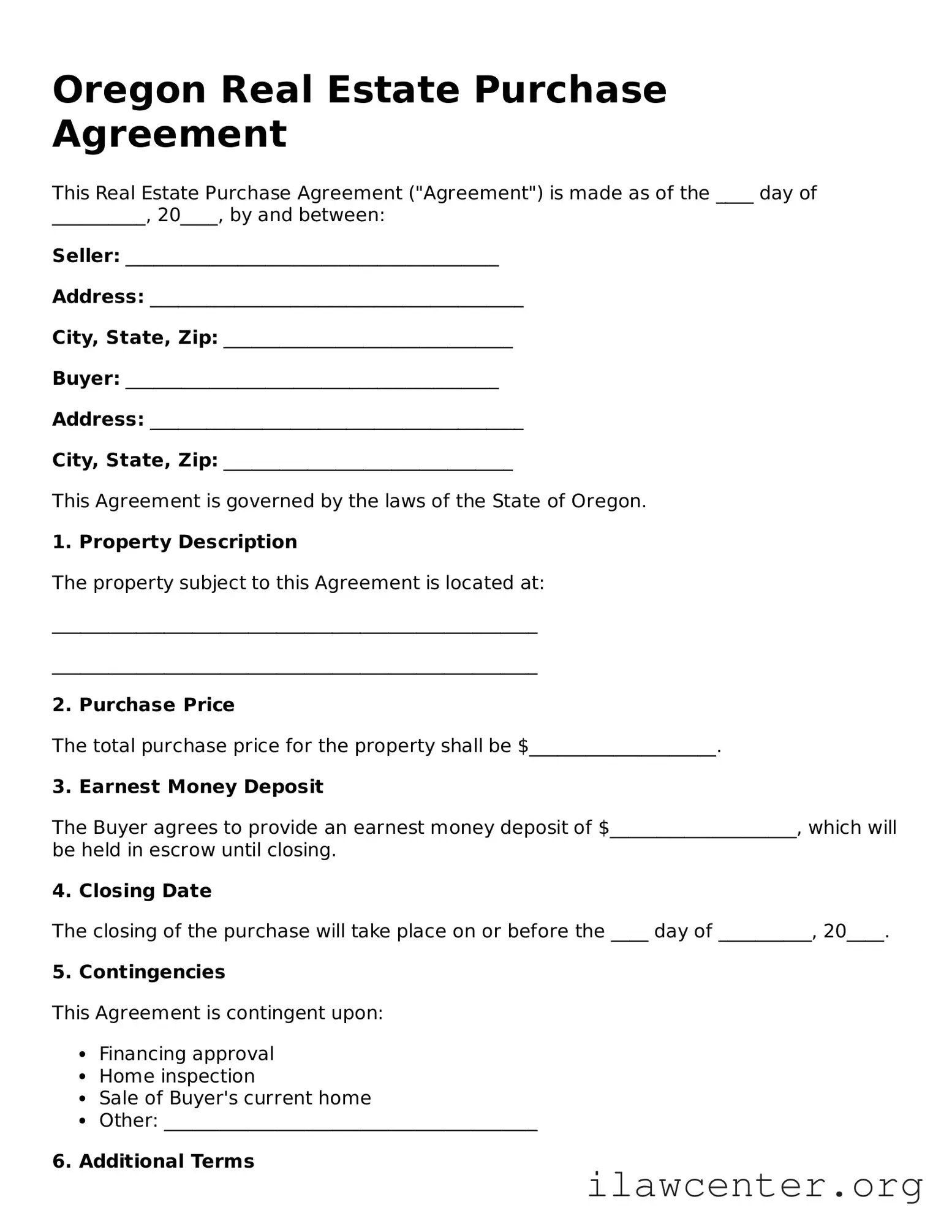
Oregon Real Estate Purchase Agreement Preview

Oregon Real Estate Purchase Agreement

This Real Estate Purchase Agreement ("Agreement") is made as of the ____ day of __________, 20____, by and between:

Seller: ________________________________________

Address: ________________________________________

City, State, Zip: _______________________________

Buyer: ________________________________________

Address: ________________________________________

City, State, Zip: _______________________________

This Agreement is governed by the laws of the State of Oregon.

1. Property Description

The property subject to this Agreement is located at:

____________________________________________________

____________________________________________________

2. Purchase Price

The total purchase price for the property shall be $____________________.

3. Earnest Money Deposit

The Buyer agrees to provide an earnest money deposit of $____________________, which will be held in escrow until closing.

4. Closing Date

The closing of the purchase will take place on or before the ____ day of __________, 20____.

5. Contingencies

This Agreement is contingent upon:

  • Financing approval
  • Home inspection
  • Sale of Buyer's current home
  • Other: ________________________________________

6. Additional Terms

____________________________________________________

____________________________________________________

7. Signatures

By signing below, both parties agree to the terms of this Agreement.

______________________________

Seller's Signature

______________________________

Buyer's Signature

Date: ________________________

PDF Form Characteristics

Fact Name Details
Purpose The Oregon Real Estate Purchase Agreement is used to outline the terms and conditions for the sale of real property in Oregon.
Governing Law This agreement is governed by the laws of the State of Oregon.
Key Components Essential elements include purchase price, property description, and contingencies.
Signatures Required Both the buyer and seller must sign the agreement for it to be legally binding.
Contingencies Common contingencies may include financing, inspections, and appraisal conditions.

Instructions on Utilizing Oregon Real Estate Purchase Agreement

Filling out the Oregon Real Estate Purchase Agreement form is an important step in the real estate transaction process. Completing this form accurately ensures that both the buyer and seller are on the same page regarding the terms of the sale. Once the form is filled out, it will be submitted for review and signatures to move forward with the transaction.

  1. Begin by entering the date at the top of the form.
  2. Fill in the names and contact information of both the buyer and the seller.
  3. Provide the property address, including city, state, and ZIP code.
  4. Specify the purchase price of the property.
  5. Indicate the amount of earnest money the buyer will provide.
  6. Outline the financing terms, including whether the buyer will be using a loan or paying cash.
  7. Detail any contingencies, such as home inspections or financing approval.
  8. Include the closing date and any specific terms related to the closing process.
  9. Sign and date the form at the designated areas for both the buyer and seller.
  10. Ensure all necessary attachments, such as disclosures or addendums, are included with the agreement.

Important Facts about Oregon Real Estate Purchase Agreement

What is the Oregon Real Estate Purchase Agreement form?

The Oregon Real Estate Purchase Agreement form is a legal document used in real estate transactions within the state of Oregon. It outlines the terms and conditions under which a buyer agrees to purchase property from a seller. This form is essential for both parties as it provides a clear framework for the transaction, detailing aspects such as the purchase price, financing arrangements, and any contingencies that may apply.

Who should use the Oregon Real Estate Purchase Agreement?

This form is typically used by buyers and sellers involved in residential real estate transactions in Oregon. Real estate agents, brokers, and attorneys often assist their clients in completing this document to ensure that all necessary terms are included and that the agreement complies with state laws.

What key elements are included in the agreement?

The agreement includes several critical components. These typically encompass the purchase price, property description, earnest money deposit, contingencies (such as financing or inspection), closing date, and any specific terms agreed upon by both parties. Additionally, it may outline the responsibilities of both the buyer and seller, including disclosures and repairs.

What happens if either party wants to back out of the agreement?

If either party wishes to withdraw from the agreement, they must refer to the contingencies outlined in the document. For example, if the buyer's financing falls through or if a home inspection reveals significant issues, they may have the right to cancel the agreement without penalty. However, if a party backs out without a valid reason, they could face legal consequences or financial penalties.

Can the Oregon Real Estate Purchase Agreement be modified?

Yes, the agreement can be modified, but both parties must agree to any changes. Modifications should be documented in writing and signed by both the buyer and seller to ensure clarity and enforceability. Verbal agreements or informal changes may not hold up in a legal dispute.

Is it necessary to have a real estate agent when using this form?

While it is not strictly necessary to have a real estate agent when using the Oregon Real Estate Purchase Agreement form, having one can be beneficial. Agents are knowledgeable about local market conditions and legal requirements, which can help ensure that the agreement is completed accurately and effectively protects your interests.

Where can I obtain the Oregon Real Estate Purchase Agreement form?

The Oregon Real Estate Purchase Agreement form can be obtained from various sources, including real estate agencies, legal websites, and state real estate organizations. It is crucial to use the most current version of the form to ensure compliance with any recent changes in laws or regulations.
Common mistakes

Completing the Oregon Real Estate Purchase Agreement form requires careful attention to detail. One common mistake is failing to provide accurate property descriptions. Buyers and sellers must ensure that the property address, legal description, and any relevant parcel numbers are correct. Inaccuracies can lead to disputes and complications during the transaction process.

Another frequent error involves the omission of essential terms. Parties often overlook critical elements such as purchase price, earnest money, and financing contingencies. These details are vital for establishing clear expectations. Without them, misunderstandings can arise, potentially jeopardizing the agreement.

Additionally, many individuals neglect to include necessary disclosures. Oregon law mandates that sellers disclose specific information about the property, including any known defects or issues. Failing to provide this information can result in legal consequences and may affect the buyer’s decision-making process.

Finally, improper signatures and dates can invalidate the agreement. Each party must sign and date the document correctly. Missing signatures or incorrect dates can lead to delays or disputes regarding the enforceability of the agreement. It is crucial to ensure that all parties have completed the form accurately before submission.

Documents used along the form

When engaging in a real estate transaction in Oregon, several forms and documents often accompany the Real Estate Purchase Agreement. These documents help clarify terms, protect the interests of both parties, and ensure compliance with state laws. Below is a list of commonly used forms.

  • Disclosure Statement: This document provides essential information about the property's condition. Sellers must disclose any known issues, such as structural problems or environmental hazards, ensuring buyers make informed decisions.
  • Title Report: A title report outlines the legal ownership of the property. It reveals any liens, easements, or other claims against the property, which can affect the buyer's rights and responsibilities.
  • Lead-Based Paint Disclosure: Required for homes built before 1978, this form informs buyers about potential lead-based paint hazards. Sellers must disclose any known presence of lead paint and provide buyers with relevant safety information.
  • Financing Addendum: This document details the financing terms agreed upon by the buyer and seller. It includes information about loan types, interest rates, and any contingencies related to securing financing.
  • Counteroffer Form: If the seller wishes to propose changes to the original offer, they will use a counteroffer form. This document outlines the modifications and is sent back to the buyer for consideration.

These documents play a crucial role in the real estate transaction process. Each serves a specific purpose, contributing to a transparent and legally sound agreement between the buyer and seller.

Similar forms

  • Lease Agreement: This document outlines the terms and conditions under which a property is rented. Like a Real Estate Purchase Agreement, it specifies the parties involved, the property description, and financial obligations, though it focuses on rental rather than purchase.

  • Option to Purchase Agreement: This agreement gives a buyer the right to purchase a property within a specified time frame. Similar to the Real Estate Purchase Agreement, it includes details about the property and purchase price but is contingent upon the buyer exercising their option.

  • Sales Contract: A sales contract serves as a broader term for agreements related to the sale of goods or services, including real estate. It shares similarities with the Real Estate Purchase Agreement in terms of outlining the responsibilities of both parties and the terms of the sale.

  • Seller's Disclosure Statement: This document provides information about the condition of the property being sold. While it is not an agreement itself, it complements the Real Estate Purchase Agreement by ensuring transparency regarding any known issues, which can affect the buyer's decision.

  • Title Commitment: A title commitment is a document issued by a title company that outlines the conditions under which a title insurance policy will be issued. Similar to the Real Estate Purchase Agreement, it is crucial for the transaction, as it ensures the buyer receives clear ownership of the property.

Dos and Don'ts

When filling out the Oregon Real Estate Purchase Agreement form, it is essential to approach the task with care and attention to detail. Below is a list of things you should and shouldn't do to ensure a smooth process.

  • Do read the entire form carefully before starting to fill it out. Understanding each section is crucial.
  • Do provide accurate and complete information. This includes names, addresses, and any other required details.
  • Do consult with a real estate professional or attorney if you have questions about any part of the agreement.
  • Do double-check all figures and dates for accuracy. Errors can lead to complications later on.
  • Don't leave any sections blank unless instructed. Incomplete forms can delay the process.
  • Don't rush through the process. Take your time to ensure everything is filled out correctly.

By following these guidelines, you can help ensure that your experience with the Oregon Real Estate Purchase Agreement is positive and efficient.

Misconceptions

The Oregon Real Estate Purchase Agreement form is a critical document in real estate transactions, yet several misconceptions surround its use and implications. Understanding these misconceptions can help both buyers and sellers navigate the process more effectively.

  • Misconception 1: The agreement is a binding contract as soon as it is signed.
  • While signing the agreement is a significant step, it becomes legally binding only when all parties have signed and any contingencies have been satisfied. Until that point, negotiations can continue.

  • Misconception 2: The form is a one-size-fits-all solution.
  • The Oregon Real Estate Purchase Agreement is customizable. Parties can add specific terms or conditions to meet their unique needs. This flexibility allows for tailored agreements that reflect the specifics of each transaction.

  • Misconception 3: Buyers are solely responsible for understanding the agreement.
  • Both buyers and sellers have an obligation to understand the terms of the agreement. It is advisable for both parties to seek legal counsel or professional advice to ensure they fully comprehend their rights and responsibilities.

  • Misconception 4: The agreement does not require a deposit.
  • A deposit, often referred to as "earnest money," is typically required to demonstrate the buyer's serious intent. This deposit is held in escrow and applied to the purchase price at closing.

  • Misconception 5: Once submitted, the agreement cannot be changed.
  • Changes can be made to the agreement before it is fully executed. Amendments can occur at any time during negotiations, as long as all parties agree to the new terms.

Key takeaways

Filling out the Oregon Real Estate Purchase Agreement form is an important step in the home buying process. Here are some key takeaways to consider:

  • Understand the Basics: Familiarize yourself with the main sections of the agreement. This includes details about the buyer, seller, property, and purchase price.
  • Be Accurate: Ensure that all information provided is correct. Mistakes can lead to delays or complications later on.
  • Contingencies Matter: Pay attention to contingencies. These are conditions that must be met for the sale to proceed, such as financing or inspections.
  • Review Deadlines: Note all important deadlines. Timely responses are crucial for keeping the transaction on track.
  • Seek Professional Help: Consider consulting a real estate agent or attorney. Their expertise can guide you through the complexities of the agreement.
  • Keep Copies: Always keep a copy of the signed agreement. This serves as a reference and protects your interests throughout the process.

By keeping these points in mind, you can navigate the Oregon Real Estate Purchase Agreement with confidence.