Attorney-Verified  Rental Application Document for Oregon

Attorney-Verified Rental Application Document for Oregon

The Oregon Rental Application form is a crucial document used by landlords to screen potential tenants. This form collects essential information about applicants, including their rental history, employment status, and references. If you're looking to secure a rental in Oregon, consider filling out this form by clicking the button below.

Article Guide

When navigating the rental market in Oregon, understanding the rental application form is crucial for both landlords and prospective tenants. This form serves as a key document that collects essential information about applicants, helping landlords assess their suitability for tenancy. Typically, the application requests personal details such as name, contact information, and social security number, alongside rental history and employment verification. Additionally, it may include questions about income to ensure that applicants can meet their financial obligations. Importantly, the form often requires consent for background checks, which can encompass credit history and criminal records. Familiarity with the Oregon rental application process not only aids landlords in making informed decisions but also empowers tenants to present themselves effectively. By knowing what to expect, both parties can foster a smoother rental experience and establish a foundation of trust and transparency.

Oregon Rental Application Preview

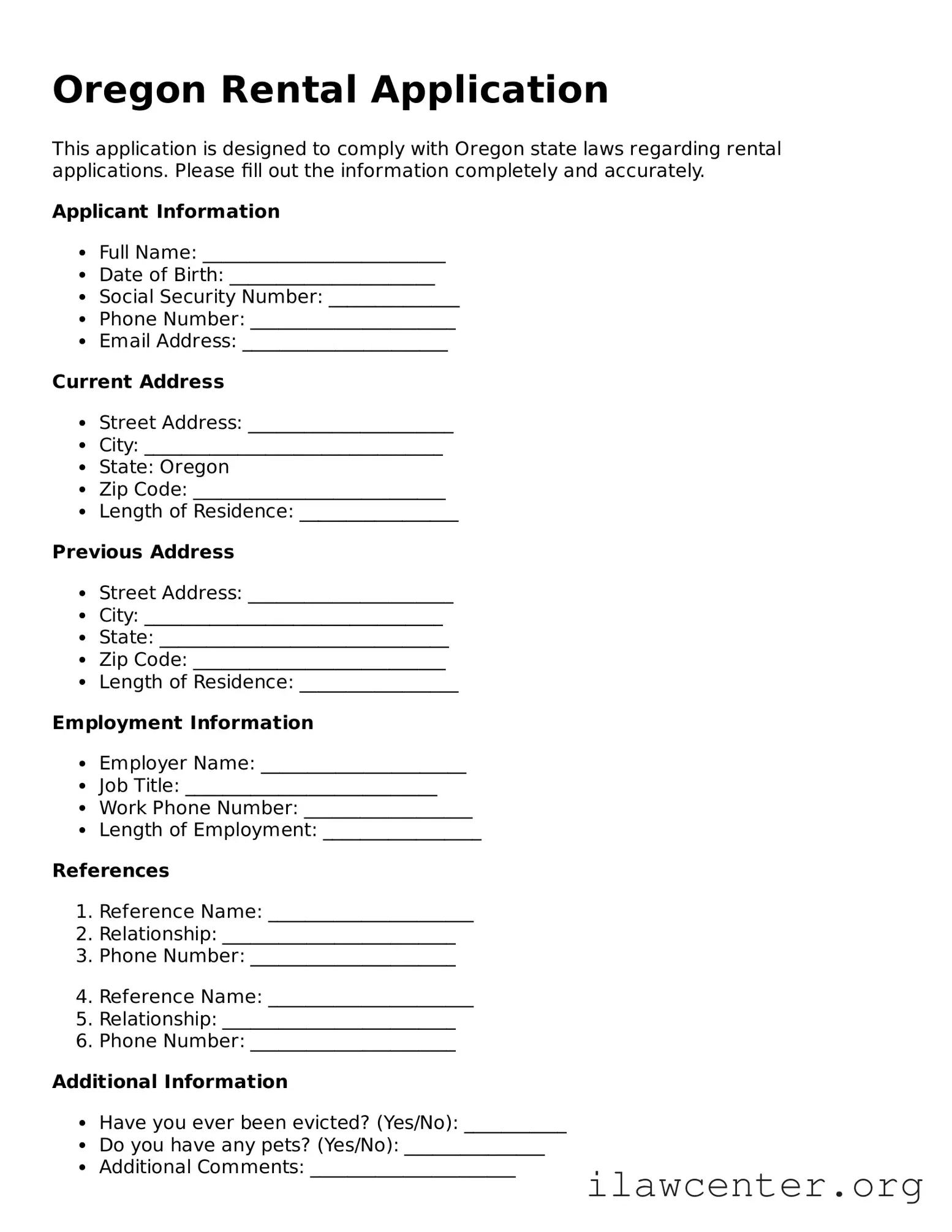
Oregon Rental Application

This application is designed to comply with Oregon state laws regarding rental applications. Please fill out the information completely and accurately.

Applicant Information

  • Full Name: __________________________
  • Date of Birth: ______________________
  • Social Security Number: ______________
  • Phone Number: ______________________
  • Email Address: ______________________

Current Address

  • Street Address: ______________________
  • City: ________________________________
  • State: Oregon
  • Zip Code: ___________________________
  • Length of Residence: _________________

Previous Address

  • Street Address: ______________________
  • City: ________________________________
  • State: _______________________________
  • Zip Code: ___________________________
  • Length of Residence: _________________

Employment Information

  • Employer Name: ______________________
  • Job Title: ___________________________
  • Work Phone Number: __________________
  • Length of Employment: _________________

References

  1. Reference Name: ______________________
  2. Relationship: _________________________
  3. Phone Number: ______________________
  1. Reference Name: ______________________
  2. Relationship: _________________________
  3. Phone Number: ______________________

Additional Information

  • Have you ever been evicted? (Yes/No): ___________
  • Do you have any pets? (Yes/No): _______________
  • Additional Comments: ______________________

By signing below, you certify that the information provided is accurate and complete.

Signature: ___________________________

Date: ________________________________

PDF Form Characteristics

Fact Name Details
Purpose The Oregon Rental Application form is used by landlords to screen potential tenants.
Required Information Applicants must provide personal details, rental history, employment information, and references.
Application Fee Landlords may charge an application fee, but it must be reasonable and disclosed upfront.
Governing Law The application process is governed by Oregon state law, specifically the Oregon Residential Landlord and Tenant Act.
Fair Housing Compliance Landlords must comply with federal and state fair housing laws, ensuring non-discrimination in the application process.
Retention of Applications Landlords are required to retain rental applications for at least one year after the application date.

Instructions on Utilizing Oregon Rental Application

After obtaining the Oregon Rental Application form, you are ready to begin the process of filling it out. This form is essential for landlords to assess potential tenants. Completing it accurately will facilitate a smoother application process.

  1. Start with your personal information. Fill in your full name, current address, and contact details, including phone number and email address.
  2. Provide employment details. Include your current employer's name, your job title, and the duration of your employment. If applicable, mention any previous employers.
  3. List your income sources. Clearly state your monthly income and any additional sources of income that may support your application.
  4. Fill out your rental history. List your previous addresses, including the landlord's contact information and the duration of your stay at each location.
  5. Disclose any criminal history if required. Some applications may ask about past criminal offenses. Be honest in your response.
  6. Provide references. Include names and contact information for personal or professional references who can vouch for your character.
  7. Review the application for accuracy. Ensure all information is correct and complete to avoid delays.
  8. Sign and date the application. Your signature indicates that the information provided is true and complete.

Once you have completed the form, submit it to the landlord or property manager along with any required fees. They will review your application and may contact you for further information or clarification.

Important Facts about Oregon Rental Application

What is the Oregon Rental Application form?

The Oregon Rental Application form is a document used by landlords to collect essential information from prospective tenants. This form typically includes sections for personal details, employment history, rental history, and references. By filling out this application, potential tenants provide landlords with the necessary information to evaluate their suitability for renting a property.

What information do I need to provide on the application?

When completing the Oregon Rental Application, you will generally need to provide personal information such as your full name, contact information, and Social Security number. Additionally, you may be asked to include details about your employment, income, rental history, and references. It is important to be thorough and accurate in your responses to ensure a smooth application process.

Is there a fee associated with the rental application?

Yes, landlords in Oregon may charge an application fee to cover the costs of background checks and processing the application. However, this fee must be reasonable and disclosed upfront. Oregon law limits the amount a landlord can charge for application fees, so it is advisable to confirm the fee before submitting your application.

Can I be denied rental based on my application?

Yes, landlords can deny rental applications for various reasons, including insufficient income, poor rental history, or negative background check results. However, they must comply with fair housing laws, which prohibit discrimination based on race, color, national origin, religion, sex, familial status, or disability. If you are denied, the landlord is generally required to provide you with a reason for the denial.

How long does it take to process a rental application?

The processing time for a rental application can vary. Typically, it may take anywhere from a few hours to a few days, depending on the landlord's policies and the thoroughness of the background checks. It is a good idea to ask the landlord about their expected timeline when you submit your application.

What should I do if I have a poor rental history?

If you have a poor rental history, it is important to be honest on your application. Consider providing an explanation for any negative aspects of your history, such as late payments or evictions. Additionally, you might offer references from previous landlords who can vouch for your character and reliability as a tenant. Being proactive can help mitigate concerns that landlords may have.

Can I withdraw my application after submitting it?

Yes, you can typically withdraw your application after submission. However, it is advisable to notify the landlord as soon as possible. Depending on the landlord's policy, you may or may not be entitled to a refund of your application fee if you decide to withdraw. Always check the specific terms outlined by the landlord regarding application withdrawals.

Common mistakes

Filling out a rental application in Oregon can be straightforward, but many people make common mistakes that can jeopardize their chances of securing a rental. One significant mistake is failing to provide complete information. Applicants sometimes leave out crucial details like previous addresses or employment history. This omission can raise red flags for landlords, who may see it as a lack of transparency.

Another frequent error is not checking for accuracy. Typos or incorrect information, such as misspelled names or wrong phone numbers, can lead to confusion. It’s essential to double-check all entries to ensure everything is accurate. An application with errors may be dismissed or delayed.

Some applicants neglect to include references. Landlords often want to speak to previous landlords or employers to verify information. Failing to provide these references can make an application seem incomplete. Always include at least two reliable references who can vouch for your character and reliability as a tenant.

Moreover, many people forget to sign the application. A signature is not just a formality; it indicates that the applicant agrees to the terms outlined. Without a signature, the application may be considered invalid, leading to unnecessary delays in the rental process.

Another mistake is not providing the necessary documentation. Many landlords require proof of income, identification, or credit history. If these documents are missing, it could slow down the application process or result in outright rejection. Always prepare the required documents ahead of time.

Some applicants fail to disclose relevant information about their rental history. If there are past evictions or issues, it's better to be upfront about them. Hiding this information can lead to distrust if discovered later, potentially ruining your chances of getting the rental.

Additionally, many individuals overlook the importance of the application fee. Some landlords charge a fee to process the application. Not including this payment can delay the review process or result in the application being set aside in favor of others who have paid their fees.

Lastly, a common mistake is not following up after submitting the application. After a few days, it’s wise to check in with the landlord. This shows initiative and interest in the property. Ignoring this step can make it seem like you’re not serious about the rental.

Documents used along the form

When renting a property in Oregon, the rental application form is just one part of the process. Several other documents are commonly used to ensure a smooth and transparent rental experience. Below is a list of important forms and documents that landlords and tenants may encounter.

  • Lease Agreement: This is a legally binding contract between the landlord and tenant that outlines the terms of the rental arrangement, including rent amount, duration, and responsibilities of both parties.
  • Rental History Verification: This document is often used to confirm a tenant's previous rental history, including payment habits and any issues with past landlords.
  • Credit Report Authorization: Landlords may request permission to obtain a tenant's credit report to assess their financial reliability and ability to pay rent on time.
  • Employment Verification: This form confirms a tenant's employment status and income level, providing assurance to the landlord regarding the tenant's financial stability.
  • Pet Agreement: If pets are allowed, this document outlines the rules and responsibilities regarding pet ownership, including any additional fees or deposits.
  • Move-In/Move-Out Checklist: This checklist is used to document the condition of the property at the time of move-in and move-out, helping to prevent disputes over security deposits.
  • Security Deposit Receipt: This receipt acknowledges the amount of the security deposit paid by the tenant and outlines the conditions for its return at the end of the lease.
  • Notice of Rent Increase: If a landlord intends to raise the rent, this document formally notifies the tenant of the change, including the new amount and effective date.
  • Application for Rental Assistance: This form may be used by tenants seeking financial help with rent payments, often required for government or nonprofit assistance programs.

Understanding these documents can help both landlords and tenants navigate the rental process more effectively. Being prepared with the necessary paperwork can lead to a more efficient and positive rental experience.

Similar forms

The Rental Application form is a crucial document used in the process of securing a rental property. Several other documents share similarities with it, often serving related purposes in various contexts. Here are six documents that are similar to the Rental Application form:

  • Lease Agreement: This document outlines the terms and conditions of the rental arrangement between the landlord and tenant. Like the Rental Application, it requires personal information and details about the rental property.
  • Credit Application: A credit application is used to assess an individual's creditworthiness. Similar to the Rental Application, it collects personal financial information to determine eligibility for a loan or credit line.
  • Employment Application: An employment application gathers information about a job candidate's work history and qualifications. Both forms require personal details and may include background checks to verify the information provided.
  • Tenant Screening Report: This report compiles various background checks on potential tenants, including credit history and rental history. It serves a similar purpose to the Rental Application by helping landlords assess the suitability of applicants.
  • Mortgage Application: When purchasing a home, a mortgage application is submitted to evaluate a buyer's financial situation. It shares similarities with the Rental Application in that both require detailed financial disclosures to determine approval.
  • Rental History Verification Form: This form is used to confirm a potential tenant's previous rental experiences. Like the Rental Application, it seeks to provide landlords with insights into an applicant's reliability and behavior as a tenant.

Dos and Don'ts

When filling out the Oregon Rental Application form, it's important to approach it with care. Here are some tips on what to do and what to avoid:

  • Do provide accurate information. Double-check your details to ensure everything is correct.
  • Do include all necessary documentation. This may include proof of income or references.
  • Do read the application thoroughly. Understand what is being asked before you start filling it out.
  • Do be honest about your rental history. Landlords appreciate transparency.
  • Do follow up after submission. A quick call or email can show your interest.
  • Don't leave sections blank. Fill out every part of the application to avoid delays.
  • Don't provide false information. Misrepresenting yourself can lead to denial.
  • Don't forget to sign the application. An unsigned application is typically not considered valid.
  • Don't rush through the process. Take your time to ensure everything is completed accurately.
  • Don't ignore the application fee. Be prepared to pay it as part of the process.

Misconceptions

When it comes to the Oregon Rental Application form, many people hold misconceptions that can lead to confusion. Here are ten common misunderstandings, along with clarifications to help you navigate the process more smoothly.

  1. All landlords require the same information. Not all landlords ask for the same details on their rental applications. Each landlord may have specific requirements based on their policies.
  2. Rental applications are only for new tenants. Existing tenants may also need to fill out a rental application if they are renewing their lease or transferring to a different unit.
  3. You must pay a fee for every application. While some landlords charge an application fee, others do not. Always check the specific requirements of the landlord.
  4. Your credit score is the only factor considered. Landlords typically look at multiple factors, including income, rental history, and references, not just credit scores.
  5. Application forms are the same across the state. Different cities or counties in Oregon may have variations in their rental application forms, reflecting local laws and practices.
  6. Once submitted, you cannot change your application. You can often update or correct information on your application before the landlord makes a decision.
  7. Landlords must accept every application. Landlords have the right to deny applications based on their criteria, which may include financial stability or rental history.
  8. All applications are processed in the same timeframe. The processing time for rental applications can vary significantly depending on the landlord's workload and policies.
  9. Providing personal information is unnecessary. Personal information is essential for landlords to verify your identity and assess your eligibility for the rental.
  10. Once approved, you are guaranteed the rental. Approval of your application does not guarantee that you will secure the rental unit, as other factors, like lease signing, are still required.

Understanding these misconceptions can help you approach the rental application process with clarity and confidence. Always communicate openly with your potential landlord to clarify any uncertainties.

Key takeaways

When filling out and using the Oregon Rental Application form, there are several important points to consider to ensure a smooth process. Here are key takeaways:

  • Complete Information: Provide accurate and complete personal details, including your full name, contact information, and rental history.
  • Employment Verification: Include your current employment details, as landlords often verify income to assess your ability to pay rent.
  • References: List personal and professional references who can vouch for your character and reliability as a tenant.
  • Background Checks: Be aware that landlords may conduct background checks, which can include credit history and criminal records.
  • Application Fees: Expect to pay a non-refundable application fee, which covers the costs associated with processing your application.
  • Co-Signers: If your credit history is lacking, consider having a co-signer who can provide additional assurance to the landlord.
  • Timeliness: Submit your application promptly, as rental units can be in high demand and may not remain available for long.
  • Read Terms: Carefully review any terms and conditions associated with the application process, including policies on deposits and lease agreements.