Attorney-Verified  Self-Proving Affidavit Document for Oregon

Attorney-Verified Self-Proving Affidavit Document for Oregon

The Oregon Self-Proving Affidavit is a legal document that allows a testator’s will to be validated without the need for witnesses to appear in court. This form streamlines the probate process, providing a smoother experience for the executor and beneficiaries. If you're ready to complete your affidavit, click the button below.

Article Guide

In the realm of estate planning, ensuring that your wishes are honored after your passing is paramount. One tool that can significantly streamline the probate process in Oregon is the Self-Proving Affidavit form. This legal document serves as a powerful testament to the authenticity of your will, allowing your executor to bypass the often lengthy and complex process of proving the will's validity in court. By including this affidavit, you affirm that the will was signed in the presence of witnesses, who also attest to your mental capacity and understanding at the time of signing. This not only simplifies the administration of your estate but also reduces the potential for disputes among heirs. With a Self-Proving Affidavit, you provide peace of mind to your loved ones, ensuring that your final wishes are respected and carried out efficiently. Understanding the nuances of this form can empower you to make informed decisions about your estate planning, ultimately safeguarding your legacy.

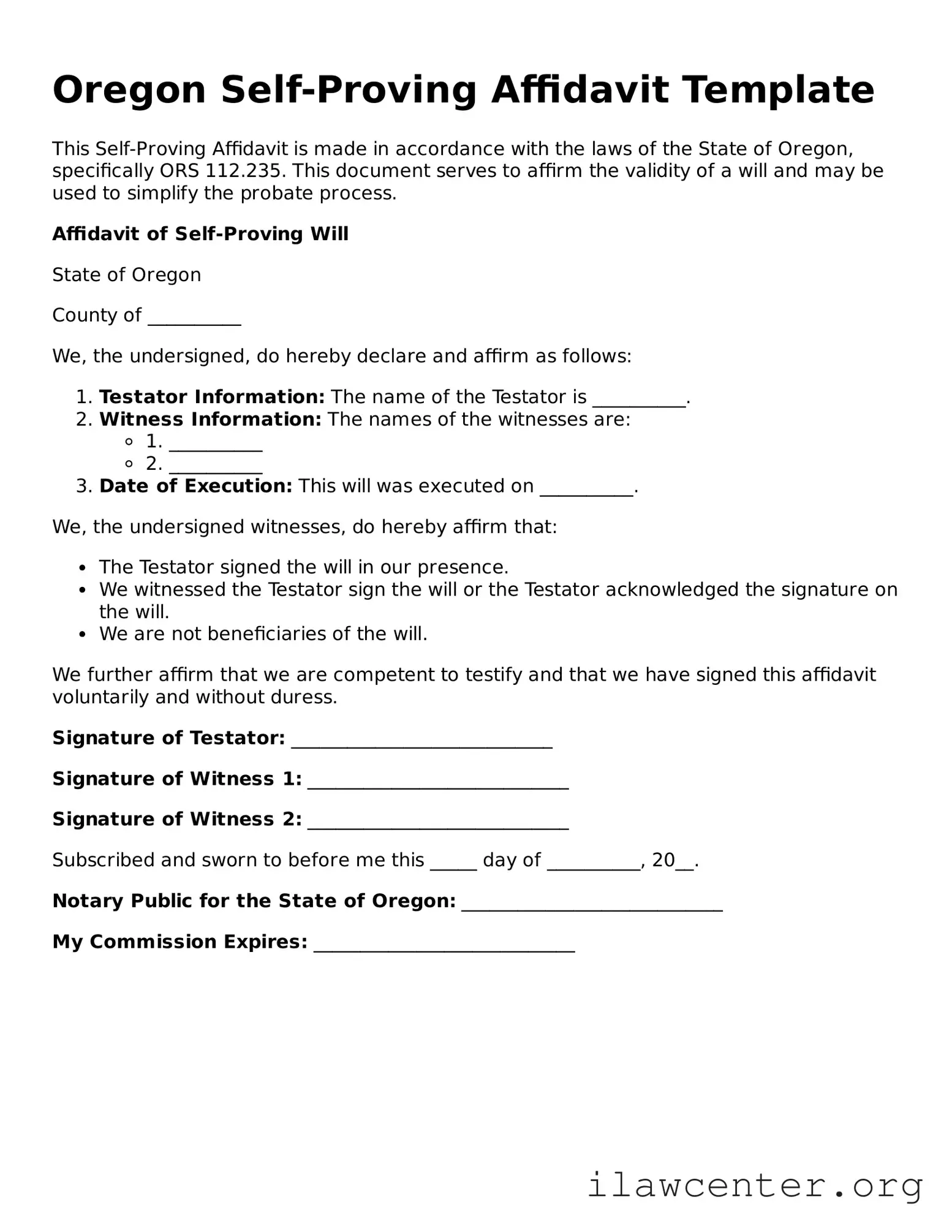
Oregon Self-Proving Affidavit Preview

Oregon Self-Proving Affidavit Template

This Self-Proving Affidavit is made in accordance with the laws of the State of Oregon, specifically ORS 112.235. This document serves to affirm the validity of a will and may be used to simplify the probate process.

Affidavit of Self-Proving Will

State of Oregon

County of __________

We, the undersigned, do hereby declare and affirm as follows:

  1. Testator Information: The name of the Testator is __________.
  2. Witness Information: The names of the witnesses are:
    • 1. __________
    • 2. __________
  3. Date of Execution: This will was executed on __________.

We, the undersigned witnesses, do hereby affirm that:

  • The Testator signed the will in our presence.
  • We witnessed the Testator sign the will or the Testator acknowledged the signature on the will.
  • We are not beneficiaries of the will.

We further affirm that we are competent to testify and that we have signed this affidavit voluntarily and without duress.

Signature of Testator: ____________________________

Signature of Witness 1: ____________________________

Signature of Witness 2: ____________________________

Subscribed and sworn to before me this _____ day of __________, 20__.

Notary Public for the State of Oregon: ____________________________

My Commission Expires: ____________________________

PDF Form Characteristics

Fact Name Description
Purpose The Oregon Self-Proving Affidavit is used to simplify the probate process by allowing a will to be accepted without requiring witnesses to testify.
Governing Law The form is governed by Oregon Revised Statutes (ORS) 112.235.
Eligibility Only individuals who have executed a valid will in Oregon can use this affidavit.
Signature Requirements The testator and two witnesses must sign the affidavit in the presence of each other.
Notarization The affidavit must be notarized to be considered self-proving.
Form Availability The Oregon Self-Proving Affidavit form can be obtained from various legal resources or state websites.
Effect on Probate Using this affidavit can expedite the probate process by eliminating the need for witness testimony.
Revocation A self-proving affidavit can be revoked if the will is revoked, but the affidavit itself remains valid unless specifically challenged.

Instructions on Utilizing Oregon Self-Proving Affidavit

Filling out the Oregon Self-Proving Affidavit form is a straightforward process. Once completed, this document will serve as a formal declaration that the will was executed properly and in accordance with state laws. This can simplify the probate process later on.

  1. Begin by downloading the Oregon Self-Proving Affidavit form from a reliable source.
  2. At the top of the form, write the name of the deceased person, known as the testator.
  3. Next, enter the date on which the will was signed.
  4. Provide the names and addresses of the witnesses who were present during the signing of the will. Ensure that you have at least two witnesses.
  5. Each witness must then sign the form in the designated area. Their signatures affirm that they witnessed the testator signing the will.
  6. After the witnesses have signed, the notary public will need to complete their section. This includes verifying the identities of the witnesses and the testator.
  7. Finally, ensure that all sections of the form are filled out completely and accurately before submitting it for filing.

Important Facts about Oregon Self-Proving Affidavit

What is an Oregon Self-Proving Affidavit?

An Oregon Self-Proving Affidavit is a legal document that helps to simplify the probate process for a will. By including this affidavit with a will, the testator (the person who made the will) and witnesses affirm that they signed the will voluntarily. This affidavit can help avoid the need for witnesses to testify in court later on.

Why should I use a Self-Proving Affidavit?

Using a Self-Proving Affidavit can save time and reduce complications during the probate process. It provides proof that the will was executed properly, which can help streamline the validation process in court. This can be especially beneficial if witnesses are unavailable or if there are disputes regarding the will.

Who can sign the Self-Proving Affidavit?

The Self-Proving Affidavit must be signed by the testator and at least two witnesses. These witnesses should be individuals who are not beneficiaries of the will, ensuring that they have no personal interest in the outcome. Their impartiality is crucial for the affidavit's validity.

How do I complete the Self-Proving Affidavit?

To complete the Self-Proving Affidavit, you need to fill out the form with the necessary details, including the names and signatures of the testator and witnesses. It's important to ensure that all parties are present when signing. After signing, the affidavit should be attached to the will for it to be effective.

Is a Self-Proving Affidavit required in Oregon?

No, a Self-Proving Affidavit is not required in Oregon. However, including one can make the probate process smoother and less contentious. If you want to avoid potential issues down the line, it’s a good idea to consider using this affidavit when drafting your will.

Can I revoke a Self-Proving Affidavit?

Yes, a Self-Proving Affidavit can be revoked. If you decide to change your will or the accompanying affidavit, you can do so by creating a new will or affidavit that explicitly revokes the previous ones. Always ensure that any new documents are properly executed to avoid confusion.

Where do I file the Self-Proving Affidavit?

The Self-Proving Affidavit should be filed with the will in the probate court when the time comes. It’s important to keep a copy of both the will and the affidavit for your records. This will ensure that your wishes are clear and can be easily followed during the probate process.

Can I create my own Self-Proving Affidavit?

While it is possible to draft your own Self-Proving Affidavit, it’s advisable to use a standard form or consult with a legal professional. This helps ensure that all necessary elements are included and that the document complies with Oregon law. A well-prepared affidavit can help prevent legal challenges later on.
Common mistakes

When filling out the Oregon Self-Proving Affidavit form, many individuals make common mistakes that can lead to complications in the future. One frequent error is failing to properly identify the testator. The testator is the person whose will is being affirmed. If their name is misspelled or omitted, it can cause confusion or even invalidate the affidavit.

Another mistake involves not including the correct date and location of the signing. This information is crucial as it provides context for when and where the affidavit was executed. Omitting this can lead to questions about the validity of the document and may complicate the probate process.

Some people overlook the requirement for witnesses. In Oregon, at least two witnesses must sign the affidavit. If this step is skipped, the affidavit may not hold up in court. It’s essential to ensure that the witnesses are present and understand their role in the process.

Additionally, individuals often forget to include their signatures. The affidavit must be signed by the testator and the witnesses. Without these signatures, the affidavit lacks authenticity and may be deemed invalid.

Another common oversight is not providing adequate information about the witnesses. The affidavit should include the names and addresses of the witnesses. Failing to provide this information can lead to issues if the validity of the will is challenged later on.

Finally, some individuals neglect to review the entire document for accuracy before submission. Simple typos or incorrect information can create significant problems down the line. Taking the time to double-check everything can save a lot of trouble in the future.

Documents used along the form

The Oregon Self-Proving Affidavit form is an important document that helps validate a will by confirming the authenticity of the signatures and the intent of the testator. However, several other forms and documents are commonly used in conjunction with this affidavit to ensure a comprehensive estate planning process. Below is a list of these documents, along with brief descriptions of each.

  • Last Will and Testament: This document outlines how a person's assets will be distributed upon their death. It names beneficiaries and may appoint guardians for minor children.
  • Durable Power of Attorney: This form allows an individual to designate someone to make financial and legal decisions on their behalf if they become incapacitated.
  • Advance Directive: This document specifies a person's healthcare preferences in the event they are unable to communicate their wishes. It may include a living will and a healthcare power of attorney.
  • Trust Agreement: A trust is a legal arrangement where one party holds property for the benefit of another. This document outlines the terms and conditions of the trust.
  • Affidavit of Death: This form provides official proof of a person's death, which may be required to settle the estate or transfer assets.
  • Estate Inventory: This document lists all assets and liabilities of the deceased. It helps in assessing the estate's value and facilitates the distribution process.
  • Notice to Creditors: This notice informs creditors of a person's death and provides them with an opportunity to make claims against the estate for any debts owed.

Utilizing these documents alongside the Oregon Self-Proving Affidavit can streamline the estate planning process and help ensure that an individual's wishes are honored. Each document serves a specific purpose and plays a critical role in managing the complexities of estate management.

Similar forms

The Self-Proving Affidavit is an important legal document, often used in the context of wills. It provides a way to validate a will without needing witnesses to testify in court. Here are five documents that are similar to the Self-Proving Affidavit, along with a brief explanation of how they relate:

  • Last Will and Testament: This document outlines a person's wishes regarding the distribution of their assets after death. Like the Self-Proving Affidavit, it serves to clarify intentions and can be made self-proving with the right affidavit.
  • Power of Attorney: This document allows one person to act on behalf of another in legal matters. Both documents require signatures and may need witnesses or notarization to confirm their validity.
  • Living Will: A living will specifies a person's wishes regarding medical treatment in case they cannot communicate. Similar to the Self-Proving Affidavit, it often requires a signature and may need to be notarized to be effective.
  • Trust Document: A trust outlines how a person's assets will be managed during their lifetime and after death. Both trusts and self-proving affidavits can simplify the legal process and avoid court disputes.
  • Durable Power of Attorney for Health Care: This document allows someone to make health care decisions on behalf of another. Like the Self-Proving Affidavit, it is often executed with specific formalities to ensure it is legally binding.

Dos and Don'ts

When filling out the Oregon Self-Proving Affidavit form, it is essential to follow specific guidelines to ensure the document is valid and properly executed. Below is a list of things to do and avoid during this process.

Things You Should Do:

  • Read the instructions carefully to understand the requirements of the affidavit.
  • Ensure that all required signatures are present before submitting the form.
  • Use clear and legible handwriting or type the information to avoid any misinterpretation.
  • Double-check all entries for accuracy, including names and dates.
  • Keep a copy of the completed affidavit for your records.
  • Consult with a legal professional if you have questions about the form.
  • File the affidavit in accordance with local laws and regulations.

Things You Shouldn't Do:

  • Do not leave any required fields blank; all sections must be completed.
  • Avoid using abbreviations or shorthand that may cause confusion.
  • Do not sign the affidavit before all witnesses are present.
  • Refrain from altering the form after it has been signed by witnesses.
  • Do not submit the form without verifying that it is the most current version.
  • Do not ignore the specific requirements for notarization if applicable.
  • Do not rush through the process; take your time to ensure everything is correct.

Misconceptions

Understanding the Oregon Self-Proving Affidavit form is essential for anyone involved in estate planning or managing a will. However, several misconceptions can lead to confusion. Here are five common misconceptions:

  • It is mandatory to use the Self-Proving Affidavit. Many people believe that this form is required for a will to be valid. In reality, while it can simplify the probate process, it is not a legal requirement in Oregon.
  • Only attorneys can prepare a Self-Proving Affidavit. Some individuals think that this form must be drafted by a legal professional. However, anyone can create this affidavit, provided they follow the necessary guidelines.
  • The Self-Proving Affidavit replaces the need for witnesses. There is a misconception that using this affidavit eliminates the need for witnesses. In fact, the affidavit must be signed in the presence of witnesses, just like any other will.
  • It is only useful for complex estates. Some assume that the Self-Proving Affidavit is only beneficial for large or complicated estates. In truth, it can be advantageous for any estate, simplifying the probate process regardless of size.
  • Once completed, the Self-Proving Affidavit cannot be changed. Many believe that the affidavit is set in stone once signed. However, it can be updated or revoked if changes to the will occur, ensuring that it remains aligned with the testator's wishes.

By clarifying these misconceptions, individuals can make informed decisions regarding their estate planning and ensure that their wishes are honored.

Key takeaways

When considering the Oregon Self-Proving Affidavit form, there are several important points to keep in mind. This document serves as a valuable tool in the estate planning process, particularly for ensuring the validity of a will. Here are key takeaways:

  • The Self-Proving Affidavit allows a will to be accepted in probate court without the need for witnesses to testify.
  • Both the testator (the person making the will) and the witnesses must sign the affidavit in the presence of a notary public.
  • It is advisable to complete the Self-Proving Affidavit at the same time as signing the will to avoid any complications later.
  • The affidavit must include specific language affirming that the testator was of sound mind and under no undue influence at the time of signing.
  • Once executed, the Self-Proving Affidavit becomes part of the will and should be stored with it in a safe place.
  • If the will is contested, the affidavit can help streamline the probate process by providing evidence of the will's validity.
  • Consulting with an estate planning attorney can ensure that the affidavit is filled out correctly and meets all legal requirements.