Attorney-Verified  Small Estate Affidavit Document for Oregon

Attorney-Verified Small Estate Affidavit Document for Oregon

The Oregon Small Estate Affidavit is a legal document that allows individuals to claim the assets of a deceased person without going through a lengthy probate process. This form simplifies the transfer of property and ensures that beneficiaries can access their inheritance quickly. To get started, fill out the form by clicking the button below.

Article Guide

In Oregon, settling the estate of a deceased person can sometimes be a complex and lengthy process. However, for smaller estates, the state provides a streamlined option known as the Small Estate Affidavit. This form is designed for estates valued at $275,000 or less, making it a practical choice for families who want to avoid the time and expense of probate. By using the Small Estate Affidavit, heirs can claim assets directly without going through the court system. The form allows individuals to collect personal property, bank accounts, and other assets, as long as they meet the necessary criteria. To complete the affidavit, the affiant must provide essential information, such as the deceased's details, a list of assets, and the names of the heirs. Additionally, the form requires a declaration that the affiant is entitled to the assets, ensuring that the rightful beneficiaries receive what they are owed. Understanding how to properly fill out and submit this form can simplify the process of settling a small estate, allowing families to focus on healing and moving forward.

Oregon Small Estate Affidavit Preview

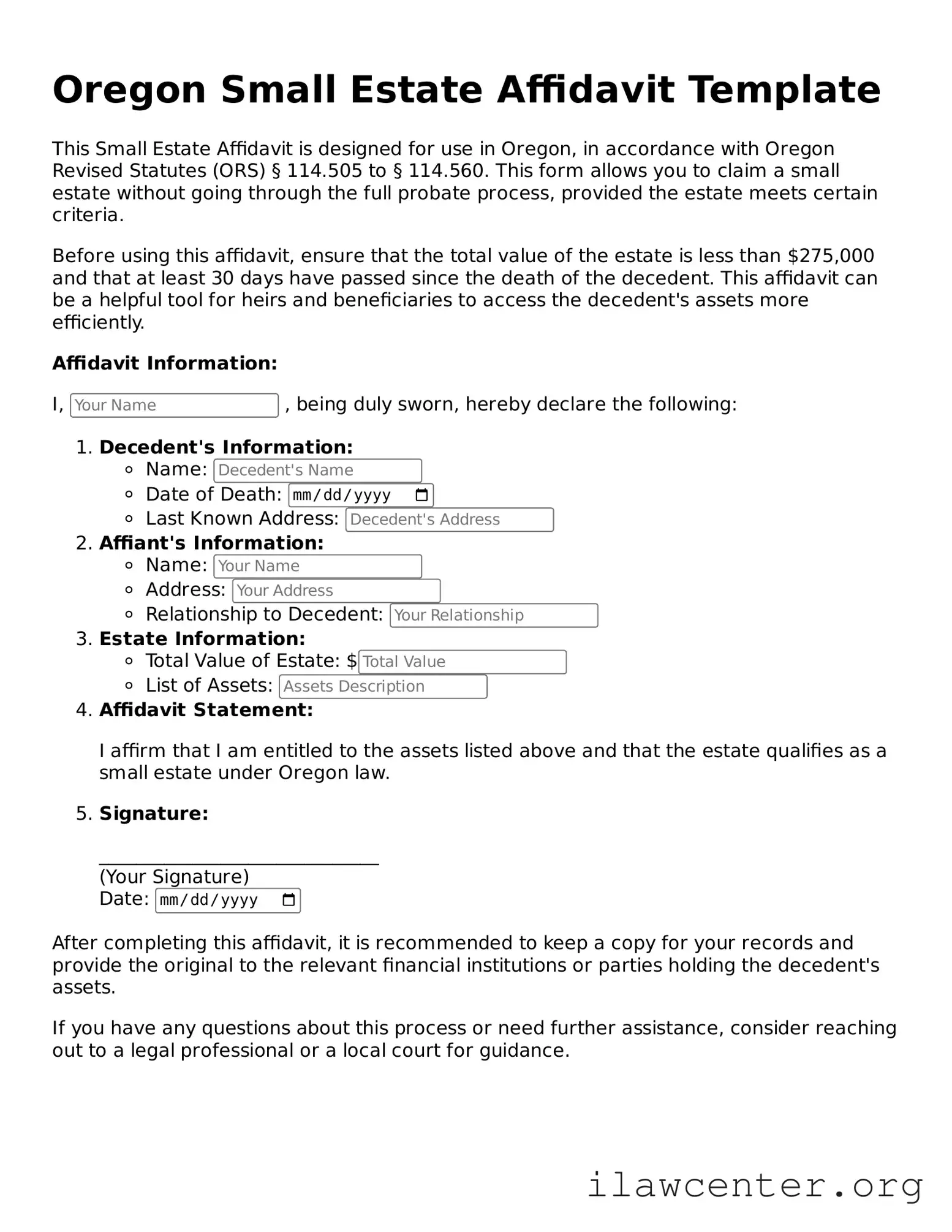
Oregon Small Estate Affidavit Template

This Small Estate Affidavit is designed for use in Oregon, in accordance with Oregon Revised Statutes (ORS) § 114.505 to § 114.560. This form allows you to claim a small estate without going through the full probate process, provided the estate meets certain criteria.

Before using this affidavit, ensure that the total value of the estate is less than $275,000 and that at least 30 days have passed since the death of the decedent. This affidavit can be a helpful tool for heirs and beneficiaries to access the decedent's assets more efficiently.

Affidavit Information:

I, , being duly sworn, hereby declare the following:

  1. Decedent's Information:
    • Name:
    • Date of Death:
    • Last Known Address:
  2. Affiant's Information:
    • Name:
    • Address:
    • Relationship to Decedent:
  3. Estate Information:
    • Total Value of Estate: $
    • List of Assets:
  4. Affidavit Statement:
  5. I affirm that I am entitled to the assets listed above and that the estate qualifies as a small estate under Oregon law.

  6. Signature:
  7. ______________________________
    (Your Signature)
    Date:

After completing this affidavit, it is recommended to keep a copy for your records and provide the original to the relevant financial institutions or parties holding the decedent's assets.

If you have any questions about this process or need further assistance, consider reaching out to a legal professional or a local court for guidance.

PDF Form Characteristics

Fact Name Description
Purpose The Oregon Small Estate Affidavit allows individuals to claim assets of a deceased person without going through probate, simplifying the process for small estates.
Eligibility To qualify, the total value of the estate must be less than $275,000, excluding certain types of property like real estate.
Governing Law The form is governed by Oregon Revised Statutes, specifically ORS 114.505 to 114.560.
Required Information The affidavit must include details about the deceased, the estate's assets, and the relationship of the affiant to the deceased.
Filing Process The completed affidavit must be filed with the appropriate court, and copies should be provided to any institutions holding the deceased's assets.

Instructions on Utilizing Oregon Small Estate Affidavit

Once you have gathered all necessary information and documents, you can begin filling out the Oregon Small Estate Affidavit form. This form is essential for individuals seeking to settle the estate of a deceased person without going through the formal probate process. Completing it accurately is crucial to ensure a smooth transition of assets.

  1. Begin by downloading the Oregon Small Estate Affidavit form from the appropriate state website or obtaining a physical copy.
  2. At the top of the form, provide the name of the deceased individual, along with their date of death.
  3. Next, fill in your name and address as the affiant (the person making the affidavit).
  4. Indicate your relationship to the deceased. This could be a spouse, child, sibling, or another family member.
  5. List all the assets owned by the deceased at the time of their passing. Be specific about each asset, including bank accounts, real estate, and personal property.
  6. Include the estimated value of each asset. This will help establish that the total value falls below the state's small estate threshold.
  7. Provide information about any debts or liabilities the deceased may have had. This is important for transparency and to ensure all obligations are addressed.
  8. Sign the affidavit in the presence of a notary public. Your signature confirms the accuracy of the information provided.
  9. Make copies of the completed affidavit and any supporting documents for your records.
  10. Submit the original affidavit along with any required documents to the appropriate court or agency as instructed.

After submitting the form, you may need to wait for a response or further instructions from the court. It is advisable to keep track of any communications and follow up if necessary to ensure the process continues smoothly.

Important Facts about Oregon Small Estate Affidavit

What is the Oregon Small Estate Affidavit?

The Oregon Small Estate Affidavit is a legal document that allows individuals to claim property from a deceased person's estate without going through the lengthy probate process. This form is typically used when the total value of the estate is below a certain threshold, which is currently set at $275,000, excluding any real property. It simplifies the transfer of assets to heirs or beneficiaries, making it a more accessible option for families dealing with loss.

Who can use the Small Estate Affidavit?

Any individual who is entitled to inherit from the deceased person can use the Small Estate Affidavit. This usually includes spouses, children, or other close relatives. However, it's essential to ensure that the estate meets the value limit and that the person filing the affidavit has the legal right to claim the assets. If there are multiple heirs, they may need to work together to complete the process.

How do I complete the Small Estate Affidavit?

To complete the Small Estate Affidavit, you will need to gather specific information about the deceased person's assets and debts. The form requires details such as the name of the deceased, their date of death, and a list of assets that fall under the small estate threshold. After filling out the form, you must sign it in front of a notary public. Once notarized, you can present it to the institutions holding the deceased's assets, like banks or insurance companies, to claim what is owed.

Do I need to file the Small Estate Affidavit with the court?

No, you do not need to file the Small Estate Affidavit with the court. This document is used primarily for transferring assets directly to the heirs or beneficiaries. However, it's a good idea to keep a copy for your records. If there are disputes among heirs or if the estate is larger than the small estate limit, you may need to consider formal probate proceedings instead.

What happens if the estate exceeds the small estate limit?

If the estate exceeds the $275,000 limit, you cannot use the Small Estate Affidavit. In this case, the estate must go through the formal probate process. This process can be more complex and time-consuming, often requiring the assistance of an attorney. It involves validating the will, paying off debts, and distributing the remaining assets according to the will or state law.

Common mistakes

Filling out the Oregon Small Estate Affidavit form can be a straightforward process, but many individuals make common mistakes that can lead to delays or complications. One frequent error is providing incorrect or incomplete information about the deceased. It’s crucial to ensure that the name, date of birth, and date of death are accurate. Any discrepancies can cause significant issues in the processing of the affidavit.

Another mistake involves failing to list all the assets. The Small Estate Affidavit is designed for estates with limited assets, but all qualifying assets must be included. Omitting an asset can complicate matters, especially if it’s discovered later, potentially leading to legal disputes among heirs.

People often overlook the requirement for signatures. The affidavit must be signed by the person claiming the estate, and in some cases, additional signatures may be necessary from other heirs or beneficiaries. Missing a signature can render the form invalid and delay the process.

Additionally, not properly notarizing the affidavit is a common pitfall. The affidavit must be notarized to be legally binding. Failing to have it notarized or using an unlicensed notary can invalidate the document, causing further complications.

Another mistake is not understanding the eligibility criteria for using the Small Estate Affidavit. Some individuals mistakenly believe they can use this form for any estate, but it is specifically for estates valued at less than $275,000 (as of 2023). If the estate exceeds this value, a different process is required.

People sometimes also forget to include a copy of the death certificate with their affidavit. This document serves as proof of the deceased's passing and is necessary for the affidavit to be processed correctly. Without it, the filing may be rejected.

Inadequate attention to detail in the affidavit can lead to mistakes in asset valuations. It is essential to provide accurate valuations for all listed assets. Overvaluing or undervaluing assets can result in complications, especially if disputes arise among heirs.

Another common issue is not keeping copies of the submitted affidavit and supporting documents. It is important to retain these for personal records and future reference. If questions arise later, having a copy can simplify the resolution process.

Finally, individuals often underestimate the time it takes for the affidavit to be processed. While the Small Estate Affidavit is designed to expedite the process, delays can still occur. Planning ahead and being patient can help manage expectations and ensure a smoother experience.

Documents used along the form

The Oregon Small Estate Affidavit is a valuable tool for individuals seeking to settle the estate of a deceased person when the total value of the estate is below a certain threshold. Alongside this form, several other documents are commonly utilized to ensure a smooth process. Below is a list of these documents, each serving a specific purpose in the estate settlement process.

  • Death Certificate: This official document confirms the death of the individual and is typically required to initiate the probate process or to use the Small Estate Affidavit. It provides essential information about the deceased, including the date and cause of death.
  • Will: If the deceased left a will, it outlines their wishes regarding the distribution of their assets. While not always necessary for a Small Estate Affidavit, it can clarify the intentions of the deceased and assist in identifying beneficiaries.
  • List of Assets: This document details the assets owned by the deceased at the time of death. It helps establish the total value of the estate and ensures that all assets are accounted for when completing the Small Estate Affidavit.
  • Affidavit of Heirship: In cases where there is no will, this affidavit can be used to establish the heirs of the deceased. It provides a sworn statement regarding the family relationships and can support the claims of those seeking to inherit.

These documents work in conjunction with the Oregon Small Estate Affidavit to facilitate the efficient settlement of an estate. Understanding their roles can help beneficiaries navigate the often complex process of estate administration.

Similar forms

The Small Estate Affidavit form is similar to several other legal documents that serve to simplify the process of transferring assets after someone passes away. Here’s a list of those documents:

  • Last Will and Testament: This document outlines how a person's assets should be distributed after their death. Unlike the Small Estate Affidavit, a will often requires probate to be validated.
  • Letters of Administration: Issued by a court, this document appoints someone to manage the estate of a deceased person when there is no will. It provides legal authority similar to what a Small Estate Affidavit does for smaller estates.
  • Trust Agreement: A trust allows a person to manage their assets during their lifetime and specifies how those assets will be distributed after death. It can bypass probate, similar to a Small Estate Affidavit.
  • Affidavit of Heirship: This document establishes the rightful heirs of a deceased person when there is no will. It helps to transfer property without going through probate, akin to the Small Estate Affidavit.
  • Transfer on Death Deed: This deed allows a person to transfer real estate to a beneficiary upon their death without going through probate. It serves a similar purpose as the Small Estate Affidavit for real property.
  • Declaration of Trust: This document outlines the terms of a trust and names the beneficiaries. Like the Small Estate Affidavit, it can facilitate the transfer of assets without the need for probate.

Dos and Don'ts

When filling out the Oregon Small Estate Affidavit form, it’s essential to follow certain guidelines to ensure the process goes smoothly. Here are six things you should and shouldn't do:

  • Do ensure you meet the eligibility criteria for using the Small Estate Affidavit. The estate must be valued at less than $275,000.
  • Don't forget to provide accurate information about the deceased. Inaccuracies can lead to delays or complications.
  • Do gather all necessary documents, such as the death certificate and a list of the deceased's assets and debts.
  • Don't overlook the requirement for notarization. The affidavit must be signed in front of a notary public.
  • Do file the affidavit with the appropriate court in the county where the deceased lived.
  • Don't assume that submitting the affidavit is the final step. Be prepared for potential follow-up actions or additional requirements.

Misconceptions

The Oregon Small Estate Affidavit form is often misunderstood. Here are six common misconceptions about this form:

  1. Only wealthy individuals can use the Small Estate Affidavit. Many people believe that this affidavit is only for those with substantial assets. In reality, it is designed for estates valued under a specific threshold, making it accessible to a wide range of individuals.
  2. The Small Estate Affidavit can be used for any type of asset. Some think they can use the affidavit for all assets. However, it is typically limited to certain types of property, such as personal belongings and bank accounts, excluding real estate and other complex assets.
  3. The form is only applicable to estates with a will. A common misconception is that a will is necessary to file a Small Estate Affidavit. In fact, this form can be utilized for intestate estates, where no will exists.
  4. Filing the Small Estate Affidavit is a lengthy process. Many assume that the process will take a long time. In truth, the Small Estate Affidavit can often be filed quickly, allowing heirs to access the estate's assets in a timely manner.
  5. All heirs must agree to use the Small Estate Affidavit. Some believe that unanimous agreement among heirs is required. While it is advisable to communicate with all parties involved, the affidavit can still be filed even if not everyone is in agreement.
  6. Legal representation is mandatory for filing. There is a misconception that hiring an attorney is necessary. While legal assistance can be helpful, individuals can file the Small Estate Affidavit on their own if they feel comfortable doing so.

Understanding these misconceptions can help individuals navigate the process more effectively and ensure they are making informed decisions regarding estate matters in Oregon.

Key takeaways

When dealing with the Oregon Small Estate Affidavit form, there are several important points to keep in mind. This form simplifies the process of transferring assets without going through probate. Here are some key takeaways:

  • Eligibility Requirements: The estate must be valued at $275,000 or less, excluding certain assets like real estate. Ensure you meet this threshold before proceeding.
  • Proper Completion: Fill out the affidavit accurately, providing all required information about the deceased and their assets. Incomplete forms may delay the process.
  • Signatures: The affidavit must be signed by all heirs or beneficiaries. Their signatures confirm their agreement to the terms and the distribution of assets.
  • Filing Process: Once completed, the affidavit is presented to financial institutions or other entities holding the deceased's assets. This allows for the transfer without court intervention.

Understanding these points can help streamline the process of settling a small estate in Oregon.