Attorney-Verified  Transfer-on-Death Deed Document for Oregon

Attorney-Verified Transfer-on-Death Deed Document for Oregon

The Oregon Transfer-on-Death Deed is a legal document that allows property owners to transfer their real estate to beneficiaries upon their death, without the need for probate. This form provides a straightforward way to ensure that your property is passed on according to your wishes, simplifying the process for your loved ones. If you are considering this option, take the first step by filling out the form below.

Article Guide

The Oregon Transfer-on-Death Deed form is an important legal tool for property owners who wish to simplify the transfer of their real estate upon death. This form allows individuals to designate beneficiaries who will receive their property directly, bypassing the often lengthy and costly probate process. By filling out this deed, property owners can ensure that their wishes are honored without the need for court intervention. The form requires specific information, including the names of the beneficiaries and a clear description of the property being transferred. Additionally, it must be signed, dated, and recorded with the county clerk to be valid. Understanding how to properly complete and file this deed can help individuals secure their legacy and provide peace of mind for their loved ones during a difficult time.

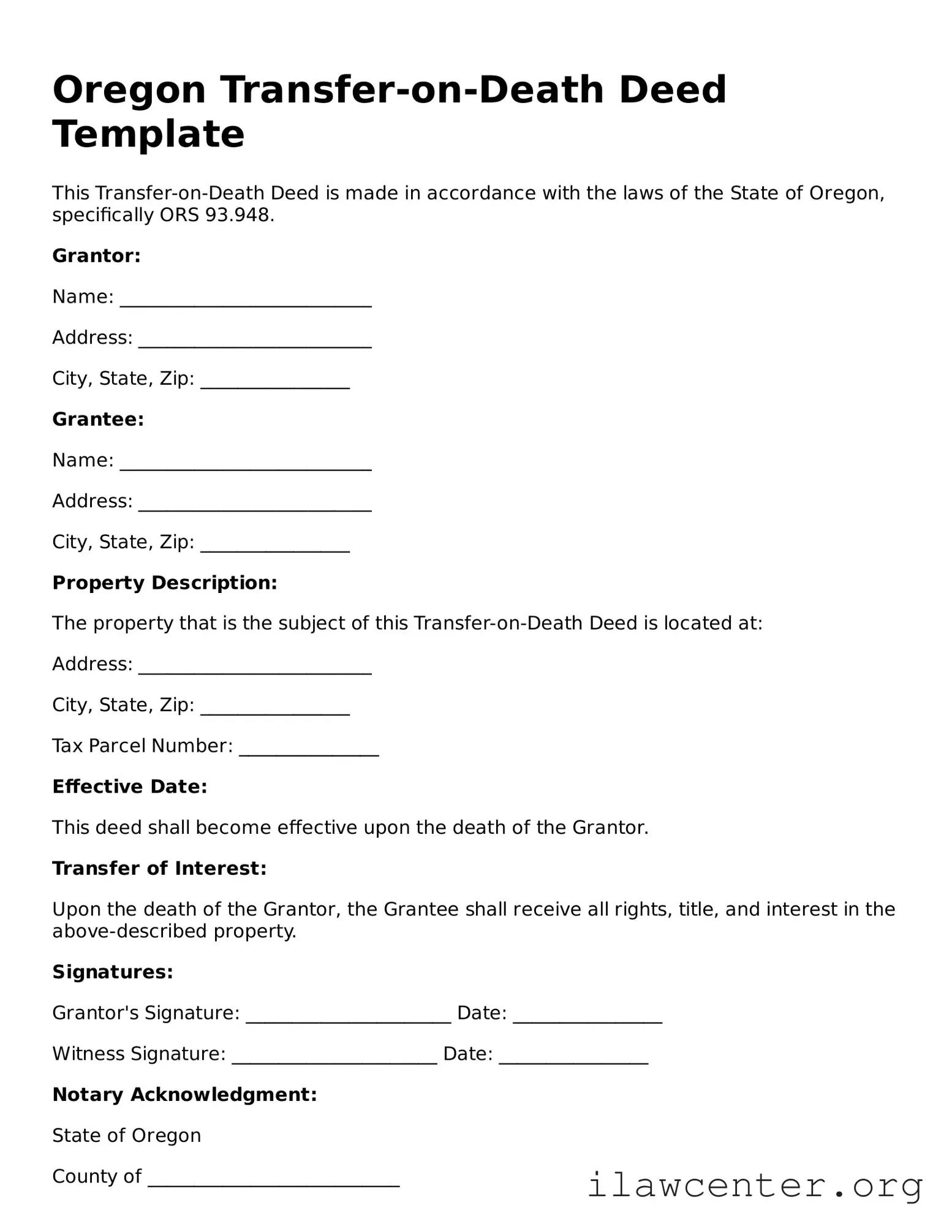
Oregon Transfer-on-Death Deed Preview

Oregon Transfer-on-Death Deed Template

This Transfer-on-Death Deed is made in accordance with the laws of the State of Oregon, specifically ORS 93.948.

Grantor:

Name: ___________________________

Address: _________________________

City, State, Zip: ________________

Grantee:

Name: ___________________________

Address: _________________________

City, State, Zip: ________________

Property Description:

The property that is the subject of this Transfer-on-Death Deed is located at:

Address: _________________________

City, State, Zip: ________________

Tax Parcel Number: _______________

Effective Date:

This deed shall become effective upon the death of the Grantor.

Transfer of Interest:

Upon the death of the Grantor, the Grantee shall receive all rights, title, and interest in the above-described property.

Signatures:

Grantor's Signature: ______________________ Date: ________________

Witness Signature: ______________________ Date: ________________

Notary Acknowledgment:

State of Oregon

County of ___________________________

On this ____ day of ___________, 20__, before me, a Notary Public, personally appeared ______________________, known to me to be the person whose name is subscribed to this instrument, and acknowledged that they executed the same.

Notary Public Signature: ______________________

My Commission Expires: ______________________

This document must be recorded with the county clerk of the county where the property is located to be effective.

PDF Form Characteristics

Fact Name Details
Definition The Oregon Transfer-on-Death Deed allows property owners to transfer real estate to designated beneficiaries upon their death without the need for probate.
Governing Law The Transfer-on-Death Deed in Oregon is governed by Oregon Revised Statutes, specifically ORS 93.948 to 93.979.
Requirements The deed must be signed by the property owner and recorded with the county clerk to be valid.
Revocation Property owners can revoke or change the beneficiary designation at any time before their death, provided the revocation is properly recorded.

Instructions on Utilizing Oregon Transfer-on-Death Deed

After obtaining the Oregon Transfer-on-Death Deed form, you’ll need to complete it carefully to ensure it accurately reflects your intentions. Once filled out, the next step will involve signing the document in front of a notary public and then recording it with the county clerk where the property is located.

  1. Begin by downloading the Oregon Transfer-on-Death Deed form from the official state website or obtain a physical copy from your local county clerk’s office.
  2. In the top section of the form, enter the name of the current property owner(s). Make sure to include the full legal names as they appear on the property title.
  3. Next, provide the address of the property that will be transferred upon death. This should include the street address, city, state, and zip code.
  4. Identify the beneficiary or beneficiaries who will receive the property. Include their full legal names and addresses. If there are multiple beneficiaries, list them clearly.
  5. In the designated section, specify any conditions or instructions regarding the transfer, if applicable. This might include stipulations about how the property should be managed or divided among beneficiaries.
  6. Review the entire form for accuracy. Double-check the names, addresses, and any conditions you've included.
  7. Once you are satisfied with the information provided, sign the document in the presence of a notary public. The notary will verify your identity and witness your signature.
  8. Finally, take the signed and notarized deed to your local county clerk’s office to have it officially recorded. This step is crucial for the transfer to be legally recognized.

Important Facts about Oregon Transfer-on-Death Deed

What is a Transfer-on-Death Deed in Oregon?

A Transfer-on-Death Deed (TOD) in Oregon is a legal document that allows property owners to designate one or more beneficiaries to inherit their property upon their death. This deed enables the transfer of real estate without the need for probate, simplifying the process for heirs. The property remains under the owner’s control during their lifetime, and the beneficiaries do not have any rights to the property until the owner passes away.

How do I create a Transfer-on-Death Deed in Oregon?

To create a Transfer-on-Death Deed in Oregon, you must fill out the appropriate form, which includes details about the property and the beneficiaries. It’s essential to ensure that the deed is signed in front of a notary public. After signing, the deed must be recorded with the county clerk in the county where the property is located. This recording is crucial, as it provides public notice of your intentions regarding the property transfer.

Can I change or revoke a Transfer-on-Death Deed after it has been created?

Yes, you can change or revoke a Transfer-on-Death Deed at any time while you are still alive. To revoke the deed, you must execute a new deed that explicitly states the revocation or record a formal revocation document with the county clerk. If you wish to change the beneficiaries, you can create a new TOD deed that names the new beneficiaries and record it as well. Always ensure that any changes are properly documented and recorded to avoid confusion later.

Are there any tax implications for beneficiaries receiving property through a Transfer-on-Death Deed?

Generally, beneficiaries who receive property through a Transfer-on-Death Deed do not face immediate tax implications. The property is transferred outside of probate, which can help avoid certain estate taxes. However, beneficiaries should be aware that they may be responsible for property taxes and capital gains taxes if they decide to sell the property later. Consulting a tax professional is advisable to understand the full implications of inheriting property.

What types of property can be transferred using a Transfer-on-Death Deed?

In Oregon, a Transfer-on-Death Deed can be used to transfer real property, such as residential homes, commercial properties, and land. However, it cannot be used for personal property, bank accounts, or other assets. If you wish to transfer these types of assets, you will need to consider other estate planning tools, such as wills or trusts.

Is legal assistance necessary to create a Transfer-on-Death Deed?

While it is not legally required to have an attorney assist you in creating a Transfer-on-Death Deed, seeking legal advice can be beneficial. An attorney can help ensure that the deed is properly drafted and executed, and they can provide guidance on how it fits into your overall estate plan. If you have complex family dynamics or significant assets, consulting a legal expert can help you avoid potential pitfalls.

Common mistakes

Filling out the Oregon Transfer-on-Death Deed form can be a straightforward process, but many individuals make common mistakes that can lead to complications down the line. One frequent error is not properly identifying the property. It is crucial to provide a clear and accurate description of the property being transferred. This includes the legal description, which is often found on the property deed. Failing to include this information can create ambiguity and potentially invalidate the deed.

Another mistake involves the designation of beneficiaries. Individuals sometimes overlook the importance of clearly naming all beneficiaries. If a beneficiary is not explicitly named, there may be disputes or confusion regarding who is entitled to the property upon the owner’s passing. Additionally, it is essential to ensure that the names are spelled correctly and that the relationship to the property owner is clearly defined.

Many people also neglect to sign the deed in the presence of a notary. In Oregon, a Transfer-on-Death Deed must be signed by the owner and notarized to be valid. Skipping this step can render the deed ineffective, meaning that the property may not transfer as intended. It is advisable to double-check that all signatures are present and properly witnessed.

Another common oversight is failing to record the deed with the county clerk’s office. A Transfer-on-Death Deed must be recorded to take effect. Without this crucial step, the deed may not be recognized, and the property could be subject to probate, which is often a lengthy and costly process. Recording the deed soon after completion helps to ensure that the owner’s wishes are honored.

People sometimes forget to consider the implications of transferring property upon death. It is important to understand how this deed interacts with other estate planning tools. For example, if a property owner has a will that designates different heirs, the Transfer-on-Death Deed may conflict with those wishes. Consulting with an estate planning professional can provide clarity and help avoid unintended consequences.

Lastly, individuals may not review their Transfer-on-Death Deed periodically. Life circumstances change, and so do relationships. It is wise to revisit the deed regularly to ensure that it still reflects the owner’s intentions. This includes updating beneficiary information or making adjustments in response to changes in the law. Regular reviews can prevent misunderstandings and ensure that the property is transferred according to the owner’s wishes.

Documents used along the form

The Oregon Transfer-on-Death Deed allows property owners to designate beneficiaries who will receive their property upon their death without going through probate. However, several other forms and documents are often used in conjunction with this deed to ensure a smooth transfer of assets and to clarify the owner’s intentions. Below is a list of these related documents.

  • Will: A legal document that outlines how a person wishes their assets to be distributed after their death. It can include specific bequests and appoint an executor to manage the estate.
  • Living Trust: This document allows individuals to place their assets into a trust during their lifetime, which can help avoid probate and provide more control over asset distribution.
  • Beneficiary Designation Forms: These forms are often used for financial accounts and insurance policies to name beneficiaries who will receive those assets directly upon the owner's death, bypassing probate.
  • Power of Attorney: This legal document grants someone the authority to act on another person's behalf in financial or legal matters. It can be crucial for managing property if the owner becomes incapacitated.
  • Affidavit of Heirship: This document can be used to establish the heirs of a deceased person, particularly when no will exists. It helps clarify ownership and transfer of property without going through probate.

Utilizing these documents alongside the Oregon Transfer-on-Death Deed can provide a comprehensive estate plan, ensuring that your wishes are honored and that your beneficiaries receive their inheritance with minimal complications.

Similar forms

The Transfer-on-Death Deed form shares similarities with several other legal documents. Each of these documents serves to transfer property or assets upon certain conditions. Here are eight documents that are similar:

  • Last Will and Testament: This document outlines how a person's assets will be distributed after their death, similar to how a Transfer-on-Death Deed specifies the transfer of property upon death.
  • Living Trust: A living trust allows for the management and distribution of assets during a person's lifetime and after death, akin to the Transfer-on-Death Deed's function of transferring property outside of probate.
  • Beneficiary Designation Form: This form is used for accounts like life insurance or retirement plans to designate who receives the assets after death, similar to how a Transfer-on-Death Deed names beneficiaries for real estate.
  • Joint Tenancy Agreement: This agreement allows two or more people to own property together, with rights of survivorship, which means the property automatically passes to the surviving owner, much like the Transfer-on-Death Deed.
  • Payable-on-Death (POD) Account: A POD account allows a bank account holder to name beneficiaries who will receive the funds upon their death, similar to the way a Transfer-on-Death Deed designates property transfer.
  • Life Estate Deed: This deed allows a person to retain the right to use property during their lifetime while transferring ownership upon death, paralleling the Transfer-on-Death Deed's intent to transfer property at death.
  • Transfer-on-Death Account (TOD): This type of account allows the account holder to name a beneficiary who will inherit the account upon death, mirroring the Transfer-on-Death Deed's beneficiary designation for real estate.
  • Revocable Trust: A revocable trust can be changed or revoked during the grantor's lifetime and facilitates the transfer of assets upon death, similar to the Transfer-on-Death Deed's property transfer provisions.

Dos and Don'ts

When filling out the Oregon Transfer-on-Death Deed form, it's important to approach the process with care. Here are ten things to keep in mind, divided into what you should do and what you shouldn't do.

Things You Should Do:

  • Ensure you are eligible to use the Transfer-on-Death Deed by confirming your ownership of the property.
  • Provide accurate and complete information about the property, including its legal description.
  • Clearly identify the beneficiaries who will receive the property upon your passing.
  • Sign the deed in the presence of a notary public to ensure its validity.
  • File the completed deed with the appropriate county office to make it official.

Things You Shouldn't Do:

  • Do not leave any sections of the form blank, as incomplete information can lead to complications.
  • Avoid using vague language when describing the property or beneficiaries.
  • Do not forget to check for any local regulations that may affect the deed.
  • Refrain from using the deed for properties that are not eligible under Oregon law.
  • Do not assume that the deed is automatically effective without proper filing and notarization.

By following these guidelines, you can help ensure a smoother process when completing your Transfer-on-Death Deed in Oregon.

Misconceptions

  • Misconception 1: The Transfer-on-Death Deed is only for wealthy individuals.
  • This is not true. The Transfer-on-Death Deed can benefit anyone who owns property in Oregon, regardless of their financial status. It provides a simple way to transfer property without going through probate.

  • Misconception 2: A Transfer-on-Death Deed can only be used for residential properties.
  • This is incorrect. The deed can be used for various types of real estate, including commercial properties and vacant land.

  • Misconception 3: The property automatically transfers upon signing the deed.
  • This misconception arises from misunderstanding how the deed works. The property does not transfer until the owner passes away. Until then, the owner retains full control of the property.

  • Misconception 4: You cannot change or revoke a Transfer-on-Death Deed once it is created.
  • This is false. The deed can be revoked or changed at any time before the owner's death, as long as the proper procedures are followed.

  • Misconception 5: A Transfer-on-Death Deed eliminates the need for a will.
  • This is misleading. While the deed allows for the transfer of specific property, it does not replace a will for other assets or for addressing other estate matters.

  • Misconception 6: All heirs will automatically inherit the property if there is a Transfer-on-Death Deed.
  • This is not accurate. The property will transfer only to the named beneficiary on the deed, regardless of other heirs.

  • Misconception 7: The Transfer-on-Death Deed has tax implications that complicate the transfer process.
  • This is a common concern, but the transfer itself does not trigger any immediate tax consequences. However, beneficiaries may need to consider potential tax liabilities in the future.

  • Misconception 8: You need an attorney to create a Transfer-on-Death Deed.
  • This is not necessary. While consulting an attorney can be beneficial, individuals can complete the deed themselves using the forms provided by the state, as long as they follow the instructions carefully.

Key takeaways

When considering the Oregon Transfer-on-Death Deed, it's essential to understand its implications and the process involved. Here are some key takeaways to keep in mind:

  • Purpose: The Transfer-on-Death Deed allows property owners to designate beneficiaries who will automatically receive the property upon the owner's death, avoiding probate.
  • Eligibility: This deed can be used for residential real estate and must be executed by the property owner who is at least 18 years old.
  • Execution: To be valid, the deed must be signed by the owner in the presence of a notary public and recorded with the county clerk's office.
  • Revocation: Property owners can revoke or change the deed at any time before their death, providing flexibility in estate planning.
  • Tax Implications: Beneficiaries may need to consider potential tax consequences, as the property may be subject to estate taxes depending on the overall estate value.

Understanding these points can help ensure that the Transfer-on-Death Deed is used effectively as part of an estate plan in Oregon.