

Osha 300 PDF Template

Osha 300 PDF Template

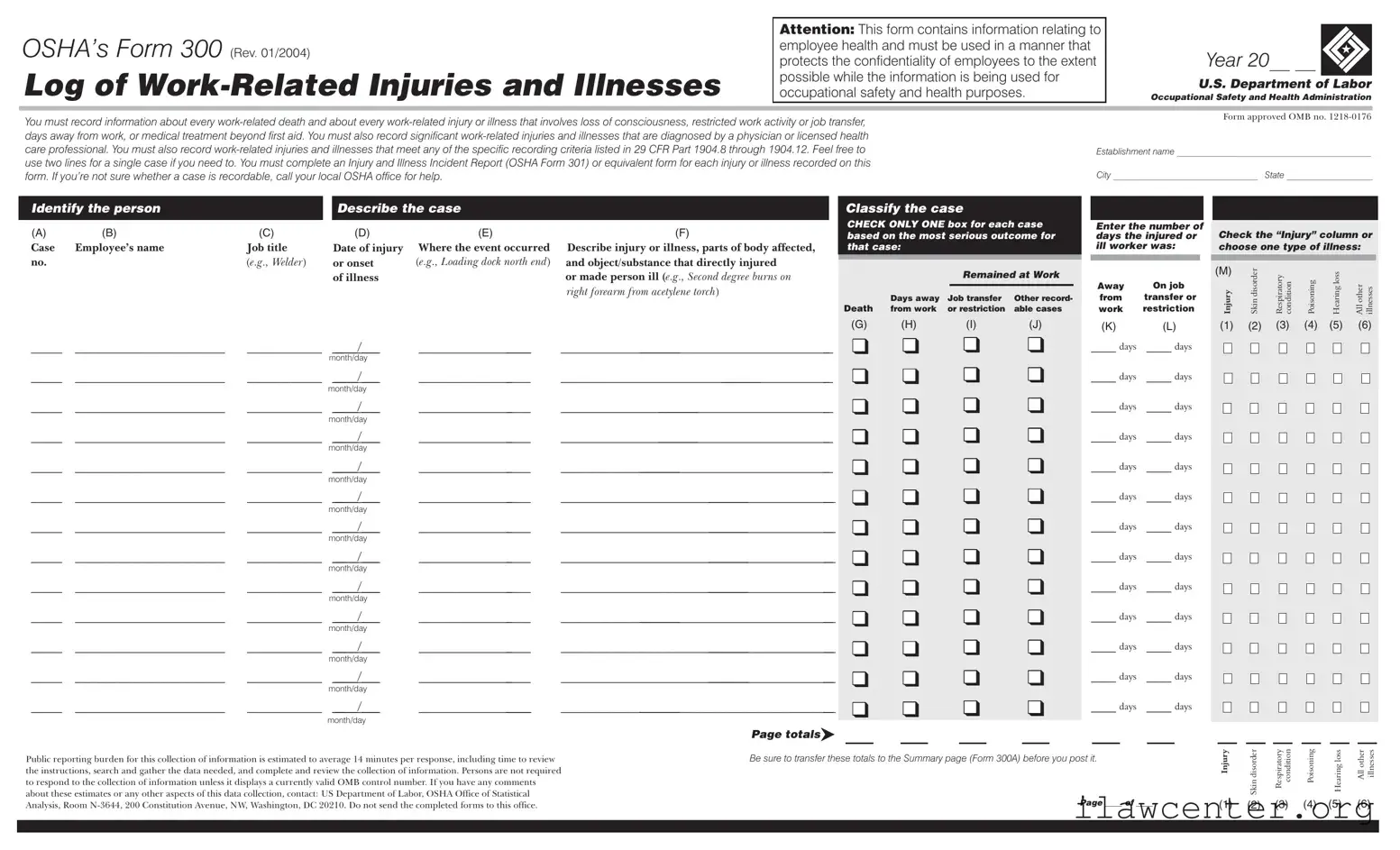
OSHA’s Form 300 is a crucial document that logs work-related injuries and illnesses within a workplace. It ensures that every incident, from serious injuries to illnesses diagnosed by healthcare professionals, is recorded accurately to promote safety and health standards. Understanding how to fill out this form is essential for maintaining a safe work environment, so take the first step by clicking the button below to get started.

Article Guide

The OSHA 300 form is a crucial tool for employers to track work-related injuries and illnesses within their organizations. This log captures essential details about each incident, including the employee's name, job title, and the nature of the injury or illness. It is important to document every work-related death, as well as any injury or illness that leads to loss of consciousness, restricted work activity, job transfer, days away from work, or medical treatment beyond first aid. Additionally, significant injuries diagnosed by a healthcare professional must also be recorded. The form requires careful attention to detail, as it includes specific criteria for what constitutes a recordable case, as outlined in federal regulations. Employers are encouraged to complete an Injury and Illness Incident Report for each recorded case to ensure comprehensive tracking. Maintaining confidentiality while fulfilling these requirements is essential, as the information pertains to employee health. If there is uncertainty about whether an incident should be recorded, reaching out to the local OSHA office for guidance is advisable. Ultimately, the data collected on the OSHA 300 form not only aids in regulatory compliance but also contributes to fostering a safer workplace environment.

Osha 300 Preview

OSHA’s Form 300 (Rev. 01/2004)

Log of Work-Related Injuries and Illnesses

Attention: This form contains information relating to employee health and must be used in a manner that protects the confidentiality of employees to the extent possible while the information is being used for occupational safety and health purposes.

Year 20__ __

U.S. Department of Labor

Occupational Safety and Health Administration

You must record information about every work-related death and about every work-related injury or illness that involves loss of consciousness, restricted work activity or job transfer, days away from work, or medical treatment beyond first aid. You must also record significant work-related injuries and illnesses that are diagnosed by a physician or licensed health care professional. You must also record work-related injuries and illnesses that meet any of the specific recording criteria listed in 29 CFR Part 1904.8 through 1904.12. Feel free to use two lines for a single case if you need to. You must complete an Injury and Illness Incident Report (OSHA Form 301) or equivalent form for each injury or illness recorded on this form. If you’re not sure whether a case is recordable, call your local OSHA office for help.

Form approved OMB no. 1218-0176

Establishment name ___________________________________________

City ________________________________ State ___________________


Identify the person


Describe the case


Classify the case


CHECK ONLY ONE box for each case


(A)

(B)

(C)


(D)

(E)

(F)


Enter the number of


Check the “Injury” column or


based on the most serious outcome for


days the injured or


Case

Employee’s name

Job title


Date of injury

Where the event occurred

Describe injury or illness, parts of body affected,


that case:


ill worker was:


choose one type of illness:

no.

(e.g., Welder)

or onset

(e.g., Loading dock north end) and object/substance that directly injured


Remained at Work


of illness

or made person ill (e.g., Second degree burns on


Away

On job


right forearm from acetylene torch)


Job transfer

Other record-

from

transfer or


Days away


Death from work

or restriction

able cases

work

restriction

(M)

Injury

Skindisorder

Respiratory condition

Poisoning

Hearingloss

Allother illnesses

_____

________________________

____________

/___

__________________

__________________________________________________


month/day


_____

________________________

____________

/___

__________________

__________________________________________________


month/day


_____

________________________

____________

/___

__________________

__________________________________________________


month/day


_____

________________________

____________

/___

__________________

__________________________________________________


month/day


_____

________________________

____________

/___

__________________

__________________________________________________


month/day


_____

________________________

____________

/___

__________________

__________________________________________________


month/day


_____

________________________

____________

/___

__________________

__________________________________________________


month/day


_____

________________________

____________

/___

__________________

__________________________________________________


month/day


_____

________________________

____________

/___

__________________

__________________________________________________


month/day


_____

________________________

____________

/___

__________________

__________________________________________________


month/day


_____

________________________

____________

/___

__________________

__________________________________________________


month/day


_____

________________________

____________

/___

__________________

__________________________________________________


month/day


_____

________________________

____________

/___

__________________

__________________________________________________


month/day


(G)

(H)

(I)

(J)

(K)

(L)

(1) (2) (3) (4) (5) (6)

____ days

____ days


____ days

____ days


____ days

____ days


____ days

____ days


____ days

____ days


____ days

____ days


____ days

____ days


____ days

____ days


____ days

____ days


____ days

____ days


____ days

____ days


____ days

____ days


____ days

____ days


Public reporting burden for this collection of information is estimated to average 14 minutes per response, including time to review the instructions, search and gather the data needed, and complete and review the collection of information. Persons are not required to respond to the collection of information unless it displays a currently valid OMB control number. If you have any comments about these estimates or any other aspects of this data collection, contact: US Department of Labor, OSHA Office of Statistical Analysis, Room N-3644, 200 Constitution Avenue, NW, Washington, DC 20210. Do not send the completed forms to this office.

Page totals

Be sure to transfer these totals to the Summary page (Form 300A) before you post it.

Page ____ of ____

Injury

(1)

Skindisorder

Respiratory condition

Poisoning

Hearingloss

Allother illnesses

(2)

(3)

(4)

(5)

(6)


OSHA’s Form 300A (Rev. 01/2004)

Year 20__ __


Summary of Work-Related Injuries and Illnesses


Occupational Safety and Health Administration


U.S. Department of Labor


Form approved OMB no. 1218-0176

All establishments covered by Part 1904 must complete this Summary page, even if no work-related injuries or illnesses occurred during the year. Remember to review the Log to verify that the entries are complete and accurate before completing this summary.

Using the Log, count the individual entries you made for each category. Then write the totals below, making sure you’ve added the entries from every page of the Log. If you had no cases, write “0.”

Employees, former employees, and their representatives have the right to review the OSHA Form 300 in its entirety. They also have limited access to the OSHA Form 301 or its equivalent. See 29 CFR Part 1904.35, in OSHA’s recordkeeping rule, for further details on the access provisions for these forms.

Number of Cases

Establishment information

Your establishment name __________________________________________

Street

_____________________________________________________

City

____________________________ State ______ ZIP _________

Total number of deaths

__________________

(G)

Total number of cases with days away from work

__________________

(H)

Total number of

Total number of

cases with job

other recordable

transfer or restriction

cases

__________________

__________________

(I)

(J)

Industry description (e.g., Manufacture of motor truck trailers)

_______________________________________________________

Standard Industrial Classification (SIC), if known (e.g., 3715)

____ ____ ____ ____

OR

North American Industrial Classification (NAICS), if known (e.g., 336212)

Number of Days

Total number of days away

Total number of days of job

from work

transfer or restriction

___________

___________

____ ____ ____ ____ ____ ____

Employment information (If you don’t have these figures, see the Worksheet on the back of this page to estimate.)

Annual average number of employees

______________

(K)

Injury and Illness Types

Total number of . . .


(M)


(1)

Injuries

______

(2)

Skin disorders

______

(3)

Respiratory conditions

______

(L)

(4)

Poisonings

______

(5)

Hearing loss

______

(6)

All other illnesses

______

Total hours worked by all employees last year ______________

Sign here

Knowingly falsifying this document may result in a fine.

I certify that I have examined this document and that to the best of my knowledge the entries are true, accurate, and complete.

___________________________________________________________

Company executive


Title

(

)

-

/ /

Phone


Date

Post this Summary page from February 1 to April 30 of the year following the year covered by the form.

Public reporting burden for this collection of information is estimated to average 58 minutes per response, including time to review the instructions, search and gather the data needed, and complete and review the collection of information. Persons are not required to respond to the collection of information unless it displays a currently valid OMB control number. If you have any comments about these estimates or any other aspects of this data collection, contact: US Department of Labor, OSHA Office of Statistical Analysis, Room N-3644, 200 Constitution Avenue, NW, Washington, DC 20210. Do not send the completed forms to this office.

OSHA’s Form 301

Injury and Illness Incident Report

Attention: This form contains information relating to employee health and must be used in a manner that protects the confidentiality of employees to the extent possible while the information is being used for occupational safety and health purposes.

U.S. Department of Labor

Occupational Safety and Health Administration

Form approved OMB no. 1218-0176

This Injury and Illness Incident Report is one of the first forms you must fill out when a recordable work- related injury or illness has occurred. Together with the Log of Work-Related Injuries and Illnesses and the accompanying Summary, these forms help the employer and OSHA develop a picture of the extent and severity of work-related incidents.

Within 7 calendar days after you receive information that a recordable work-related injury or illness has occurred, you must fill out this form or an equivalent. Some state workers’ compensation, insurance, or other reports may be acceptable substitutes. To be considered an equivalent form, any substitute must contain all the information asked for on this form.

According to Public Law 91-596 and 29 CFR 1904, OSHA’s recordkeeping rule, you must keep this form on file for 5 years following the year to which it pertains.

If you need additional copies of this form, you may photocopy and use as many as you need.

Completed by _______________________________________________________

Title _________________________________________________________________

Phone (________)_________--_____________

Date _____/ _____ / _____

Information about the employee

1)Full name _____________________________________________________________

2)Street ________________________________________________________________

City ______________________________________ State _________ ZIP ___________

3)Date of birth ______ / _____ / ______

4)Date hired ______ / _____ / ______

5)￿ Male

￿ Female

Information about the physician or other health care professional

6) Name of physician or other health care professional __________________________

________________________________________________________________________

7)If treatment was given away from the worksite, where was it given?

Facility _________________________________________________________________

Street _______________________________________________________________

City ______________________________________ State _________ ZIP ___________

8)Was employee treated in an emergency room?

￿Yes

￿No

9)Was employee hospitalized overnight as an in-patient?

￿Yes

￿No

Information about the case

10)Case number from the Log _____________________ (Transfer the case number from the Log after you record the case.)

11)

Date of injury or illness

______ / _____ / ______


12)

Time employee began work ____________________

AM / PM

13)

Time of event

____________________

AM / PM ￿ Check if time cannot be determined

14)What was the employee doing just before the incident occurred? Describe the activity, as well as the tools, equipment, or material the employee was using. Be specific. Examples: “climbing a ladder while carrying roofing materials”; “spraying chlorine from hand sprayer”; “daily computer key-entry.”

15)What happened? Tell us how the injury occurred. Examples: “When ladder slipped on wet floor, worker fell 20 feet”; “Worker was sprayed with chlorine when gasket broke during replacement”; “Worker developed soreness in wrist over time.”

16)What was the injury or illness? Tell us the part of the body that was affected and how it was affected; be more specific than “hurt,” “pain,” or sore.” Examples: “strained back”; “chemical burn, hand”; “carpal tunnel syndrome.”

17)What object or substance directly harmed the employee? Examples: “concrete floor”; “chlorine”; “radial arm saw.” If this question does not apply to the incident, leave it blank.

18) If the employee died, when did death occur? Date of death ______ / _____ / ______

Public reporting burden for this collection of information is estimated to average 22 minutes per response, including time for reviewing instructions, searching existing data sources, gathering and maintaining the data needed, and completing and reviewing the collection of information. Persons are not required to respond to the collection of information unless it displays a current valid OMB control number. If you have any comments about this estimate or any other aspects of this data collection, including suggestions for reducing this burden, contact: US Department of Labor, OSHA Office of Statistical Analysis, Room N-3644, 200 Constitution Avenue, NW, Washington, DC 20210. Do not send the completed forms to this office.

File Properties

Fact Name Details
Purpose The OSHA 300 form is used to log work-related injuries and illnesses. It captures essential information about incidents that result in serious outcomes, such as death, loss of consciousness, or days away from work.
Recordable Cases Employers must record every work-related death and any injury or illness that meets specific criteria outlined in 29 CFR Part 1904. These include cases requiring medical treatment beyond first aid or resulting in restricted work activity.
Confidentiality The form contains sensitive information regarding employee health. Employers are required to protect the confidentiality of employees while using the data for safety and health purposes.
Related Forms For each case recorded on the OSHA 300 form, an Injury and Illness Incident Report (OSHA Form 301) or an equivalent form must also be completed.
Completion Guidance If there is uncertainty about whether a case is recordable, employers are encouraged to contact their local OSHA office for assistance.
State-Specific Forms Some states may have their own requirements regarding injury and illness reporting. Employers should refer to state laws, such as California's Title 8, Section 14300, for specific obligations.

Instructions on Utilizing Osha 300

Filling out the OSHA 300 form is an essential step in documenting work-related injuries and illnesses. This form helps ensure compliance with safety regulations and contributes to a safer workplace. Below are the steps to accurately complete the form.

  1. Gather necessary information. Collect details about each incident, including the employee's name, job title, date of injury, and where the event occurred.
  2. Identify the case. For each work-related injury or illness, determine the nature of the case. This includes whether it resulted in loss of consciousness, restricted work activity, or required medical treatment beyond first aid.
  3. Describe the injury or illness. Clearly describe the injury or illness, specifying the parts of the body affected and the object or substance that caused the injury. For example, "Second degree burns on right forearm from acetylene torch."
  4. Classify the case. Check the appropriate box for the most serious outcome of the case, such as "Remained at Work," "Days Away from Work," "Job Transfer," or "Other Recordable Cases."
  5. Enter the number of days. If applicable, enter the number of days the employee was away from work or had restrictions due to the injury or illness.
  6. Complete the form. Fill in all required fields for each incident. If necessary, use additional lines for detailed descriptions or multiple cases.
  7. Review the information. Double-check all entries for accuracy and completeness before finalizing the form.
  8. Transfer totals. After completing the form, be sure to transfer the totals to the Summary page (Form 300A) before posting it.

Once the form is filled out, it's important to keep it confidential and secure, as it contains sensitive employee health information. Ensure that the completed form is stored properly and accessible only to authorized personnel.

Important Facts about Osha 300

What is the OSHA 300 Form?

The OSHA 300 Form, officially known as the Log of Work-Related Injuries and Illnesses, is a record-keeping tool used by employers to document work-related injuries and illnesses. This form helps track incidents that result in loss of consciousness, restricted work activity, job transfers, days away from work, or require medical treatment beyond first aid. It is essential for maintaining workplace safety and health standards.

Who is required to use the OSHA 300 Form?

Most employers with more than 10 employees are required to use the OSHA 300 Form, unless they fall into a category that is exempt. This includes certain low-risk industries. Employers must record all work-related deaths, injuries, and illnesses that meet specific criteria outlined in OSHA regulations.

What types of incidents must be recorded on the OSHA 300 Form?

Employers must record any work-related death, as well as injuries or illnesses that result in loss of consciousness, restricted work activity, job transfers, days away from work, or medical treatment beyond first aid. Significant injuries diagnosed by a physician or licensed health care professional should also be recorded. If there is any uncertainty about whether an incident is recordable, it’s advisable to consult with the local OSHA office.

How do I complete the OSHA 300 Form?

To complete the OSHA 300 Form, you need to provide detailed information about each incident, including the employee’s name, job title, date of injury, and a description of the injury or illness. You will classify each case based on its most serious outcome and record the number of days the employee was away from work or had work restrictions. Each entry should be clear and concise to ensure accurate reporting.

What is the purpose of the OSHA 301 Form?

The OSHA 301 Form, or Injury and Illness Incident Report, is a detailed report that must be completed for each incident recorded on the OSHA 300 Form. This form provides a comprehensive overview of the circumstances surrounding the injury or illness, including how it occurred and the specific details of the injury. It serves as a supporting document to the OSHA 300 Form.

When is the OSHA 300 Form due?

The OSHA 300 Form must be updated throughout the year as incidents occur. At the end of the calendar year, employers are required to summarize the information and post the totals on the OSHA 300A Summary Form. The summary must be displayed in a visible location for employees to see from February 1 to April 30 of the following year.

How long must records be kept?

Employers are required to keep the OSHA 300 Form and associated records for at least five years. This retention period allows for review and analysis of workplace safety trends and ensures compliance with OSHA regulations. Records should be readily accessible for inspection by OSHA representatives if needed.

What should I do if I have questions about the OSHA 300 Form?

If you have questions or need assistance regarding the OSHA 300 Form, you can contact your local OSHA office. They can provide guidance on record-keeping requirements and help clarify any uncertainties about what should be recorded. It's important to ensure compliance to maintain a safe working environment.

Common mistakes

Filling out the OSHA 300 form accurately is crucial for maintaining workplace safety records. However, many individuals make common mistakes that can lead to incomplete or inaccurate reporting. One frequent error is failing to record all relevant injuries and illnesses. It is essential to document every work-related death, injury, or illness that results in loss of consciousness, restricted work activity, job transfer, days away from work, or medical treatment beyond first aid. Missing even one incident can lead to significant compliance issues.

Another common mistake involves not classifying cases correctly. Each case should be checked against the most serious outcome. For instance, if an employee suffers a minor injury but is later diagnosed with a more serious condition, it is crucial to classify the case based on the most severe outcome. Misclassification can skew data and misrepresent workplace safety conditions.

Inaccurate descriptions of injuries or illnesses also pose a problem. The form requires a detailed account of the injury, including the parts of the body affected and the object or substance that caused the injury. Vague descriptions can lead to misunderstandings and make it difficult to analyze trends in workplace hazards. Clear and precise language should be used to avoid ambiguity.

Another mistake is neglecting to complete the Injury and Illness Incident Report (OSHA Form 301) for each recorded case. This report is necessary for each incident documented on the OSHA 300 form. Failing to complete this step can result in incomplete records and potential penalties from regulatory agencies.

Some individuals also overlook the importance of confidentiality when filling out the form. The information contained in the OSHA 300 form relates to employee health and must be handled with care. It is vital to protect the confidentiality of employees while still fulfilling reporting requirements. This balance is necessary to maintain trust and comply with legal obligations.

Lastly, people often forget to transfer totals to the Summary page (Form 300A) before posting it. This step is essential for ensuring that the summary reflects all recorded incidents accurately. Neglecting this task can lead to discrepancies in workplace safety records and hinder efforts to improve safety measures.

Documents used along the form

When managing workplace injuries and illnesses, the OSHA Form 300 is a crucial document. However, it is not the only form you may need. Several other documents complement the OSHA 300 form, helping employers maintain compliance and ensure the safety and health of their employees. Below is a list of these essential forms.

  • OSHA Form 301: This is the Injury and Illness Incident Report. For each incident recorded on the OSHA 300 form, this detailed report must be completed. It provides specific information about the injury or illness, including the circumstances surrounding the event, which can help in identifying safety improvements.
  • OSHA Form 300A: This is the Summary of Work-Related Injuries and Illnesses. Employers must complete this form at the end of each calendar year. It summarizes the total number of injuries and illnesses recorded on the OSHA 300 form and must be posted in a visible area for employees to see.
  • First Aid Log: While not a formal OSHA document, maintaining a First Aid Log can be beneficial. This log records all first aid treatments provided to employees, even if they do not meet the criteria for recording on the OSHA 300 form. It helps track minor injuries and can reveal patterns that may require attention.
  • Incident Investigation Report: This report is typically created after a significant incident. It outlines the details of the incident, identifies root causes, and suggests corrective actions. This document is essential for preventing future occurrences and improving workplace safety.
  • Employee Training Records: Keeping records of safety training is vital. These documents show that employees have received proper training on safety procedures and protocols, which can be important in case of an incident. They help demonstrate compliance with OSHA regulations.

Utilizing these forms and documents alongside the OSHA 300 form helps create a comprehensive safety management system. By doing so, employers can foster a safer work environment and ensure compliance with OSHA regulations, ultimately protecting their employees and their business.

Similar forms

The OSHA 300 form is an important document used to log work-related injuries and illnesses. There are several other documents that serve similar purposes in tracking workplace safety and health incidents. Below is a list of these documents and how they relate to the OSHA 300 form:

  • OSHA Form 301: This form is used to provide detailed information about each individual injury or illness recorded on the OSHA 300 form. It includes specifics such as the nature of the injury, how it occurred, and the treatment received.
  • OSHA Form 300A: This is a summary of the injuries and illnesses recorded on the OSHA 300 form. It is posted in the workplace to inform employees about the safety record of the establishment for the previous year.
  • Incident Report Forms: Many companies use their own incident report forms to document workplace injuries and illnesses. These forms often capture similar information to the OSHA 300 form, helping employers maintain accurate records.
  • First Aid Records: These records document any first aid treatment provided to employees for work-related injuries. While not as comprehensive as the OSHA 300 form, they still contribute to understanding workplace safety.
  • Workers' Compensation Claims: When an employee files a claim for a work-related injury, the claim form collects information about the incident. This data can be useful for tracking and analyzing injury trends, similar to the OSHA 300 form.
  • Safety Inspection Reports: These reports detail findings from safety inspections conducted in the workplace. They help identify hazards and can relate to the incidents logged on the OSHA 300 form.
  • Training Records: Documentation of safety training provided to employees can be related to the prevention of incidents recorded on the OSHA 300 form. These records show that employees were trained to handle specific risks.
  • Return-to-Work Documentation: When an employee returns to work after an injury, this documentation outlines any accommodations or restrictions. It is important for managing cases logged on the OSHA 300 form.
  • Health and Safety Policies: Written policies that outline safety procedures and protocols in the workplace can help prevent incidents. These policies are often referenced when analyzing data from the OSHA 300 form.

Each of these documents plays a role in creating a comprehensive picture of workplace safety and health, just like the OSHA 300 form. Understanding how they interconnect can help employers improve their safety practices and ensure a safer work environment.

Dos and Don'ts

When filling out the OSHA 300 form, it’s crucial to follow certain guidelines to ensure accuracy and compliance. Here’s a helpful list of what to do and what to avoid:

  • Do record every work-related death, injury, or illness that meets the criteria.
  • Do include cases involving loss of consciousness or restricted work activity.
  • Do complete an Injury and Illness Incident Report (OSHA Form 301) for each recorded case.
  • Do ensure the confidentiality of employees while filling out the form.
  • Do contact your local OSHA office if you are uncertain about whether a case is recordable.
  • Don’t omit any significant injuries or illnesses diagnosed by a physician.
  • Don’t leave out important details about the injury or illness, such as the parts of the body affected.
  • Don’t forget to transfer totals to the Summary page (Form 300A) after completion.
  • Don’t send completed forms to the OSHA office; they are for your records.

Misconceptions

Understanding the OSHA 300 form is crucial for maintaining workplace safety and compliance. However, several misconceptions often cloud its purpose and requirements. Here are five common misunderstandings:

  • Misconception 1: The OSHA 300 form only needs to be filled out for serious injuries.
  • This is not true. You must record every work-related death, injury, or illness that meets specific criteria, including cases involving loss of consciousness, job transfers, or medical treatment beyond first aid.

  • Misconception 2: Employers can skip recording minor injuries.
  • While some minor injuries may not need to be recorded, any injury or illness that meets the recording criteria set by OSHA must be documented. Ignoring these can lead to compliance issues.

  • Misconception 3: The information on the OSHA 300 form is public and can be freely shared.
  • In reality, the form contains sensitive employee health information. Employers must protect the confidentiality of employees while using the data for safety and health purposes.

  • Misconception 4: You can record injuries without an incident report.
  • Every injury or illness recorded on the OSHA 300 form requires an accompanying Injury and Illness Incident Report (OSHA Form 301) or an equivalent form. This ensures accurate tracking and documentation.

  • Misconception 5: You can wait until the end of the year to complete the OSHA 300 form.
  • Timely completion is essential. You should record incidents as they occur throughout the year. This practice helps maintain accurate records and simplifies the annual summary process.

Clearing up these misconceptions can help ensure that workplaces remain safe and compliant with OSHA regulations. Understanding the requirements of the OSHA 300 form not only protects employees but also helps employers avoid potential penalties.

Key takeaways

Filling out and using the OSHA 300 form is crucial for maintaining workplace safety and ensuring compliance with federal regulations. Here are some key takeaways to keep in mind:

  • Record All Relevant Incidents: Every work-related death, injury, or illness that leads to loss of consciousness, restricted work activity, job transfer, days away from work, or requires medical treatment beyond first aid must be documented.
  • Consult with Professionals: If there is uncertainty about whether an incident is recordable, it is advisable to contact your local OSHA office for guidance.
  • Complete Necessary Reports: For each injury or illness recorded on the OSHA 300 form, an Injury and Illness Incident Report (OSHA Form 301) or an equivalent form must be filled out to provide detailed information.
  • Confidentiality Matters: The information contained in the form is sensitive and should be handled in a manner that protects employee confidentiality while still fulfilling occupational safety and health obligations.

By understanding these key points, employers can better navigate the requirements associated with the OSHA 300 form, contributing to a safer work environment for all employees.