Fillable Owner Financing Contract Document

Fillable Owner Financing Contract Document

An Owner Financing Contract is a legal agreement between a property seller and buyer, allowing the buyer to pay for the property in installments directly to the seller rather than through a traditional mortgage. This arrangement can benefit both parties by providing flexible payment options and potentially quicker transactions. To get started on your Owner Financing Contract, fill out the form by clicking the button below.

Article Guide

In the realm of real estate transactions, the Owner Financing Contract form plays a pivotal role for both buyers and sellers. This document facilitates a unique arrangement where the seller provides financing directly to the buyer, allowing for a more flexible purchasing process. Key aspects of the form include the purchase price, down payment requirements, interest rates, and payment schedules, all of which are crucial for establishing clear financial terms. Additionally, the contract outlines the responsibilities of both parties regarding property maintenance, insurance, and tax obligations. Importantly, it addresses the consequences of default, ensuring that both the seller's and buyer's rights are protected throughout the duration of the agreement. Understanding these elements can empower individuals to navigate owner financing effectively, making it a viable option for those who may face challenges in securing traditional mortgage financing.

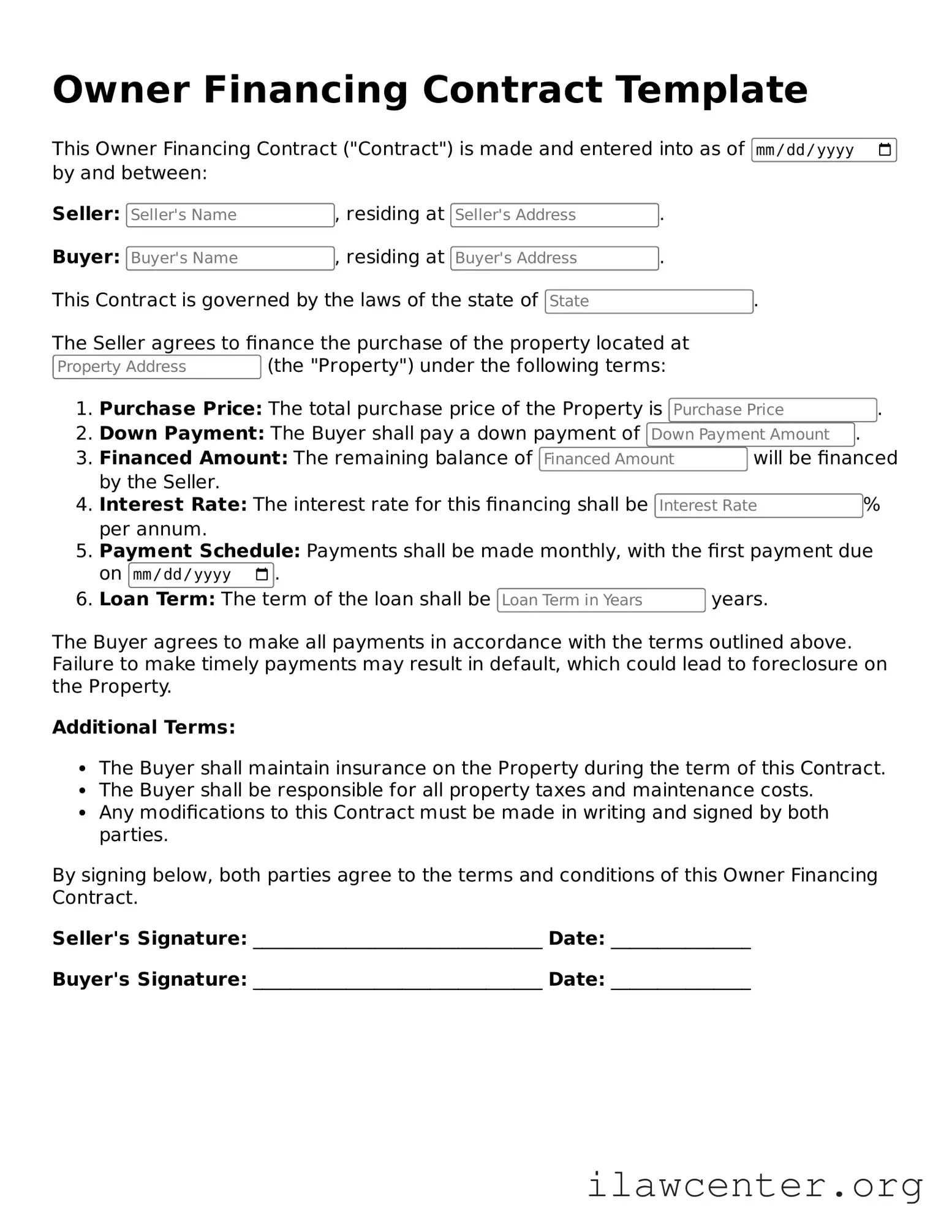
Owner Financing Contract Preview

Owner Financing Contract Template

This Owner Financing Contract ("Contract") is made and entered into as of by and between:

Seller: , residing at .

Buyer: , residing at .

This Contract is governed by the laws of the state of .

The Seller agrees to finance the purchase of the property located at (the "Property") under the following terms:

  1. Purchase Price: The total purchase price of the Property is .
  2. Down Payment: The Buyer shall pay a down payment of .
  3. Financed Amount: The remaining balance of will be financed by the Seller.
  4. Interest Rate: The interest rate for this financing shall be % per annum.
  5. Payment Schedule: Payments shall be made monthly, with the first payment due on .
  6. Loan Term: The term of the loan shall be years.

The Buyer agrees to make all payments in accordance with the terms outlined above. Failure to make timely payments may result in default, which could lead to foreclosure on the Property.

Additional Terms:

  • The Buyer shall maintain insurance on the Property during the term of this Contract.
  • The Buyer shall be responsible for all property taxes and maintenance costs.
  • Any modifications to this Contract must be made in writing and signed by both parties.

By signing below, both parties agree to the terms and conditions of this Owner Financing Contract.

Seller's Signature: _______________________________ Date: _______________

Buyer's Signature: _______________________________ Date: _______________

PDF Form Characteristics

Fact Name Description
Definition An Owner Financing Contract allows a buyer to purchase property directly from the seller without traditional bank financing.
Down Payment Typically, the buyer makes a down payment that is agreed upon in the contract, which can vary based on negotiation.
Interest Rate The interest rate is usually set by the seller and can be higher or lower than conventional mortgage rates.
Payment Terms Payments are made directly to the seller according to the terms outlined in the contract, often monthly.
Governing Law Each state has specific laws governing owner financing contracts. For example, in California, the law is governed by the California Civil Code.
Default Consequences If the buyer defaults on the payments, the seller may have the right to foreclose on the property, similar to traditional mortgages.
Title Transfer Title to the property may not transfer to the buyer until the loan is paid in full, depending on the terms of the contract.
Legal Considerations It is important for both parties to understand their rights and obligations under the contract to avoid potential disputes.
Benefits Owner financing can be beneficial for buyers who may not qualify for traditional loans and for sellers looking to sell quickly.

Instructions on Utilizing Owner Financing Contract

Filling out the Owner Financing Contract form is a straightforward process. This form is essential for establishing the terms of financing directly between the buyer and seller. Follow these steps to ensure you complete the form accurately.

  1. Begin by entering the date at the top of the form.
  2. Provide the names of both the buyer and seller in the designated fields.
  3. Fill in the property address, including the city, state, and ZIP code.
  4. Specify the purchase price of the property.
  5. Indicate the down payment amount the buyer will provide.
  6. Detail the loan amount by subtracting the down payment from the purchase price.
  7. Set the interest rate for the financing.
  8. Determine the loan term, specifying how many months or years the buyer will repay the loan.
  9. Outline the monthly payment amount based on the loan amount, interest rate, and term.
  10. Include any additional terms or conditions that apply to the financing agreement.
  11. Have both parties sign and date the form to make it legally binding.

Once you have completed the form, review it for accuracy. Ensure that all information is correct before proceeding with any further steps related to the financing agreement.

Important Facts about Owner Financing Contract

What is an Owner Financing Contract?

An Owner Financing Contract is a legal agreement between a property seller and buyer, allowing the buyer to purchase the property directly from the seller without involving a traditional lender. This arrangement typically includes details about the purchase price, down payment, interest rate, and repayment terms.

Who benefits from an Owner Financing Contract?

Both buyers and sellers can benefit from this type of financing. Buyers may find it easier to qualify for financing, especially if they have credit issues. Sellers can attract more potential buyers and may receive steady income from the interest on the loan.

What terms are typically included in the contract?

The contract usually outlines the purchase price, down payment amount, interest rate, payment schedule, and any penalties for late payments. It may also specify the duration of the financing and any contingencies that must be met before the sale is finalized.

Are there risks associated with Owner Financing?

Yes, there are risks for both parties. Sellers may face the risk of default if the buyer fails to make payments. Buyers may risk losing their investment if they cannot keep up with payments or if the seller fails to provide clear title to the property.

Is an Owner Financing Contract legally binding?

Yes, once both parties sign the contract, it becomes legally binding. This means that both the buyer and seller must adhere to the terms outlined in the agreement. It is advisable to consult with a legal professional to ensure the contract complies with state laws.

Can the terms of the contract be negotiated?

Absolutely. The terms of an Owner Financing Contract can be negotiated between the buyer and seller. This flexibility allows both parties to reach an agreement that meets their financial needs and goals.

What happens if the buyer defaults on the contract?

If the buyer defaults, the seller may have the right to initiate foreclosure proceedings, depending on the terms of the contract and state laws. The seller may reclaim the property and keep any payments made up to that point, but this process can vary significantly by jurisdiction.

Is it necessary to involve a real estate agent or attorney?

While it is not strictly necessary, involving a real estate agent or attorney is highly recommended. They can help ensure that the contract is properly drafted, protect the interests of both parties, and provide guidance throughout the process.
Common mistakes

When filling out an Owner Financing Contract form, many individuals inadvertently make mistakes that can lead to complications down the line. One common error is failing to provide complete information about the property. It’s essential to include the full address, legal description, and any relevant details that define the property clearly. Omitting this information can create confusion and disputes later.

Another frequent mistake is not specifying the purchase price. Clearly stating the agreed-upon amount helps prevent misunderstandings between the buyer and seller. Without this crucial detail, both parties may have different expectations about the financial terms of the agreement.

Additionally, many people overlook the importance of outlining the interest rate. If the interest rate is not clearly defined, it can lead to disagreements regarding monthly payments and the total cost of financing. This aspect of the contract should be explicitly detailed to avoid future conflicts.

Another area where mistakes often occur is in the payment schedule. Some individuals may forget to include the frequency of payments, such as monthly or bi-weekly. This oversight can lead to confusion about when payments are due, potentially resulting in late fees or penalties.

People also sometimes neglect to include the duration of the financing agreement. It’s important to specify how long the buyer has to repay the loan. Without a clear timeline, both parties might have different interpretations of the contract’s terms.

Inaccurate or missing signatures can also invalidate the contract. Each party must sign the document to indicate their agreement to the terms. If signatures are missing, the contract may not hold up in a legal context.

Another common error involves failing to include contingencies. These are conditions that must be met for the contract to remain valid. Without clearly stated contingencies, buyers and sellers may find themselves in difficult situations if certain expectations are not met.

Many individuals also forget to discuss and document closing costs. These costs can significantly impact the overall financial arrangement. It’s crucial to outline who is responsible for these expenses to avoid surprises at closing.

Another mistake is not including a clause for default. This clause outlines what happens if one party fails to meet their obligations. Without it, the contract may lack the necessary protections for both parties.

Lastly, people often fail to review the entire contract thoroughly before signing. Skimming through the document can lead to overlooking important details. Taking the time to read and understand every section can save both parties from future headaches.

Documents used along the form

When entering into an owner financing agreement, several additional documents are often necessary to ensure clarity and protect the interests of both parties. Below is a list of commonly used forms that complement the Owner Financing Contract.

  • Promissory Note: This document outlines the borrower's promise to repay the loan amount under the terms agreed upon in the owner financing contract. It includes details like the interest rate, payment schedule, and consequences of default.
  • Deed of Trust: This legal document secures the loan by placing a lien on the property. It allows the lender to take possession of the property if the borrower fails to make payments.
  • Disclosure Statement: This form provides essential information about the property and the terms of financing. It ensures that the borrower is fully informed before signing the contract.
  • Purchase Agreement: This document outlines the terms of the sale, including the purchase price and any contingencies. It serves as a foundation for the owner financing arrangement.
  • Title Insurance Policy: This insurance protects the buyer and lender against any claims or issues related to the property's title. It ensures that the buyer receives clear ownership of the property.
  • Amortization Schedule: This schedule breaks down each payment into principal and interest components over the life of the loan. It helps both parties understand how the loan will be repaid over time.

Using these documents in conjunction with the Owner Financing Contract can help streamline the process and provide essential protections for both the buyer and seller. Understanding each form's purpose is crucial for a successful transaction.

Similar forms

The Owner Financing Contract form shares similarities with several other documents used in real estate transactions. Below are seven documents that are comparable, along with explanations of their similarities:

  • Purchase Agreement: This document outlines the terms of sale between a buyer and seller. Like the Owner Financing Contract, it specifies the price, payment terms, and conditions of the sale.
  • Lease Option Agreement: This agreement allows a tenant to lease a property with the option to purchase it later. Both documents provide a pathway for buyers to acquire property while detailing payment structures.
  • Seller Financing Agreement: Similar to the Owner Financing Contract, this document allows the seller to finance the buyer's purchase directly. It includes terms like interest rates and repayment schedules.
  • Promissory Note: This legal document indicates the borrower's promise to repay a loan. It is often included in owner financing situations and outlines the loan amount, interest rate, and repayment terms.
  • Mortgage Agreement: This document secures a loan with the property as collateral. In both cases, the buyer is responsible for making payments, and failure to do so can result in foreclosure.
  • Deed of Trust: This document involves three parties: the borrower, the lender, and a trustee. It functions similarly to a mortgage, providing security for the loan while detailing payment obligations.
  • Real Estate Option Agreement: This agreement gives a buyer the right to purchase a property at a later date. Like the Owner Financing Contract, it establishes terms for the eventual sale and payment arrangements.

Dos and Don'ts

When filling out an Owner Financing Contract form, it is important to approach the task with care and attention to detail. Here are five things to consider doing and avoiding during this process:

  • Do read the entire contract carefully before filling it out.
  • Do provide accurate and complete information about both parties involved.
  • Do clarify any terms or conditions that are unclear before signing.
  • Do keep a copy of the completed contract for your records.
  • Do consult with a legal professional if you have questions or concerns.
  • Don't rush through the form; take your time to ensure accuracy.
  • Don't leave any sections blank unless instructed to do so.
  • Don't make assumptions about terms; seek clarification instead.
  • Don't sign the contract without fully understanding your obligations.
  • Don't ignore local laws or regulations that may impact the contract.

Misconceptions

Owner financing can be a beneficial option for both buyers and sellers, yet several misconceptions surround this method of real estate financing. Understanding these misconceptions is essential for making informed decisions. Here are ten common misunderstandings:

  1. Owner financing is only for buyers with poor credit.

    While owner financing can be an option for those with credit challenges, it is not exclusively for them. Many buyers choose this route for flexibility or to avoid traditional lender requirements.

  2. It is illegal in many states.

    Owner financing is legal in all states, though the specifics may vary. Familiarity with local laws is crucial, but it is a legitimate financing method.

  3. Only sellers with distressed properties offer owner financing.

    Many sellers of well-maintained properties also offer owner financing as a way to attract buyers and facilitate a quicker sale.

  4. Owner financing is too risky for sellers.

    While there are risks involved, sellers can mitigate them through proper documentation and by conducting thorough due diligence on the buyer.

  5. All owner financing agreements are the same.

    Each owner financing agreement can be tailored to the specific needs of both parties. Terms can vary widely, including interest rates, payment schedules, and down payments.

  6. Buyers do not have any protections in owner financing.

    Buyers can negotiate terms that provide them with protections, such as the right to inspect the property and stipulations for default scenarios.

  7. Owner financing is only beneficial for sellers.

    Buyers can benefit significantly from owner financing, including potential lower closing costs and more favorable payment terms.

  8. All owner financing deals are short-term.

    Owner financing can be structured for both short-term and long-term arrangements, depending on the needs and goals of the parties involved.

  9. Interest rates in owner financing are always higher than traditional loans.

    While some owner financing agreements may have higher rates, others can offer competitive or even lower rates compared to traditional lenders, especially in a tight credit market.

  10. Once the contract is signed, the terms cannot be changed.

    While it is important to adhere to the contract, parties can mutually agree to modify terms, provided both agree to the changes in writing.

Understanding these misconceptions can empower both buyers and sellers to explore owner financing as a viable option in real estate transactions. Knowledge is key to navigating this process effectively.

Key takeaways

  • Owner financing can be a flexible alternative to traditional mortgages. It allows buyers to negotiate terms directly with sellers.

  • Be clear about the terms of the agreement. This includes the purchase price, down payment, interest rate, and repayment schedule.

  • Ensure all parties understand their responsibilities. Both the buyer and seller should know what is expected throughout the financing period.

  • Document everything thoroughly. A well-completed contract protects both the buyer and seller in case of disputes.

  • Consult a legal professional if needed. While owner financing can be straightforward, expert advice can help navigate complex situations.