Fillable PA School Letter of Recommendation Document

Fillable PA School Letter of Recommendation Document

The PA School Letter of Recommendation form is a crucial document that helps prospective physician assistant students showcase their qualifications and character through the insights of their recommenders. This form allows evaluators to provide valuable feedback on a candidate's skills, experiences, and suitability for the demanding PA program. Ready to take the next step? Fill out the form by clicking the button below.

Article Guide

For aspiring physician assistants, the Letter of Recommendation (LOR) plays a pivotal role in the application process. This form serves as a crucial component that allows applicants to showcase their qualifications and personal attributes through the eyes of those who know them best. Typically, the LOR form requires evaluators to address specific criteria, including the applicant's clinical experience, interpersonal skills, and commitment to the healthcare profession. Additionally, it often prompts recommenders to provide insights into the applicant’s work ethic, ability to collaborate within a team, and capacity for critical thinking. The form may also include space for personal anecdotes that highlight the candidate's strengths and potential contributions to the PA field. By understanding the key aspects of this form, applicants can better prepare their recommenders, ensuring that the letters they receive effectively support their journey toward becoming a physician assistant.

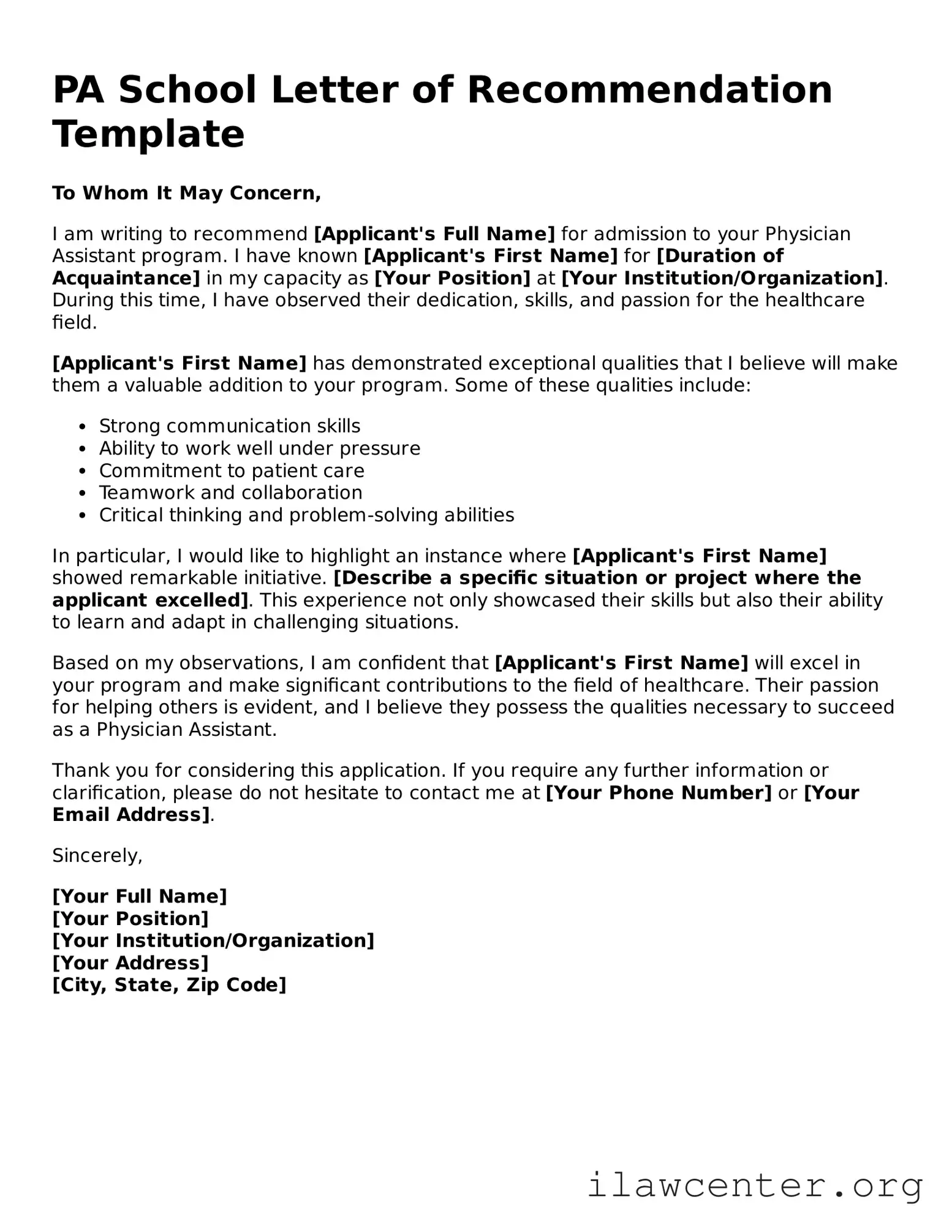
PA School Letter of Recommendation Preview

PA School Letter of Recommendation Template

To Whom It May Concern,

I am writing to recommend [Applicant's Full Name] for admission to your Physician Assistant program. I have known [Applicant's First Name] for [Duration of Acquaintance] in my capacity as [Your Position] at [Your Institution/Organization]. During this time, I have observed their dedication, skills, and passion for the healthcare field.

[Applicant's First Name] has demonstrated exceptional qualities that I believe will make them a valuable addition to your program. Some of these qualities include:

  • Strong communication skills
  • Ability to work well under pressure
  • Commitment to patient care
  • Teamwork and collaboration
  • Critical thinking and problem-solving abilities

In particular, I would like to highlight an instance where [Applicant's First Name] showed remarkable initiative. [Describe a specific situation or project where the applicant excelled]. This experience not only showcased their skills but also their ability to learn and adapt in challenging situations.

Based on my observations, I am confident that [Applicant's First Name] will excel in your program and make significant contributions to the field of healthcare. Their passion for helping others is evident, and I believe they possess the qualities necessary to succeed as a Physician Assistant.

Thank you for considering this application. If you require any further information or clarification, please do not hesitate to contact me at [Your Phone Number] or [Your Email Address].

Sincerely,

[Your Full Name]
[Your Position]
[Your Institution/Organization]
[Your Address]
[City, State, Zip Code]

PDF Form Characteristics

Fact Name Description
Purpose The PA School Letter of Recommendation form is designed to provide admissions committees with insights into an applicant's qualifications and character from a third-party perspective.
Requirements Typically, applicants must submit the form alongside their application materials, ensuring that it is completed by someone familiar with their professional or academic abilities.
Confidentiality In many cases, the letter is submitted directly by the recommender to maintain confidentiality and ensure authenticity.
Governing Law In Pennsylvania, the use of recommendation letters is guided by the Pennsylvania Code and the standards set by the Accreditation Review Commission on Education for the Physician Assistant (ARC-PA).

Instructions on Utilizing PA School Letter of Recommendation

Once you have the PA School Letter of Recommendation form, it's time to get started. This form is essential for your application process, and filling it out correctly is key to ensuring your recommendations shine. Follow the steps below to complete the form smoothly.

  1. Begin by reviewing the form carefully. Make sure you understand each section and what information is required.
  2. Fill in your personal information at the top of the form. This typically includes your full name, contact information, and any identification numbers required by the school.
  3. Identify the recommender. Provide their name, title, and contact details. Ensure you have their permission to include them.
  4. Write a brief statement about your relationship with the recommender. This should cover how long you have known them and in what capacity.
  5. Complete any specific questions or prompts included in the form. Be honest and thoughtful in your responses.
  6. Review your answers. Check for any spelling or grammatical errors to ensure professionalism.
  7. Sign and date the form if required. This may be necessary to validate your submission.
  8. Submit the form according to the instructions provided. This could involve emailing it directly or mailing a hard copy.

After you've filled out the form, it's important to communicate with your recommender. Let them know the form has been submitted and thank them for their support. This step helps maintain a positive relationship and shows your appreciation for their time and effort.

Important Facts about PA School Letter of Recommendation

What is the PA School Letter of Recommendation form?

The PA School Letter of Recommendation form is a document that prospective physician assistant students submit to gather endorsements from individuals who can speak to their qualifications. This form typically includes sections for the recommender to provide their insights about the applicant's skills, experiences, and character.

Who should I ask to write my letter of recommendation?

It is advisable to choose individuals who know you well and can provide a detailed and positive assessment of your abilities. Ideal recommenders include professors, employers, or supervisors in healthcare settings. They should be able to discuss your work ethic, interpersonal skills, and relevant experiences.

How many letters of recommendation do I need?

Most PA programs require two to three letters of recommendation. Check the specific requirements of each program you are applying to, as they may vary. It's essential to ensure that you meet the minimum requirement to strengthen your application.

What should my recommender include in the letter?

Your recommender should highlight your academic abilities, relevant experiences, and personal qualities. They should provide specific examples that illustrate your skills and commitment to the healthcare field. Personal anecdotes can make the letter more compelling.

Can I see the letter before it is submitted?

Generally, it is considered best practice to allow your recommenders to submit their letters without your review. However, you may ask for a general idea of what they plan to include. Trust in their judgment is important, as they are writing on your behalf.

How do I submit the letter of recommendation?

Submission methods vary by program. Some may require letters to be submitted directly through an online portal, while others may accept mailed letters. Ensure you provide your recommenders with clear instructions based on the requirements of each program.

What if my recommender is unable to write a letter?

If a potential recommender feels they cannot write a strong letter, it is best to respect their decision. Seek out other individuals who can provide a more favorable assessment. Having a strong letter is more beneficial than having one from someone who cannot fully endorse you.

Is there a deadline for submitting letters of recommendation?

Yes, each PA program will have its own deadlines for submitting letters of recommendation. It is crucial to communicate these deadlines to your recommenders well in advance to ensure they have enough time to write and submit their letters.

What if I have a gap in my education or experience?

If you have a gap in your education or experience, consider discussing it with your recommenders. They can address this in their letters by focusing on your strengths and how you have used that time to grow or gain relevant skills.

Can I use the same letter for multiple PA programs?

While you can use the same letter for multiple applications, it is advisable to tailor each letter to reflect the specific program’s values and strengths. A personalized letter can make a stronger impact than a generic one.
Common mistakes

When completing the PA School Letter of Recommendation form, individuals often overlook critical details that can impact the strength of their application. One common mistake is failing to provide specific examples of the candidate's skills and experiences. Generic statements do not effectively showcase the candidate's abilities. Instead, detailed anecdotes can provide a clearer picture of their qualifications.

Another frequent error is neglecting to address the qualities that PA schools specifically seek. Admissions committees look for attributes such as teamwork, communication skills, and empathy. If recommenders do not highlight these traits, the letter may not resonate with evaluators.

Inaccurate or incomplete information can also undermine a recommendation. This includes misspelling the candidate's name or omitting relevant experiences. Such oversights can create a negative impression and suggest a lack of attention to detail.

Additionally, some recommenders may write letters that are too brief. While conciseness is important, a letter that lacks depth can fail to convey the candidate's potential. A well-rounded letter should balance brevity with sufficient detail to make a compelling case.

Another mistake is using a one-size-fits-all approach. Each PA program has unique requirements and values. Tailoring the letter to align with the specific program can enhance its effectiveness. Failing to customize the content can make it seem less genuine.

Moreover, recommenders sometimes forget to include their own qualifications. Providing a brief background about themselves can lend credibility to the letter. This context helps admissions committees understand the perspective from which the recommendation is made.

Some individuals may also overlook the submission process. Ensuring that the letter is submitted on time and in the correct format is crucial. Late or improperly formatted submissions can jeopardize the candidate's application.

Lastly, recommenders might hesitate to ask the candidate for input or guidance. Open communication can help ensure that the letter addresses the candidate's strengths and aligns with their application strategy. Collaboration can lead to a more powerful recommendation.

Documents used along the form

When applying to Physician Assistant (PA) schools, several documents complement the PA School Letter of Recommendation form. Each of these documents plays a crucial role in presenting a comprehensive view of the applicant's qualifications, experiences, and character. Below is a list of commonly used forms and documents in this process.

  • Application Form: This is the primary document where applicants provide personal information, educational background, and relevant experiences. It serves as the foundation for the entire application.
  • Personal Statement: This essay allows applicants to express their motivations for pursuing a career as a PA. It offers insights into their personal journey and professional aspirations.
  • Resume or Curriculum Vitae (CV): A detailed account of the applicant's work history, education, certifications, and relevant skills. This document highlights the applicant's qualifications and experiences.
  • Transcripts: Official academic records from all post-secondary institutions attended. These documents provide evidence of the applicant's academic performance and coursework.
  • Standardized Test Scores: Many PA programs require scores from tests such as the GRE. These scores can help assess the applicant's readiness for graduate-level coursework.
  • Clinical Experience Verification: Documentation that confirms the applicant's hands-on experience in healthcare settings. This may include hours worked, roles held, and types of patient interactions.
  • Supplemental Forms: Some programs may have additional forms that provide specific information or answer particular questions required by the admissions committee.
  • Interviews: While not a document, interviews are a critical part of the application process. They allow applicants to communicate their passion and suitability for the PA profession directly.
  • Financial Aid Forms: If applicable, these forms assist in determining eligibility for financial assistance and scholarships, helping to ease the financial burden of education.

In conclusion, each of these documents contributes to a well-rounded application for PA school. Together, they provide admissions committees with a fuller understanding of the applicant's qualifications, experiences, and commitment to the field of healthcare.

Similar forms

  • Medical School Letter of Recommendation: This document serves a similar purpose by providing insight into a candidate's qualifications, character, and suitability for medical school. It is typically written by someone who knows the applicant well, such as a professor or employer.
  • Nursing School Letter of Recommendation: Like the PA School Letter of Recommendation, this document highlights the applicant's skills and experiences relevant to nursing. It emphasizes the candidate's compassion, work ethic, and ability to handle challenging situations.
  • Graduate School Letter of Recommendation: This document assesses a student's academic abilities and potential for success in a graduate program. It often includes specific examples of the applicant's strengths, similar to how a PA recommendation would.
  • Job Reference Letter: A job reference letter provides an overview of a candidate's professional skills and work history. It shares insights into the applicant's work ethic and interpersonal skills, paralleling the personal qualities highlighted in a PA recommendation.

Dos and Don'ts

When filling out the PA School Letter of Recommendation form, it is essential to approach the task with care. Here are six important do's and don'ts to keep in mind:

  • Do ensure that you know the applicant well. A strong recommendation comes from someone who understands the applicant's skills and character.
  • Don't exaggerate or provide false information. Honesty is crucial, and any discrepancies can harm the applicant's chances.
  • Do provide specific examples of the applicant's achievements and qualities. This adds credibility to your recommendation.
  • Don't use generic phrases or clichés. Personalizing your recommendation makes it more impactful.
  • Do submit the form on time. Meeting deadlines is important for the applicant's application process.
  • Don't forget to proofread your recommendation. Spelling and grammatical errors can detract from the professionalism of your letter.

Misconceptions

When applying to Physician Assistant (PA) schools, the Letter of Recommendation (LOR) form can be a source of confusion. Here are five common misconceptions about the PA School Letter of Recommendation form:

  • All recommenders must be healthcare professionals. Many applicants believe that only healthcare professionals can write letters of recommendation. However, PA schools often accept letters from a variety of sources, including professors, employers, and community leaders, as long as they can speak to the applicant's skills and character.
  • Letters must be submitted directly by the recommender. Some applicants think that letters must be sent directly by the recommenders. In reality, while many schools prefer this method, some allow applicants to submit the letters themselves, provided they are sealed and signed.
  • Length of the letter is critical. Another misconception is that longer letters are better. In fact, a concise, well-written letter that highlights specific strengths and experiences can be more impactful than a lengthy one filled with generalities.
  • All letters need to be from academic sources. Some candidates feel that they must have all letters from academic sources. However, a mix of academic and professional references can provide a more rounded view of the applicant's abilities and character.
  • Letters of recommendation are not important. Many applicants underestimate the importance of these letters. In reality, strong recommendations can significantly enhance an application, providing insights into the applicant’s qualifications and character that grades and test scores cannot convey.

Key takeaways

When filling out and using the PA School Letter of Recommendation form, consider the following key takeaways:

  • Choose the right recommenders: Select individuals who know you well and can speak positively about your skills and experiences relevant to the PA program.
  • Provide clear instructions: Ensure that your recommenders understand the requirements of the letter and the submission process.
  • Follow submission guidelines: Adhere to any specific instructions regarding formatting, length, and deadlines to ensure your letters are accepted.
  • Communicate with your recommenders: Keep an open line of communication. Update them on your application status and express gratitude for their support.