Fillable Partial Release of Lien Document

Fillable Partial Release of Lien Document

The Partial Release of Lien form is a legal document that allows a property owner to remove a lien from a specific portion of their property while retaining other liens. This form is essential for ensuring that any outstanding debts or obligations are clearly defined and managed. To proceed with your needs, please fill out the form by clicking the button below.

Article Guide

The Partial Release of Lien form serves as a crucial document in the realm of real estate transactions, particularly when a property owner seeks to clear a portion of a lien against their property. This form is typically utilized when a contractor or subcontractor has completed a segment of work, and the property owner wishes to release the lien on that specific portion while retaining the right to enforce the lien on any remaining unpaid work. It includes essential details such as the names of the parties involved, a description of the property, and the specific amount being released. By executing this form, property owners can demonstrate their good faith in making payments for completed work, while contractors can protect their interests in the remaining unpaid balance. The Partial Release of Lien not only aids in maintaining clear title to the property but also facilitates smoother transactions by reducing potential disputes over payment and lien rights. Understanding the implications of this form is vital for all parties engaged in construction projects, as it plays a significant role in ensuring that financial obligations are met and that the rights of all stakeholders are respected.

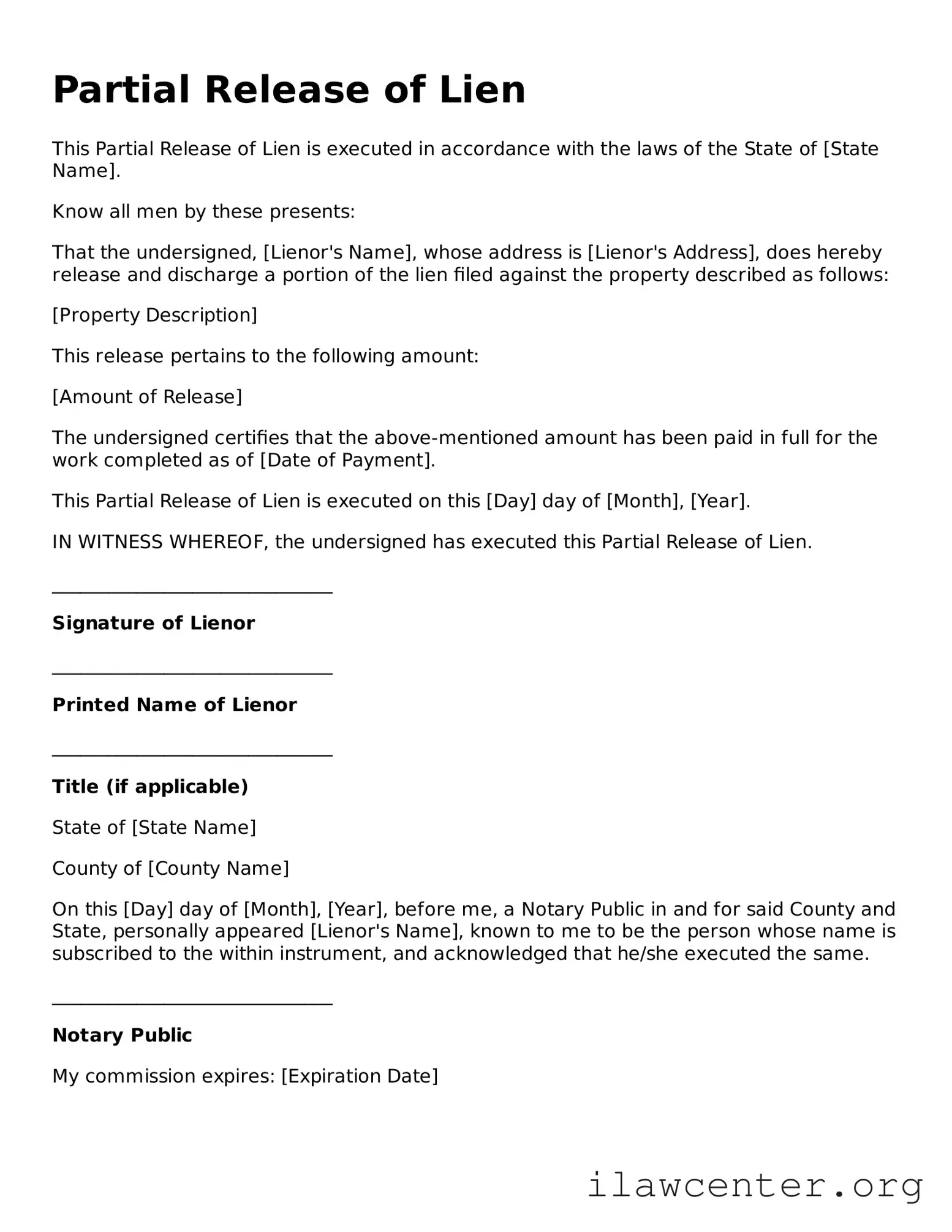
Partial Release of Lien Preview

Partial Release of Lien

This Partial Release of Lien is executed in accordance with the laws of the State of [State Name].

Know all men by these presents:

That the undersigned, [Lienor's Name], whose address is [Lienor's Address], does hereby release and discharge a portion of the lien filed against the property described as follows:

[Property Description]

This release pertains to the following amount:

[Amount of Release]

The undersigned certifies that the above-mentioned amount has been paid in full for the work completed as of [Date of Payment].

This Partial Release of Lien is executed on this [Day] day of [Month], [Year].

IN WITNESS WHEREOF, the undersigned has executed this Partial Release of Lien.

______________________________

Signature of Lienor

______________________________

Printed Name of Lienor

______________________________

Title (if applicable)

State of [State Name]

County of [County Name]

On this [Day] day of [Month], [Year], before me, a Notary Public in and for said County and State, personally appeared [Lienor's Name], known to me to be the person whose name is subscribed to the within instrument, and acknowledged that he/she executed the same.

______________________________

Notary Public

My commission expires: [Expiration Date]

PDF Form Characteristics

Fact Name Description
Definition A Partial Release of Lien form is a legal document that removes a portion of a lien from a property, allowing for the release of specific parts of the property from the lien's encumbrance.
Purpose This form is often used in construction projects where a contractor or subcontractor wants to release their claim on a portion of the property after receiving payment.
State-Specific Forms Each state may have its own version of the Partial Release of Lien form, reflecting local laws and requirements.
Governing Laws The laws governing the Partial Release of Lien vary by state, with many states following the Uniform Commercial Code (UCC) or specific lien statutes.
Requirements Typically, the form must include details such as the property description, the amount released, and the signatures of relevant parties.
Filing Process After completion, the form may need to be filed with the county clerk or recorder's office to ensure it is officially recognized.
Impact on Property Once filed, the Partial Release of Lien reduces the total amount of the lien on the property, which can facilitate future transactions or financing.
Potential Risks Failing to properly execute or file the form can lead to misunderstandings about the status of the lien and potential legal disputes.
Legal Advice Consulting with a legal professional is advisable to ensure compliance with state laws and to address any specific circumstances related to the lien.
Common Uses Commonly used in construction and real estate transactions, this form is crucial for contractors, subcontractors, and property owners.

Instructions on Utilizing Partial Release of Lien

After gathering the necessary information, you will be ready to complete the Partial Release of Lien form. This form is essential for indicating that a portion of the lien has been released. Follow these steps carefully to ensure accuracy.

  1. Begin by entering the date at the top of the form.
  2. Provide the name of the property owner in the designated space.
  3. List the address of the property that the lien pertains to.
  4. Identify the lienholder by writing their name in the appropriate section.
  5. Include the amount of the lien that is being released.
  6. Clearly state the reason for the partial release, if applicable.
  7. Sign the form where indicated, ensuring that the signature matches the name of the lienholder.
  8. Print the name of the lienholder beneath the signature.
  9. Include the date of the signature.
  10. Make copies of the completed form for your records and for the parties involved.

Once you have filled out the form, it is important to file it with the appropriate authority. This may involve submitting it to a county clerk or other relevant office, depending on local requirements. Ensure that all parties receive a copy for their records.

Important Facts about Partial Release of Lien

What is a Partial Release of Lien?

A Partial Release of Lien is a legal document that allows a property owner or contractor to remove a lien from a specific portion of a property. This is often used in construction projects where a contractor has been partially paid for their work, but a lien still exists on the entire property. By filing this document, the contractor releases their claim on the part of the property that has been paid for, while still retaining their rights to the unpaid portions.

When should I use a Partial Release of Lien?

You should consider using a Partial Release of Lien when you have received payment for a portion of the work completed on a property, but a lien has been filed against the entire property. This document helps clarify that you relinquish your claim on the part of the property that has been compensated, allowing the owner to sell or refinance that portion without the burden of the lien.

Who can file a Partial Release of Lien?

Typically, contractors, subcontractors, or suppliers who have filed a lien against a property can file a Partial Release of Lien. It is essential that the party filing the release is the same entity that filed the original lien. This ensures that the release is valid and legally binding.

What information is needed to complete a Partial Release of Lien?

To complete a Partial Release of Lien, you will need specific information, including the property address, the original lien details, the amount paid, and a description of the work performed. It’s also important to include the date of the release and the signatures of the parties involved to ensure its enforceability.

Is a Partial Release of Lien legally binding?

Yes, a properly executed Partial Release of Lien is legally binding. Once filed with the appropriate local government office, it serves as official documentation that a lien has been partially released. This protects both the property owner and the contractor by clarifying the scope of the lien and the payments made.

How does a Partial Release of Lien affect my rights?

Filing a Partial Release of Lien means you are relinquishing your claim to the portion of the property that has been paid for. However, it does not affect your rights to claim the remaining unpaid amounts. It is crucial to understand that while you are releasing part of your lien, you still retain the right to pursue payment for any outstanding balances related to the work performed.

Can I revoke a Partial Release of Lien?

Once a Partial Release of Lien has been filed and recorded, it generally cannot be revoked. The release acts as a formal acknowledgment that a portion of the lien has been satisfied. If there are issues or disputes regarding the payment, it’s advisable to seek legal counsel to explore your options, but simply revoking the release is not typically feasible.

Where do I file a Partial Release of Lien?

A Partial Release of Lien should be filed with the same local government office where the original lien was recorded. This is usually the county clerk or recorder’s office. Filing it in the correct location ensures that the release is recognized and enforceable, providing clarity to all parties involved.
Common mistakes

Filling out a Partial Release of Lien form can be a straightforward task, but many individuals make common mistakes that can lead to complications. One frequent error is failing to include the correct legal description of the property. The legal description is crucial, as it identifies the specific property being released from the lien. Without this information, the release may be deemed invalid, causing unnecessary delays and confusion.

Another mistake often made is neglecting to include all necessary parties' signatures. If any party involved in the lien does not sign the form, it may not be enforceable. This oversight can result in disputes later on, as all parties must agree to the terms of the release. It is essential to ensure that everyone with a stake in the lien is accounted for and has provided their consent.

People also frequently overlook the importance of providing the correct date on the form. The date serves as a critical reference point for the release. If the date is missing or incorrect, it could create ambiguity about when the lien was officially released. Such ambiguity can lead to legal challenges or misunderstandings down the line.

In addition, individuals sometimes make the mistake of not providing adequate supporting documentation. A Partial Release of Lien should be accompanied by relevant documents that substantiate the release. These may include payment receipts or other evidence that the obligations tied to the lien have been fulfilled. Without this documentation, the release may be questioned or contested.

Another common error is using vague language in the form. Clear and precise language is essential to ensure that the intent of the release is unmistakable. Ambiguities can lead to misinterpretations and disputes in the future. It is advisable to use straightforward terms that leave little room for confusion.

Lastly, people sometimes forget to file the completed form with the appropriate governmental office. Even if the form is filled out correctly, failing to file it can render the release ineffective. Proper filing is crucial to ensure that the lien is officially removed from public records. This step should not be overlooked, as it is essential for protecting the rights of all parties involved.

Documents used along the form

A Partial Release of Lien form is often used in construction and real estate transactions to formally acknowledge that a portion of a lien has been released. This document is typically accompanied by several other forms and documents that help clarify the terms of the agreement and protect the rights of all parties involved. Below is a list of related documents that may be utilized in conjunction with a Partial Release of Lien.

  • Notice of Intent to Lien: This document informs property owners that a lien may be filed if payment is not received. It serves as a warning and allows the owner to address the issue before a lien is officially placed.
  • Mechanic's Lien: This legal claim is filed by contractors or suppliers to secure payment for services rendered or materials provided. It establishes a right to payment against the property until the debt is satisfied.
  • Release of Lien: This document is used to remove a lien from a property once the debt has been paid. It is essential for clearing the title and allowing for the sale or refinancing of the property.
  • Waiver of Lien: This form is signed by a contractor or subcontractor to relinquish their right to file a lien against a property. It can be conditional or unconditional, depending on the terms agreed upon.
  • Subcontractor Agreement: This contract outlines the terms between a contractor and subcontractor, including payment schedules and responsibilities. It helps clarify the relationship and obligations of each party.
  • Payment Application: This document is submitted by contractors to request payment for work completed. It details the work done and the amount owed, serving as a formal request for funds.
  • Final Release of Lien: This document is issued once all payments have been made, formally releasing any claims against the property. It confirms that the contractor or supplier has been fully compensated.
  • Construction Contract: This agreement outlines the terms and conditions of a construction project, including scope, timelines, and payment terms. It serves as the foundation for the working relationship between parties.

Understanding these documents can help ensure that all parties are protected and that the process runs smoothly. Each form serves a specific purpose and contributes to the overall clarity and legality of the transaction.

Similar forms

  • Release of Lien: This document formally removes a lien from a property, similar to a Partial Release, but it applies to the entire amount owed rather than just a portion.
  • Waiver of Lien: This document is used to waive the right to file a lien. It can be similar in function, as both serve to protect property owners from future claims.
  • Subordination Agreement: This document allows a lien to be ranked below another lien. Like a Partial Release, it adjusts the priority of claims against a property.
  • Notice of Completion: This document informs interested parties that a project is finished. It can trigger the timeline for filing liens, making it relevant to lien releases.
  • Final Invoice: This document details the final amounts owed for services rendered. It can accompany a Partial Release by clarifying the payment status.
  • Construction Contract: This agreement outlines the terms of work performed. It relates to liens as it establishes the basis for any claims that might arise.
  • Affidavit of Payment: This document certifies that all payments have been made. It is similar because it can help facilitate the release of a lien.
  • Certificate of Title: This document confirms ownership of a property. It is relevant as it shows whether any liens exist, impacting the need for a Partial Release.

Dos and Don'ts

When filling out a Partial Release of Lien form, it's important to follow certain guidelines. Here are some dos and don'ts to keep in mind:

  • Do double-check the names of all parties involved.
  • Do ensure the property description is accurate.
  • Do sign and date the form where required.
  • Do keep a copy for your records.
  • Do consult with a legal professional if unsure.
  • Don't leave any fields blank unless instructed.
  • Don't use outdated forms; always use the latest version.
  • Don't forget to check state-specific requirements.
  • Don't rush the process; take your time to ensure accuracy.

Misconceptions

The Partial Release of Lien form is often misunderstood. Here are ten common misconceptions about it:

  1. It cancels the entire lien. Many believe that a partial release cancels the entire lien. In reality, it only releases a portion of the property or the amount owed.
  2. It is not legally binding. Some think that a partial release has no legal standing. However, when properly executed, it is a legally binding document.
  3. Only contractors can file a partial release. This form is not limited to contractors. Subcontractors and suppliers can also file a partial release for amounts owed to them.
  4. It must be filed in person. While filing in person is an option, many jurisdictions allow for electronic filing of the partial release of lien.
  5. It requires court approval. A partial release does not typically require court approval. It is usually sufficient to have the parties involved sign the document.
  6. It eliminates the need for a final lien waiver. A partial release does not replace the need for a final lien waiver. Both documents serve different purposes in the payment process.
  7. It can be used for any amount. Some assume that any amount can be released. However, the amount released must be specific and clearly stated in the form.
  8. It affects the entire property. A common misconception is that a partial release affects the entire property. In fact, it only pertains to the specific portion or amount indicated.
  9. It is the same as a lien waiver. A partial release is not synonymous with a lien waiver. They are distinct documents, each serving its own purpose in the construction process.
  10. Once filed, it cannot be revoked. Some believe that a partial release cannot be revoked. In certain circumstances, it can be rescinded if both parties agree.

Understanding these misconceptions can help individuals navigate the complexities of property liens more effectively.

Key takeaways

When dealing with a Partial Release of Lien form, understanding its components and implications is crucial. Here are ten key takeaways to consider:

  1. The Partial Release of Lien form is used to remove a lien on a specific portion of a property, while keeping the lien in place for the remaining amount.
  2. It is important to ensure that the form is filled out accurately to avoid any legal complications.
  3. Both the lien claimant and the property owner must sign the form for it to be valid.
  4. Check state-specific requirements, as some jurisdictions may have unique rules regarding the form.
  5. Submitting the form to the appropriate local government office is necessary for the release to take effect.
  6. Retain a copy of the completed form for your records, as it serves as proof of the release.
  7. Consider consulting a legal professional if there are any uncertainties about the process.
  8. The form typically includes details such as the property description, the amount being released, and the parties involved.
  9. Filing the Partial Release of Lien form can help facilitate the sale or refinancing of a property.
  10. Timeliness is essential; delays in filing may impact the rights of the parties involved.

Understanding these points can help ensure that the process of using a Partial Release of Lien form is smooth and effective.