Pay Stub PDF Template

Pay Stub PDF Template

The Pay Stub form is a document that provides employees with a detailed summary of their earnings and deductions for a specific pay period. It typically includes information such as gross pay, net pay, taxes withheld, and any other deductions. Understanding this form is essential for managing personal finances effectively, so take a moment to fill it out by clicking the button below.

Article Guide

When it comes to understanding your earnings and deductions, the Pay Stub form plays a crucial role in providing clarity and transparency. This essential document breaks down your gross pay, which is the total amount earned before any deductions are made. It also outlines various deductions, such as taxes, health insurance, retirement contributions, and other withholdings, giving you a complete picture of your net pay—the amount you actually take home. Additionally, the Pay Stub form typically includes vital information such as your employer's name and address, your employee identification number, and the pay period covered by the stub. This form not only serves as a record of your earnings but also helps you keep track of your financial health over time. Understanding each component of the Pay Stub can empower you to make informed decisions about your finances and ensure that you are being compensated fairly for your work.

Pay Stub Preview

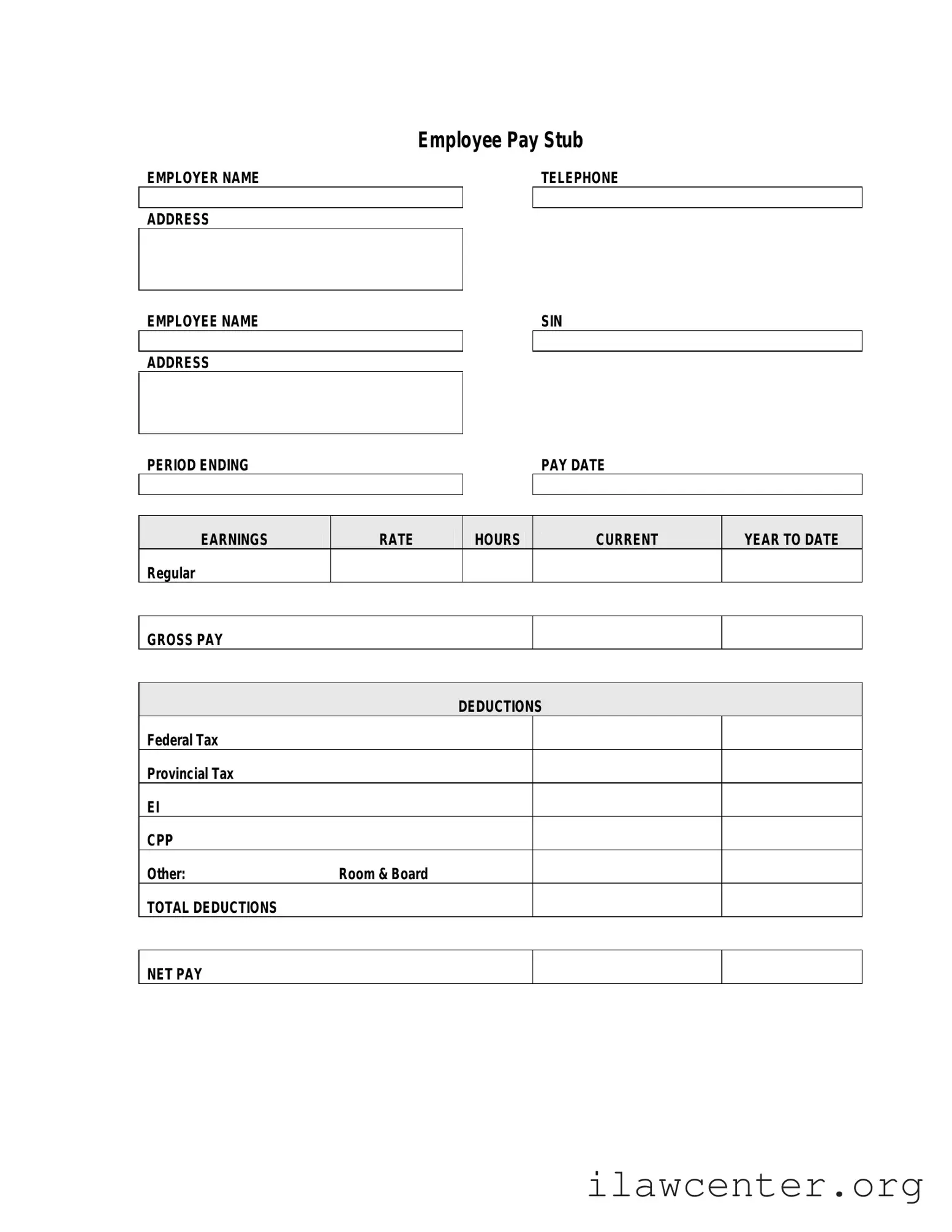
Employee Pay Stub
EMPLOYER NAME TELEPHONE
ADDRESS
EMPLOYEE NAME SIN
ADDRESS
PERIOD ENDING PAY DATE
EARNINGS RATE HOURS CURRENT YEAR TO DATE
Regular
GROSS PAY
DEDUCTIONS
Federal Tax
Provincial Tax
EI
CPP
Other: Room & Board
TOTAL DEDUCTIONS
NET PAY

File Properties

Fact Name Description
Definition A pay stub is a document that outlines an employee's earnings and deductions for a specific pay period.
Purpose Pay stubs provide employees with a detailed breakdown of their wages, taxes withheld, and other deductions.
Legal Requirement Many states require employers to provide pay stubs to employees, ensuring transparency in compensation.
Content A typical pay stub includes the employee's name, pay period dates, gross pay, net pay, and itemized deductions.
Frequency Pay stubs are issued on a regular basis, typically weekly, biweekly, or monthly, depending on the employer's payroll schedule.
State Variations Some states, like California, have specific laws governing the format and content of pay stubs (California Labor Code Section 226).
Digital vs. Paper Employers may provide pay stubs in digital format, but they must ensure employees have easy access to them.
Record Keeping Employees should keep pay stubs for personal records and tax purposes, as they provide proof of income.
Discrepancies If there are discrepancies in a pay stub, employees should address them with their employer promptly to resolve issues.

Instructions on Utilizing Pay Stub

Filling out the Pay Stub form is an important task that ensures accurate record-keeping for your employment income. Completing this form allows you to maintain clear financial documentation, which can be helpful for budgeting, tax purposes, or when applying for loans. Follow the steps below to accurately fill out the Pay Stub form.

  1. Begin by entering your employee name in the designated field.
  2. Next, provide your employee ID number or social security number.
  3. Fill in the pay period dates that the stub covers, indicating the start and end dates.
  4. Enter your hourly rate or salary in the appropriate section.
  5. List the total number of hours worked during the pay period.
  6. Calculate and input the gross pay, which is your total earnings before deductions.
  7. Detail any deductions, such as taxes, health insurance, or retirement contributions.
  8. Calculate the net pay by subtracting total deductions from gross pay.
  9. Finally, review all entries for accuracy before submitting the form.

Important Facts about Pay Stub

What is a Pay Stub?

A pay stub is a document provided by an employer that outlines an employee's earnings for a specific pay period. It details gross pay, deductions, and net pay. This document serves as proof of income and is often required for various financial transactions, such as applying for loans or renting property.

What information is typically included on a Pay Stub?

A pay stub generally includes the employee's name, address, and Social Security number, along with the employer's information. Key financial details are also present, such as the pay period dates, gross earnings, deductions (like taxes, health insurance, and retirement contributions), and the net pay amount. Some pay stubs may also show year-to-date totals for earnings and deductions.

How can I obtain my Pay Stub?

Why is it important to keep my Pay Stubs?

Keeping pay stubs is crucial for several reasons. They serve as a record of income, which is important for tax filing and financial planning. Additionally, if discrepancies arise regarding pay or deductions, having pay stubs allows employees to verify their earnings and resolve issues with their employer.

What should I do if I find an error on my Pay Stub?

If an employee notices an error on their pay stub, they should report it to their HR or payroll department as soon as possible. It's important to provide specific details about the discrepancy, such as the incorrect amount and the expected correct amount. Employers are typically required to correct any errors promptly.

Are Pay Stubs required by law?

In the United States, laws regarding pay stubs vary by state. While some states require employers to provide pay stubs, others do not have such mandates. Regardless of legal requirements, many employers choose to provide pay stubs as a best practice to ensure transparency and maintain good employee relations.

Can I access my Pay Stub if I am no longer employed?

Common mistakes

Filling out a Pay Stub form can seem straightforward, but many people make common mistakes that can lead to confusion or issues down the line. One frequent error is incorrect personal information. This includes misspelling names or providing the wrong Social Security number. Such mistakes can cause problems with tax reporting and payroll processing.

Another common mistake is miscalculating hours worked. Whether it's due to rounding errors or forgetting to include overtime, inaccuracies in reported hours can affect paychecks. It's essential to double-check the hours to ensure you receive the correct compensation for your work.

People often overlook the importance of specifying the correct pay period. Failing to indicate the right dates can lead to discrepancies in pay. This oversight can also complicate record-keeping for both employees and employers.

Some individuals neglect to account for deductions. Not listing health insurance, retirement contributions, or taxes can result in an inaccurate net pay amount. Always ensure that all deductions are clearly stated to avoid surprises when you receive your paycheck.

Another mistake is not keeping a copy of the completed Pay Stub form. This can make it difficult to track past payments or resolve any disputes that may arise later. Retaining a copy is a good practice for personal records.

Lastly, many people fail to review the final pay stub for accuracy. Taking a moment to verify all information before submission can save time and prevent issues. Always ensure everything is correct before handing in the form.

Documents used along the form

When managing payroll and employee compensation, several forms and documents complement the Pay Stub form. Each of these documents plays a crucial role in ensuring clarity and compliance in financial transactions between employers and employees. Below is a list of commonly used forms that often accompany the Pay Stub.

  • W-2 Form: This form reports an employee's annual wages and the taxes withheld from their paycheck. Employers must provide a W-2 to each employee by January 31 of the following year, allowing employees to accurately file their income tax returns.
  • W-4 Form: This document is filled out by employees to indicate their tax withholding preferences. It helps employers determine the correct amount of federal income tax to withhold from each paycheck based on the employee's filing status and allowances.
  • Direct Deposit Authorization Form: Employees use this form to authorize their employer to deposit their paycheck directly into their bank account. It streamlines the payment process and enhances convenience for employees.
  • Time Sheet: This document records the hours worked by an employee during a specific pay period. It is essential for calculating wages accurately, especially for hourly employees or those on commission.
  • Employee Handbook: While not a form in the traditional sense, this document outlines company policies, procedures, and employee rights. It serves as a reference for employees regarding their benefits, including payroll practices.

Understanding these documents can significantly enhance the payroll process. Each form contributes to a transparent and efficient system, ensuring that both employers and employees are on the same page regarding compensation and tax obligations.

Similar forms

  • W-2 Form: This document summarizes an employee's annual wages and the taxes withheld from their paycheck. Like a pay stub, it provides essential information for tax filing.
  • 1099 Form: Used for independent contractors, this form reports income earned outside of traditional employment. Similar to a pay stub, it shows earnings but does not withhold taxes.
  • Direct Deposit Receipt: This document confirms that an employee's paycheck has been electronically deposited into their bank account. It provides details similar to a pay stub, such as the amount and date of deposit.
  • Payroll Summary: This report provides a comprehensive overview of all payroll transactions for a specific period. It includes details on gross pay, deductions, and net pay, much like a pay stub.
  • Commission Statement: For employees earning commission, this document outlines sales and the corresponding commission earned. It shares similarities with a pay stub by detailing earnings and deductions.
  • Expense Reimbursement Form: This form allows employees to claim back costs incurred for work-related expenses. It provides a breakdown of amounts, similar to how a pay stub details earnings and deductions.
  • Time Sheet: This record tracks the hours worked by an employee. It is similar to a pay stub in that it reflects the basis for calculating pay, including regular and overtime hours.

Dos and Don'ts

When filling out a Pay Stub form, attention to detail is crucial. Here are some important dos and don'ts to keep in mind.

  • Do ensure that all personal information is accurate, including your name, address, and Social Security number.
  • Do double-check your hours worked and pay rate to avoid discrepancies.
  • Do review deductions carefully, including taxes and benefits, to understand your take-home pay.
  • Don't leave any sections blank; every part of the form should be filled out completely.
  • Don't ignore the importance of keeping a copy for your records; this can be valuable for future reference.

Misconceptions

Many people have misunderstandings about pay stubs. Here are five common misconceptions:

  1. Pay stubs are only for full-time employees.

    This is not true. Pay stubs can be issued to both full-time and part-time employees. Anyone who receives a paycheck should receive a pay stub detailing their earnings.

  2. Pay stubs are not important.

    Some believe pay stubs are just pieces of paper. In reality, they serve as important records of income. They can be crucial for tax purposes, loan applications, and personal budgeting.

  3. All pay stubs look the same.

    Pay stubs can vary significantly from one employer to another. Each company may have its own format and information included, which can lead to confusion.

  4. Pay stubs only show gross pay.

    This is a misconception. Pay stubs typically display both gross pay and net pay, along with deductions such as taxes and benefits. This helps employees understand what they earn and what is taken out.

  5. You don’t need to keep pay stubs.

    Many people think they can discard pay stubs after receiving them. However, it is wise to keep them for at least a year. They can be useful for verifying income or resolving any discrepancies later on.

Key takeaways

When filling out and using the Pay Stub form, there are several important points to keep in mind. Understanding these key takeaways can help ensure accuracy and compliance.

  • Know the Purpose: The Pay Stub form provides a detailed breakdown of an employee's earnings and deductions. It serves as an important record for both employees and employers.
  • Accurate Information: Ensure that all personal and employment information is filled out correctly. This includes the employee's name, address, and Social Security number.
  • Check Earnings: Review the earnings section carefully. It should include regular pay, overtime, bonuses, and any other forms of compensation.
  • Understand Deductions: Familiarize yourself with the deductions listed on the form. This may include taxes, health insurance, retirement contributions, and other withholdings.
  • Keep Records: Retain copies of pay stubs for your records. This documentation is useful for tax purposes and can help in verifying income when applying for loans or other financial services.
  • Review Regularly: Regularly reviewing pay stubs can help identify any discrepancies or errors in pay. Address any issues promptly with your employer.