Pedigree Chart PDF Template

Pedigree Chart PDF Template

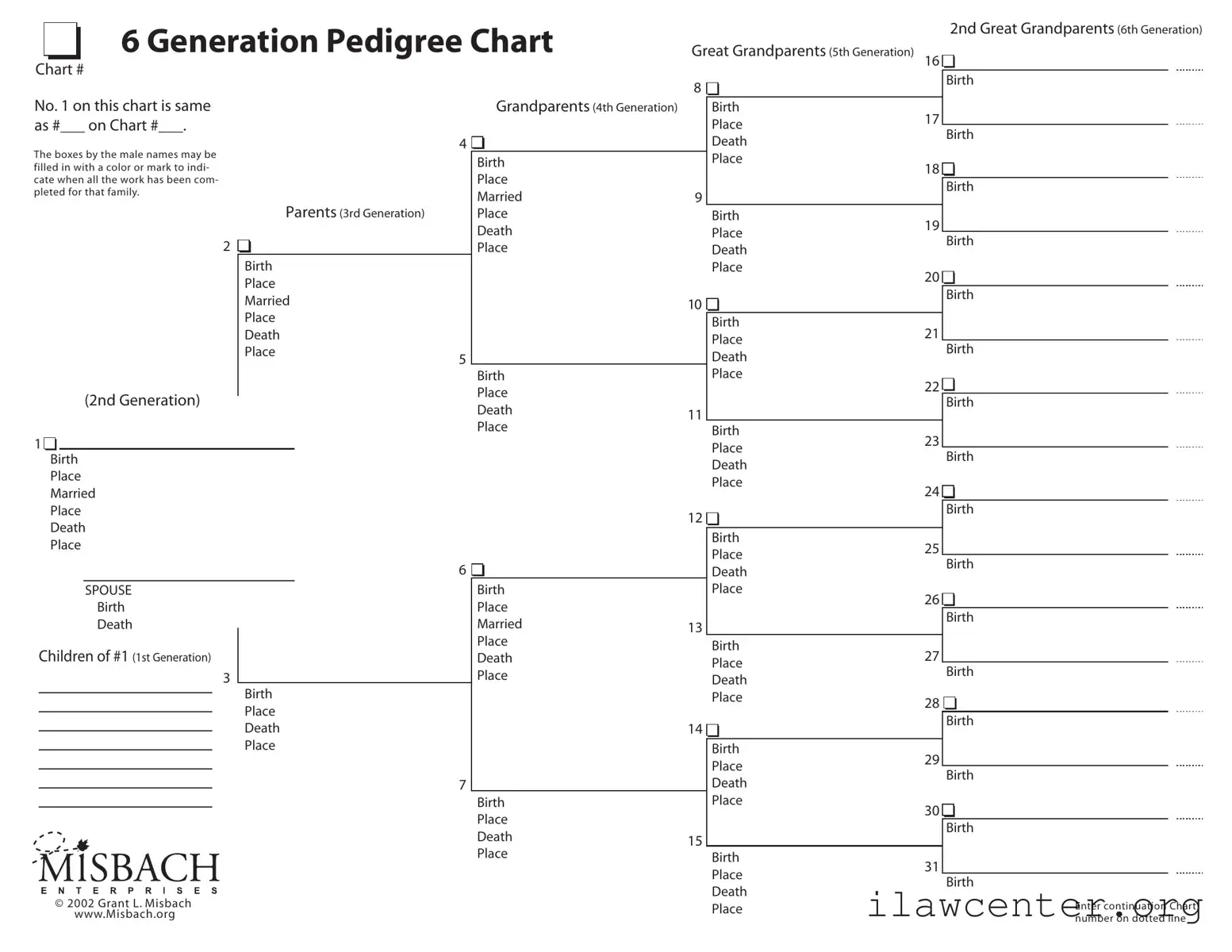
A Pedigree Chart is a visual representation of family relationships and lineage, commonly used in genetics and genealogy. This chart helps individuals trace their ancestry and understand hereditary traits. To get started on your own family history, fill out the form by clicking the button below.

Article Guide

The Pedigree Chart form serves as a vital tool in various fields, particularly in genetics, medicine, and family history research. This form visually represents family relationships and genetic traits across generations, allowing individuals to trace lineage and understand hereditary patterns. It typically includes spaces for names, dates of birth, and relevant medical histories of family members. By organizing this information, the chart facilitates the identification of inherited conditions and helps healthcare professionals assess risks associated with genetic disorders. Additionally, the Pedigree Chart can be instrumental in genealogy, providing a clear depiction of ancestral connections that can enrich personal and familial narratives. Its structured format allows for easy updates and modifications, ensuring that the information remains current and comprehensive.

Pedigree Chart Preview

ENTERPRISES
2nd Great Grandparents (6th Generation)
6 Generation Pedigree Chart
Great Grandparents (5th Generation)
16
Chart #
Birth
8
No. 1 on this chart is same
Grandparents
(4th Generation)
as #___ on Chart #___.
Birth
4
The boxes by the male names may be
filled in with a color or mark to indi-
cate when all the work has been com-
Birth
pleted for that family.
Parents (3rd Generation)
Birth
19
Place
Birth
2
Death
Birth
Place
20
Place
Birth
Married
Place
Death
Place
Birth
5
Birth
Place
(2nd Generation)
Birth
Death
11
Place
Birth
1
23
Place
Birth
Place
Married
Place
Death
Place
Birth
Place
Death
Place
Birth
Place
Death
Place
9
10
17
18
21
22
Birth
Birth
Death
Place
Place
24
Place
Married
Birth
12
Death
Place
Birth
6
SPOUSE
Birth
Birth
Death
Birth
27
Children of #1 (1st Generation)
Place
Birth
3
Death
Birth
Place
28
Place
Birth
Death
Place
Birth
7
Birth
Place
Birth
Death
15
Place
Birth
31
Place
Birth
Place
Death
Place
Birth
Place
Death
Place
Birth
Place
Married
Place
Death
Place
13
14
25
26
29
30
Birth
Death
© 2002 Grant L. Misbach
Enter continuation Chart
Place
www.Misbach.org
number on dotted line

File Properties

Fact Name Description
Definition A Pedigree Chart form is a visual representation of a person's ancestry, showing familial relationships across generations.
Purpose This form is often used in legal contexts to establish lineage, inheritance rights, or eligibility for certain benefits.
Format Typically, the chart includes squares for males and circles for females, with lines connecting parents to their children.
State-Specific Forms Some states require specific formats for Pedigree Charts, governed by laws such as the Uniform Parentage Act.
Usage in Adoption In adoption cases, a Pedigree Chart can help clarify biological relationships and support legal proceedings.
Documentation Supporting documents, like birth certificates and marriage licenses, may be needed alongside the Pedigree Chart for validation.

Instructions on Utilizing Pedigree Chart

After obtaining the Pedigree Chart form, you will need to provide specific information about your family tree. This process requires careful attention to detail to ensure accuracy. Follow the steps below to complete the form correctly.

  1. Begin with your name. Write it in the designated space at the top of the form.
  2. Next, fill in your date of birth. This information is usually requested in a specific format, such as MM/DD/YYYY.
  3. Identify your parents. Write down their names in the provided sections. Include both your mother’s and father’s names.
  4. For each parent, provide their date of birth. Again, follow the requested format.
  5. Continue with your grandparents. List their names beneath your parents’ names. Include both maternal and paternal grandparents.
  6. Fill in the dates of birth for each grandparent, ensuring you use the correct format.
  7. If applicable, include any additional information requested about your siblings. Write their names and dates of birth as needed.
  8. Review the completed form for any errors or missing information. Make sure everything is clear and legible.
  9. Finally, sign and date the form at the bottom, if required.

Once you have completed these steps, you can submit the form according to the instructions provided with it. Ensure that you keep a copy for your records.

Important Facts about Pedigree Chart

What is a Pedigree Chart form?

A Pedigree Chart form is a visual representation that outlines the lineage of an individual, often used in genealogy, animal breeding, or health assessments. It typically includes information about ancestors, descendants, and relationships among family members. By mapping out these connections, it helps individuals understand their heritage and genetic background more clearly.

How do I fill out the Pedigree Chart form?

To complete the Pedigree Chart form, start by entering your name and details at the top. Next, work backward through your family tree, filling in the names of your parents, grandparents, and great-grandparents. Include relevant dates, such as birth and death dates, if available. Make sure to indicate relationships clearly, using lines to connect family members. If you have children, list them below your name, ensuring the chart remains organized and easy to read.

Why is a Pedigree Chart important?

A Pedigree Chart is important for several reasons. It can help individuals trace their ancestry and understand their family history. This information is valuable for medical reasons, as certain hereditary conditions may be identified through family lineage. Additionally, in animal breeding, a Pedigree Chart can showcase the lineage of pets or livestock, assisting breeders in making informed decisions about mating and health practices.

Where can I find a Pedigree Chart form?

You can find a Pedigree Chart form through various sources. Many genealogy websites offer downloadable templates that you can print and fill out by hand. Local libraries or historical societies may also provide forms or guidance on creating your own. For those who prefer digital options, numerous online tools and software allow you to create and maintain a Pedigree Chart electronically, making it easy to update and share.

Common mistakes

Filling out a Pedigree Chart form can be a straightforward task, but many individuals make common mistakes that can lead to confusion or inaccurate information. One frequent error is not including all relevant family members. It's important to capture not just direct ancestors but also siblings and other relatives who may play a role in understanding genetic traits.

Another mistake is failing to use consistent naming conventions. For example, using nicknames or abbreviations instead of full names can create ambiguity. It’s best to stick with formal names to ensure clarity for anyone reviewing the chart later.

People often overlook the importance of accurate dates. Missing or incorrect birth and death dates can skew the family history timeline. When filling out the form, double-check these dates to avoid potential discrepancies.

Inaccurate relationships can also be a significant issue. Sometimes, individuals mistakenly label a family member's relationship, which can lead to misunderstandings about lineage. Make sure to clearly indicate whether someone is a parent, sibling, or cousin.

Additionally, some may forget to include their own information. This can create gaps in the chart and make it harder to trace the lineage accurately. Always start with your own details before branching out to other family members.

Another common error is neglecting to indicate any adoptions or step-relationships. These connections are vital for a complete family picture and should be clearly marked to avoid confusion.

People sometimes use vague terms to describe relationships, such as “aunt” or “uncle,” without specifying whether they are maternal or paternal. This can lead to complications in understanding the family structure. Clear distinctions are necessary for an accurate representation.

Many individuals also fail to review their charts for completeness before submission. Taking a moment to go over the entire form can help catch any mistakes or omissions. A thorough review can save time and prevent future issues.

Lastly, not keeping a backup of the completed Pedigree Chart can be a significant oversight. In the event of loss or damage, having a copy ensures that the information is not permanently lost. Keeping a digital version can be particularly helpful.

Documents used along the form

The Pedigree Chart form is an essential tool for understanding family relationships and genetic history. However, it is often accompanied by other important documents that provide additional context and information. Below is a list of commonly used forms and documents that complement the Pedigree Chart, each serving a unique purpose.

  • Family Group Sheet: This document summarizes the details of a nuclear family, including parents and their children. It captures vital information such as birth dates, marriage dates, and places of residence.
  • Birth Certificate: A legal document that records the birth of an individual. It includes essential information like the date of birth, place of birth, and parentage, providing a foundation for establishing lineage.
  • Death Certificate: This official record details the circumstances surrounding an individual's death. It includes the date, cause of death, and personal information, which can be crucial for genealogical research.
  • Marriage Certificate: A legal document that confirms the union between two individuals. It typically contains the names of the couple, the date of the marriage, and the officiant’s details, helping to trace family connections.
  • Divorce Decree: This document outlines the legal dissolution of a marriage. It may include terms of separation, custody arrangements, and division of assets, providing insight into family dynamics.
  • Census Records: Collected by the government, these records provide a snapshot of a household at a specific time. They include information about family members, occupations, and living conditions, offering a broader view of family history.
  • Military Records: These documents detail an individual's service in the armed forces. They can include enlistment papers, discharge papers, and service records, which may reveal important aspects of a person's life and family history.
  • Obituary: Often published in newspapers, an obituary provides a summary of a person's life, including significant achievements, family members, and funeral arrangements. This can be a valuable resource for understanding family ties and histories.

Each of these documents plays a vital role in constructing a comprehensive view of family lineage and relationships. Together, they enrich the information contained in the Pedigree Chart, making it a more powerful tool for understanding one’s heritage.

Similar forms

  • Family Tree: Like a pedigree chart, a family tree visually represents relationships among family members. It typically shows generations and can include additional details about each individual.
  • Genogram: This document is similar in that it maps out family relationships, but it also includes emotional and social relationships, providing a deeper understanding of family dynamics.
  • Birth Certificate: While not a visual chart, a birth certificate documents vital information about an individual, such as their parents, which is also a key focus of a pedigree chart.
  • Death Certificate: This document serves a similar purpose by recording an individual’s lineage and can provide information about familial connections, just like a pedigree chart.
  • Marriage Certificate: This document details the union between individuals, indicating familial ties and relationships, akin to what a pedigree chart illustrates.
  • Adoption Records: These records detail the legal process of adoption and often include information about biological parents, similar to how a pedigree chart outlines family lineage.
  • Genealogical Research Reports: These reports compile extensive research on family history, often resulting in charts that resemble pedigree charts in their presentation of lineage.
  • Lineage Book: A lineage book documents the ancestry of a family and provides a narrative that can accompany the visual representation found in a pedigree chart.
  • DNA Test Results: While primarily scientific, these results can reveal familial connections and ancestry, similar to the information conveyed in a pedigree chart.
  • Historical Census Records: These records list individuals within households and can trace family relationships over time, much like a pedigree chart does across generations.

Dos and Don'ts

When filling out the Pedigree Chart form, it's essential to follow certain guidelines to ensure accuracy and clarity. Below is a list of things you should and shouldn't do:

  • Do gather all necessary information about your family members before starting.
  • Do use clear and legible handwriting if filling out the form by hand.
  • Do include full names, dates of birth, and places of birth for each individual.
  • Do double-check the information for any spelling errors or inaccuracies.
  • Do keep the format consistent throughout the chart.
  • Don't leave any fields blank unless instructed otherwise.
  • Don't use abbreviations that may confuse the reader.
  • Don't include personal opinions or anecdotes about family members.
  • Don't forget to indicate relationships clearly, such as parents and siblings.
  • Don't rush through the process; take your time to ensure accuracy.

Following these guidelines will help create a comprehensive and useful Pedigree Chart. Remember, accuracy is key!

Misconceptions

Understanding the Pedigree Chart form is crucial for accurately representing family relationships and genetic information. However, several misconceptions can lead to confusion. Below are six common misconceptions explained.

  1. Misconception 1: The Pedigree Chart is only for genetic disorders.

    This is not true. While it is commonly used to track genetic conditions, the Pedigree Chart can also illustrate family relationships and lineage, regardless of health issues.

  2. Misconception 2: Only professionals can create a Pedigree Chart.

    Anyone can create a Pedigree Chart. With basic knowledge of family relationships, individuals can construct their own charts using simple symbols and lines.

  3. Misconception 3: The symbols used in a Pedigree Chart are arbitrary.

    In fact, the symbols are standardized. Squares represent males, circles represent females, and different shading indicates affected individuals or carriers.

  4. Misconception 4: A Pedigree Chart can only show direct lineage.

    This is incorrect. The chart can also include collateral relatives, such as cousins, aunts, and uncles, providing a more comprehensive view of family connections.

  5. Misconception 5: A Pedigree Chart is static and cannot be updated.

    This is misleading. A Pedigree Chart can and should be updated as new information about family members becomes available, such as marriages or births.

  6. Misconception 6: The Pedigree Chart is only useful for medical professionals.

    While medical professionals utilize Pedigree Charts, they are also valuable for genealogists and family historians. These charts help track ancestry and understand family history.

By clarifying these misconceptions, individuals can better utilize the Pedigree Chart form for their needs, whether for medical, genealogical, or personal purposes.

Key takeaways

Filling out and utilizing a Pedigree Chart form can be an insightful process. It helps individuals track familial relationships and genetic traits. Below are key takeaways to consider when working with this form:

  1. Understand the Purpose: The Pedigree Chart is designed to visually represent family relationships and inherited traits.
  2. Gather Information: Collect accurate data about family members, including names, birth dates, and any relevant medical history.
  3. Use Standard Symbols: Familiarize yourself with the symbols used in pedigree charts. Squares typically represent males, while circles represent females.
  4. Indicate Relationships: Clearly denote relationships using lines. Horizontal lines connect partners, while vertical lines connect parents to their children.
  5. Mark Affected Individuals: Use shading or different colors to indicate family members who are affected by a specific condition.
  6. Be Consistent: Ensure that the same symbols and colors are used throughout the chart for clarity and ease of understanding.
  7. Update Regularly: As new information becomes available or family dynamics change, update the chart to maintain its accuracy.
  8. Share with Family: Consider sharing the completed chart with family members to gather additional insights or corrections.
  9. Utilize for Research: Use the completed chart as a foundation for further genealogical research or medical inquiries.

By following these guidelines, individuals can create a comprehensive and useful Pedigree Chart that serves as a valuable tool for understanding family history and genetic connections.