Attorney-Verified  Commercial Lease Agreement Document for Pennsylvania

Attorney-Verified Commercial Lease Agreement Document for Pennsylvania

A Pennsylvania Commercial Lease Agreement is a legal document that outlines the terms and conditions under which a landlord leases commercial property to a tenant. This agreement details the rights and responsibilities of both parties, ensuring a clear understanding of the lease terms. To get started with your lease, fill out the form by clicking the button below.

Article Guide

When entering into a commercial lease in Pennsylvania, it is essential to understand the key components that shape the agreement between landlords and tenants. A Pennsylvania Commercial Lease Agreement typically outlines the terms and conditions under which a business can occupy a property for commercial purposes. This form includes critical details such as the duration of the lease, rental payment schedules, and the responsibilities of both parties regarding maintenance and repairs. It may also specify permitted uses of the property, any restrictions, and the process for renewing or terminating the lease. Additionally, the agreement often addresses security deposits, insurance requirements, and the handling of disputes. By familiarizing oneself with these aspects, both landlords and tenants can ensure a smoother leasing experience that protects their rights and interests.

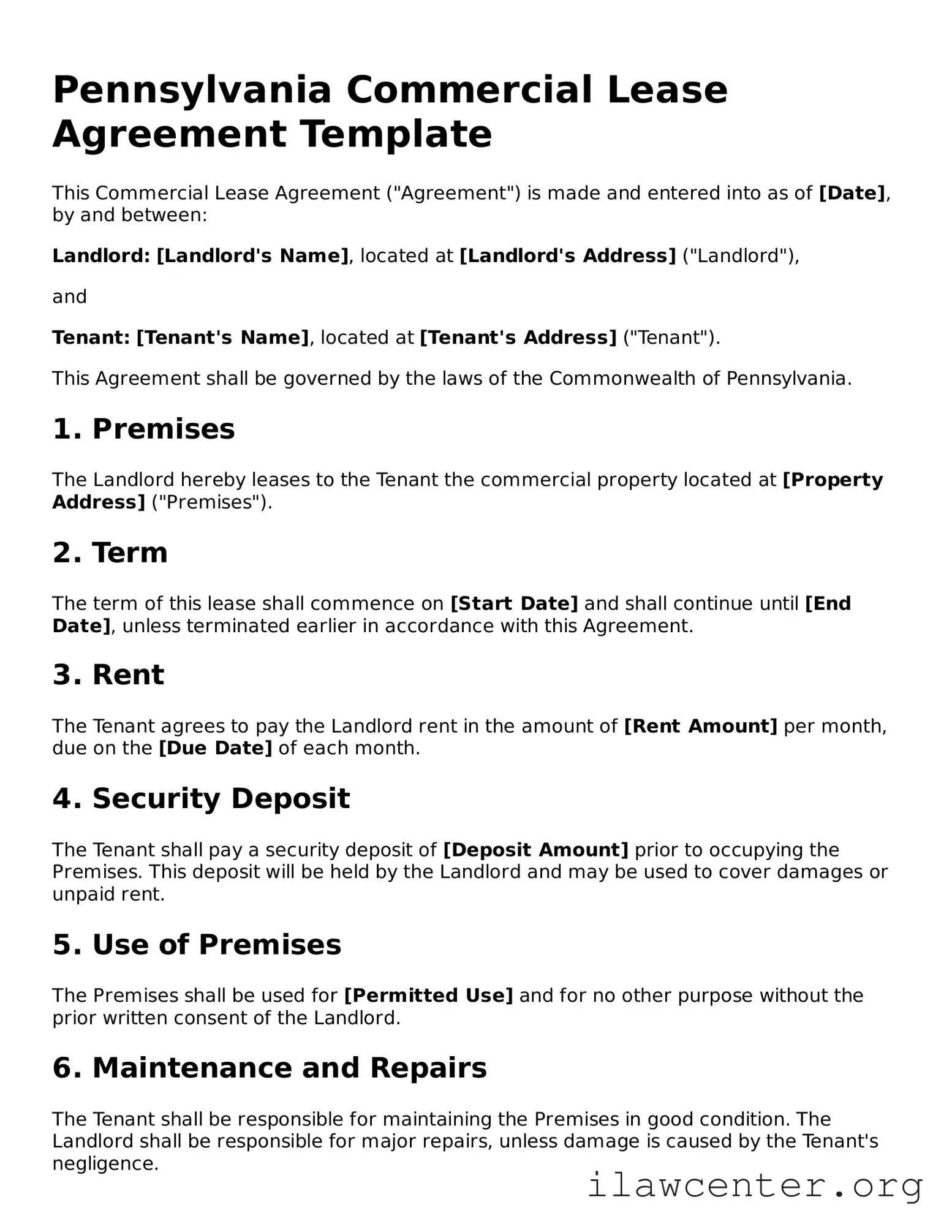
Pennsylvania Commercial Lease Agreement Preview

Pennsylvania Commercial Lease Agreement Template

This Commercial Lease Agreement ("Agreement") is made and entered into as of [Date], by and between:

Landlord: [Landlord's Name], located at [Landlord's Address] ("Landlord"),

and

Tenant: [Tenant's Name], located at [Tenant's Address] ("Tenant").

This Agreement shall be governed by the laws of the Commonwealth of Pennsylvania.

1. Premises

The Landlord hereby leases to the Tenant the commercial property located at [Property Address] ("Premises").

2. Term

The term of this lease shall commence on [Start Date] and shall continue until [End Date], unless terminated earlier in accordance with this Agreement.

3. Rent

The Tenant agrees to pay the Landlord rent in the amount of [Rent Amount] per month, due on the [Due Date] of each month.

4. Security Deposit

The Tenant shall pay a security deposit of [Deposit Amount] prior to occupying the Premises. This deposit will be held by the Landlord and may be used to cover damages or unpaid rent.

5. Use of Premises

The Premises shall be used for [Permitted Use] and for no other purpose without the prior written consent of the Landlord.

6. Maintenance and Repairs

The Tenant shall be responsible for maintaining the Premises in good condition. The Landlord shall be responsible for major repairs, unless damage is caused by the Tenant's negligence.

7. Insurance

The Tenant agrees to maintain general liability insurance covering the Premises with a minimum coverage of [Coverage Amount].

8. Termination

This Agreement may be terminated by either party upon [Notice Period] written notice to the other party.

9. Governing Law

This Agreement shall be governed by and construed in accordance with the laws of the Commonwealth of Pennsylvania.

10. Signatures

IN WITNESS WHEREOF, the parties hereto have executed this Agreement as of the date first above written.

Landlord Signature: ____________________________ Date: ___________

Tenant Signature: ____________________________ Date: ___________

PDF Form Characteristics

Fact Name Details
Governing Law The Pennsylvania Commercial Lease Agreement is governed by the laws of Pennsylvania.
Lease Duration Commercial leases in Pennsylvania can vary in length, often ranging from one year to several years.
Security Deposits Landlords may require a security deposit, typically equivalent to one to three months' rent, to cover potential damages.
Termination Clauses Termination clauses are essential, outlining the conditions under which either party can end the lease agreement.

Instructions on Utilizing Pennsylvania Commercial Lease Agreement

Completing the Pennsylvania Commercial Lease Agreement form requires careful attention to detail. Each section of the form must be filled out accurately to ensure that all parties understand their rights and obligations. Follow these steps to fill out the form correctly.

  1. Begin with the date at the top of the form. Write the date when the agreement is being executed.
  2. Identify the parties involved. Enter the names and addresses of both the landlord and the tenant in the designated sections.
  3. Specify the property details. Clearly describe the location and type of commercial property being leased.
  4. Indicate the lease term. Fill in the start and end dates of the lease period, ensuring they are accurate.
  5. Detail the rent amount. Write down the monthly rent amount and any additional fees or deposits required.
  6. Outline the payment terms. Specify how and when the rent should be paid, including any grace periods or late fees.
  7. Include any specific conditions. Note any special clauses that apply to the lease, such as maintenance responsibilities or restrictions on use.
  8. Signatures are crucial. Ensure both parties sign and date the form at the bottom, confirming their agreement to the terms.

Once you have completed the form, review it carefully for any errors or omissions. It’s essential to keep a copy for your records and provide a signed copy to the other party involved in the lease agreement.

Important Facts about Pennsylvania Commercial Lease Agreement

What is a Pennsylvania Commercial Lease Agreement?

A Pennsylvania Commercial Lease Agreement is a legally binding document that outlines the terms and conditions under which a property owner (the landlord) allows a business (the tenant) to occupy and use a commercial space. This agreement typically includes details about the rental amount, duration of the lease, maintenance responsibilities, and other important aspects that govern the landlord-tenant relationship.

What key elements should be included in the lease?

Essential elements of a Pennsylvania Commercial Lease Agreement include the names of the parties involved, the property address, the lease term (length of the agreement), rent amount, payment schedule, security deposit details, maintenance obligations, and provisions for renewing or terminating the lease. It’s also important to address any specific use restrictions, insurance requirements, and clauses regarding default and dispute resolution.

How long is a typical commercial lease in Pennsylvania?

The duration of a commercial lease can vary widely, but most agreements range from one to five years. Some businesses may prefer shorter leases to maintain flexibility, while others might opt for longer terms to secure a stable location. It's crucial to choose a lease length that aligns with your business goals and financial plans.

Can a commercial lease be modified after it is signed?

Yes, a commercial lease can be modified after it is signed, but any changes must be documented in writing and agreed upon by both parties. Verbal agreements are typically not enforceable, so it’s important to ensure that all modifications are clearly stated in an amendment to the original lease. This protects both the landlord and tenant from misunderstandings.

What happens if a tenant wants to break the lease early?

If a tenant wishes to break the lease early, they should first review the lease agreement for any early termination clauses. Many leases include specific conditions under which a tenant can terminate the agreement early, often requiring notice and possibly a penalty fee. If no such clause exists, the tenant may still be responsible for paying rent until the lease expires unless the landlord agrees to release them from the obligation.

What are the consequences of not adhering to the lease terms?

Failing to adhere to the lease terms can lead to various consequences, including eviction, loss of the security deposit, and potential legal action from the landlord. It’s important for tenants to understand their responsibilities and communicate with the landlord if issues arise. Addressing concerns early can often prevent misunderstandings and legal complications.

Common mistakes

Filling out the Pennsylvania Commercial Lease Agreement can be a straightforward process, but mistakes often occur. One common error is failing to provide complete contact information for both the landlord and the tenant. Incomplete information can lead to confusion and miscommunication, which can be detrimental in a business relationship.

Another mistake is not clearly defining the lease term. It's crucial to specify the start and end dates of the lease. Leaving this information vague can result in disputes later on. Ensure that both parties understand the duration of the agreement to avoid any misunderstandings.

Many individuals overlook the importance of detailing the rent amount and payment schedule. Clearly stating the monthly rent, due dates, and acceptable payment methods is essential. Ambiguities in this area can lead to payment delays and financial strain.

Some people neglect to include provisions for maintenance and repairs. It’s important to outline the responsibilities of both the landlord and tenant regarding property upkeep. This can prevent conflicts over who is responsible for repairs and maintenance costs.

Another frequent oversight involves not addressing the terms of lease renewal or termination. Clearly outlining how either party can terminate or renew the lease can save time and avoid legal complications in the future. This section should be explicit to ensure that both parties understand their rights and obligations.

Many individuals also fail to review the entire agreement before signing. Reading through the document carefully can help identify any potential issues or unclear terms. Taking the time to review ensures that all parties are in agreement and aware of their commitments.

Lastly, some people forget to keep a copy of the signed lease. Retaining a copy is essential for reference and can be invaluable in case of disputes. Having documentation readily available protects both parties and provides clarity in the future.

Documents used along the form

When entering into a commercial lease agreement in Pennsylvania, several additional forms and documents may be necessary to ensure a smooth transaction. These documents help clarify terms, protect the rights of both parties, and provide necessary disclosures.

  • Letter of Intent: This document outlines the preliminary terms of the lease agreement. It serves as a starting point for negotiations and typically includes details like rental rates, lease duration, and any special conditions.
  • Security Deposit Agreement: This agreement specifies the amount of the security deposit required, the conditions for its return, and any deductions that may be made. It protects both the landlord and tenant regarding the handling of the deposit.
  • Guaranty Agreement: Often required when the tenant is a business entity, this document holds a third party accountable for the lease obligations. It provides additional security to the landlord in case the tenant defaults.
  • Disclosure Statement: Landlords may need to provide a disclosure statement that outlines any known issues with the property, such as zoning restrictions or environmental hazards. This transparency helps tenants make informed decisions.

These documents complement the Pennsylvania Commercial Lease Agreement and are essential for protecting the interests of both landlords and tenants. Properly completing and understanding these forms can lead to a successful leasing experience.

Similar forms

  • Residential Lease Agreement: This document outlines the terms under which a tenant rents a residential property from a landlord. Similar to a commercial lease, it specifies the rental amount, duration, and responsibilities of both parties.
  • Sublease Agreement: A sublease agreement allows a tenant to rent out their leased space to another party. It shares similarities with a commercial lease in that it must detail the terms of occupancy and payment obligations.
  • Real Estate Purchase Agreement: This document is used when buying or selling property. Like a commercial lease, it includes terms regarding payment, property condition, and responsibilities of the buyer and seller.
  • Property Management Agreement: This agreement outlines the relationship between a property owner and a management company. It is similar to a commercial lease as it defines responsibilities and expectations for property management services.
  • Joint Venture Agreement: This document establishes a partnership between two or more parties for a specific business project. It shares common ground with a commercial lease in that both involve shared responsibilities and profit-sharing arrangements.
  • Tenant Estoppel Certificate: This certificate is used to confirm the terms of a lease and the status of the tenant’s obligations. It is similar to a commercial lease in that it provides clarity on the lease terms and tenant rights.
  • Commercial Real Estate Listing Agreement: This document is used by property owners to list their commercial property for sale or lease. It parallels a commercial lease by defining the terms under which the property can be marketed.
  • Lease Option Agreement: This agreement gives a tenant the right to purchase the property they are leasing. Like a commercial lease, it outlines terms related to payment and property use.
  • Confidentiality Agreement: Often used in business dealings, this document ensures that sensitive information remains private. It is similar to a commercial lease in that both involve trust and protection of proprietary information.
  • Business Partnership Agreement: This document outlines the terms of a partnership between business owners. It shares similarities with a commercial lease by detailing the roles, responsibilities, and profit distribution among partners.

Dos and Don'ts

When filling out the Pennsylvania Commercial Lease Agreement form, it is essential to approach the task with care. The following guidelines outline what to do and what to avoid.

  • Do read the entire lease agreement thoroughly before starting.
  • Do ensure all parties involved in the lease are clearly identified.
  • Do provide accurate and complete information regarding the leased property.
  • Do specify the lease term, including start and end dates.
  • Do outline the payment terms, including rent amount and due dates.
  • Don't leave any sections blank; fill in all required fields.
  • Don't use vague language that could lead to misunderstandings.
  • Don't ignore local laws and regulations that may impact the lease.
  • Don't forget to keep a copy of the completed lease for your records.

By adhering to these guidelines, the process of completing the Pennsylvania Commercial Lease Agreement can be more straightforward and efficient.

Misconceptions

Understanding the Pennsylvania Commercial Lease Agreement form can be challenging. Many people hold misconceptions that can lead to confusion or even legal issues. Here are six common misconceptions:

  • 1. All commercial leases are the same. Many believe that all commercial leases follow a standard format. In reality, each lease can vary significantly based on the specific terms negotiated between the landlord and tenant.
  • 2. A verbal agreement is enough. Some tenants think that a verbal agreement is sufficient to secure their lease. However, without a written contract, it becomes difficult to enforce any terms or conditions agreed upon.
  • 3. The landlord can change terms at any time. Many assume that landlords can modify lease terms unilaterally. In fact, any changes to the lease must be agreed upon by both parties and documented in writing.
  • 4. Security deposits are non-refundable. There is a belief that all security deposits are non-refundable. However, under Pennsylvania law, tenants may be entitled to a refund of their deposit, minus any lawful deductions, at the end of the lease term.
  • 5. The lease covers all possible issues. Some tenants think that a lease will address every potential issue. While leases cover many important aspects, they may not include every scenario. It is wise to discuss specific concerns with the landlord before signing.
  • 6. Lease terms are set in stone. Many believe that once a lease is signed, the terms cannot be changed. However, tenants and landlords can negotiate amendments if both parties agree.

Being aware of these misconceptions can help tenants and landlords navigate their agreements more effectively. Understanding the nuances of the Pennsylvania Commercial Lease Agreement form is crucial for a successful leasing experience.

Key takeaways

When filling out and using the Pennsylvania Commercial Lease Agreement form, it's essential to understand several key aspects. Here are some important takeaways:

  • Understand the Parties Involved: Clearly identify the landlord and tenant, including their legal names and contact information.
  • Define the Premises: Specify the exact location and description of the commercial space being leased.
  • Lease Term: Indicate the duration of the lease, including the start and end dates, as well as any options for renewal.
  • Rent Payment Details: Clearly outline the amount of rent, payment due dates, and acceptable payment methods.
  • Security Deposit: State the amount required for the security deposit and the conditions under which it may be withheld.
  • Maintenance Responsibilities: Specify who is responsible for maintenance and repairs of the property during the lease term.
  • Termination Clauses: Include any conditions under which either party may terminate the lease early.

Being thorough in these areas can help prevent misunderstandings and protect the interests of both parties involved in the lease agreement.