Attorney-Verified  Deed Document for Pennsylvania

Attorney-Verified Deed Document for Pennsylvania

A Pennsylvania Deed form is a legal document used to transfer ownership of real estate from one party to another. This form outlines the details of the property and the parties involved in the transaction, ensuring that the transfer is recognized by the state. Ready to make your property transfer official? Fill out the form by clicking the button below.

Article Guide

When it comes to transferring property ownership in Pennsylvania, the Pennsylvania Deed form plays a crucial role in ensuring that the process is both clear and legally binding. This form serves as a written document that outlines the details of the property being transferred, including its legal description and the names of the parties involved in the transaction. It is essential for establishing a clear chain of title, which helps prevent disputes over ownership in the future. The form typically requires the signature of the grantor, or the person transferring the property, and may also need to be notarized to add an extra layer of authenticity. Additionally, the Pennsylvania Deed form can come in various types, such as warranty deeds, quitclaim deeds, and special purpose deeds, each serving different purposes based on the needs of the parties involved. Understanding the nuances of this form is vital for anyone looking to buy or sell real estate in the state, as it ensures compliance with local laws and protects the rights of all parties. The proper execution and recording of the deed with the county office are necessary steps to finalize the transfer and make it legally effective.

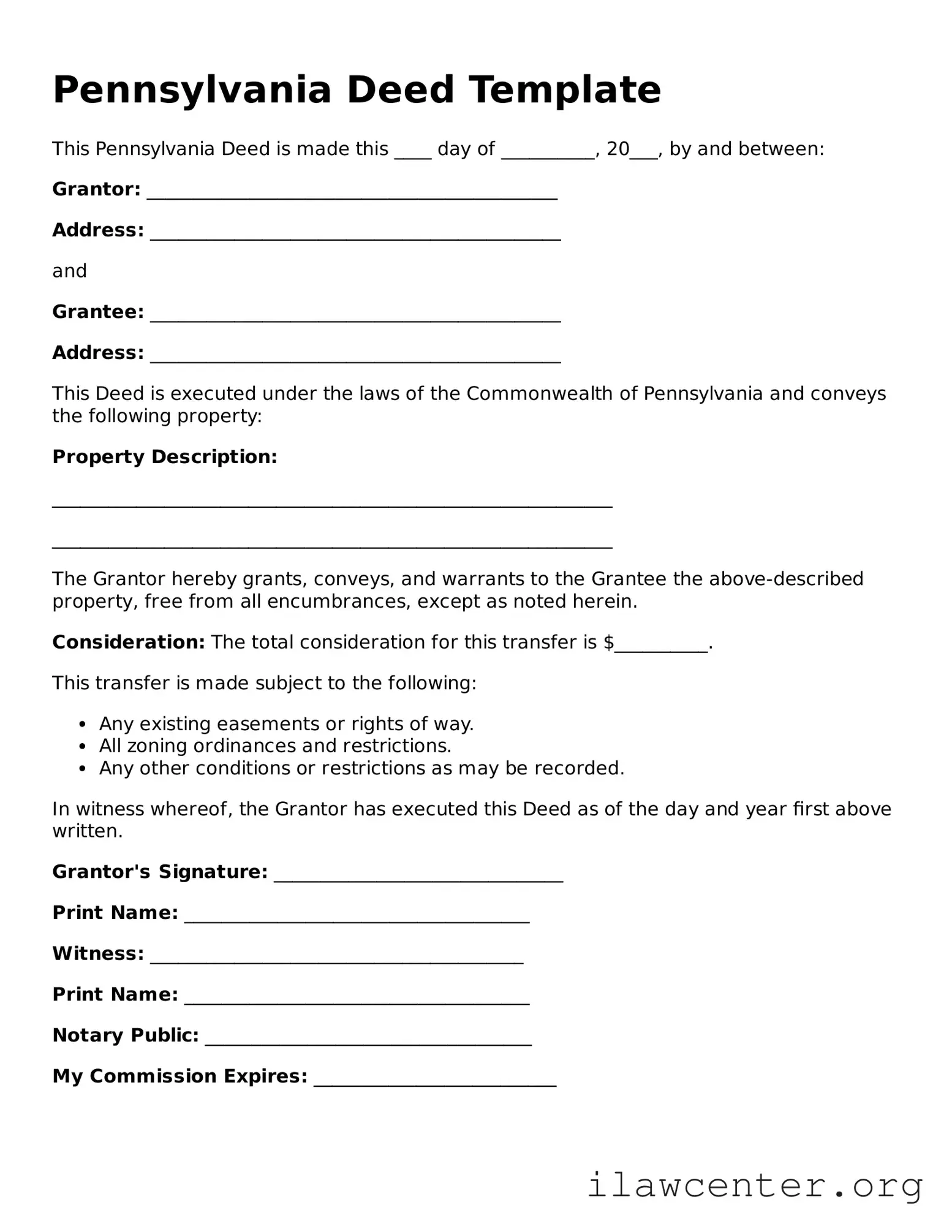
Pennsylvania Deed Preview

Pennsylvania Deed Template

This Pennsylvania Deed is made this ____ day of __________, 20___, by and between:

Grantor: ____________________________________________

Address: ____________________________________________

and

Grantee: ____________________________________________

Address: ____________________________________________

This Deed is executed under the laws of the Commonwealth of Pennsylvania and conveys the following property:

Property Description:

____________________________________________________________

____________________________________________________________

The Grantor hereby grants, conveys, and warrants to the Grantee the above-described property, free from all encumbrances, except as noted herein.

Consideration: The total consideration for this transfer is $__________.

This transfer is made subject to the following:

  • Any existing easements or rights of way.
  • All zoning ordinances and restrictions.
  • Any other conditions or restrictions as may be recorded.

In witness whereof, the Grantor has executed this Deed as of the day and year first above written.

Grantor's Signature: _______________________________

Print Name: _____________________________________

Witness: ________________________________________

Print Name: _____________________________________

Notary Public: ___________________________________

My Commission Expires: __________________________

PDF Form Characteristics

Fact Name Description
Definition A Pennsylvania Deed is a legal document used to transfer property ownership from one party to another.
Governing Law The transfer of property in Pennsylvania is governed by Title 68 of the Pennsylvania Consolidated Statutes.
Types of Deeds Common types of deeds in Pennsylvania include warranty deeds, quitclaim deeds, and special warranty deeds.
Notarization Requirement All Pennsylvania Deeds must be notarized to be valid and enforceable.
Recording To protect ownership rights, deeds should be recorded with the county's Recorder of Deeds.
Consideration A deed must state the consideration, or value, exchanged for the property, although it can be nominal.
Grantor and Grantee The grantor is the person transferring the property, while the grantee is the person receiving it.
Legal Description A precise legal description of the property must be included in the deed to ensure clarity.
Tax Implications Transfer taxes may apply when property is transferred, and these should be considered during the process.

Instructions on Utilizing Pennsylvania Deed

Filling out the Pennsylvania Deed form is an important step in transferring property ownership. Once you complete the form, you will need to file it with the appropriate county office to ensure that the transfer is legally recognized. Here are the steps to guide you through the process of filling out the form.

  1. Begin by entering the date at the top of the form. This should be the date when the deed is being executed.
  2. Next, identify the grantor, which is the person or entity transferring the property. Include their full legal name and address.
  3. Provide the grantee's information, which is the person or entity receiving the property. Again, include their full legal name and address.
  4. Clearly describe the property being transferred. This should include the full legal description, which can often be found in previous deeds or property tax records.
  5. If applicable, list any considerations or payment terms involved in the transfer. This could be a sale price or other forms of compensation.
  6. Sign the deed in the designated area. The grantor must sign the form to validate the transfer.
  7. Have the deed notarized. A notary public will need to witness the signing and provide their signature and seal.
  8. Finally, make copies of the completed deed for your records before filing the original with the appropriate county office.

Important Facts about Pennsylvania Deed

What is a Pennsylvania Deed form?

A Pennsylvania Deed form is a legal document used to transfer ownership of real estate in the state of Pennsylvania. It outlines the details of the property being transferred and identifies the parties involved in the transaction. This document is essential for ensuring that the transfer is legally recognized and recorded by the county.

What types of deeds are available in Pennsylvania?

In Pennsylvania, there are several types of deeds, including Warranty Deeds, Quitclaim Deeds, and Special Purpose Deeds. A Warranty Deed provides a guarantee that the seller holds clear title to the property. A Quitclaim Deed transfers any interest the seller has without any guarantees. Special Purpose Deeds are used for specific situations, such as tax sales or foreclosure.

Who needs to sign the Pennsylvania Deed form?

The Pennsylvania Deed form must be signed by the grantor (the person transferring the property) and, in some cases, the grantee (the person receiving the property). If there are multiple grantors, all must sign the deed. Signatures should be notarized to ensure the document's validity.

Do I need to have the deed notarized?

Yes, notarization is typically required for a Pennsylvania Deed form. Having the deed notarized adds an extra layer of authenticity and ensures that the signatures are valid. This is crucial for the deed to be recorded in the county's public records.

How do I record a Pennsylvania Deed?

To record a Pennsylvania Deed, take the signed and notarized document to the county recorder of deeds office where the property is located. There may be a fee for recording the deed. Once recorded, the deed becomes part of the public record, providing official proof of ownership.

What information is required on the Pennsylvania Deed form?

The Pennsylvania Deed form should include the names and addresses of the grantor and grantee, a legal description of the property, the date of the transfer, and any relevant terms of the transfer. It's important to ensure that all information is accurate and complete to avoid issues later.

Can I create my own Pennsylvania Deed form?

While you can create your own Pennsylvania Deed form, it is advisable to use a standard template or seek assistance to ensure compliance with state laws. Errors in the deed can lead to complications in the transfer process or future ownership disputes.

What happens if I don’t record the deed?

If you do not record the Pennsylvania Deed, the transfer of ownership may not be recognized by third parties. This can lead to issues when selling the property in the future or if disputes arise regarding ownership. Recording the deed protects your rights as the new owner.

Are there any taxes associated with transferring a property in Pennsylvania?

Yes, when transferring property in Pennsylvania, you may be subject to a Realty Transfer Tax. This tax is typically based on the sale price of the property. Both the buyer and seller can negotiate who will pay this tax, but it is essential to factor it into your transaction costs.
Common mistakes

Filling out a Pennsylvania Deed form can be straightforward, but many people make common mistakes that can lead to complications. One frequent error is not providing complete and accurate information about the property. Ensure that the property description is detailed, including the correct address and any relevant parcel numbers. Missing or incorrect information can delay the transfer process.

Another mistake involves the names of the parties involved. It's crucial to list the grantor and grantee correctly. If the names are misspelled or not listed in the correct order, it can cause confusion and may even invalidate the deed. Double-check all names for accuracy before submission.

Many people overlook the need for signatures. A deed must be signed by the grantor, and in some cases, additional signatures may be required. Failing to include the necessary signatures can render the deed ineffective. Always verify that all required parties have signed the document.

Not having the deed notarized is a common oversight. In Pennsylvania, a deed must be acknowledged before a notary public to be valid. Skipping this step can lead to issues with the deed's acceptance in the future. Make sure to arrange for notarization before submitting the form.

Finally, individuals often neglect to record the deed with the county. After completing the form, it’s essential to file it with the appropriate county office. Failing to record the deed can result in loss of rights to the property and complications in proving ownership. Always follow through with the recording process to ensure your property rights are protected.

Documents used along the form

When completing a property transaction in Pennsylvania, several forms and documents are often used alongside the Pennsylvania Deed form. These documents help ensure a smooth transfer of ownership and provide necessary information for both parties involved. Below is a list of commonly used forms that may accompany the Deed.

  • Title Search Report: This document provides a history of the property’s ownership, revealing any liens, encumbrances, or claims against it.
  • Settlement Statement (HUD-1): This itemized list outlines all the costs associated with the sale, including fees, taxes, and other charges that the buyer and seller must pay at closing.
  • Property Disclosure Statement: Sellers typically provide this document to inform buyers of any known issues with the property, such as structural problems or pest infestations.
  • Affidavit of Title: This sworn statement from the seller confirms their ownership of the property and that there are no outstanding claims against it.
  • Mortgage Documents: If the buyer is financing the purchase, these documents outline the terms of the loan, including interest rates and repayment schedules.
  • Power of Attorney: This legal document allows one person to act on behalf of another in the property transaction, which can be useful if one party cannot be present at closing.
  • Easement Agreements: If there are any rights to use a portion of the property for a specific purpose, this document outlines those rights and responsibilities.
  • Tax Certification: This form verifies that all property taxes have been paid, ensuring there are no outstanding debts that could affect the sale.
  • Homeowner’s Association (HOA) Documents: If the property is part of an HOA, these documents provide rules, regulations, and fees associated with the community.

Understanding these documents can help facilitate a successful property transaction in Pennsylvania. Each form plays a vital role in ensuring that both buyers and sellers are informed and protected throughout the process.

Similar forms

The Deed form serves a specific purpose in real estate and legal transactions. Several other documents share similarities with the Deed form in terms of their function and importance in establishing rights, ownership, or agreements. Below are seven documents that are akin to the Deed form:

  • Title Insurance Policy: This document protects property owners and lenders against losses arising from defects in title. Like a deed, it confirms ownership but focuses more on the assurance of that ownership against potential claims.
  • Lease Agreement: A lease outlines the terms under which one party rents property from another. It is similar to a deed in that it establishes rights and responsibilities regarding property use, although it does not transfer ownership.
  • Bill of Sale: This document transfers ownership of personal property from one party to another. It parallels a deed in its function of conveying rights, but it typically applies to movable items rather than real estate.
  • Trust Agreement: This document creates a trust, outlining how assets will be managed and distributed. Like a deed, it formalizes the transfer of property, though it involves a fiduciary relationship.
  • Mortgage Document: A mortgage secures a loan with real property as collateral. While a deed conveys ownership, a mortgage establishes a lender's interest in that property until the loan is repaid.
  • Power of Attorney: This document allows one person to act on behalf of another in legal matters. Similar to a deed, it grants authority over property but does not itself transfer ownership.
  • Quitclaim Deed: This specific type of deed transfers whatever interest the grantor has in the property without guaranteeing that interest is valid. It is closely related to a standard deed but provides less assurance about the ownership being transferred.

Dos and Don'ts

When filling out the Pennsylvania Deed form, there are several important considerations to keep in mind. Here’s a list of things you should and shouldn’t do:

  • Do double-check the names of all parties involved to ensure accuracy.
  • Do use clear and legible handwriting or type the information to avoid confusion.
  • Do include a legal description of the property to be transferred.
  • Do sign the form in the presence of a notary public.
  • Don't leave any fields blank; incomplete forms may be rejected.
  • Don't forget to date the document upon signing.
  • Don't use abbreviations that could lead to misunderstandings.
  • Don't overlook the need for additional documentation, such as tax certifications.

By following these guidelines, you can help ensure that your Pennsylvania Deed form is filled out correctly and processed smoothly.

Misconceptions

When it comes to the Pennsylvania Deed form, there are several misconceptions that can lead to confusion. Understanding these can help ensure a smoother process when transferring property. Here’s a list of common misunderstandings:

  • All deeds are the same. Many people think that all deed forms are interchangeable. However, Pennsylvania has specific types of deeds, such as warranty deeds and quitclaim deeds, each serving different purposes.
  • A deed does not need to be recorded. Some believe that recording a deed is optional. In reality, recording is crucial as it provides public notice of ownership and protects against future claims.
  • Verbal agreements are sufficient. It’s a common myth that a verbal agreement suffices for property transfer. In Pennsylvania, a deed must be in writing to be legally binding.
  • Only a lawyer can prepare a deed. While it’s advisable to consult a lawyer, individuals can prepare their own deeds as long as they follow the required legal format.
  • All deeds require notarization. Not all deeds need to be notarized in Pennsylvania. However, having a notarized signature can provide additional legal protection.
  • Transferring property is always expensive. Many assume that transferring property incurs high fees. In Pennsylvania, costs can vary widely depending on the type of deed and the property’s value.
  • Once a deed is signed, it cannot be changed. Some people think that a deed is permanent and unchangeable. However, deeds can be amended or revoked under certain circumstances.
  • Only the seller needs to sign the deed. It’s a common belief that only the seller's signature is necessary. In fact, both the seller and buyer typically need to sign the deed for it to be valid.

By clearing up these misconceptions, individuals can better navigate the process of property transfer in Pennsylvania. Knowledge is key to ensuring that everything goes smoothly.

Key takeaways

Filling out and using the Pennsylvania Deed form can seem daunting, but understanding the essentials can make the process smoother. Here are some key takeaways:

  • Know the Types of Deeds: Pennsylvania recognizes several types of deeds, including warranty deeds and quitclaim deeds. Each serves a different purpose, so choose wisely based on your needs.
  • Gather Necessary Information: Before starting, collect all required information. This includes the names of the parties involved, a legal description of the property, and any relevant tax identification numbers.
  • Complete the Form Accurately: Fill out the deed form carefully. Ensure that all names are spelled correctly and that the property description is precise. Mistakes can lead to delays or legal issues.
  • Signatures Matter: All parties involved must sign the deed. In Pennsylvania, signatures must be notarized. This adds an extra layer of authenticity and helps prevent fraud.
  • File the Deed: Once completed, the deed must be filed with the county recorder of deeds where the property is located. This step is crucial for the deed to be legally recognized.
  • Keep Copies: After filing, keep copies of the deed for your records. Having a copy can be helpful for future reference or in case of disputes.

By following these guidelines, you can navigate the process of completing and using the Pennsylvania Deed form with confidence.