Attorney-Verified  Durable Power of Attorney Document for Pennsylvania

Attorney-Verified Durable Power of Attorney Document for Pennsylvania

A Durable Power of Attorney form in Pennsylvania allows an individual to designate another person to make decisions on their behalf, even if they become incapacitated. This legal document ensures that your financial and medical wishes are respected when you are unable to communicate them yourself. Take control of your future by filling out the form below.

Article Guide

The Pennsylvania Durable Power of Attorney form is an essential tool for anyone looking to ensure their financial and medical decisions are handled according to their wishes when they can no longer do so themselves. This legal document allows you to appoint a trusted individual, known as your agent, to make decisions on your behalf. It covers various aspects of your life, including managing your finances, handling real estate transactions, and making healthcare choices. By designating an agent, you provide them with the authority to act in your best interest, even if you become incapacitated. It’s important to understand the specific powers you grant, as well as the responsibilities your agent will assume. The form is flexible, allowing you to tailor it to your unique needs and preferences, ensuring that your wishes are respected and upheld. In Pennsylvania, this document must meet certain requirements to be valid, so it’s crucial to follow the guidelines closely. With the right preparation, you can create a durable power of attorney that gives you peace of mind and protects your interests.

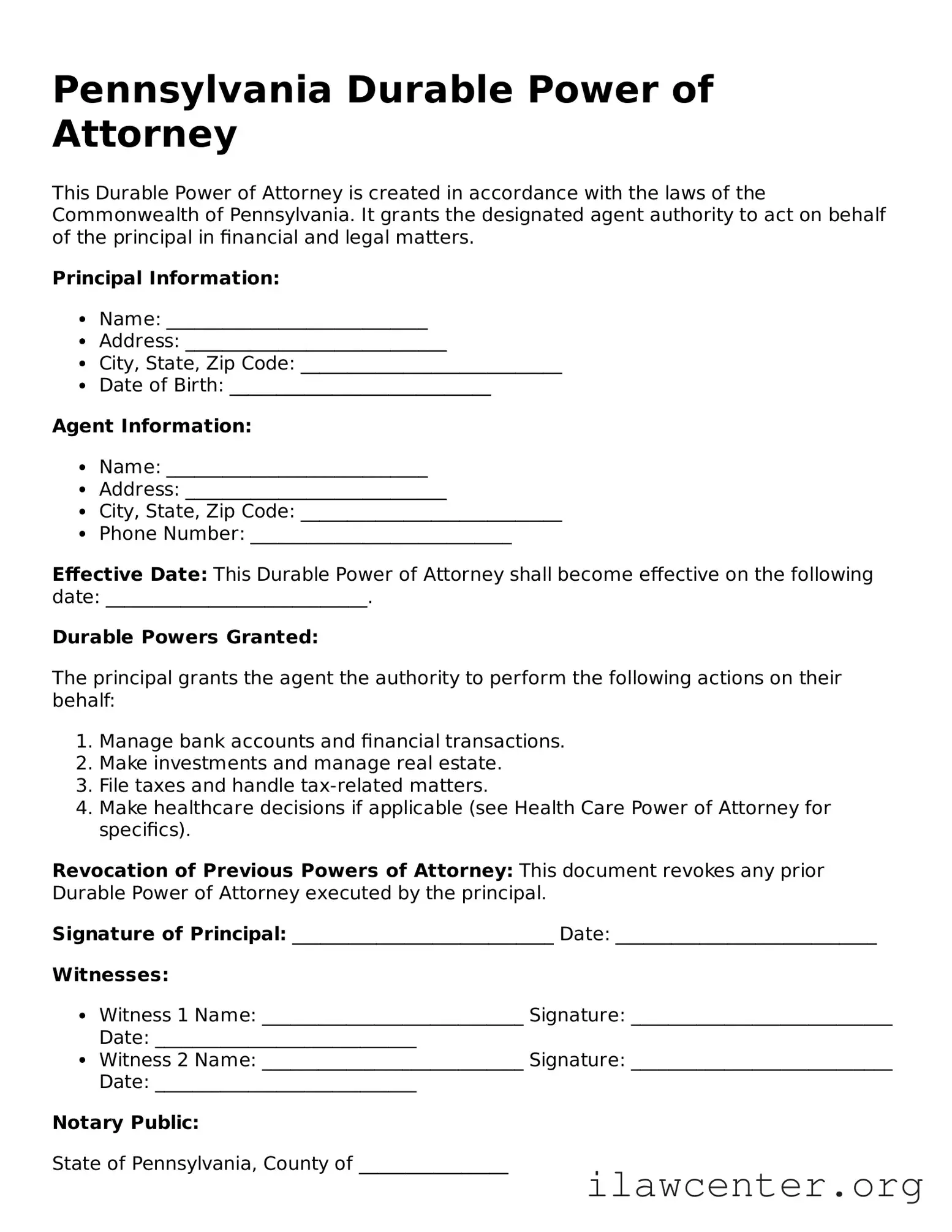
Pennsylvania Durable Power of Attorney Preview

Pennsylvania Durable Power of Attorney

This Durable Power of Attorney is created in accordance with the laws of the Commonwealth of Pennsylvania. It grants the designated agent authority to act on behalf of the principal in financial and legal matters.

Principal Information:

  • Name: ____________________________
  • Address: ____________________________
  • City, State, Zip Code: ____________________________
  • Date of Birth: ____________________________

Agent Information:

  • Name: ____________________________
  • Address: ____________________________
  • City, State, Zip Code: ____________________________
  • Phone Number: ____________________________

Effective Date: This Durable Power of Attorney shall become effective on the following date: ____________________________.

Durable Powers Granted:

The principal grants the agent the authority to perform the following actions on their behalf:

  1. Manage bank accounts and financial transactions.
  2. Make investments and manage real estate.
  3. File taxes and handle tax-related matters.
  4. Make healthcare decisions if applicable (see Health Care Power of Attorney for specifics).

Revocation of Previous Powers of Attorney: This document revokes any prior Durable Power of Attorney executed by the principal.

Signature of Principal: ____________________________ Date: ____________________________

Witnesses:

  • Witness 1 Name: ____________________________ Signature: ____________________________ Date: ____________________________
  • Witness 2 Name: ____________________________ Signature: ____________________________ Date: ____________________________

Notary Public:

State of Pennsylvania, County of ________________

On this _____ day of ______________, 20____, before me, a Notary Public, personally appeared ____________________________, known to me (or satisfactorily proven) to be the person whose name is subscribed to this instrument, and acknowledged that they executed the same for the purposes therein contained.

In witness whereof, I hereunto set my hand and official seal.

______________________________
Notary Public

PDF Form Characteristics

Fact Name Description
Definition A Pennsylvania Durable Power of Attorney allows an individual to appoint someone else to make financial and legal decisions on their behalf.
Durability This form remains effective even if the principal becomes incapacitated, ensuring continuity in decision-making.
Governing Laws The Pennsylvania Durable Power of Attorney is governed by the Pennsylvania Consolidated Statutes, Title 20, Chapter 56.
Agent's Authority The agent's authority can be broad or limited, depending on the specific powers granted in the document.
Revocation The principal can revoke the Durable Power of Attorney at any time, as long as they are mentally competent.

Instructions on Utilizing Pennsylvania Durable Power of Attorney

Filling out the Pennsylvania Durable Power of Attorney form is an important step in ensuring that your financial and legal matters are managed according to your wishes if you become unable to make decisions for yourself. Follow these steps carefully to complete the form accurately.

  1. Obtain the Pennsylvania Durable Power of Attorney form from a reliable source or legal professional.
  2. Begin by entering your full name and address at the top of the form. This identifies you as the principal.
  3. Designate your chosen agent by providing their full name and address. This person will have the authority to act on your behalf.
  4. Clearly outline the powers you wish to grant to your agent. Be specific about the decisions they can make, such as handling financial transactions or managing real estate.
  5. Include any limitations on the powers you are granting, if applicable. This helps ensure your wishes are respected.
  6. Sign and date the form in the designated area. Your signature must be witnessed by two individuals who are not related to you and who will not benefit from your estate.
  7. Have the witnesses sign and print their names and addresses in the appropriate sections. This verifies that they witnessed your signature.
  8. Consider having the document notarized for additional legal validity, though it is not required in Pennsylvania.

After completing the form, keep a copy for your records and provide copies to your agent and any relevant financial institutions or family members. This will ensure that your wishes are known and can be acted upon when necessary.

Important Facts about Pennsylvania Durable Power of Attorney

What is a Durable Power of Attorney in Pennsylvania?

A Durable Power of Attorney (DPOA) in Pennsylvania is a legal document that allows an individual, known as the principal, to appoint another person, referred to as the agent, to make decisions on their behalf. This document remains effective even if the principal becomes incapacitated, ensuring that their financial and healthcare decisions can continue to be managed without interruption.

What are the key features of a Durable Power of Attorney in Pennsylvania?

The key features of a DPOA include the ability to grant broad or limited powers to the agent, the requirement for the document to be signed in the presence of a notary, and the option to specify when the powers become effective. Additionally, the principal can include specific instructions regarding healthcare decisions and financial matters, allowing for customized authority based on individual needs.

Who can serve as an agent under a Durable Power of Attorney?

In Pennsylvania, any competent adult can serve as an agent under a DPOA. This includes family members, friends, or professionals such as attorneys or financial advisors. It is essential for the principal to choose someone they trust, as the agent will have significant authority over their affairs.

Can a Durable Power of Attorney be revoked in Pennsylvania?

Yes, a Durable Power of Attorney can be revoked at any time by the principal, as long as they are still competent. The revocation must be made in writing, and it is advisable to notify the agent and any relevant institutions or parties to ensure that the revocation is recognized and respected.

What happens if the agent can no longer serve?

If the designated agent is unable to serve due to incapacity, death, or resignation, the DPOA may include provisions for successor agents. If no successor is named, it may be necessary for the principal to create a new DPOA or for a court to appoint a guardian to manage the principal's affairs.

Is it necessary to have a lawyer to create a Durable Power of Attorney in Pennsylvania?

While it is not legally required to have a lawyer to create a DPOA in Pennsylvania, consulting with one is advisable. An attorney can provide guidance on the specific powers to include, ensure compliance with state laws, and help tailor the document to meet the principal's unique needs.

Where should a Durable Power of Attorney be kept?

The original Durable Power of Attorney should be kept in a safe but accessible location. It is essential for the principal to inform the agent of its location. Additionally, copies of the DPOA should be provided to financial institutions, healthcare providers, and any other relevant parties to facilitate its use when necessary.

Common mistakes

Filling out a Pennsylvania Durable Power of Attorney (DPOA) form is an important step in ensuring that your financial and legal affairs are managed according to your wishes. However, many individuals make common mistakes during this process that can lead to complications later on. Understanding these pitfalls can help you avoid them.

One frequent mistake is failing to clearly identify the agent. The agent is the person you designate to make decisions on your behalf. If the agent's name is not written clearly or is incomplete, it could lead to confusion or disputes. Always ensure that the agent’s full name and contact information are included.

Another common error involves not specifying the powers granted to the agent. The DPOA form should explicitly outline what decisions the agent can make. If the form is vague or lacks detail, the agent may not have the authority to act in certain situations. It is crucial to be as specific as possible about the powers you are granting.

People often overlook the importance of signing the document in the presence of a notary. In Pennsylvania, a Durable Power of Attorney must be notarized to be valid. Neglecting this step can render the document ineffective. Make sure to have the form notarized to ensure its legality.

Another mistake is not considering alternate agents. Life can be unpredictable, and the person you initially choose may not always be available to act on your behalf. It is wise to designate an alternate agent in case the primary agent is unable or unwilling to serve.

Some individuals may also forget to date the document. A DPOA should always include the date it was signed. Without a date, there may be questions about the document’s validity or when the powers were granted. Always include the date to avoid any ambiguity.

Additionally, failing to communicate with the appointed agent can lead to misunderstandings. It is essential to discuss your wishes and the powers you are granting with your agent. This conversation ensures that the agent understands your intentions and can act accordingly when needed.

Finally, individuals sometimes neglect to review or update the DPOA as life circumstances change. Major life events, such as marriage, divorce, or the death of a loved one, may necessitate changes to the DPOA. Regularly reviewing the document ensures that it reflects your current wishes and situation.

By being aware of these common mistakes, individuals can better navigate the process of completing a Pennsylvania Durable Power of Attorney form. Taking the time to ensure accuracy and clarity will help safeguard your interests and ensure that your affairs are managed as you intend.

Documents used along the form

When planning for the future, having the right documents in place is essential. A Pennsylvania Durable Power of Attorney (DPOA) allows you to appoint someone to make decisions on your behalf if you become unable to do so. However, there are other important forms and documents that often accompany the DPOA. Here’s a list of some key documents that you may want to consider.

  • Living Will: This document outlines your wishes regarding medical treatment in case you are unable to communicate them. It specifies what life-sustaining measures you want or do not want.
  • Health Care Power of Attorney: Similar to a DPOA, this form allows you to designate someone to make health care decisions for you when you cannot make them yourself.
  • Will: A will details how you want your assets distributed after your death. It also allows you to name guardians for minor children.
  • Revocable Trust: This document holds your assets during your lifetime and specifies how they should be managed and distributed after your death, often avoiding probate.
  • HIPAA Authorization: This form allows designated individuals to access your medical records and health information, ensuring they can make informed decisions on your behalf.
  • Financial Power of Attorney: While similar to a DPOA, this document specifically focuses on financial matters, allowing someone to manage your finances and make financial decisions.
  • Beneficiary Designations: These forms specify who will receive your assets, such as life insurance or retirement accounts, upon your death, bypassing probate.
  • Property Deed: If you own real estate, a property deed outlines ownership. It can also specify what happens to the property after your death.
  • Guardianship Designation: This document allows you to name a guardian for your minor children in case something happens to you.
  • Asset Inventory: Keeping a detailed list of your assets helps your appointed agent understand what they need to manage or distribute on your behalf.

Having these documents in place can provide peace of mind and ensure that your wishes are honored. Each document serves a unique purpose, and together, they create a comprehensive plan for your future. Always consider discussing your options with a legal professional to ensure your documents align with your goals.

Similar forms

  • General Power of Attorney: Similar to a Durable Power of Attorney, this document grants someone the authority to act on your behalf. However, it becomes invalid if you become incapacitated.
  • Healthcare Power of Attorney: This document allows you to designate someone to make medical decisions for you if you are unable to do so. It focuses specifically on healthcare matters.
  • Living Will: A Living Will outlines your wishes regarding medical treatment in situations where you cannot communicate. It complements a Healthcare Power of Attorney.
  • Financial Power of Attorney: This form specifically gives someone the authority to manage your financial affairs. It can be durable or non-durable, depending on your needs.
  • Trust Agreement: A Trust Agreement allows a trustee to manage assets on behalf of beneficiaries. Like a Durable Power of Attorney, it can provide for management in case of incapacity.
  • Guardianship Papers: These documents appoint someone to make decisions for an individual who cannot do so themselves, similar to the role of an agent under a Durable Power of Attorney.
  • Advance Healthcare Directive: This combines elements of a Living Will and a Healthcare Power of Attorney, allowing you to state your healthcare preferences and appoint an agent.

Dos and Don'ts

When filling out the Pennsylvania Durable Power of Attorney form, it's essential to approach the task with care. Here are some helpful tips to guide you through the process:

  • Do ensure you understand the powers you are granting. Familiarize yourself with what a Durable Power of Attorney allows your agent to do on your behalf.
  • Do choose a trustworthy agent. This person will have significant authority over your financial matters, so select someone you trust implicitly.
  • Do sign the document in front of a notary. In Pennsylvania, notarization is required for the form to be valid.
  • Don't leave any sections blank. Filling out all required fields helps avoid confusion and ensures the document is legally binding.
  • Don't overlook the importance of discussing your wishes with your agent. Clear communication can prevent misunderstandings in the future.

Taking these steps can help ensure that your Durable Power of Attorney form is completed correctly and serves your intended purpose.

Misconceptions

Many people have misunderstandings about the Pennsylvania Durable Power of Attorney (DPOA) form. Here are ten common misconceptions:

  1. It is only for financial decisions. Many believe the DPOA only covers financial matters. In reality, it can also address health care decisions if specified.
  2. It must be notarized to be valid. While notarization is recommended, Pennsylvania law allows for a DPOA to be valid without a notary if it is signed by two witnesses.
  3. It becomes effective only when I am incapacitated. Some think a DPOA is only active when they cannot make decisions. However, it can be effective immediately upon signing, depending on how it is drafted.
  4. Once signed, I cannot change it. Many assume that a DPOA is permanent. In fact, you can revoke or change it at any time while you are still competent.
  5. My agent can do anything they want with my DPOA. People often believe that their agent has unlimited power. However, the DPOA can limit what the agent is allowed to do.
  6. It is only necessary for the elderly. Some think only older adults need a DPOA. In truth, anyone can benefit from having one, regardless of age.
  7. It is the same as a living will. Many confuse a DPOA with a living will. They serve different purposes; a DPOA appoints someone to make decisions, while a living will outlines your wishes for medical treatment.
  8. Once I appoint an agent, I lose control. Some fear that appointing an agent means losing control. However, you can still make your own decisions as long as you are capable.
  9. All DPOA forms are the same. People often think that all DPOA forms are interchangeable. Each state has its own requirements and provisions, so it is important to use the correct form for Pennsylvania.
  10. My spouse automatically has power of attorney. Many assume their spouse has authority to make decisions without a DPOA. This is not true; a formal document is needed to grant that power.

Key takeaways

Filling out and using the Pennsylvania Durable Power of Attorney form is a significant step in planning for future financial and legal matters. Here are some key takeaways to consider:

  • Understand the Purpose: A Durable Power of Attorney allows you to appoint someone to make decisions on your behalf if you become incapacitated.
  • Choose Your Agent Wisely: Select a trusted individual as your agent. This person will have significant authority over your financial matters.
  • Be Specific: Clearly outline the powers you are granting. You can specify certain powers or give broad authority.
  • Sign and Date: Ensure that you sign and date the form in the presence of a notary public to make it legally binding.
  • Review Regularly: Periodically review your Durable Power of Attorney to ensure it still reflects your wishes and circumstances.