Attorney-Verified  Firearm Bill of Sale Document for Pennsylvania

Attorney-Verified Firearm Bill of Sale Document for Pennsylvania

The Pennsylvania Firearm Bill of Sale form is a legal document used to record the sale or transfer of a firearm between parties in Pennsylvania. This form serves as proof of the transaction and includes essential details about the buyer, seller, and the firearm itself. To ensure compliance and protect both parties, it is important to fill out this form accurately; click the button below to get started.

Article Guide

The Pennsylvania Firearm Bill of Sale form serves as a crucial document in the transfer of ownership for firearms within the state. This form outlines essential details about the transaction, including the identities of both the seller and the buyer, as well as a description of the firearm being sold, such as its make, model, and serial number. It ensures that both parties are in agreement regarding the sale and provides a record that can be referenced in the future. The form also includes important legal disclaimers, affirming that the seller has the right to sell the firearm and that the buyer is legally permitted to purchase it. By completing this document, individuals can protect themselves from potential legal issues that may arise from an improper transfer. Understanding the significance of this form is vital for anyone involved in the buying or selling of firearms in Pennsylvania.

Pennsylvania Firearm Bill of Sale Preview

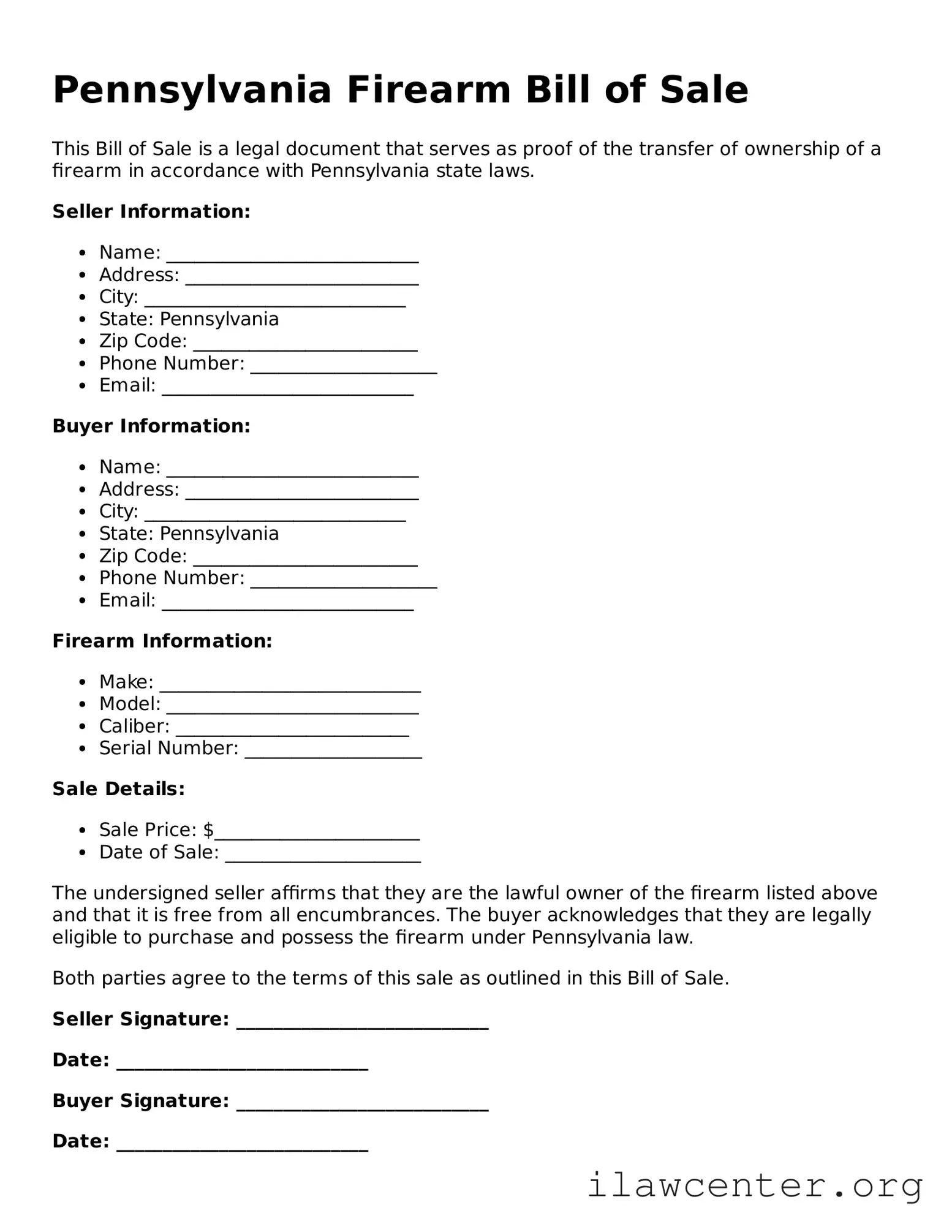
Pennsylvania Firearm Bill of Sale

This Bill of Sale is a legal document that serves as proof of the transfer of ownership of a firearm in accordance with Pennsylvania state laws.

Seller Information:

  • Name: ___________________________
  • Address: _________________________
  • City: ____________________________
  • State: Pennsylvania
  • Zip Code: ________________________
  • Phone Number: ____________________
  • Email: ___________________________

Buyer Information:

  • Name: ___________________________
  • Address: _________________________
  • City: ____________________________
  • State: Pennsylvania
  • Zip Code: ________________________
  • Phone Number: ____________________
  • Email: ___________________________

Firearm Information:

  • Make: ____________________________
  • Model: ___________________________
  • Caliber: _________________________
  • Serial Number: ___________________

Sale Details:

  • Sale Price: $______________________
  • Date of Sale: _____________________

The undersigned seller affirms that they are the lawful owner of the firearm listed above and that it is free from all encumbrances. The buyer acknowledges that they are legally eligible to purchase and possess the firearm under Pennsylvania law.

Both parties agree to the terms of this sale as outlined in this Bill of Sale.

Seller Signature: ___________________________

Date: ___________________________

Buyer Signature: ___________________________

Date: ___________________________

This document is a legal agreement and should be retained by both parties for their records.

PDF Form Characteristics

Fact Name Description
Purpose The Pennsylvania Firearm Bill of Sale form serves as a legal document to record the sale of a firearm between a buyer and a seller.
Governing Law This form is governed by Pennsylvania state law, specifically Title 18, Chapter 61 of the Pennsylvania Consolidated Statutes.
Identification Both parties must provide valid identification, such as a driver's license or state ID, to verify their identities.
Firearm Details The form requires detailed information about the firearm, including make, model, caliber, and serial number.
Buyer’s Responsibilities The buyer must ensure they are legally eligible to purchase a firearm under both state and federal laws.
Seller’s Responsibilities The seller must confirm that the buyer is legally allowed to possess a firearm before completing the sale.
Record Keeping It is recommended that both parties keep a copy of the completed Bill of Sale for their records.
Notarization While notarization is not required, having the document notarized can add an extra layer of legal protection.
Transfer of Ownership The Bill of Sale serves as proof of transfer of ownership and may be required for future legal matters or registrations.

Instructions on Utilizing Pennsylvania Firearm Bill of Sale

Filling out the Pennsylvania Firearm Bill of Sale form is a straightforward process that requires attention to detail. Once completed, this form serves as a record of the transaction between the buyer and the seller. It is important to ensure all information is accurate to avoid any potential issues in the future.

  1. Begin by obtaining the Pennsylvania Firearm Bill of Sale form. This can typically be found online or through local gun shops.
  2. Fill in the date of the transaction at the top of the form.
  3. Provide the seller's full name and address. This information should be current and accurate.
  4. Next, enter the buyer's full name and address. Ensure that this information matches the buyer's identification.
  5. Describe the firearm being sold. Include details such as the make, model, caliber, and serial number. This information is crucial for identification purposes.
  6. Indicate the sale price of the firearm. Make sure this amount is clear and legible.
  7. Both the seller and the buyer must sign the form. Signatures should be dated to reflect the transaction date.
  8. Make copies of the completed form for both parties. This ensures that each party has a record of the sale.

Important Facts about Pennsylvania Firearm Bill of Sale

What is a Pennsylvania Firearm Bill of Sale?

A Pennsylvania Firearm Bill of Sale is a legal document that records the sale or transfer of a firearm between two parties. It serves as proof of the transaction and includes details about the firearm, the buyer, and the seller. This document is important for both parties to ensure compliance with state laws regarding firearm ownership and transfer.

Is a Bill of Sale required for firearm transactions in Pennsylvania?

While Pennsylvania does not legally require a Bill of Sale for private firearm sales, it is highly recommended. Having a Bill of Sale can protect both the buyer and the seller by providing a record of the transaction. It can also help in case of any future disputes or legal issues related to the firearm.

What information should be included in the Bill of Sale?

A comprehensive Bill of Sale should include the following information: the names and addresses of both the buyer and seller, the date of the transaction, a description of the firearm (including make, model, caliber, and serial number), and the sale price. Additionally, both parties should sign and date the document to validate it.

Do I need to have the Bill of Sale notarized?

No, notarization is not a requirement for a Bill of Sale in Pennsylvania. However, having the document notarized can add an extra layer of authenticity and may be beneficial if you need to prove the transaction in the future.

Can I use a Bill of Sale from another state?

While you can use a Bill of Sale from another state, it’s best to use a form that complies with Pennsylvania laws. Each state may have different requirements, so using a state-specific form can help ensure that all necessary information is included and that the document is valid in Pennsylvania.

What if the firearm is a gift instead of a sale?

If the firearm is being given as a gift, it’s still a good idea to create a Bill of Sale. This document can indicate that the firearm was transferred without payment. Including this information can help clarify the nature of the transaction and protect both parties.

What should I do if I lose my Bill of Sale?

If you lose your Bill of Sale, it’s advisable to try to obtain a copy from the other party involved in the transaction. If that’s not possible, you may need to create a new Bill of Sale that includes all relevant information about the original transaction. Keep in mind that having a record of the sale is important for your protection.

Where can I find a Pennsylvania Firearm Bill of Sale template?

You can find templates for a Pennsylvania Firearm Bill of Sale online, often provided by legal websites or local gun organizations. Make sure to choose a template that specifically mentions Pennsylvania laws to ensure it meets all necessary requirements. Always review the template to ensure it covers all pertinent details before using it.
Common mistakes

Filling out the Pennsylvania Firearm Bill of Sale form requires careful attention to detail. One common mistake is failing to include all necessary information. This form typically requires the names and addresses of both the buyer and seller. Omitting any of this information can lead to complications in the transaction.

Another frequent error is not providing accurate descriptions of the firearm. The make, model, and serial number should be clearly stated. Inaccurate or vague descriptions can create confusion and may even lead to legal issues down the line.

Many individuals overlook the importance of signatures. Both the buyer and seller must sign the form to validate the transaction. If either party neglects to sign, the document may be considered incomplete and unenforceable.

Some people mistakenly think that the date of the transaction is unimportant. However, including the correct date is crucial for record-keeping and legal purposes. A missing or incorrect date can complicate matters if questions arise about the sale later.

Another common mistake is failing to keep a copy of the completed form. Both parties should retain a copy for their records. Without a copy, it may be difficult to prove the transaction occurred, should any disputes arise in the future.

Inaccurate identification of the buyer can also pose a problem. It is essential to verify that the buyer is legally eligible to purchase a firearm. If the buyer is not properly identified, it may lead to serious legal ramifications for the seller.

Some individuals do not check for any local regulations that may apply to firearm sales. Pennsylvania has specific laws that must be followed, and overlooking these can result in penalties. Always ensure compliance with both state and local laws.

People sometimes rush through the form, leading to typographical errors. Simple mistakes in spelling or numbers can lead to confusion. Take the time to double-check all entries to avoid these errors.

Another oversight involves not understanding the difference between a private sale and a sale through a licensed dealer. Each type of sale has different requirements. Misunderstanding these can lead to non-compliance with the law.

Finally, failing to disclose any relevant information about the firearm can be detrimental. For instance, if the firearm has been modified or has a history that could affect its sale, this should be disclosed. Transparency is key in any transaction to ensure both parties are fully informed.

Documents used along the form

When transferring ownership of a firearm in Pennsylvania, several other forms and documents may be necessary to ensure compliance with state laws. Each document serves a specific purpose in the transaction process, providing clarity and legal protection for both the buyer and seller.

  • Background Check Consent Form: This form allows the buyer to consent to a background check, which is required for most firearm purchases to ensure they are legally eligible to own a firearm.
  • Firearm Transfer Application: This application is often required by licensed dealers and must be completed for the transfer of a firearm to a new owner.
  • Identification Verification: A valid form of identification, such as a driver's license or state ID, is necessary to verify the identity of the buyer and seller.
  • Affidavit of Firearm Ownership: This document can be used by the seller to affirm that they legally own the firearm and have the right to sell it.
  • Firearm Registration Form: While not mandatory in Pennsylvania, some individuals may choose to complete a registration form to document the transfer for personal records.
  • Release of Liability Form: This form protects the seller from any future legal issues related to the firearm after the sale has been completed.
  • Sales Tax Receipt: If applicable, this receipt provides proof of any sales tax collected during the transaction, which may be required for record-keeping purposes.
  • Bill of Sale for Accessories: If the sale includes accessories such as ammunition or holsters, a separate bill of sale may be created to document those items.
  • Notice of Sale: This document may be filed with local law enforcement to inform them of the sale, providing an additional layer of transparency.

By understanding and utilizing these documents alongside the Pennsylvania Firearm Bill of Sale form, both buyers and sellers can facilitate a smooth and legally compliant transaction. Proper documentation protects all parties involved and helps ensure adherence to state regulations.

Similar forms

The Firearm Bill of Sale form is an important document that serves as proof of a transaction involving firearms. However, there are several other documents that share similarities with it in terms of purpose and function. Below is a list of eight documents that are comparable to the Firearm Bill of Sale form:

  • Vehicle Bill of Sale: This document records the transfer of ownership for a vehicle, similar to how the Firearm Bill of Sale records the transfer of a firearm. Both serve as proof of purchase and can be used for registration purposes.
  • Real Estate Purchase Agreement: This agreement outlines the terms of a property sale, detailing the buyer and seller's obligations. Like the Firearm Bill of Sale, it formalizes the transaction and protects both parties involved.
  • Boat Bill of Sale: Similar to the Firearm Bill of Sale, this document transfers ownership of a boat. It provides essential details about the transaction, ensuring that both the buyer and seller have a record of the sale.
  • Personal Property Bill of Sale: This document can be used for various types of personal property, such as electronics or furniture. It serves the same purpose as the Firearm Bill of Sale by documenting the sale and protecting the rights of both parties.
  • Lease Agreement: While primarily used for rental properties, a lease agreement outlines the terms of a temporary transfer of property use. It shares the common goal of defining the relationship between the parties involved, similar to the Firearm Bill of Sale.
  • Gift Receipt: When a firearm is given as a gift, a gift receipt can serve as proof of the transaction. This document is akin to a Bill of Sale, as it records the transfer of ownership without a monetary exchange.
  • Inventory List: An inventory list documents items owned by an individual or business. When firearms are included, it functions similarly to the Firearm Bill of Sale by providing a record of ownership and details about the items.
  • Pawn Ticket: This document is issued when an item, including firearms, is pawned. It serves as a record of the transaction and can be similar to a Bill of Sale in terms of documenting ownership and transaction details.

Each of these documents plays a crucial role in ensuring that transactions are clear and legally recognized. They provide a way for individuals to protect their rights and establish ownership, much like the Firearm Bill of Sale does for firearms.

Dos and Don'ts

When filling out the Pennsylvania Firearm Bill of Sale form, it is important to follow certain guidelines to ensure the process goes smoothly. Below is a list of things you should and shouldn't do.

  • Do ensure that all information is accurate and complete.
  • Do include the make, model, and serial number of the firearm.
  • Do sign and date the form in the designated areas.
  • Do provide identification for both the buyer and seller.
  • Do keep a copy of the completed form for your records.
  • Don't leave any sections blank; this may cause issues later.
  • Don't use white-out or any correction fluid on the form.
  • Don't fill out the form in pencil; use a black or blue pen.
  • Don't forge signatures; this is illegal and can lead to serious consequences.
  • Don't forget to verify the buyer's eligibility to own a firearm.

Misconceptions

Understanding the Pennsylvania Firearm Bill of Sale form can be challenging due to various misconceptions. Here are nine common misunderstandings:

  1. It is required for all firearm transactions. Many people believe that a Bill of Sale is mandatory for every firearm sale. However, Pennsylvania law does not require a Bill of Sale for private sales between individuals.
  2. It serves as a background check. Some individuals think that completing a Bill of Sale automatically conducts a background check. In reality, a Bill of Sale is simply a record of the transaction and does not replace the need for a background check when applicable.
  3. It is only necessary for handguns. There is a misconception that the Bill of Sale is only relevant for handgun transactions. The form can be used for any type of firearm, including rifles and shotguns.
  4. It must be notarized. Many assume that a notarized Bill of Sale is necessary. While notarization can add an extra layer of authenticity, it is not a legal requirement in Pennsylvania.
  5. It protects against future liability. Some believe that having a Bill of Sale protects them from any legal issues that may arise after the sale. While it provides documentation of the transaction, it does not absolve the seller from liability if the firearm is misused.
  6. It is a government form. There is a common belief that the Bill of Sale is a government-issued form. In fact, it is a private document created by the parties involved in the transaction.
  7. It needs to be filed with the state. Many people think that the Bill of Sale must be submitted to a state agency. However, this document is typically kept by the buyer and seller for their records and does not require state filing.
  8. It is only necessary for sales. Some individuals think that a Bill of Sale is only needed for selling a firearm. In reality, it can also be used for gifting or transferring ownership of a firearm.
  9. It can be used in any state. Many believe that a Pennsylvania Bill of Sale is valid in all states. Each state has its own laws regarding firearm transactions, so it is essential to understand the specific requirements of each state.

Clarifying these misconceptions can help individuals navigate firearm transactions more effectively and responsibly in Pennsylvania.

Key takeaways

When filling out and using the Pennsylvania Firearm Bill of Sale form, there are several important points to keep in mind. Here are some key takeaways:

  • Ensure that all information is accurate. This includes the names, addresses, and identification details of both the buyer and the seller.
  • Both parties should sign and date the form. This step is crucial as it signifies agreement and acknowledgment of the transaction.
  • Keep a copy of the completed Bill of Sale for your records. This document serves as proof of the transaction and can be important for future reference.
  • Be aware of Pennsylvania laws regarding firearm sales. Understanding the legal requirements helps ensure compliance and avoid potential issues.