Attorney-Verified  General Power of Attorney Document for Pennsylvania

Attorney-Verified General Power of Attorney Document for Pennsylvania

A General Power of Attorney form in Pennsylvania allows you to appoint someone to make decisions on your behalf, covering a wide range of financial and legal matters. This document grants your chosen agent the authority to act in your best interests when you are unable to do so yourself. Ready to take control of your future? Fill out the form by clicking the button below.

Article Guide

In Pennsylvania, the General Power of Attorney form serves as a crucial legal document that empowers an individual, known as the agent or attorney-in-fact, to make decisions on behalf of another person, referred to as the principal. This form is particularly significant for those who wish to ensure that their financial and legal affairs are managed in accordance with their wishes, especially in situations where they may become incapacitated or unable to communicate their preferences. The document outlines the specific powers granted to the agent, which can include managing bank accounts, handling real estate transactions, and making healthcare decisions. It is essential for individuals to understand that the powers granted can be broad or limited, depending on the principal's needs. Additionally, the form must be executed in compliance with Pennsylvania law, requiring signatures and, in some cases, notarization to ensure its validity. By establishing a General Power of Attorney, individuals can provide peace of mind, knowing that their affairs will be handled by a trusted person during times of need.

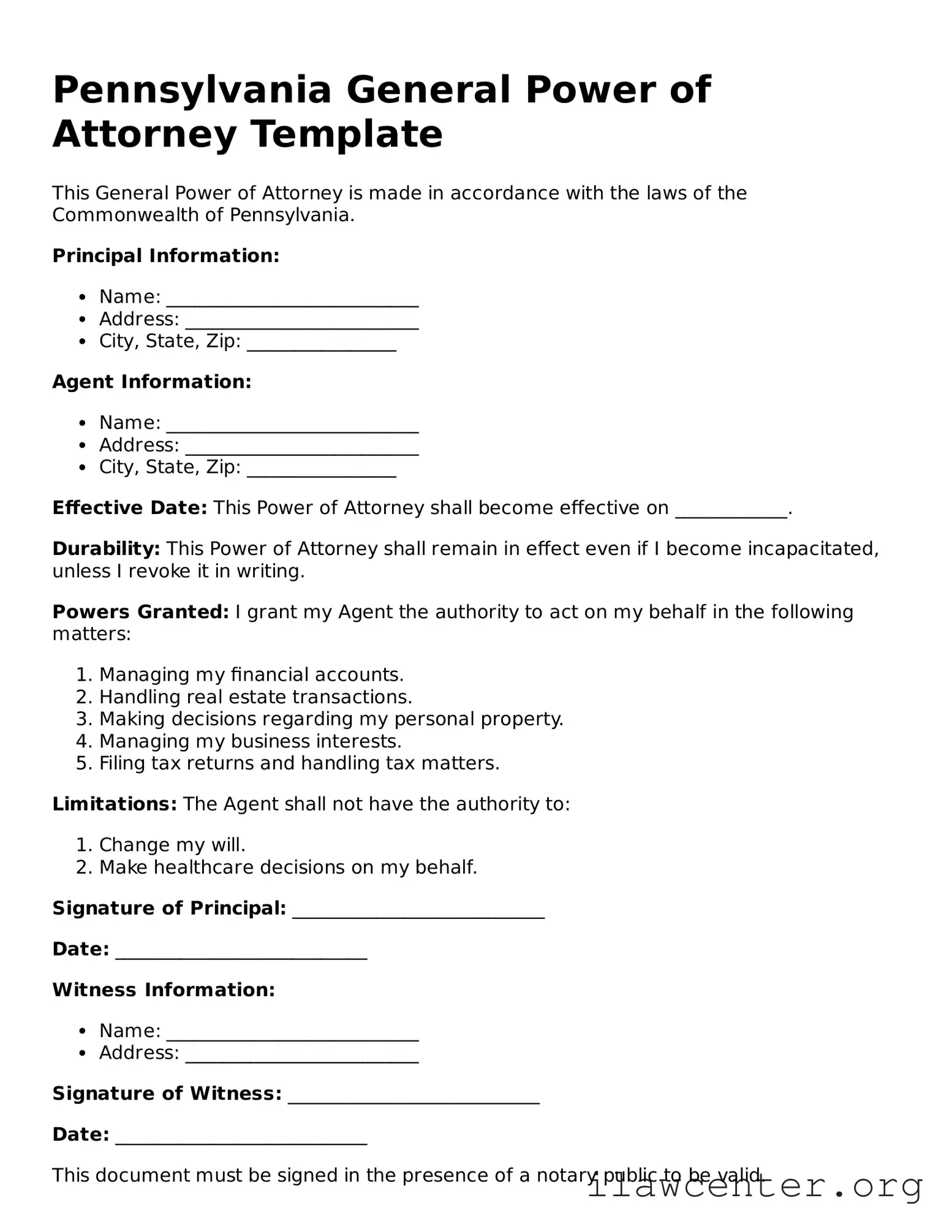
Pennsylvania General Power of Attorney Preview

Pennsylvania General Power of Attorney Template

This General Power of Attorney is made in accordance with the laws of the Commonwealth of Pennsylvania.

Principal Information:

  • Name: ___________________________
  • Address: _________________________
  • City, State, Zip: ________________

Agent Information:

  • Name: ___________________________
  • Address: _________________________
  • City, State, Zip: ________________

Effective Date: This Power of Attorney shall become effective on ____________.

Durability: This Power of Attorney shall remain in effect even if I become incapacitated, unless I revoke it in writing.

Powers Granted: I grant my Agent the authority to act on my behalf in the following matters:

  1. Managing my financial accounts.
  2. Handling real estate transactions.
  3. Making decisions regarding my personal property.
  4. Managing my business interests.
  5. Filing tax returns and handling tax matters.

Limitations: The Agent shall not have the authority to:

  1. Change my will.
  2. Make healthcare decisions on my behalf.

Signature of Principal: ___________________________

Date: ___________________________

Witness Information:

  • Name: ___________________________
  • Address: _________________________

Signature of Witness: ___________________________

Date: ___________________________

This document must be signed in the presence of a notary public to be valid.

PDF Form Characteristics

Fact Name Description
Definition A Pennsylvania General Power of Attorney allows one person to grant another person the authority to act on their behalf in financial matters.
Governing Law This form is governed by the Pennsylvania Consolidated Statutes, Title 20, Chapter 56.
Durability The General Power of Attorney can be made durable, meaning it remains effective even if the principal becomes incapacitated.
Agent's Authority The agent can handle a variety of financial transactions, including managing bank accounts, selling property, and making investments.
Revocation The principal can revoke the General Power of Attorney at any time, as long as they are mentally competent.
Witnesses The form must be signed in the presence of a notary public, and it is advisable to have two witnesses as well.
Limitations Some powers, such as making healthcare decisions, require a separate document and are not covered by the General Power of Attorney.

Instructions on Utilizing Pennsylvania General Power of Attorney

Filling out the Pennsylvania General Power of Attorney form requires careful attention to detail. Once completed, this document allows you to designate someone to make financial and legal decisions on your behalf. It's essential to ensure that all information is accurate and clearly presented to avoid any potential issues.

  1. Begin by obtaining the Pennsylvania General Power of Attorney form. You can find it online or at legal offices.
  2. Read through the entire form to familiarize yourself with its sections and requirements.
  3. In the first section, provide your full legal name and address. This identifies you as the principal.
  4. Next, enter the name and address of the person you are appointing as your agent. This individual will act on your behalf.
  5. Specify the powers you are granting to your agent. You can choose general powers or limit them to specific tasks.
  6. Include the effective date of the power of attorney. You can choose for it to take effect immediately or at a later date.
  7. Sign and date the form in the designated area. This signature must be yours and should be done in the presence of a notary.
  8. Have the form notarized. This step is crucial for the document to be legally binding.
  9. Make copies of the completed and notarized form for your records and for your agent.

Important Facts about Pennsylvania General Power of Attorney

What is a General Power of Attorney in Pennsylvania?

A General Power of Attorney (GPOA) is a legal document that allows one person, known as the "principal," to grant another person, referred to as the "agent" or "attorney-in-fact," the authority to act on their behalf. This authority can cover a wide range of financial and legal matters, such as managing bank accounts, paying bills, and making investment decisions.

Why would someone need a General Power of Attorney?

People often use a GPOA to ensure that someone they trust can handle their affairs if they become unable to do so themselves due to illness, travel, or other circumstances. It provides peace of mind, knowing that decisions will be made by someone who understands their wishes and needs.

How do I create a General Power of Attorney in Pennsylvania?

To create a GPOA in Pennsylvania, you must fill out the appropriate form, which can often be found online or obtained from a legal professional. The form must be signed by the principal in the presence of a notary public. It’s essential to ensure that the document clearly outlines the powers granted to the agent.

Can I revoke a General Power of Attorney?

Yes, you can revoke a GPOA at any time, as long as you are mentally competent. To revoke the power, you should create a written revocation document and notify the agent and any institutions or individuals that were relying on the original GPOA. This ensures that your wishes are clear and legally recognized.

What happens if the principal becomes incapacitated?

If the principal becomes incapacitated, the GPOA remains in effect unless it is specifically stated to terminate upon incapacity. This means the agent can continue to act on behalf of the principal, making decisions as outlined in the document. It’s crucial to choose a trustworthy agent for this reason.

Can I limit the powers granted in a General Power of Attorney?

Yes, you can limit the powers granted in a GPOA. The document can specify particular actions the agent is allowed to take or exclude certain powers altogether. Be clear and detailed in your instructions to avoid confusion later on.

Is a General Power of Attorney valid in other states?

A GPOA created in Pennsylvania is generally valid in other states, but it’s wise to check the specific laws of the state where it will be used. Some states may have different requirements or may require a new document to be created. Consulting with a legal professional can help ensure that the document meets the necessary criteria.

Common mistakes

Filling out a Pennsylvania General Power of Attorney form can be a straightforward process, but many people make mistakes that can lead to complications down the line. One common error is not clearly identifying the agent. The agent is the person you designate to make decisions on your behalf. If their name is misspelled or if there’s any ambiguity about who they are, it can create confusion and potentially invalidate the document.

Another frequent mistake is failing to specify the powers granted. While the form provides a list of powers you can grant, some individuals overlook the importance of being explicit. If you don’t clearly outline what your agent can and cannot do, you may end up in a situation where your agent exceeds their authority or, conversely, is unable to act when necessary.

Many people also neglect to date the document. A Power of Attorney is only effective if it is dated, and without a date, it can be questioned in terms of validity. This simple oversight can lead to significant issues, especially if the form is challenged in the future.

Another mistake involves not having the document properly witnessed or notarized. In Pennsylvania, a Power of Attorney must be signed by the principal and either witnessed by two individuals or notarized. Skipping this step can render the document ineffective, leaving your wishes unfulfilled.

Some individuals fail to consider the need for a successor agent. Life is unpredictable, and your primary agent may not always be available to act on your behalf. By not naming a successor, you risk leaving your affairs in limbo if something happens to your first choice.

Additionally, people often overlook the importance of reviewing the form for accuracy. After filling out the document, it’s crucial to double-check all information for errors. A simple typo or omission can lead to significant legal issues, so taking the time to review is essential.

Another common pitfall is not communicating with the agent about their responsibilities. It’s vital to have an open conversation with your chosen agent about your wishes and expectations. Failing to do so can lead to misunderstandings and decisions that may not align with your intentions.

Lastly, many individuals do not keep a copy of the completed Power of Attorney form. It’s essential to retain a copy for your records and to provide one to your agent. Without access to the document, your agent may struggle to fulfill their role, which can create unnecessary complications during critical times.

Documents used along the form

A Pennsylvania General Power of Attorney form allows an individual to designate another person to make decisions on their behalf. However, several other documents may complement this form to ensure comprehensive legal coverage. Below are five important documents often used alongside the General Power of Attorney.

  • Durable Power of Attorney: This document remains effective even if the principal becomes incapacitated. It ensures that the designated agent can continue to act on behalf of the principal without interruption.
  • Healthcare Power of Attorney: This form specifically grants someone the authority to make medical decisions for the principal when they are unable to do so themselves. It focuses on health-related choices and end-of-life care.
  • Living Will: A living will outlines a person's wishes regarding medical treatment and end-of-life care. It provides guidance to healthcare providers and family members about the principal’s preferences in critical situations.
  • Financial Power of Attorney: Similar to the General Power of Attorney, this document specifically focuses on financial matters. It allows the agent to manage the principal's financial affairs, including banking and property transactions.
  • Revocation of Power of Attorney: This document formally cancels any existing power of attorney agreements. It is essential for the principal to use this if they wish to change their agent or terminate the authority granted to someone.

Using these documents together can help ensure that all aspects of decision-making and care are addressed, providing peace of mind for both the principal and their loved ones.

Similar forms

  • Durable Power of Attorney: This document remains effective even if the principal becomes incapacitated. It provides a similar scope of authority as a General Power of Attorney, allowing the agent to make decisions on behalf of the principal.
  • Limited Power of Attorney: Unlike a General Power of Attorney, this document restricts the agent's authority to specific tasks or situations. It’s useful when the principal needs someone to handle particular affairs without granting broad powers.
  • Health Care Proxy: This document allows an individual to designate someone to make medical decisions on their behalf if they are unable to do so. While it focuses on health care, it shares the principle of appointing an agent to act for another.
  • Living Will: A Living Will outlines an individual's wishes regarding medical treatment in situations where they cannot communicate. Though it does not appoint an agent, it complements the Health Care Proxy by clarifying the principal's preferences.
  • Revocable Trust: This legal arrangement allows a person to place their assets into a trust, which they can alter or revoke during their lifetime. Like a General Power of Attorney, it provides flexibility in managing assets but focuses more on estate planning.
  • Financial Power of Attorney: This document specifically grants authority over financial matters. While a General Power of Attorney can encompass various areas, a Financial Power of Attorney is tailored for financial transactions and decisions.

Dos and Don'ts

When filling out the Pennsylvania General Power of Attorney form, it's important to get it right. Here are ten things you should and shouldn't do:

  • Do read the entire form carefully before starting.
  • Don't rush through the process. Take your time to ensure accuracy.
  • Do provide clear and specific information about the powers you are granting.
  • Don't leave any sections blank unless instructed. This can lead to confusion.
  • Do sign and date the form in the presence of a notary public.
  • Don't forget to have witnesses if required. Check local laws for specifics.
  • Do keep a copy of the completed form for your records.
  • Don't assume the agent knows your wishes without discussing them first.
  • Do review the form periodically to ensure it still meets your needs.
  • Don't use outdated versions of the form. Always use the most current version available.

Misconceptions

Understanding the Pennsylvania General Power of Attorney (GPOA) form is essential for anyone considering its use. Unfortunately, there are several misconceptions that can lead to confusion. Here’s a breakdown of nine common misunderstandings:

  1. It only applies to financial matters.

    Many people believe that a GPOA is limited to financial decisions. In reality, it can cover a wide range of decisions, including healthcare, property management, and other personal matters.

  2. It becomes effective only when the principal is incapacitated.

    Some think that the GPOA is only activated when the person granting it becomes incapacitated. However, it can be set up to take effect immediately or upon a specific event, depending on the principal's wishes.

  3. Anyone can serve as an agent.

    While you can choose almost anyone to be your agent, it’s crucial to select someone trustworthy and capable of handling your affairs. Not everyone is equipped for such a responsibility.

  4. It is permanent and cannot be revoked.

    This is a common myth. A GPOA can be revoked at any time by the principal, as long as they are still competent to make that decision.

  5. It must be notarized to be valid.

    While notarization is strongly recommended for the GPOA to be effective, it is not strictly required in Pennsylvania. However, having it notarized can help avoid disputes later.

  6. All powers are automatically granted.

    Not all powers are granted by default. The principal must specify which powers are included in the GPOA. This allows for tailored authority based on individual needs.

  7. It is the same as a healthcare power of attorney.

    Although both documents grant authority to act on behalf of another, a GPOA is broader and can include financial matters, while a healthcare power of attorney specifically addresses medical decisions.

  8. Agents can act without any oversight.

    Agents have a fiduciary duty to act in the best interest of the principal. They are accountable for their actions and can be held liable for any misuse of authority.

  9. Once signed, the principal loses control.

    This is a significant misconception. The principal retains control over their affairs and can make decisions independently, even after granting a GPOA, as long as they are competent.

By clarifying these misconceptions, individuals can make informed decisions about using a General Power of Attorney in Pennsylvania. It’s always wise to consult with a legal professional to ensure that your specific needs are met.

Key takeaways

When considering the Pennsylvania General Power of Attorney form, it is essential to understand its implications and the responsibilities involved. Here are seven key takeaways to keep in mind:

  1. Purpose of the Document: A General Power of Attorney allows an individual, known as the principal, to grant another person, called the agent or attorney-in-fact, the authority to make decisions on their behalf.
  2. Types of Powers Granted: The powers granted can include financial decisions, real estate transactions, and managing personal affairs. The scope can be broad or limited, depending on the principal’s wishes.
  3. Durability: The General Power of Attorney can be made durable, meaning it remains effective even if the principal becomes incapacitated. This is crucial for long-term planning.
  4. Choosing an Agent: Selecting a trustworthy agent is vital. The agent will have significant control over the principal’s assets and decisions, so choose someone reliable and responsible.
  5. Revocation: The principal can revoke the power of attorney at any time, as long as they are mentally competent. It is important to notify the agent and any relevant third parties of this revocation.
  6. Witness and Notarization Requirements: In Pennsylvania, the form must be signed in the presence of a notary public. This adds a layer of authenticity and helps prevent fraud.
  7. Legal Advice: It is advisable to seek legal counsel when filling out the General Power of Attorney form. An attorney can provide guidance tailored to individual circumstances and ensure that the document meets all legal requirements.

Understanding these key points can help individuals navigate the complexities of the Pennsylvania General Power of Attorney form effectively.