Attorney-Verified  Hold Harmless Agreement Document for Pennsylvania

Attorney-Verified Hold Harmless Agreement Document for Pennsylvania

The Pennsylvania Hold Harmless Agreement form is a legal document designed to protect one party from liability for any potential damages or injuries that may occur during a specific activity or event. This agreement ensures that participants understand the risks involved and agree not to hold the other party responsible. To safeguard your interests, consider filling out the form by clicking the button below.

Article Guide

The Pennsylvania Hold Harmless Agreement form serves as a vital legal document that protects parties from liability in various situations. This agreement is commonly used in contexts such as rental agreements, construction projects, and events where one party may face risks associated with the actions of another. By signing this form, individuals or organizations agree to assume responsibility for any injuries or damages that may occur, thereby shielding the other party from legal claims. The form typically outlines specific conditions under which the hold harmless clause applies, ensuring clarity on the extent of liability. It is crucial for both parties to understand the implications of this agreement, as it can significantly impact their legal rights and responsibilities. Properly executed, the Pennsylvania Hold Harmless Agreement can provide peace of mind and foster trust in business and personal relationships.

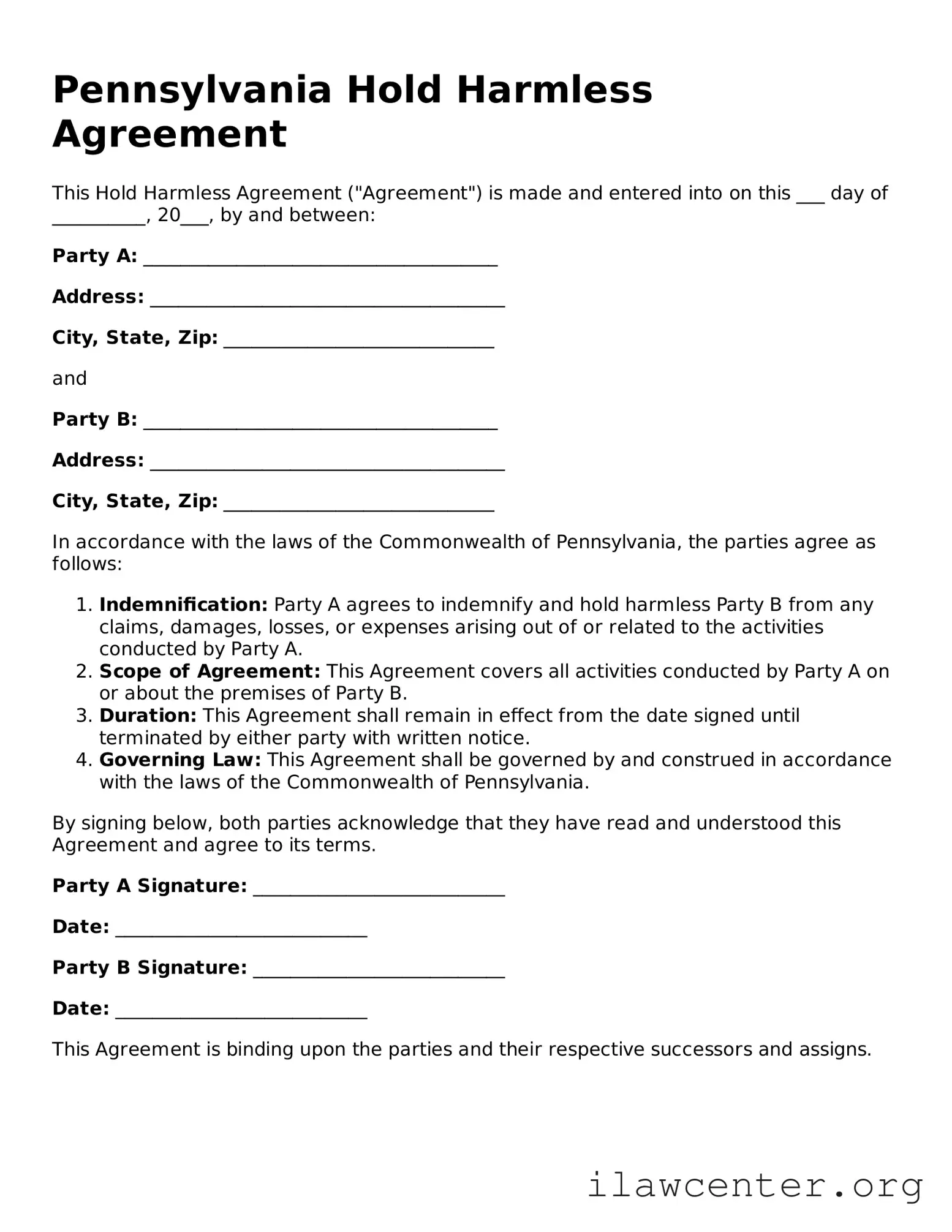
Pennsylvania Hold Harmless Agreement Preview

Pennsylvania Hold Harmless Agreement

This Hold Harmless Agreement ("Agreement") is made and entered into on this ___ day of __________, 20___, by and between:

Party A: ______________________________________

Address: ______________________________________

City, State, Zip: _____________________________

and

Party B: ______________________________________

Address: ______________________________________

City, State, Zip: _____________________________

In accordance with the laws of the Commonwealth of Pennsylvania, the parties agree as follows:

  1. Indemnification: Party A agrees to indemnify and hold harmless Party B from any claims, damages, losses, or expenses arising out of or related to the activities conducted by Party A.
  2. Scope of Agreement: This Agreement covers all activities conducted by Party A on or about the premises of Party B.
  3. Duration: This Agreement shall remain in effect from the date signed until terminated by either party with written notice.
  4. Governing Law: This Agreement shall be governed by and construed in accordance with the laws of the Commonwealth of Pennsylvania.

By signing below, both parties acknowledge that they have read and understood this Agreement and agree to its terms.

Party A Signature: ___________________________

Date: ___________________________

Party B Signature: ___________________________

Date: ___________________________

This Agreement is binding upon the parties and their respective successors and assigns.

PDF Form Characteristics

Fact Name Description
Definition A Hold Harmless Agreement is a legal document where one party agrees not to hold another party liable for any damages or injuries that may occur.
Purpose These agreements are often used to protect individuals or organizations from legal claims arising from specific activities or events.
Common Usage They are frequently utilized in situations involving rentals, events, and activities where risks are present, such as sports and recreational activities.
State Specificity In Pennsylvania, these agreements must adhere to state laws and regulations to be enforceable.
Governing Laws The enforcement of Hold Harmless Agreements in Pennsylvania is guided by general contract law principles and specific statutory provisions.
Limitations These agreements cannot protect against gross negligence or willful misconduct. Courts may not enforce them if they attempt to waive liability for such actions.
Considerations Parties should carefully review the terms of the agreement, ensuring clarity and mutual understanding before signing.
Legal Advice Consulting with a legal professional is advisable to ensure that the agreement meets all necessary legal requirements and adequately protects your interests.

Instructions on Utilizing Pennsylvania Hold Harmless Agreement

Filling out the Pennsylvania Hold Harmless Agreement form requires careful attention to detail. Once completed, this form will need to be submitted to the appropriate parties for review and approval. It is important to ensure that all required information is accurately provided to avoid any delays in processing.

  1. Begin by downloading the Pennsylvania Hold Harmless Agreement form from the official website or obtaining a physical copy.
  2. Read through the form thoroughly to understand the information required.
  3. In the first section, enter your full name and contact information, including your address, phone number, and email.
  4. Provide the name and contact information of the other party involved in the agreement.
  5. Clearly state the purpose of the agreement in the designated area, ensuring it reflects the specific situation.
  6. Review any clauses or terms outlined in the agreement. If there are sections that require your initials or signature, ensure you complete these as indicated.
  7. Once all information is filled out, review the entire form for accuracy and completeness.
  8. Sign and date the form where indicated. If a witness is required, ensure that they also sign and date the form.
  9. Make a copy of the completed form for your records before submitting it to the relevant party.

Important Facts about Pennsylvania Hold Harmless Agreement

What is a Hold Harmless Agreement in Pennsylvania?

A Hold Harmless Agreement is a legal document that protects one party from liability for certain actions or events. In Pennsylvania, this agreement is commonly used in various contexts, such as rental agreements, construction contracts, and event planning. It ensures that one party agrees not to hold the other party responsible for any damages or injuries that may occur during the course of their relationship or activity.

Who typically uses a Hold Harmless Agreement?

This agreement is often utilized by property owners, contractors, event organizers, and businesses. For example, a property owner may require a tenant to sign a Hold Harmless Agreement to limit liability for injuries that occur on the premises. Similarly, a contractor may ask subcontractors to sign such an agreement to protect against claims related to their work.

What are the key components of a Hold Harmless Agreement?

A Hold Harmless Agreement generally includes the following components: identification of the parties involved, a clear statement of the activities covered by the agreement, the scope of liability being waived, and the duration of the agreement. It may also include provisions for indemnification, where one party agrees to compensate the other for any losses incurred.

Is a Hold Harmless Agreement legally enforceable in Pennsylvania?

Yes, a Hold Harmless Agreement can be legally enforceable in Pennsylvania, provided it meets certain criteria. The agreement must be clear and unambiguous, and both parties must voluntarily agree to its terms. Courts may scrutinize the agreement for fairness, especially if it seeks to waive liability for gross negligence or intentional misconduct.

Can a Hold Harmless Agreement protect against all types of liability?

No, a Hold Harmless Agreement cannot protect against all types of liability. While it can limit liability for certain risks, it typically does not cover gross negligence or willful misconduct. Courts may refuse to enforce provisions that attempt to waive liability for serious wrongdoing or violations of public policy.

How does one create a Hold Harmless Agreement?

To create a Hold Harmless Agreement, parties should clearly outline their intentions in writing. It is advisable to include specific details about the activities involved and the extent of liability being waived. Consulting with a legal professional can help ensure that the agreement is properly drafted and compliant with Pennsylvania law.

Can a Hold Harmless Agreement be modified after it is signed?

Yes, a Hold Harmless Agreement can be modified after it is signed, but both parties must agree to the changes. Modifications should be documented in writing and signed by all parties involved to ensure clarity and enforceability.

What happens if a party violates the Hold Harmless Agreement?

If a party violates the terms of a Hold Harmless Agreement, the other party may seek legal remedies. This could include filing a lawsuit for breach of contract. The specific consequences will depend on the terms outlined in the agreement and the nature of the violation.

Is legal advice necessary when dealing with a Hold Harmless Agreement?

While it is not legally required to seek advice, obtaining legal counsel is highly recommended. A legal professional can provide guidance on the implications of the agreement, help draft the document, and ensure that it complies with applicable laws in Pennsylvania.

Where can I find a Hold Harmless Agreement template?

Hold Harmless Agreement templates can be found through various online legal resources, law firms, and legal document services. However, it is important to ensure that any template used is appropriate for the specific situation and compliant with Pennsylvania law. Customization may be necessary to address the unique circumstances of the parties involved.
Common mistakes

When filling out the Pennsylvania Hold Harmless Agreement form, individuals often make several common mistakes that can lead to misunderstandings or legal complications. One frequent error is failing to read the entire document thoroughly before signing. This oversight can result in the signer not fully understanding their rights and responsibilities under the agreement. It is crucial to take the time to read each section carefully.

Another mistake is not providing accurate information. Individuals sometimes rush through the form and may enter incorrect names, dates, or other essential details. This can create confusion later on, especially if the agreement needs to be enforced or referenced in the future. Always double-check the information for accuracy before submitting the form.

People also often neglect to include all necessary parties in the agreement. A Hold Harmless Agreement typically requires the signatures of all involved parties to be valid. Failing to include everyone who may be affected by the agreement can lead to disputes or challenges regarding its enforceability.

Additionally, some individuals overlook the importance of including specific details about the activities or situations covered by the agreement. A vague description can lead to ambiguity, which may cause problems if a dispute arises. Clearly outlining the scope of the agreement helps to ensure that all parties understand what is being covered.

Finally, many people forget to keep a copy of the signed agreement for their records. Without a copy, it can be challenging to reference the terms later if questions or issues arise. Keeping a well-organized file of important documents, including the Hold Harmless Agreement, is essential for future reference.

Documents used along the form

The Pennsylvania Hold Harmless Agreement is a legal document that protects one party from liability for certain actions or events. This agreement is often accompanied by other forms and documents that serve various purposes in legal and business transactions. Below is a list of related documents commonly used alongside the Hold Harmless Agreement.

  • Indemnity Agreement: This document outlines the responsibilities of one party to compensate another for any loss or damage that may occur. It is often used in conjunction with hold harmless agreements to provide additional protection.
  • Liability Waiver: A liability waiver releases one party from liability for injuries or damages that may occur during an activity. This form is frequently used in recreational or event settings.
  • Insurance Certificate: This document provides proof of insurance coverage. It is often required to ensure that parties involved have adequate protection against potential claims.
  • Release of Liability: A release of liability form is signed by participants to acknowledge the risks involved in an activity and to waive their right to sue for injuries. This is commonly used in sports and recreational activities.
  • Contractor Agreement: This agreement outlines the terms between a contractor and a client. It typically includes clauses about liability and indemnification, making it relevant when discussing hold harmless provisions.
  • Service Agreement: A service agreement details the services to be provided and the obligations of both parties. It may contain indemnity clauses to protect against claims arising from the services rendered.
  • Risk Assessment Form: This document evaluates potential risks associated with an activity or project. It helps parties understand the liabilities they may face and informs the creation of hold harmless agreements.

These documents play a crucial role in ensuring that all parties involved in a transaction or activity are aware of their rights and responsibilities. Utilizing these forms together can enhance protection and clarity in legal agreements.

Similar forms

  • Indemnity Agreement: This document also focuses on protecting one party from legal liability. It ensures that if one party faces a claim or lawsuit, the other party will cover the costs associated with that claim.
  • Liability Waiver: A liability waiver is similar in that it releases one party from responsibility for injuries or damages. Participants often sign these before engaging in activities that could pose risks.
  • Release of Liability: This document is often used in sports and recreational activities. It releases the organizer from liability for any injuries that may occur during the event, similar to a Hold Harmless Agreement.
  • Contractual Disclaimer: A disclaimer outlines the limits of liability for a party. It serves to inform others that certain risks are not the responsibility of the party, much like the Hold Harmless Agreement.
  • Service Agreement: This document may include clauses that protect one party from claims arising from the services provided. It often contains provisions similar to those found in a Hold Harmless Agreement.

Dos and Don'ts

When filling out the Pennsylvania Hold Harmless Agreement form, it's important to approach the process carefully. Here are five things to keep in mind:

  • Do read the entire agreement thoroughly before signing.
  • Do provide accurate and complete information in all sections of the form.
  • Do consult with a legal expert if you have any questions or concerns.
  • Don't rush through the form; take your time to ensure everything is correct.
  • Don't ignore any specific instructions or requirements outlined in the agreement.

Misconceptions

Understanding the Pennsylvania Hold Harmless Agreement can be tricky. Here are eight common misconceptions that often lead to confusion:

  1. It completely eliminates liability. Many believe that signing a Hold Harmless Agreement means they cannot be held liable for any actions. In reality, it typically limits liability but does not eliminate it entirely.
  2. It protects against all types of claims. Some think these agreements cover every possible claim. However, they usually protect against specific risks outlined in the agreement, not all potential claims.
  3. It is only for businesses. While often used by businesses, individuals can also benefit from these agreements in personal transactions or events.
  4. It is legally binding in all situations. Not every Hold Harmless Agreement is enforceable. Courts may not uphold them if they are deemed unfair or overly broad.
  5. Signing means you accept all risks. People often think that signing means they accept every risk associated with an activity. Instead, it usually means they agree not to hold the other party responsible for specific risks.
  6. It requires a lawyer to draft. While having a lawyer can help, it is not mandatory. Many simple agreements can be drafted by the parties involved, as long as they clearly outline the terms.
  7. It is the same as an insurance policy. Some confuse this agreement with insurance. A Hold Harmless Agreement does not provide coverage; it simply outlines who is responsible for certain risks.
  8. Once signed, it cannot be changed. Many think that once the agreement is signed, it’s set in stone. In fact, parties can negotiate and amend the agreement as long as both sides agree to the changes.

Clearing up these misconceptions can help you navigate the use of Hold Harmless Agreements more effectively. Always consider your specific situation and seek clarity on any points that may be confusing.

Key takeaways

When utilizing the Pennsylvania Hold Harmless Agreement form, it is essential to understand its purpose and implications. Below are key takeaways to consider:

  • The Hold Harmless Agreement is designed to protect one party from liability for damages or injuries that may occur during a specified activity.
  • Both parties should clearly identify themselves in the agreement to avoid ambiguity.
  • Specific activities or events that the agreement covers must be detailed to ensure clarity.
  • Consideration of state laws is crucial, as they may influence the enforceability of the agreement.
  • Both parties should read the entire document carefully before signing to fully understand their rights and obligations.
  • It is advisable to consult with a legal professional when drafting or reviewing the agreement.
  • Signatures of all parties must be obtained for the agreement to be valid and enforceable.
  • Keep a copy of the signed agreement for future reference and documentation.
  • The agreement may not absolve a party from gross negligence or willful misconduct, so consider the limitations of the protection it offers.

By understanding these key points, individuals can better navigate the process of completing and utilizing the Pennsylvania Hold Harmless Agreement form.