Attorney-Verified  Last Will and Testament Document for Pennsylvania

Attorney-Verified Last Will and Testament Document for Pennsylvania

A Last Will and Testament is a legal document that outlines how a person's assets and responsibilities will be handled after their death. In Pennsylvania, this form is essential for ensuring that your wishes are honored and your loved ones are taken care of. To get started on securing your legacy, fill out the form by clicking the button below.

Article Guide

In Pennsylvania, the Last Will and Testament form serves as a crucial document for individuals seeking to outline their final wishes regarding the distribution of their assets after death. This legal instrument allows a person, known as the testator, to designate beneficiaries who will inherit property and possessions, ensuring that their intentions are honored. The form typically includes sections for naming an executor, who is responsible for managing the estate and ensuring that the will is executed according to the testator's directives. Additionally, it may address guardianship for minor children, providing peace of mind about their care. Properly executing the will, which involves signing in the presence of witnesses, is essential for its validity, as Pennsylvania law requires specific formalities to be met. Understanding these elements is vital for anyone preparing to create a will, as it not only reflects personal wishes but also impacts the legal process of estate distribution. By utilizing this form, individuals can take proactive steps to secure their legacy and provide clarity for their loved ones during a difficult time.

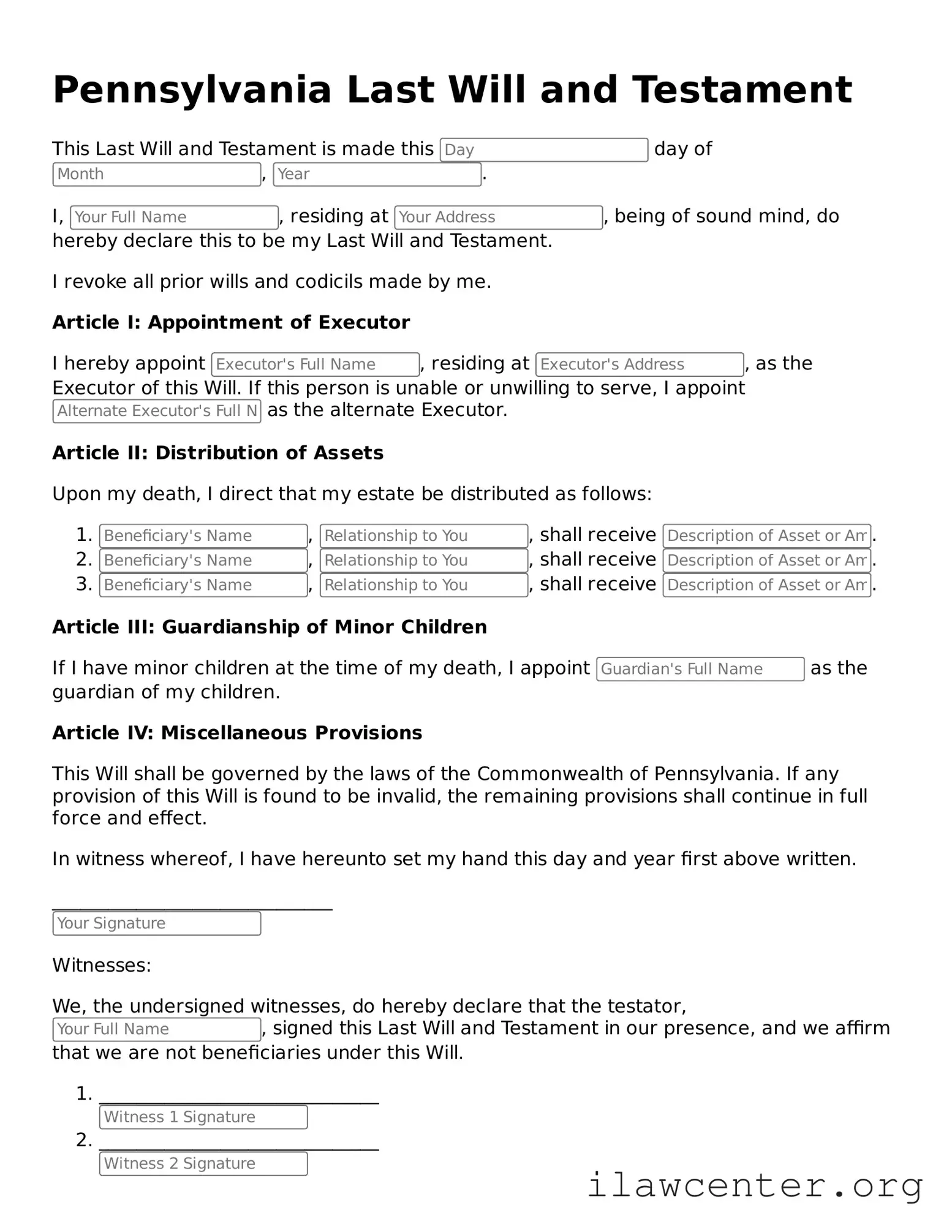
Pennsylvania Last Will and Testament Preview

Pennsylvania Last Will and Testament

This Last Will and Testament is made this day of , .

I, , residing at , being of sound mind, do hereby declare this to be my Last Will and Testament.

I revoke all prior wills and codicils made by me.

Article I: Appointment of Executor

I hereby appoint , residing at , as the Executor of this Will. If this person is unable or unwilling to serve, I appoint as the alternate Executor.

Article II: Distribution of Assets

Upon my death, I direct that my estate be distributed as follows:

  1. , , shall receive .
  2. , , shall receive .
  3. , , shall receive .

Article III: Guardianship of Minor Children

If I have minor children at the time of my death, I appoint as the guardian of my children.

Article IV: Miscellaneous Provisions

This Will shall be governed by the laws of the Commonwealth of Pennsylvania. If any provision of this Will is found to be invalid, the remaining provisions shall continue in full force and effect.

In witness whereof, I have hereunto set my hand this day and year first above written.

______________________________

Witnesses:

We, the undersigned witnesses, do hereby declare that the testator, , signed this Last Will and Testament in our presence, and we affirm that we are not beneficiaries under this Will.

  1. ______________________________
  2. ______________________________

Signed on this day of , .

PDF Form Characteristics

Fact Name Details
Governing Law The Pennsylvania Last Will and Testament is governed by the Pennsylvania Probate, Estates and Fiduciaries Code (Title 20, Chapter 2501).
Age Requirement Individuals must be at least 18 years old to create a valid will in Pennsylvania.
Witness Requirement The will must be signed by at least two witnesses who are present at the same time.
Revocation A will can be revoked by creating a new will or by physically destroying the original document.
Self-Proving Will Pennsylvania allows for a self-proving will, which simplifies the probate process by including a notarized affidavit from the witnesses.
Intestate Succession If a person dies without a will, Pennsylvania law dictates how their assets will be distributed according to intestate succession laws.

Instructions on Utilizing Pennsylvania Last Will and Testament

After obtaining the Pennsylvania Last Will and Testament form, you will need to carefully fill it out to ensure your wishes are clearly expressed. This document is essential for outlining how your assets will be distributed after your passing. The following steps will guide you through the process of completing the form accurately.

  1. Begin by entering your full name at the top of the form. Make sure it matches your legal name as it appears on identification documents.
  2. Next, provide your current address. This should be your permanent residence, including the city and state.
  3. Indicate the date on which you are filling out the will. This helps establish the timeline of your intentions.
  4. Designate an executor. This is the person you trust to carry out the instructions in your will. Include their full name and contact information.
  5. List your beneficiaries. These are the individuals or organizations who will receive your assets. Clearly state their names and relationship to you.
  6. Detail the specific assets you wish to bequeath. Be as descriptive as possible, including items like property, bank accounts, or personal belongings.
  7. Include any specific instructions or conditions regarding the distribution of your assets. This could involve stipulations about when or how beneficiaries receive their inheritance.
  8. Sign the will in the designated area. Your signature confirms your intent to create this document as your Last Will and Testament.
  9. Have at least two witnesses sign the document. They should be present when you sign the will and must also provide their names and addresses.
  10. Finally, store the completed will in a safe place. Inform your executor and trusted family members where it can be found.

Important Facts about Pennsylvania Last Will and Testament

What is a Last Will and Testament in Pennsylvania?

A Last Will and Testament is a legal document that outlines how a person's assets and property should be distributed after their death. In Pennsylvania, this document allows individuals to specify their wishes regarding the distribution of their estate, the appointment of guardians for minor children, and the designation of an executor to manage the estate. It is an important tool for ensuring that one's wishes are honored and can help avoid disputes among family members after passing.

Who can create a Last Will and Testament in Pennsylvania?

In Pennsylvania, any individual who is at least 18 years old and of sound mind can create a Last Will and Testament. This means that the person must be able to understand the nature of the document and the implications of their decisions. There are no specific educational or professional requirements to draft a will, but it is advisable to seek guidance to ensure that it meets all legal standards and accurately reflects the individual's wishes.

What are the requirements for a valid Last Will and Testament in Pennsylvania?

For a Last Will and Testament to be considered valid in Pennsylvania, it must be in writing and signed by the testator (the person making the will). Additionally, the will must be witnessed by at least two individuals who are present at the same time. These witnesses must also sign the document, affirming that they witnessed the testator's signature. It is important to note that Pennsylvania does not require a will to be notarized, although having a notary can add an extra layer of authenticity.

Can a Last Will and Testament be changed or revoked in Pennsylvania?

Yes, a Last Will and Testament can be changed or revoked at any time while the testator is alive and of sound mind. Changes can be made through a new will or by creating a codicil, which is an amendment to the existing will. If a person wishes to revoke their will entirely, they can do so by destroying the document or explicitly stating their intent to revoke it in writing. It is important to ensure that any changes are made in accordance with Pennsylvania's legal requirements to avoid complications in the future.

Common mistakes

Filling out a Last Will and Testament form in Pennsylvania is an important step in ensuring that your wishes are honored after your passing. However, many individuals make common mistakes during this process. One frequent error is failing to clearly identify the beneficiaries. It is essential to specify who will receive your assets, as vague language can lead to confusion and disputes among family members.

Another mistake involves not updating the will when significant life changes occur. Events such as marriage, divorce, or the birth of a child can affect how you want your estate to be distributed. If the will is not revised to reflect these changes, it may not align with your current intentions.

Some people overlook the necessity of having witnesses present when signing the will. In Pennsylvania, at least two witnesses must observe the signing of the document for it to be considered valid. Failing to have witnesses can result in the will being contested or deemed invalid.

Additionally, individuals often neglect to include a residuary clause. This clause addresses any assets not specifically mentioned in the will. Without it, any assets not accounted for may be subject to intestate succession laws, which may not reflect your wishes.

Another common oversight is not properly dating the will. A date helps establish the most current version of the document. If there are multiple versions of a will, the date can clarify which one should be honored, preventing potential conflicts.

Many people also forget to appoint an executor. The executor is responsible for managing the estate and ensuring that your wishes are carried out. Without a designated executor, the court may appoint someone, which may not align with your preferences.

Some individuals may not consider the implications of digital assets. In today’s digital age, it is important to address online accounts, social media profiles, and cryptocurrencies in your will. Failing to do so may leave these assets unaccounted for, complicating the estate settlement process.

Finally, a lack of legal guidance can lead to mistakes. While it is possible to fill out a will without professional assistance, seeking advice from an attorney can help ensure that the document meets all legal requirements and accurately reflects your wishes. This step can save time and prevent complications in the future.

Documents used along the form

When creating a Pennsylvania Last Will and Testament, several other documents may be necessary to ensure your wishes are fully expressed and legally upheld. Each of these documents serves a unique purpose in the estate planning process.

  • Living Will: This document outlines your preferences for medical treatment if you become unable to communicate your wishes. It specifies the types of life-sustaining treatments you do or do not want.
  • Durable Power of Attorney: This form allows you to appoint someone to make financial and legal decisions on your behalf if you become incapacitated.
  • Healthcare Power of Attorney: Similar to a durable power of attorney, this document designates someone to make medical decisions for you when you cannot do so.
  • Revocable Trust: This legal arrangement allows you to place your assets into a trust during your lifetime, which can help avoid probate and manage your estate after your death.
  • Beneficiary Designations: These forms specify who will receive your assets, such as life insurance policies and retirement accounts, upon your death, bypassing the will process.
  • Letter of Intent: While not legally binding, this letter provides guidance to your executor about your wishes and any specific instructions regarding your estate.
  • Codicil: This document serves as an amendment to your existing will, allowing you to make changes without creating an entirely new will.
  • Asset Inventory List: A detailed list of your assets can help your executor manage your estate more effectively and ensure that all items are accounted for.
  • Funeral Planning Document: This outlines your wishes regarding funeral arrangements and can relieve your family from making difficult decisions during a stressful time.
  • Guardianship Designation: If you have minor children, this document allows you to designate a guardian to care for them in the event of your death.

Having these documents in place can provide clarity and peace of mind for you and your loved ones. They help ensure that your wishes are honored and that your estate is managed according to your preferences.

Similar forms

  • Living Will: This document outlines a person's wishes regarding medical treatment and end-of-life care. Like a Last Will and Testament, it communicates important decisions but focuses on health care rather than asset distribution.
  • Power of Attorney: A Power of Attorney allows someone to make financial or legal decisions on behalf of another person. Both documents empower individuals to make choices, but the Power of Attorney is effective during a person's lifetime, while a Last Will takes effect after death.
  • Trust: A trust is a legal arrangement where one party holds property for the benefit of another. Similar to a Last Will, it can dictate how assets are distributed, but it often avoids probate, allowing for quicker access to assets.
  • Advance Healthcare Directive: This document combines a Living Will and a Power of Attorney for healthcare. It specifies medical preferences and designates a representative, paralleling the Last Will's role in outlining personal wishes after death.
  • Letter of Intent: A Letter of Intent is a non-legal document that provides guidance on the testator's wishes. While a Last Will is legally binding, the Letter of Intent can clarify intentions and provide context for beneficiaries.
  • Beneficiary Designations: Many financial accounts allow individuals to name beneficiaries directly. This can operate similarly to a Last Will, as it dictates who receives certain assets upon death, bypassing the probate process.
  • Codicil: A codicil is an amendment to an existing will. It serves a similar purpose by updating or changing specific provisions, maintaining the original will's validity while reflecting new intentions.
  • Estate Plan: An estate plan encompasses various documents, including a Last Will, trusts, and powers of attorney. It provides a comprehensive strategy for managing and distributing assets, similar in purpose to a Last Will.
  • Guardianship Designation: This document appoints a guardian for minor children. While a Last Will may also include guardianship provisions, this designation focuses specifically on the care of dependents.
  • Living Trust: A living trust allows individuals to manage their assets during their lifetime and specify distribution after death. Like a Last Will, it addresses asset distribution but can provide additional benefits like privacy and avoiding probate.

Dos and Don'ts

When filling out the Pennsylvania Last Will and Testament form, it is important to approach the process with care. Here are some essential dos and don'ts to consider:

  • Do ensure that you are of sound mind when creating your will.
  • Do clearly identify yourself and your beneficiaries in the document.
  • Do sign your will in the presence of at least two witnesses.
  • Do keep your will in a safe place and inform your executor of its location.
  • Do review and update your will as necessary, especially after major life events.
  • Don't use ambiguous language that could lead to confusion about your intentions.
  • Don't forget to date your will to establish its validity.
  • Don't leave out important details, such as specific bequests or the appointment of an executor.
  • Don't sign your will without witnesses, as this may invalidate it.
  • Don't assume that verbal agreements will be honored; everything should be in writing.

Misconceptions

Understanding the Pennsylvania Last Will and Testament can be tricky. Here are seven common misconceptions that people often have:

  1. Anyone can write a will without any formalities.

    While it’s true that Pennsylvania allows for handwritten wills, there are specific requirements that must be met for the will to be valid. Following the correct format is essential.

  2. A will only takes effect after death.

    Many believe that a will is inactive until the person passes away. However, it can be useful to discuss and plan your estate while you are still alive.

  3. All assets automatically go through the will.

    Not all assets are subject to the will. Certain assets, like those held in a trust or accounts with designated beneficiaries, may bypass the will entirely.

  4. Once created, a will cannot be changed.

    This is a misconception. A will can be amended or revoked at any time as long as the person is of sound mind and follows the proper legal procedures.

  5. Only wealthy individuals need a will.

    Everyone can benefit from having a will, regardless of their financial status. A will ensures that your wishes are honored and can simplify the process for your loved ones.

  6. Verbal agreements are as binding as written wills.

    Verbal agreements regarding your estate are not legally binding in Pennsylvania. A written will is essential for your wishes to be enforceable.

  7. You don't need witnesses for your will.

    Pennsylvania law requires that your will be signed in the presence of at least two witnesses. This step is crucial to ensure its validity.

Key takeaways

When preparing to fill out and use the Pennsylvania Last Will and Testament form, it is essential to keep several key points in mind. These takeaways can help ensure that your will is valid and reflects your wishes accurately.

  • Understand the requirements: To create a valid will in Pennsylvania, you must be at least 18 years old and of sound mind. The will must be in writing.
  • Choose an executor: Select a trustworthy person to serve as your executor. This individual will be responsible for managing your estate and ensuring your wishes are carried out.
  • Be clear and specific: Clearly outline your wishes regarding the distribution of your assets. Ambiguities can lead to disputes among heirs.
  • Sign and date the document: You must sign and date your will in the presence of at least two witnesses. They should also sign the will, affirming that they witnessed your signature.
  • Keep it safe: Store your will in a secure location and inform your executor and family members where it can be found. This ensures that your wishes are honored after your passing.

By following these guidelines, you can create a will that reflects your intentions and provides peace of mind for you and your loved ones.