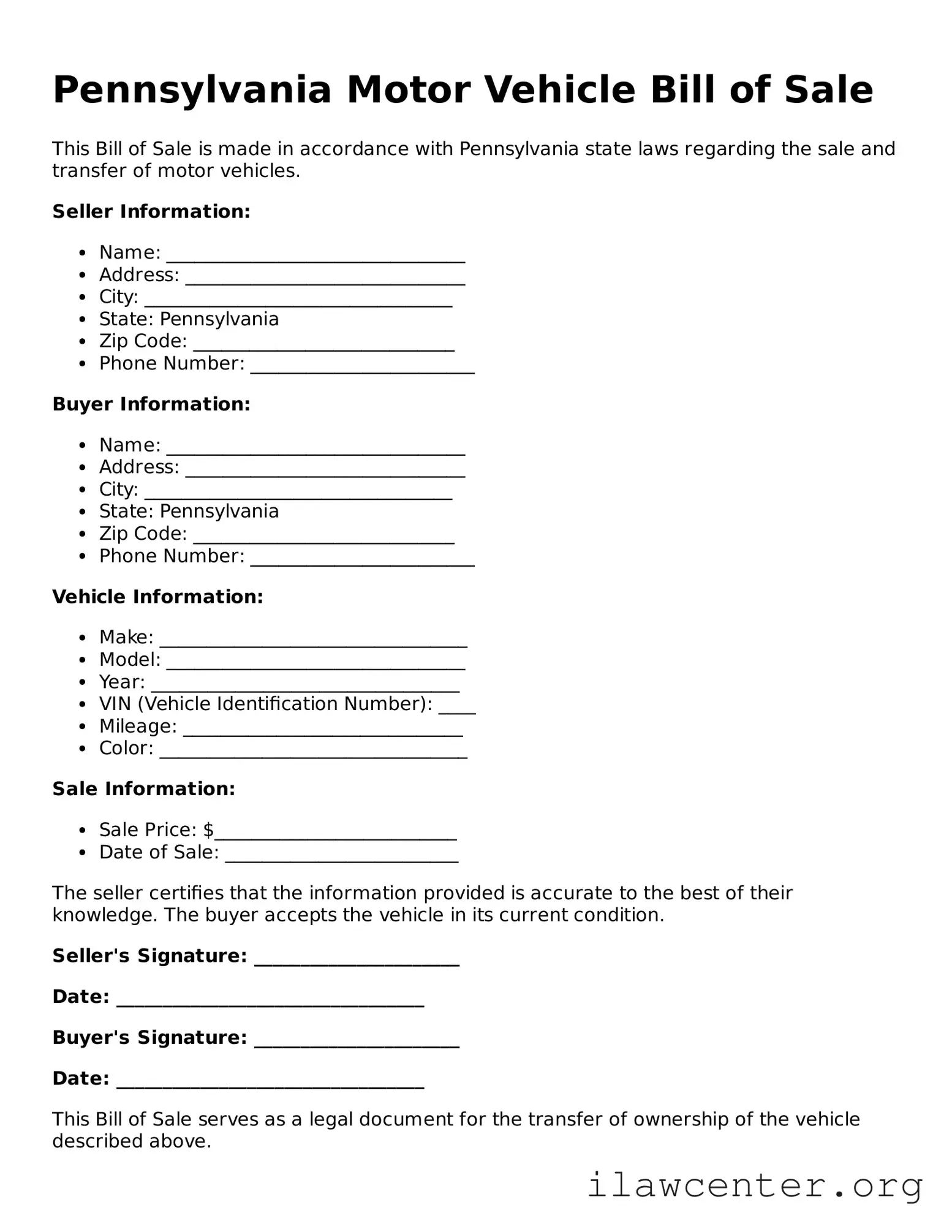
What is a Pennsylvania Motor Vehicle Bill of Sale?
The Pennsylvania Motor Vehicle Bill of Sale is a legal document that records the sale of a vehicle between a buyer and a seller. This form serves as proof of the transaction and includes essential details about the vehicle, such as its make, model, year, and Vehicle Identification Number (VIN). It also includes information about the buyer and seller, ensuring that both parties have a clear record of the sale.
Why is a Bill of Sale important?
A Bill of Sale is important for several reasons. First, it provides legal protection for both the buyer and the seller. For the buyer, it serves as proof of ownership and can be used to register the vehicle with the state. For the seller, it acts as evidence that they have transferred ownership and are no longer responsible for the vehicle. Additionally, it can help resolve any disputes that may arise after the sale.
Do I need a Bill of Sale for every vehicle sale in Pennsylvania?
In Pennsylvania, a Bill of Sale is not legally required for every vehicle sale. However, it is highly recommended, especially for private sales. Having a Bill of Sale helps document the transaction and can be beneficial if any issues arise later. It is also required if the vehicle is being registered in the buyer's name.
What information should be included in the Bill of Sale?
A complete Bill of Sale should include several key pieces of information. This includes the names and addresses of both the buyer and seller, the date of the sale, a detailed description of the vehicle (make, model, year, VIN, and odometer reading), the purchase price, and any terms of the sale. Both parties should sign and date the document to validate it.
Where can I obtain a Pennsylvania Motor Vehicle Bill of Sale form?
You can obtain a Pennsylvania Motor Vehicle Bill of Sale form from various sources. Many local Department of Motor Vehicles (DMV) offices provide the form for free. Additionally, you can find printable versions online on official state websites or legal document platforms. It is important to ensure that the form you use complies with Pennsylvania state requirements.
Is the Bill of Sale the same as the title?
No, the Bill of Sale is not the same as the title. The title is the official document that proves ownership of the vehicle and is issued by the state. The Bill of Sale is a separate document that records the transaction between the buyer and seller. While both are important, they serve different purposes in the vehicle transfer process.
Can I create my own Bill of Sale?
Yes, you can create your own Bill of Sale as long as it includes all the necessary information. However, it is advisable to use a standard form to ensure that you do not miss any important details. If you choose to draft your own document, make sure it is clear, comprehensive, and includes the required signatures from both parties.
What if I lose my Bill of Sale?
If you lose your Bill of Sale, it may be challenging to prove the transaction took place. However, if you have a copy of the title or any other documentation related to the sale, it may help. If you need a replacement, you can ask the seller for another copy or create a new Bill of Sale that both parties sign again, reflecting the original transaction.
Do I need to have the Bill of Sale notarized?
In Pennsylvania, notarization of the Bill of Sale is not a requirement. However, having it notarized can add an extra layer of authenticity and may be beneficial in case of any future disputes. It is always a good idea to check with local regulations or consult with a legal professional if you have specific concerns.
What should I do with the Bill of Sale after the transaction?
After the transaction is complete, both the buyer and seller should keep a copy of the Bill of Sale for their records. The buyer will need it when registering the vehicle in their name, while the seller should retain it as proof of the sale. Keeping these documents organized and accessible can help prevent any issues in the future.