Attorney-Verified  Non-compete Agreement Document for Pennsylvania

Attorney-Verified Non-compete Agreement Document for Pennsylvania

A Pennsylvania Non-compete Agreement form is a legal document that restricts an employee from working for competitors or starting a similar business after leaving their job. This agreement aims to protect a company's confidential information and business interests. To ensure compliance and protect your rights, consider filling out the form by clicking the button below.

Article Guide

In Pennsylvania, the Non-compete Agreement form plays a crucial role in defining the relationship between employers and employees. This form outlines the terms under which an employee agrees not to engage in certain competitive activities after leaving a job. It typically includes key elements such as the duration of the restriction, the geographic area it covers, and the specific activities that are prohibited. Employers often use this agreement to protect their business interests, trade secrets, and client relationships. However, it’s important for both parties to understand that these agreements must be reasonable in scope and not overly restrictive. Courts in Pennsylvania will enforce non-compete agreements only if they serve a legitimate business interest and are not unduly burdensome on the employee's ability to find work. Thus, understanding the nuances of this form is essential for anyone entering into an employment relationship in the state.

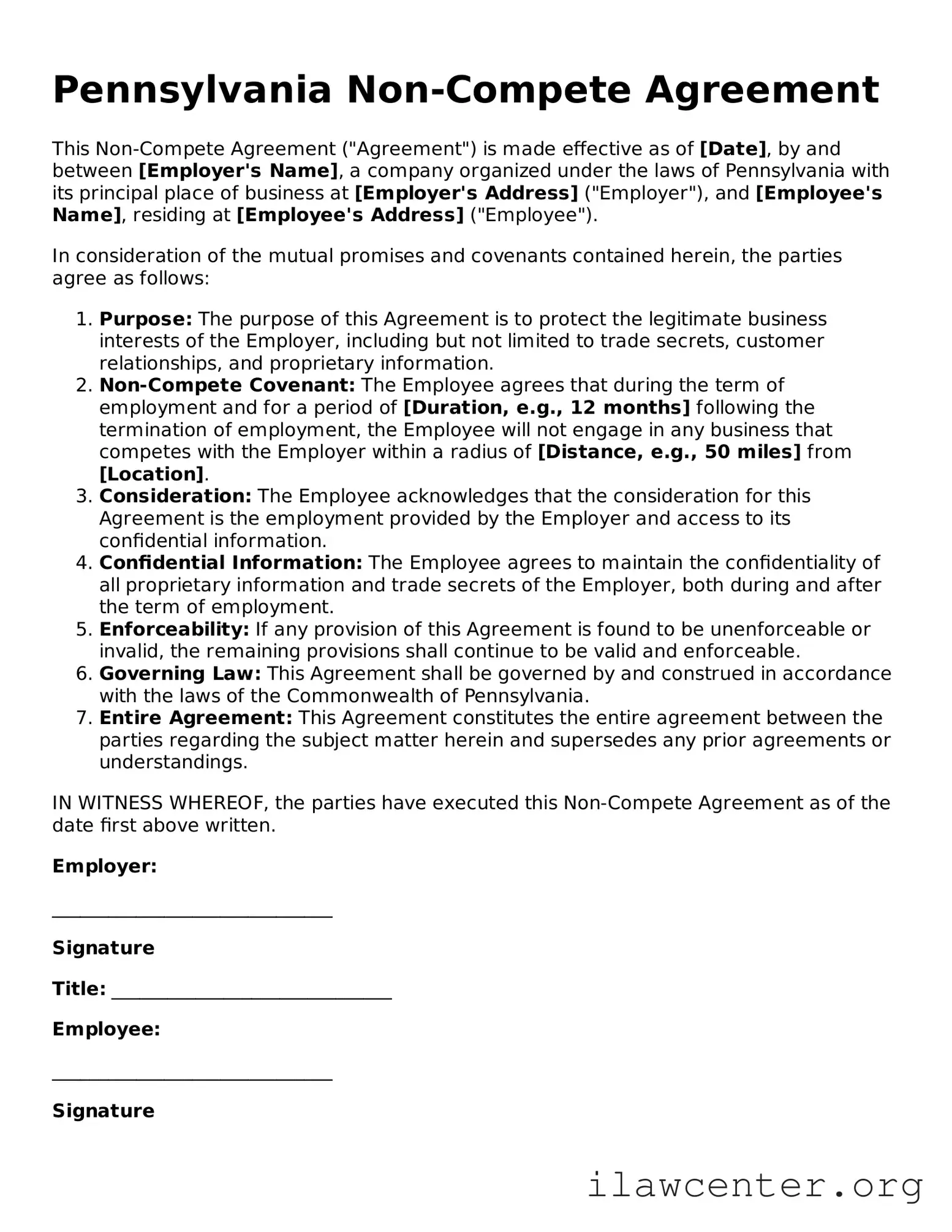
Pennsylvania Non-compete Agreement Preview

Pennsylvania Non-Compete Agreement

This Non-Compete Agreement ("Agreement") is made effective as of [Date], by and between [Employer's Name], a company organized under the laws of Pennsylvania with its principal place of business at [Employer's Address] ("Employer"), and [Employee's Name], residing at [Employee's Address] ("Employee").

In consideration of the mutual promises and covenants contained herein, the parties agree as follows:

  1. Purpose: The purpose of this Agreement is to protect the legitimate business interests of the Employer, including but not limited to trade secrets, customer relationships, and proprietary information.
  2. Non-Compete Covenant: The Employee agrees that during the term of employment and for a period of [Duration, e.g., 12 months] following the termination of employment, the Employee will not engage in any business that competes with the Employer within a radius of [Distance, e.g., 50 miles] from [Location].
  3. Consideration: The Employee acknowledges that the consideration for this Agreement is the employment provided by the Employer and access to its confidential information.
  4. Confidential Information: The Employee agrees to maintain the confidentiality of all proprietary information and trade secrets of the Employer, both during and after the term of employment.
  5. Enforceability: If any provision of this Agreement is found to be unenforceable or invalid, the remaining provisions shall continue to be valid and enforceable.
  6. Governing Law: This Agreement shall be governed by and construed in accordance with the laws of the Commonwealth of Pennsylvania.
  7. Entire Agreement: This Agreement constitutes the entire agreement between the parties regarding the subject matter herein and supersedes any prior agreements or understandings.

IN WITNESS WHEREOF, the parties have executed this Non-Compete Agreement as of the date first above written.

Employer:

______________________________

Signature

Title: ______________________________

Employee:

______________________________

Signature

PDF Form Characteristics

Fact Name Details
Definition A non-compete agreement restricts an employee from working for competitors after leaving a job.
Governing Law Pennsylvania law governs non-compete agreements, particularly under the Pennsylvania Uniform Trade Secrets Act.
Enforceability These agreements are enforceable if they are reasonable in scope, duration, and geographic area.
Consideration For a non-compete to be valid, there must be consideration, such as employment or a promotion.
Duration Typically, a duration of one to two years is considered reasonable, but this can vary based on circumstances.
Geographic Limitations The agreement must specify a geographic area where the restrictions apply, which should be reasonable.
Trade Secrets Non-compete agreements often protect trade secrets, preventing former employees from sharing confidential information.
Judicial Review Courts in Pennsylvania will review non-compete agreements for reasonableness and may modify them if necessary.
Employee Rights Employees have the right to negotiate the terms of a non-compete agreement before signing.
State Variations Other states have different rules regarding non-compete agreements, so it's important to understand local laws.

Instructions on Utilizing Pennsylvania Non-compete Agreement

Completing the Pennsylvania Non-compete Agreement form requires careful attention to detail. After filling out the form, it will need to be reviewed and signed by both parties involved. Ensure that all information is accurate and complete before submission.

  1. Obtain a copy of the Pennsylvania Non-compete Agreement form.
  2. Read through the form to understand the sections that need to be filled out.
  3. Enter the name of the employer in the designated section.
  4. Provide the employee's name and address in the appropriate fields.
  5. Specify the duration of the non-compete period in the relevant section.
  6. Outline the geographical area that the non-compete will cover.
  7. Detail the specific activities or business interests that the non-compete will restrict.
  8. Include any additional terms or conditions that may apply.
  9. Review all entered information for accuracy.
  10. Both parties should sign and date the form where indicated.
  11. Make copies of the signed agreement for both the employer and employee.

Important Facts about Pennsylvania Non-compete Agreement

What is a Pennsylvania Non-compete Agreement?

A Pennsylvania Non-compete Agreement is a legal contract that restricts an employee from working for competitors or starting a competing business for a specified period after leaving their job. The goal is to protect the employer's business interests and confidential information.

Are non-compete agreements enforceable in Pennsylvania?

Yes, non-compete agreements can be enforceable in Pennsylvania, but they must meet certain criteria. The agreement should be reasonable in scope, duration, and geographic area. Courts will evaluate whether the restrictions are necessary to protect legitimate business interests.

How long can a non-compete agreement last in Pennsylvania?

The duration of a non-compete agreement can vary. Typically, agreements lasting six months to two years are considered reasonable, depending on the nature of the business and the employee's role. However, longer durations may be scrutinized by courts.

What makes a non-compete agreement valid?

For a non-compete agreement to be valid, it should be supported by consideration, such as a job offer or access to trade secrets. Additionally, it must protect legitimate business interests without imposing undue hardship on the employee.

Can I negotiate a non-compete agreement?

Yes, you can negotiate the terms of a non-compete agreement. If you feel the restrictions are too broad or unreasonable, it’s important to discuss your concerns with your employer before signing. Clear communication can lead to a more balanced agreement.

What happens if I violate a non-compete agreement?

If you violate a non-compete agreement, your former employer may take legal action against you. This could include seeking an injunction to prevent you from working for a competitor or pursuing damages for any losses incurred due to your breach.

Can I still work in my field if I have a non-compete agreement?

Yes, you can still work in your field, but your options may be limited based on the terms of the agreement. It’s essential to review the specific restrictions outlined in your non-compete to understand where you can work and what roles you can take on.

Do I need a lawyer to review my non-compete agreement?

While it’s not mandatory, consulting with a lawyer can be beneficial. A legal professional can help you understand the implications of the agreement, assess its enforceability, and guide you through any negotiations.

What should I do if I have questions about my non-compete agreement?

If you have questions about your non-compete agreement, consider discussing them with your employer or HR department first. If you need further clarification, reaching out to a legal professional can provide you with tailored advice based on your situation.
Common mistakes

Filling out the Pennsylvania Non-compete Agreement form can be a straightforward process, but many individuals make common mistakes that can affect the enforceability of the agreement. One prevalent error is failing to clearly define the scope of the non-compete. Without a specific description of the restricted activities, the agreement may be considered too vague and, therefore, unenforceable.

Another mistake is neglecting to specify the duration of the non-compete. An agreement that does not indicate how long the restrictions will last can lead to confusion and potential legal challenges. Courts often require a reasonable timeframe, so it is crucial to include a specific duration that reflects the nature of the business and the competitive landscape.

Many individuals also overlook the geographical limitations of the non-compete. It is essential to clearly outline the areas where the restrictions apply. A poorly defined geographical scope can render the agreement ineffective, as it may be deemed overly broad.

In addition, some people fail to consider whether the non-compete is necessary for their specific situation. If the agreement is too restrictive or not justified by the business interests, it may not hold up in court. Evaluating the necessity of the agreement before signing can save time and legal trouble later.

Another common error is not obtaining legal advice before signing the agreement. Individuals often assume that they understand the implications of the non-compete without consulting a professional. Legal advice can provide clarity and help ensure that the agreement is fair and enforceable.

Moreover, individuals sometimes neglect to read the entire agreement thoroughly. Skimming through the document can lead to missing critical clauses or terms that could impact their rights. It is essential to understand every aspect of the agreement before signing.

Additionally, failing to keep a copy of the signed agreement is a mistake that can lead to complications in the future. Without a personal copy, individuals may struggle to remember the terms or prove what they agreed to, should a dispute arise.

Finally, individuals may not consider the potential consequences of violating the non-compete. Understanding the penalties for breach of the agreement is vital. Awareness of these consequences can influence decisions and actions after leaving a position.

Documents used along the form

When entering into a Pennsylvania Non-compete Agreement, several other forms and documents may accompany it to ensure clarity and legal compliance. Understanding these documents can help both parties navigate the terms of the agreement effectively.

  • Employment Agreement: This document outlines the terms of employment, including job responsibilities, compensation, and duration. It often serves as the foundation for the non-compete agreement.
  • Confidentiality Agreement: Also known as a Non-disclosure Agreement (NDA), this document protects sensitive information that an employee may encounter during their tenure, ensuring it remains confidential even after employment ends.
  • Intellectual Property Agreement: This agreement clarifies ownership rights to any inventions, designs, or creative works developed by an employee during their employment, often tying into the non-compete terms.
  • Severance Agreement: In the event of termination, this document outlines the terms of severance pay and other benefits, which can impact the enforceability of a non-compete clause.
  • Job Offer Letter: This formal letter extends an offer of employment and may include preliminary terms that relate to the non-compete agreement, such as the position and start date.
  • Release of Claims: Often signed at the end of employment, this document releases the employer from any future claims by the employee, which can include waiving rights related to the non-compete.
  • Performance Review Documentation: Records of employee evaluations can influence the enforcement of non-compete clauses, particularly if performance impacts continued employment.
  • Termination Letter: This letter formally notifies an employee of their termination and may reference the non-compete agreement, reminding them of their obligations.
  • Legal Compliance Documents: These may include various forms required to comply with state and federal employment laws, ensuring that the non-compete agreement adheres to legal standards.
  • Amendment or Modification Agreement: If changes are needed to the original non-compete agreement, this document formally modifies the terms and conditions previously agreed upon.

Each of these documents plays a crucial role in the overall employment relationship and can significantly impact the enforceability of a Pennsylvania Non-compete Agreement. Being informed about these related forms can help individuals and organizations make better decisions regarding their agreements and obligations.

Similar forms

  • Non-disclosure Agreement (NDA): This document prevents individuals from sharing confidential information. Like a non-compete agreement, it protects a company's interests by limiting what can be disclosed to outside parties.
  • Non-solicitation Agreement: This agreement restricts a former employee from soliciting clients or employees of the company. It shares similarities with a non-compete by aiming to protect business relationships and trade secrets.
  • Employment Contract: An employment contract outlines the terms of employment, including duties and compensation. It often includes non-compete clauses, making it similar in intent to protect the employer's interests.
  • Confidentiality Agreement: This document ensures that sensitive information remains private. Similar to a non-compete agreement, it aims to safeguard proprietary information from being shared or used against the company.

Dos and Don'ts

When filling out the Pennsylvania Non-compete Agreement form, it's crucial to be thorough and accurate. Here’s a list of ten things to consider, both dos and don’ts.

  • Do read the entire agreement carefully before signing.
  • Do ensure that the terms are reasonable and clearly defined.
  • Do discuss the agreement with a legal advisor if you have questions.
  • Do provide accurate personal and employment information.
  • Do keep a copy of the signed agreement for your records.
  • Don't rush through the form without understanding the implications.
  • Don't agree to terms that seem overly restrictive or vague.
  • Don't sign the agreement if you feel pressured or uncertain.
  • Don't ignore any clauses that seem unfair or confusing.
  • Don't forget to check for any state-specific laws that may apply.

Misconceptions

Understanding non-compete agreements in Pennsylvania can be challenging. Many people have misconceptions about what these agreements entail and how they function. Here are nine common misconceptions:

  1. Non-compete agreements are always enforceable.

    Not true. In Pennsylvania, these agreements must be reasonable in scope, duration, and geographic area to be enforceable.

  2. All employees must sign a non-compete agreement.

    This is a misconception. Employers may choose to require non-compete agreements for certain positions, but not all employees are obligated to sign them.

  3. Non-compete agreements prevent employees from working in their field forever.

    In reality, these agreements typically have a specific duration. Once that time period expires, employees are free to pursue work in their field.

  4. Non-compete agreements only apply to high-level employees.

    This is not accurate. While they are more common for executives and key personnel, non-compete agreements can be applied to various positions depending on the employer's needs.

  5. Signing a non-compete agreement means I cannot start my own business.

    Not necessarily. If the agreement is reasonable and specific, it may only restrict certain actions. Starting a business may still be possible, depending on the terms.

  6. Non-compete agreements are the same as non-disclosure agreements.

    This is a common mix-up. Non-disclosure agreements protect confidential information, while non-compete agreements limit where and how an employee can work after leaving a job.

  7. Only employers benefit from non-compete agreements.

    Employees can also benefit. They may receive additional training, resources, or compensation in exchange for signing the agreement.

  8. I can ignore a non-compete agreement if I find it unfair.

    Ignoring the agreement can lead to legal consequences. It’s essential to understand the terms and seek legal advice if you believe the agreement is unreasonable.

  9. All non-compete agreements are the same.

    Each agreement is unique and tailored to the specific circumstances of the employment relationship. It’s important to read and understand the terms of your own agreement.

By clearing up these misconceptions, individuals can make more informed decisions regarding their employment and contractual obligations in Pennsylvania.

Key takeaways

When filling out and using the Pennsylvania Non-compete Agreement form, consider the following key takeaways:

  1. Understand the Purpose: A non-compete agreement is designed to protect a business's interests by restricting employees from working with competitors for a certain period after leaving the company.
  2. Know the Limitations: Pennsylvania courts often scrutinize non-compete agreements. Ensure the restrictions are reasonable in terms of time, geography, and scope of work.
  3. Clearly Define Terms: Use clear language to define the terms of the agreement. Ambiguity can lead to disputes and unenforceability.
  4. Consider Employee Impact: Think about how the agreement may affect employees' future job prospects. Fair agreements can foster goodwill.
  5. Consult Legal Guidance: Before finalizing the agreement, seek legal advice to ensure compliance with Pennsylvania laws and regulations.
  6. Document Everything: Keep a record of signed agreements and any communications regarding the non-compete. This documentation can be crucial if disputes arise.

By keeping these points in mind, you can create a non-compete agreement that is fair, clear, and enforceable.