Attorney-Verified  Notary Acknowledgement Document for Pennsylvania

Attorney-Verified Notary Acknowledgement Document for Pennsylvania

The Pennsylvania Notary Acknowledgement form serves as a vital document that verifies the identity of a signer and confirms that they willingly signed a particular document. This form is essential for ensuring the authenticity of legal documents and protecting the interests of all parties involved. To get started on your own Notary Acknowledgement form, click the button below.

Article Guide

The Pennsylvania Notary Acknowledgement form plays a crucial role in the notarization process, ensuring that documents are properly verified and authenticated. This form is used to confirm that a signer has willingly and knowingly signed a document in the presence of a notary public. Key elements include the identification of the signer, the notary's details, and the specific document being acknowledged. By requiring the signer to declare their identity and intent, the form helps prevent fraud and misunderstandings. Additionally, it provides a record of the notarization, which can be important for legal and official purposes. Understanding the nuances of this form is essential for anyone involved in the signing of legal documents in Pennsylvania, as it upholds the integrity of the notarization process and protects all parties involved.

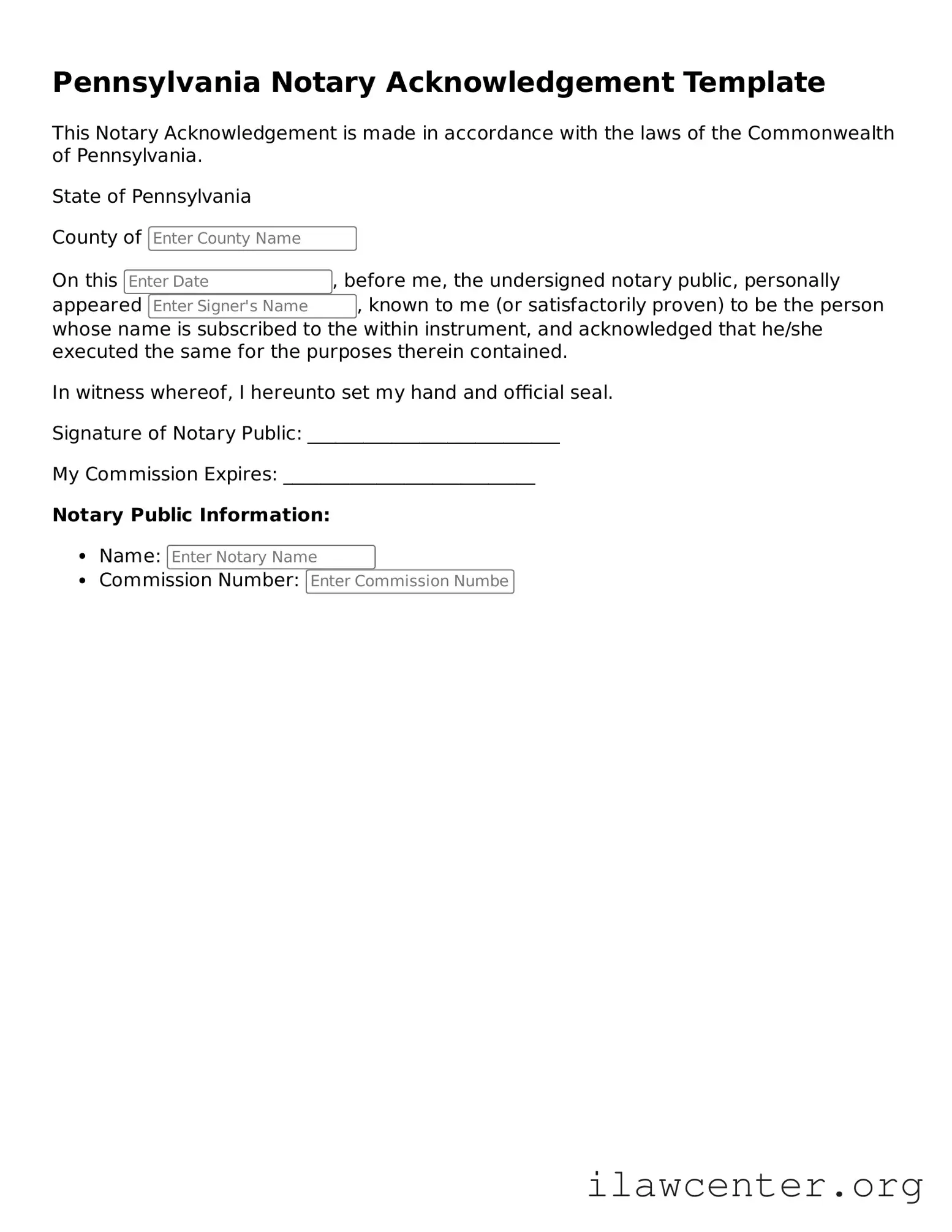
Pennsylvania Notary Acknowledgement Preview

Pennsylvania Notary Acknowledgement Template

This Notary Acknowledgement is made in accordance with the laws of the Commonwealth of Pennsylvania.

State of Pennsylvania

County of

On this , before me, the undersigned notary public, personally appeared , known to me (or satisfactorily proven) to be the person whose name is subscribed to the within instrument, and acknowledged that he/she executed the same for the purposes therein contained.

In witness whereof, I hereunto set my hand and official seal.

Signature of Notary Public: ___________________________

My Commission Expires: ___________________________

Notary Public Information:

  • Name:
  • Commission Number:

PDF Form Characteristics

Fact Name Description
Purpose The Pennsylvania Notary Acknowledgment form is used to confirm the identity of individuals signing a document.
Governing Law This form is governed by the Pennsylvania Notary Law, specifically 57 Pa. C.S. § 301 et seq.
Signature Requirement The signer must be present before the notary at the time of acknowledgment.
Notary's Role The notary verifies the identity of the signer and ensures they are signing voluntarily.
Form Availability The form is available online and can be printed for use.
Record Keeping Notaries are required to keep a record of all acknowledgments performed in their notary journal.

Instructions on Utilizing Pennsylvania Notary Acknowledgement

Once you have the Pennsylvania Notary Acknowledgement form in hand, it is important to complete it accurately. This form requires specific information to be filled out correctly to ensure its validity. Follow the steps below to fill out the form properly.

  1. Begin by writing the date on which the acknowledgment is being made.
  2. In the designated space, enter the name of the person who is signing the document.
  3. Next, indicate the type of identification the signer is providing. This could include a driver's license number or another form of ID.
  4. Fill in the address of the signer, including the city, state, and zip code.
  5. Clearly state the capacity in which the signer is acting, if applicable (e.g., as an individual, corporate officer, etc.).
  6. Leave the notary public section blank for now; this will be filled out by the notary.
  7. Sign and date the form where indicated, ensuring your signature matches the name provided earlier.

After completing these steps, the form will be ready for the notary public to review and finalize. Ensure that all information is accurate and legible to avoid any issues during the notarization process.

Important Facts about Pennsylvania Notary Acknowledgement

What is a Pennsylvania Notary Acknowledgement form?

The Pennsylvania Notary Acknowledgement form is a legal document used to verify the identity of a signer and confirm that they willingly signed a document. This form is essential in various legal transactions, ensuring that the signatures are authentic and that the signers understand what they are signing.

Who can serve as a notary public in Pennsylvania?

In Pennsylvania, a notary public must be at least 18 years old, a resident of the state, and must complete an application process that includes passing an exam. Notaries are appointed by the Governor and are responsible for performing notarial acts, such as taking acknowledgments, administering oaths, and certifying documents.

When is a Notary Acknowledgement form required?

A Notary Acknowledgement form is typically required when a document needs to be recorded or submitted to a government agency. Common examples include real estate transactions, wills, and powers of attorney. By having a notary acknowledge the signatures, the document gains credibility and is more likely to be accepted by institutions.

What information is included in the Notary Acknowledgement form?

The form generally includes the name of the signer, the date of the acknowledgment, the name of the notary, and a statement confirming that the signer appeared before the notary and acknowledged signing the document. Additionally, the notary will affix their seal to validate the acknowledgment.

Can a Notary Acknowledgement be done remotely in Pennsylvania?

Yes, Pennsylvania has provisions for remote notarization, especially in response to changes in technology and the need for social distancing. However, specific requirements must be met, such as using approved audio-visual technology. It is essential to ensure that all parties are aware of and comply with these requirements for the acknowledgment to be valid.

What happens if a Notary Acknowledgement is not completed correctly?

If a Notary Acknowledgement is not completed correctly, the document may be deemed invalid. This can lead to complications in legal transactions, such as delays or rejections. It is crucial for both the signer and the notary to ensure that all information is accurate and that the acknowledgment is properly executed to avoid these issues.

Common mistakes

Filling out the Pennsylvania Notary Acknowledgement form can seem straightforward, but many individuals make common mistakes that can lead to complications. One frequent error is failing to include the correct date. The date of the acknowledgment is crucial as it establishes when the notary witnessed the signing. If this field is left blank or filled in incorrectly, it can render the document invalid.

Another mistake often seen is the omission of the notary's signature. The notary's signature is essential for validating the acknowledgment. Without it, the document lacks the official recognition it needs, which can cause issues down the line. Ensure that the notary has signed in the designated area before submitting the form.

Many people also forget to provide the notary's seal. In Pennsylvania, a notary's seal is a vital component of the acknowledgment process. The absence of this seal can lead to questions about the authenticity of the document. Always check that the seal is present and clearly legible.

Additionally, some individuals neglect to include the signer's name as it appears on their identification. Accurate identification is crucial for the notary to confirm the identity of the signer. If the name is misspelled or does not match the ID, it could lead to legal challenges regarding the document's validity.

Another common pitfall is failing to include the appropriate notary jurisdiction. This section specifies where the notary is authorized to perform their duties. Missing this information can create confusion about the document's legitimacy, particularly if it needs to be used in a different jurisdiction.

Finally, people often overlook the requirement for the signer to be present during the acknowledgment. The notary must witness the signing of the document in person. If the signer is not present, the acknowledgment cannot be completed properly. This step is vital to ensure that the notary can affirm the authenticity of the signature.

Documents used along the form

When engaging in legal transactions in Pennsylvania, several forms and documents may accompany the Notary Acknowledgement form. Each of these documents serves a unique purpose and plays a crucial role in ensuring the validity and legality of agreements. Below is a list of common documents that are often used alongside the Notary Acknowledgement form.

  • : This document allows one person to authorize another to act on their behalf in legal matters. It is often notarized to confirm the identity of the person granting the authority.
  • : A deed is a legal document that transfers ownership of property from one party to another. Notarization is typically required to ensure the authenticity of the signatures.
  • : A contract outlines the terms of an agreement between parties. While not always required, notarization can add an extra layer of credibility and enforceability.
  • : This is a written statement confirmed by oath or affirmation. It is often used in legal proceedings and may require notarization to verify the identity of the affiant.
  • : A will outlines how a person's assets should be distributed after their death. While notarization is not always necessary, having it notarized can help prevent disputes regarding its validity.
  • : This document details the terms of a loan between a lender and a borrower. Notarization can help ensure that both parties understand and agree to the terms.
  • : This document protects one party from legal claims by another. Notarization can help confirm that all parties have willingly agreed to the terms outlined in the release.

Understanding these documents and their purposes can help individuals navigate legal processes more effectively. Properly executed forms, including notarized acknowledgements, can significantly reduce the risk of disputes and ensure that agreements are upheld in a court of law.

Similar forms

  • Affidavit: An affidavit is a written statement confirmed by oath or affirmation. Like a notary acknowledgment, it verifies the identity of the signer and the authenticity of the document.
  • Power of Attorney: This document grants one person the authority to act on behalf of another. Notarization is often required to confirm that the principal's signature is genuine.
  • Deed: A deed transfers ownership of property. Notary acknowledgment ensures that the signatures on the deed are legitimate and that the signer understands the transaction.
  • Mortgage Agreement: This document outlines the terms of a loan secured by real property. Notarization is used to authenticate the signatures and protect all parties involved.
  • Last Will and Testament: A will outlines how a person's assets will be distributed after their death. Notarization can help validate the will and prevent disputes regarding its authenticity.
  • Trust Agreement: This document establishes a trust and outlines its terms. Notary acknowledgment ensures that the signatures are valid and that the trust is legally enforceable.
  • Certificate of Incorporation: This document formally establishes a corporation. Notarization helps verify the authenticity of the signatures of the incorporators.
  • Bill of Sale: A bill of sale transfers ownership of personal property. Notary acknowledgment adds a layer of verification to the transaction, confirming that both parties are in agreement.

Dos and Don'ts

When filling out the Pennsylvania Notary Acknowledgement form, it is important to follow specific guidelines to ensure the document is valid. Here are seven things you should and shouldn't do:

  • Do ensure that the signer is present when you complete the form.
  • Do verify the identity of the signer using valid identification.
  • Do fill out the form completely and accurately.
  • Do include the date of the acknowledgment.
  • Don't sign the form before the signer has done so.
  • Don't use white-out or any correction fluid on the form.
  • Don't forget to include your notary seal where required.

Misconceptions

Understanding the Pennsylvania Notary Acknowledgement form is important for anyone involved in legal documents. However, several misconceptions can lead to confusion. Here are six common misunderstandings:

  1. Notaries can draft legal documents. Many people think that notaries can create or modify legal documents. In reality, notaries are only authorized to witness signatures and verify identities.
  2. All notaries are lawyers. Some believe that a notary must be a licensed attorney. While many lawyers are notaries, not all notaries are attorneys. They come from various professional backgrounds.
  3. A notary can refuse to notarize any document. It’s a common belief that notaries have complete discretion over what they notarize. However, they must follow specific guidelines and can refuse if the document is incomplete or if they suspect fraud.
  4. The notary's signature is the only requirement for validity. Some assume that a notary's signature alone makes a document valid. In truth, the document must also meet other legal requirements to be enforceable.
  5. Notaries can notarize documents in any state. People often think that a notary can perform their duties anywhere in the U.S. However, notaries can only notarize documents in the state where they are commissioned.
  6. Notarization guarantees the truth of the document. Many believe that notarization means the contents of a document are true. This is not the case; notarization only verifies the identity of the signer and their willingness to sign.

By clearing up these misconceptions, individuals can better navigate the notary process and ensure their documents are handled correctly.

Key takeaways

When filling out and using the Pennsylvania Notary Acknowledgement form, keep these key points in mind:

  • Understand the Purpose: The form serves to confirm that a person signed a document willingly and was properly identified.
  • Verify Identity: Always ensure the signer presents valid identification before notarizing.
  • Complete All Fields: Fill out all required sections of the form, including the date and location of the acknowledgment.
  • Signature Requirement: The signer must sign the document in the presence of the notary.
  • Use Appropriate Language: The wording of the acknowledgment must comply with Pennsylvania law to be valid.
  • Record Keeping: Maintain a record of the notarization in your notary journal for future reference.
  • Understand Liability: Be aware that improper notarization can lead to legal consequences for the notary.