Attorney-Verified  Operating Agreement Document for Pennsylvania

Attorney-Verified Operating Agreement Document for Pennsylvania

The Pennsylvania Operating Agreement form is a crucial document that outlines the management structure and operational procedures of a limited liability company (LLC) in Pennsylvania. This agreement serves to protect the interests of members by clarifying their rights and responsibilities. To ensure your LLC operates smoothly, consider filling out the form by clicking the button below.

Article Guide

In the realm of business formation, particularly for limited liability companies (LLCs) in Pennsylvania, the Operating Agreement serves as a vital document that outlines the management structure and operational guidelines of the entity. This agreement is not merely a formality; it plays a crucial role in defining the rights and responsibilities of members, establishing procedures for decision-making, and addressing the distribution of profits and losses. Additionally, it lays the groundwork for resolving disputes among members, ensuring that there is a clear path for conflict resolution. Without this agreement, members may find themselves navigating uncertainties that could jeopardize the stability of their business. The Pennsylvania Operating Agreement form encompasses several key elements, including the identification of members, the duration of the LLC, and provisions for amendments, all of which contribute to a well-organized and functional business environment. As such, understanding and completing this form is essential for anyone looking to create a solid foundation for their LLC in Pennsylvania.

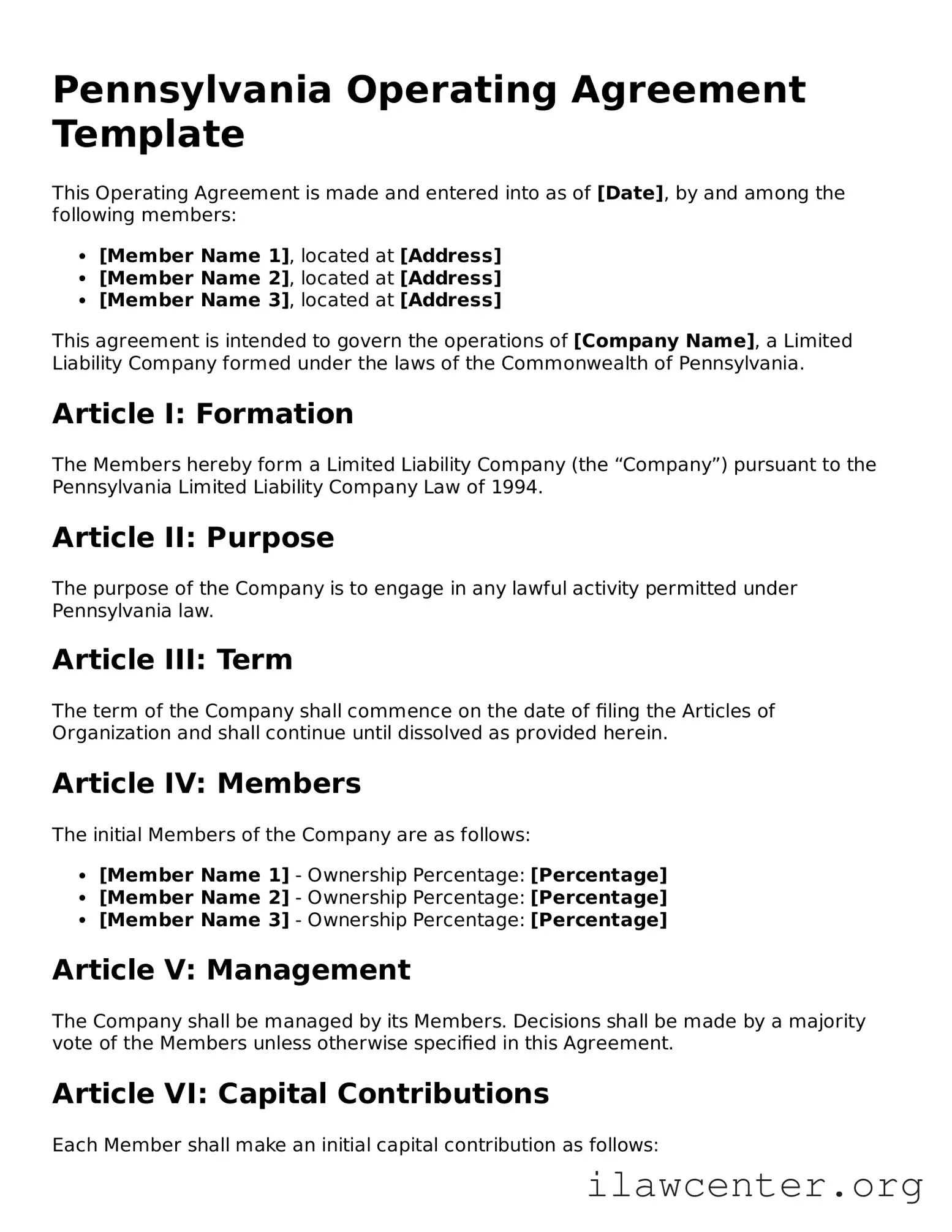
Pennsylvania Operating Agreement Preview

Pennsylvania Operating Agreement Template

This Operating Agreement is made and entered into as of [Date], by and among the following members:

  • [Member Name 1], located at [Address]
  • [Member Name 2], located at [Address]
  • [Member Name 3], located at [Address]

This agreement is intended to govern the operations of [Company Name], a Limited Liability Company formed under the laws of the Commonwealth of Pennsylvania.

Article I: Formation

The Members hereby form a Limited Liability Company (the “Company”) pursuant to the Pennsylvania Limited Liability Company Law of 1994.

Article II: Purpose

The purpose of the Company is to engage in any lawful activity permitted under Pennsylvania law.

Article III: Term

The term of the Company shall commence on the date of filing the Articles of Organization and shall continue until dissolved as provided herein.

Article IV: Members

The initial Members of the Company are as follows:

  • [Member Name 1] - Ownership Percentage: [Percentage]
  • [Member Name 2] - Ownership Percentage: [Percentage]
  • [Member Name 3] - Ownership Percentage: [Percentage]

Article V: Management

The Company shall be managed by its Members. Decisions shall be made by a majority vote of the Members unless otherwise specified in this Agreement.

Article VI: Capital Contributions

Each Member shall make an initial capital contribution as follows:

  • [Member Name 1] - Contribution Amount: [Amount]
  • [Member Name 2] - Contribution Amount: [Amount]
  • [Member Name 3] - Contribution Amount: [Amount]

Article VII: Distributions

Distributions of profits and losses shall be made to the Members in proportion to their respective ownership percentages.

Article VIII: Indemnification

The Company shall indemnify each Member against any losses or expenses incurred in connection with the Company, except in cases of gross negligence or willful misconduct.

Article IX: Amendments

This Agreement may be amended only by a written agreement signed by all Members.

Article X: Governing Law

This Agreement shall be governed by and construed in accordance with the laws of the Commonwealth of Pennsylvania.

IN WITNESS WHEREOF, the Members have executed this Operating Agreement as of the date first above written.

_____________________________
[Member Name 1]

_____________________________
[Member Name 2]

_____________________________
[Member Name 3]

PDF Form Characteristics

Fact Name Description
Definition The Pennsylvania Operating Agreement is a legal document that outlines the management structure and operating procedures of a limited liability company (LLC) in Pennsylvania.
Governing Law The agreement is governed by the Pennsylvania Uniform Limited Liability Company Act, which provides the framework for LLC operations in the state.
Purpose It serves to define the rights and responsibilities of members, establish rules for decision-making, and outline profit distribution among members.
Flexibility The Operating Agreement allows for customization, enabling members to tailor the document to fit their specific business needs and goals.
Not Mandatory While it is not legally required to file an Operating Agreement in Pennsylvania, having one is highly recommended to prevent disputes and clarify expectations.
Amendments Members can amend the Operating Agreement as needed, provided that all members agree to the changes, ensuring adaptability to evolving business circumstances.

Instructions on Utilizing Pennsylvania Operating Agreement

Filling out the Pennsylvania Operating Agreement form is an important step for any business owner looking to establish clear guidelines and responsibilities within their organization. Once you have completed the form, it will be ready for submission, ensuring that all members understand their roles and the operational structure of the business.

  1. Begin by entering the name of your business at the top of the form. Ensure the name matches what you have registered with the state.
  2. Next, provide the principal office address. This should be a physical address where your business operates.
  3. Identify the members of the LLC. List each member's name and their respective ownership percentage. This helps clarify who has a stake in the business.
  4. Outline the management structure. Indicate whether the LLC will be member-managed or manager-managed. This decision affects how day-to-day operations are handled.
  5. Include provisions for meetings. Specify how often meetings will occur and the process for notifying members about them.
  6. Detail the voting rights of each member. Describe how decisions will be made and what percentage of votes is required for approval.
  7. Address the financial arrangements. Include information on how profits and losses will be distributed among members.
  8. Lastly, sign and date the form. Ensure that all members also sign, acknowledging their agreement to the terms outlined.

Important Facts about Pennsylvania Operating Agreement

What is a Pennsylvania Operating Agreement?

A Pennsylvania Operating Agreement is a legal document that outlines the management structure and operating procedures of a limited liability company (LLC) in Pennsylvania. It serves as the foundational agreement among members, detailing their rights, responsibilities, and the rules for running the business.

Is an Operating Agreement required in Pennsylvania?

No, Pennsylvania does not legally require LLCs to have an Operating Agreement. However, having one is highly recommended. It helps clarify the roles of members and can prevent misunderstandings or disputes in the future.

What should be included in the Operating Agreement?

The Operating Agreement should include several key elements: the name and purpose of the LLC, the names of the members, their ownership percentages, management structure, voting rights, and procedures for adding or removing members. Additionally, it can address profit distribution and procedures for handling disputes.

Can I create my own Operating Agreement?

Yes, you can create your own Operating Agreement. Many templates are available online, but it’s important to tailor the document to fit your specific business needs. Consulting with a legal professional can ensure that your agreement complies with Pennsylvania laws and adequately protects your interests.

How is an Operating Agreement amended?

To amend an Operating Agreement, the members must follow the procedures outlined in the original agreement. Typically, this involves a vote among members. It’s essential to document any changes in writing and have all members sign the amended agreement to maintain clarity and enforceability.

What happens if there is no Operating Agreement?

If an LLC operates without an Operating Agreement, Pennsylvania law will govern the company’s operations. This default structure may not align with the members' intentions and can lead to disputes or confusion about roles and responsibilities.

Is the Operating Agreement a public document?

No, the Operating Agreement is not a public document in Pennsylvania. It is kept private among the members of the LLC. However, certain details, such as the names of members and the registered agent, must be filed with the state and are publicly accessible.

How often should the Operating Agreement be reviewed?

It’s advisable to review the Operating Agreement regularly, especially when there are significant changes in the business, such as adding new members or changing management structures. Regular reviews ensure that the agreement remains relevant and reflects the current operations of the LLC.

Common mistakes

Filling out the Pennsylvania Operating Agreement form can be a daunting task. Many individuals make common mistakes that can lead to confusion or even legal issues down the line. Understanding these pitfalls can help ensure a smoother process.

One frequent mistake is leaving sections blank. Each part of the form is designed to capture important information about the business and its members. Omitting details can create gaps that may complicate matters later. Always take the time to fill in every section accurately.

Another common error involves not specifying the management structure. The Operating Agreement should clearly outline whether the business will be member-managed or manager-managed. Failing to clarify this can lead to misunderstandings about who has authority in decision-making processes.

People often overlook the importance of including all members’ names. It's crucial to list every member involved in the business. If someone is left out, it may lead to disputes regarding ownership and responsibilities. Make sure to double-check that all names are included and spelled correctly.

Additionally, neglecting to define the roles and responsibilities of each member is a significant oversight. The Operating Agreement should detail what each member is responsible for. This clarity helps prevent conflicts and ensures everyone knows their duties within the business.

Another mistake is not addressing profit distribution. The agreement should outline how profits and losses will be shared among members. Without this information, disagreements can arise when it comes time to distribute earnings.

Lastly, failing to review and update the agreement can lead to problems in the future. As businesses evolve, so do their needs. Regularly revisiting the Operating Agreement ensures it remains relevant and reflects any changes in membership or business structure.

By being aware of these common mistakes, individuals can approach the Pennsylvania Operating Agreement form with confidence. Taking the time to carefully complete the form can save time, money, and stress in the long run.

Documents used along the form

When creating a Pennsylvania Operating Agreement, several other documents may be necessary to ensure compliance and proper management of the business. Each of these documents serves a specific purpose and can enhance the overall structure of your business entity.

  • Articles of Organization: This document officially establishes your LLC with the state. It includes essential information such as the business name, address, and the names of the members.
  • Bylaws: While not always required for LLCs, bylaws outline the internal rules and procedures for managing the company. They can cover meetings, voting rights, and other governance matters.
  • Member Resolutions: These are formal documents that record decisions made by the members of the LLC. They can be used for significant actions like approving new members or changes in management.
  • Membership Certificates: These certificates serve as proof of ownership in the LLC. They can provide clarity on each member's stake in the business.
  • Financial Statements: Regular financial statements, such as balance sheets and income statements, are crucial for tracking the company’s financial health and making informed decisions.
  • Tax Forms: Depending on your business structure, various tax forms may be required. These can include state and federal forms for reporting income and expenses.
  • Operating Procedures: This document outlines the day-to-day operations of the business. It can help ensure that all members understand their roles and responsibilities.

Having these documents in place can help streamline operations and protect the interests of all members involved. It’s important to keep everything organized and accessible for future reference.

Similar forms

  • Bylaws: Similar to an Operating Agreement, bylaws outline the rules and procedures for the governance of a corporation. They detail how meetings are conducted, how directors are elected, and other operational procedures.
  • Partnership Agreement: This document governs the relationships between partners in a partnership. Like an Operating Agreement, it specifies each partner's roles, responsibilities, and profit-sharing arrangements.
  • Shareholder Agreement: This agreement is used by corporations to define the rights and responsibilities of shareholders. It is similar to an Operating Agreement in that it addresses ownership interests and management structure.
  • LLC Membership Agreement: This document serves a similar purpose to an Operating Agreement but is specifically tailored for LLCs. It details the rights and obligations of each member within the LLC.
  • Joint Venture Agreement: This agreement outlines the terms of a joint venture between two or more parties. Like an Operating Agreement, it clarifies the roles and contributions of each party involved.
  • Franchise Agreement: A franchise agreement governs the relationship between a franchisor and a franchisee. It includes operational guidelines and expectations, similar to how an Operating Agreement outlines business operations.
  • Non-Disclosure Agreement (NDA): While primarily focused on confidentiality, an NDA can be similar in that it establishes the terms of a relationship and the expectations of the parties involved, much like an Operating Agreement does for business operations.
  • Employment Agreement: This document outlines the terms of employment between an employer and employee. It shares similarities with an Operating Agreement in that it defines roles, responsibilities, and compensation.
  • Real Estate Partnership Agreement: This is a specific type of partnership agreement focused on real estate ventures. It details the investment, management, and profit-sharing arrangements, akin to an Operating Agreement.
  • Investment Agreement: This document outlines the terms under which investors provide capital to a business. Similar to an Operating Agreement, it clarifies the rights and obligations of the parties involved in the investment.

Dos and Don'ts

When filling out the Pennsylvania Operating Agreement form, it’s essential to approach the task with care. Here are some important dos and don’ts to consider:

  • Do read the entire form thoroughly before starting. Understanding each section helps prevent mistakes.
  • Do provide accurate information. Ensure that names, addresses, and other details are correct to avoid future complications.
  • Do consult with a legal professional if you have questions. Getting expert advice can clarify complex areas.
  • Do keep a copy of the completed form for your records. This ensures you have a reference point in the future.
  • Do sign and date the document appropriately. An unsigned agreement may not hold up in legal situations.
  • Don't rush through the form. Taking your time helps you catch any errors or omissions.
  • Don't leave any sections blank unless instructed. Incomplete forms can lead to delays or rejections.
  • Don't use outdated information. Always check that you are using the latest version of the form.
  • Don't ignore state-specific requirements. Pennsylvania may have unique regulations that you need to follow.
  • Don't hesitate to ask for help if you’re unsure. It’s better to seek assistance than to submit an incorrect form.

Misconceptions

Understanding the Pennsylvania Operating Agreement form is essential for anyone involved in a business partnership or limited liability company (LLC). However, several misconceptions exist that can lead to confusion. Here are seven common misconceptions about this form:

  1. It is not necessary to have an Operating Agreement.

    Many people believe that an Operating Agreement is optional in Pennsylvania. In reality, while not legally required, having one is highly recommended. It outlines the management structure and operating procedures of the LLC, helping to prevent disputes.

  2. All members must sign the Operating Agreement.

    Some think that every member's signature is required for the agreement to be valid. However, as long as the agreement is adopted by a majority of the members, it can still be enforceable.

  3. Operating Agreements are only for large businesses.

    This misconception suggests that only larger companies need an Operating Agreement. In fact, even small businesses and single-member LLCs benefit from having a clear framework for operations.

  4. Verbal agreements can replace a written Operating Agreement.

    Some individuals believe that a verbal agreement suffices. However, without a written document, misunderstandings can easily arise, making it difficult to resolve disputes.

  5. The Operating Agreement is a public document.

    Many assume that the Operating Agreement must be filed with the state and is accessible to the public. In Pennsylvania, this is not the case; it is a private document that does not need to be filed.

  6. Once created, the Operating Agreement cannot be changed.

    There is a belief that an Operating Agreement is set in stone. In fact, it can be amended as needed, provided that all members agree to the changes.

  7. The Operating Agreement must follow a specific format.

    Some think there is a strict template that must be followed. While there are common elements that should be included, the format can be tailored to fit the specific needs of the business.

Addressing these misconceptions can help business owners make informed decisions regarding their Operating Agreements in Pennsylvania.

Key takeaways

When filling out and using the Pennsylvania Operating Agreement form, it's essential to understand its significance for your business. Here are seven key takeaways to keep in mind:

  • Legal Framework: An operating agreement establishes the legal framework for your business, outlining ownership and management structure.
  • Flexibility: Unlike many states, Pennsylvania allows flexibility in how you structure your agreement, accommodating various business needs.
  • Member Roles: Clearly define the roles and responsibilities of each member to prevent conflicts and ensure smooth operations.
  • Profit Distribution: Specify how profits and losses will be distributed among members, which is crucial for financial clarity.
  • Amendments: Include a process for making amendments to the agreement, allowing your business to adapt to changing circumstances.
  • Dispute Resolution: Outline a method for resolving disputes among members, which can save time and resources in the long run.
  • Compliance: Ensure that your operating agreement complies with Pennsylvania state laws to protect your business interests.

By keeping these takeaways in mind, you can create a robust operating agreement that supports your business's success and longevity.