Attorney-Verified  Promissory Note Document for Pennsylvania

Attorney-Verified Promissory Note Document for Pennsylvania

A Pennsylvania Promissory Note is a legal document that outlines a borrower's promise to repay a specified amount of money to a lender under agreed-upon terms. This form serves as a vital tool for both parties, ensuring clarity and protection in financial transactions. For those ready to formalize their agreement, consider filling out the form by clicking the button below.

Article Guide

The Pennsylvania Promissory Note is a vital financial document that facilitates the borrowing and lending process between parties. This form outlines the borrower's promise to repay a specified sum of money to the lender under agreed-upon terms. Key elements include the principal amount, interest rate, payment schedule, and maturity date, all of which are crucial for establishing clear expectations. Additionally, the document may include provisions for late payments and default, ensuring both parties understand their rights and responsibilities. By providing a structured framework, the Pennsylvania Promissory Note helps prevent misunderstandings and disputes, fostering a trustworthy relationship between the lender and borrower. Understanding the components and implications of this form is essential for anyone engaging in a loan agreement in Pennsylvania.

Pennsylvania Promissory Note Preview

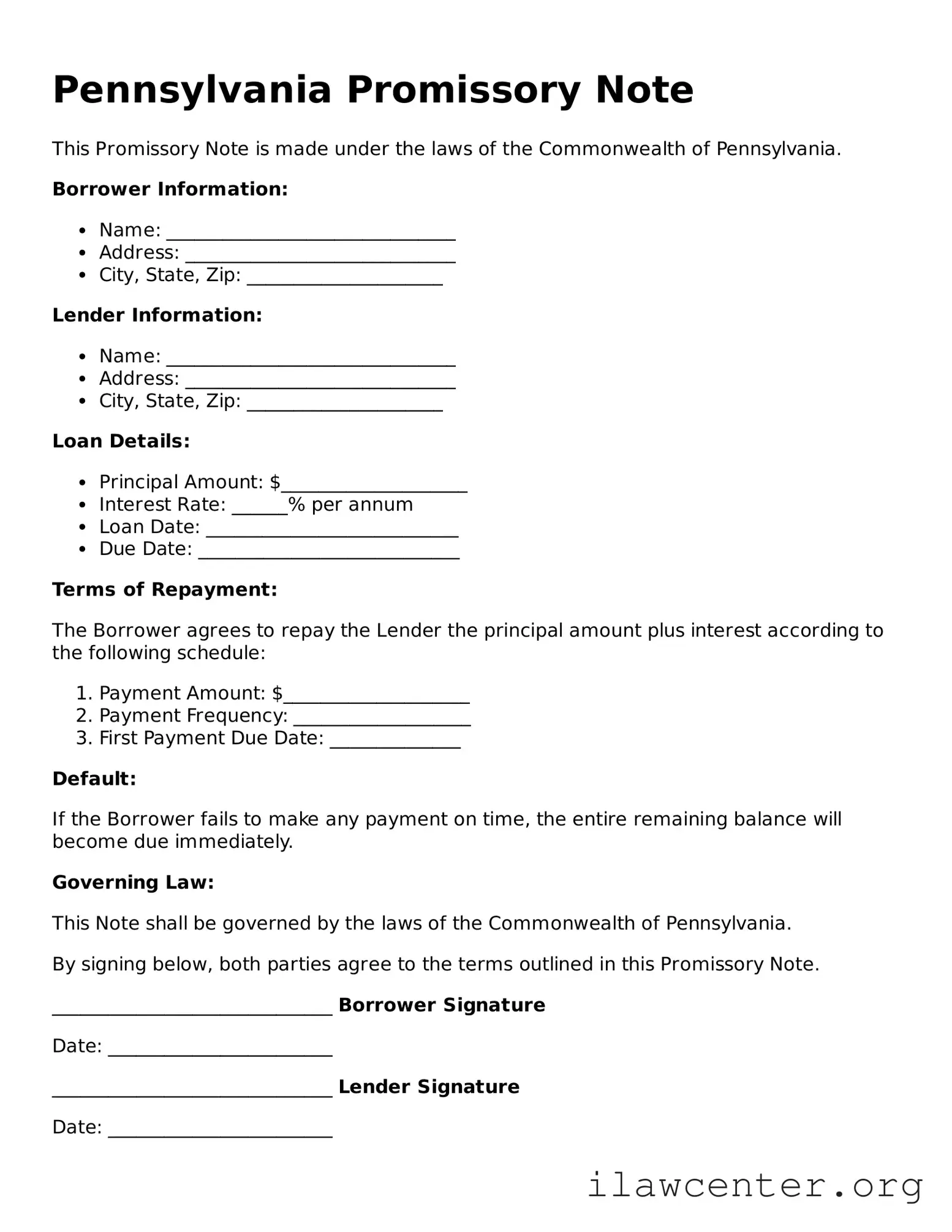
Pennsylvania Promissory Note

This Promissory Note is made under the laws of the Commonwealth of Pennsylvania.

Borrower Information:

  • Name: _______________________________
  • Address: _____________________________
  • City, State, Zip: _____________________

Lender Information:

  • Name: _______________________________
  • Address: _____________________________
  • City, State, Zip: _____________________

Loan Details:

  • Principal Amount: $____________________
  • Interest Rate: ______% per annum
  • Loan Date: ___________________________
  • Due Date: ____________________________

Terms of Repayment:

The Borrower agrees to repay the Lender the principal amount plus interest according to the following schedule:

  1. Payment Amount: $____________________
  2. Payment Frequency: ___________________
  3. First Payment Due Date: ______________

Default:

If the Borrower fails to make any payment on time, the entire remaining balance will become due immediately.

Governing Law:

This Note shall be governed by the laws of the Commonwealth of Pennsylvania.

By signing below, both parties agree to the terms outlined in this Promissory Note.

______________________________ Borrower Signature

Date: ________________________

______________________________ Lender Signature

Date: ________________________

PDF Form Characteristics

Fact Name Description
Definition A promissory note is a written promise to pay a specified amount of money to a designated person or entity.
Governing Law The Pennsylvania Uniform Commercial Code (UCC) governs promissory notes in Pennsylvania.
Parties Involved There are typically two parties: the maker (who promises to pay) and the payee (to whom the payment is made).
Interest Rate The interest rate may be specified in the note. If not, the legal rate applies.
Payment Terms Payment terms should clearly state when and how the payment will be made.
Default Clause A default clause outlines the consequences if the maker fails to pay as agreed.
Transferability Promissory notes can be transferred to others, making them negotiable instruments.
Signature Requirement The maker must sign the note for it to be legally binding.
Consideration There must be consideration, or something of value exchanged, for the note to be enforceable.
Record Keeping It is important to keep a copy of the promissory note for personal records and future reference.

Instructions on Utilizing Pennsylvania Promissory Note

After gathering the necessary information, you’re ready to complete the Pennsylvania Promissory Note form. This document will outline the terms of the loan agreement between the borrower and the lender. Following these steps will help ensure that you fill it out correctly.

  1. Obtain the Form: Download or print the Pennsylvania Promissory Note form from a reliable source.
  2. Fill in the Date: Write the date on which the note is being executed at the top of the form.
  3. Enter Borrower Information: Provide the full name and address of the borrower. This identifies who is receiving the loan.
  4. Enter Lender Information: Similarly, fill in the full name and address of the lender. This identifies who is providing the loan.
  5. Loan Amount: Clearly state the total amount of money being borrowed. Be precise to avoid any misunderstandings.
  6. Interest Rate: Specify the interest rate applicable to the loan. This can be a fixed or variable rate.
  7. Payment Terms: Outline how and when the borrower will repay the loan. Include details such as payment frequency and due dates.
  8. Signatures: Both the borrower and lender must sign the document to make it legally binding. Make sure to date the signatures.
  9. Witness or Notary: Depending on your preference, you may want to have the document witnessed or notarized for additional security.

Once you’ve completed the form, review it carefully to ensure all information is accurate. Having a well-filled Promissory Note can prevent future disputes and clarify the terms for both parties involved.

Important Facts about Pennsylvania Promissory Note

What is a Pennsylvania Promissory Note?

A Pennsylvania Promissory Note is a legal document in which one party (the borrower) agrees to pay a specific amount of money to another party (the lender) under agreed-upon terms. This document outlines the repayment schedule, interest rate, and any other conditions associated with the loan. It serves as a written record of the loan agreement and can be enforced in court if necessary.

Who can use a Promissory Note in Pennsylvania?

Any individual or business in Pennsylvania can use a Promissory Note. This includes personal loans between friends or family members, as well as formal loans between businesses and financial institutions. It is important that both parties understand the terms and conditions outlined in the note before signing.

What should be included in a Pennsylvania Promissory Note?

A well-drafted Promissory Note should include the following key elements: the names and addresses of both the borrower and lender, the principal amount of the loan, the interest rate (if applicable), the repayment schedule, and any late fees or penalties for missed payments. Additionally, it should specify whether the note is secured or unsecured.

Is a Promissory Note legally binding?

Yes, a Promissory Note is legally binding as long as it meets certain requirements. Both parties must agree to the terms, and the document should be signed and dated by both the borrower and lender. If the borrower fails to repay the loan as agreed, the lender has the right to take legal action to recover the owed amount.

Do I need a lawyer to create a Promissory Note?

Can a Promissory Note be modified after it is signed?

Yes, a Promissory Note can be modified after it is signed, but both parties must agree to the changes. It is advisable to document any modifications in writing, and both parties should sign the updated note. This helps maintain clarity and prevents potential disputes regarding the terms of the loan.

What happens if the borrower defaults on the Promissory Note?

If the borrower defaults on the Promissory Note, the lender may take legal action to recover the owed amount. This could involve filing a lawsuit or pursuing other collection methods. It is important for the lender to keep accurate records of all communications and payments related to the note, as this documentation will be crucial in any legal proceedings.

Common mistakes

Filling out a Pennsylvania Promissory Note can seem straightforward, but many people stumble over common mistakes that can lead to complications down the road. Understanding these pitfalls can help ensure that your document serves its intended purpose without any hitches.

One frequent mistake is failing to clearly identify the parties involved. It's essential to provide full names and addresses for both the borrower and the lender. Omitting this information can create confusion and make it difficult to enforce the agreement later on.

Another common error is neglecting to specify the loan amount. While it may seem obvious, leaving this blank or writing it unclearly can lead to disputes. Always double-check that the amount is clearly stated in both numerical and written form to avoid any ambiguity.

People often forget to include the interest rate or, conversely, they might not understand how to express it correctly. If the loan is interest-bearing, the rate should be clearly defined. If it’s a zero-interest loan, stating that explicitly is just as important.

Many also overlook the repayment terms. It’s crucial to specify when payments are due and how they should be made. Whether it's monthly, quarterly, or a lump sum, clear terms prevent misunderstandings. Without this information, both parties may have different expectations about when and how payments should occur.

Another mistake involves the absence of a default clause. This clause outlines what happens if the borrower fails to make payments. Including this information not only protects the lender but also clarifies the consequences for the borrower, making the agreement more transparent.

Some individuals forget to sign the document. It might seem trivial, but without signatures, the note isn’t legally binding. Both parties should sign and date the document to confirm their agreement. Additionally, having a witness or notary public can add an extra layer of legitimacy.

People sometimes use vague language, which can lead to confusion. Instead of using terms that can be interpreted in multiple ways, be specific about the obligations of each party. Clear language helps ensure that everyone understands their responsibilities.

Lastly, failing to keep a copy of the signed Promissory Note is a mistake that can have serious repercussions. Both parties should retain a copy for their records. This not only serves as proof of the agreement but also provides a reference point if any disputes arise in the future.

By avoiding these common mistakes, you can create a Promissory Note that is clear, effective, and enforceable. Taking the time to carefully fill out the form can save you a lot of trouble later on.

Documents used along the form

When dealing with a Pennsylvania Promissory Note, several other forms and documents may be necessary to ensure clarity and legal compliance. Each of these documents serves a unique purpose and can provide additional protections for both the lender and the borrower.

  • Loan Agreement: This document outlines the terms of the loan, including the interest rate, repayment schedule, and any conditions that must be met. It serves as a comprehensive contract between the parties involved.
  • Security Agreement: If the loan is secured by collateral, this agreement details the specific assets pledged as security. It protects the lender's interests in case of default.
  • Personal Guarantee: This form is often signed by a third party, agreeing to repay the loan if the borrower defaults. It adds an extra layer of security for the lender.
  • Disclosure Statement: This document provides the borrower with important information about the loan, including fees, terms, and potential risks. It ensures transparency in the lending process.
  • Amortization Schedule: This schedule breaks down each payment over the life of the loan, showing how much goes toward interest and principal. It helps borrowers understand their repayment obligations.
  • Default Notice: If a borrower fails to make payments, this notice informs them of the default and outlines the lender's rights and potential actions. It is a critical step before pursuing legal remedies.
  • Release of Liability: Once the loan is fully paid, this document releases the borrower from any further obligations. It provides peace of mind and confirms that the debt has been satisfied.
  • Loan Modification Agreement: If the terms of the loan need to be changed, this document outlines the new terms and conditions. It is essential for formalizing any adjustments to the original agreement.

These documents work together to create a clear framework for the lending process. Understanding each one can help both parties navigate their rights and responsibilities effectively.

Similar forms

The Promissory Note is a key financial document, but it shares similarities with several other important documents. Here are six documents that are comparable to a Promissory Note, along with an explanation of how they are alike:

  • Loan Agreement: Like a Promissory Note, a loan agreement outlines the terms of a loan, including the amount borrowed, interest rate, and repayment schedule. Both documents serve to formalize the borrowing process.
  • Mortgage: A mortgage is a specific type of loan secured by real property. It includes a promise to repay the loan, similar to a Promissory Note, but also involves the property as collateral.
  • Credit Agreement: This document details the terms of a credit arrangement between a lender and a borrower. It specifies the amount of credit extended and the conditions for repayment, much like a Promissory Note.
  • Installment Agreement: An installment agreement allows for the repayment of a debt in scheduled payments. It includes terms similar to those found in a Promissory Note, such as payment amounts and timelines.
  • Security Agreement: This document grants a lender a security interest in the borrower's assets. While it focuses on collateral, it often includes a promise to repay, akin to a Promissory Note.
  • Personal Guarantee: A personal guarantee involves an individual promising to repay a debt if the primary borrower defaults. This document functions similarly to a Promissory Note by establishing a legal obligation to pay.

Dos and Don'ts

When filling out the Pennsylvania Promissory Note form, it's essential to follow certain guidelines to ensure that the document is valid and enforceable. Here are five things you should and shouldn't do:

  • Do provide accurate information about the borrower and lender.
  • Do specify the loan amount clearly.
  • Do include the interest rate, if applicable.
  • Don't leave any sections blank; complete all required fields.
  • Don't use ambiguous language that could lead to confusion.

By adhering to these guidelines, you can create a clear and effective Promissory Note that serves its intended purpose. Remember, clarity and completeness are key to avoiding potential disputes in the future.

Misconceptions

Understanding the Pennsylvania Promissory Note form is essential for anyone involved in lending or borrowing money. However, several misconceptions can lead to confusion. Here are four common misconceptions:

  • All Promissory Notes are the Same: Many people believe that a promissory note is a one-size-fits-all document. In reality, the terms and conditions can vary significantly based on the agreement between the parties involved. Each note should be tailored to reflect the specific circumstances of the loan.
  • Verbal Agreements are Sufficient: Some individuals think that a verbal promise to repay is enough. However, a written promissory note provides legal protection and clarity for both the lender and borrower. It serves as a formal record of the agreement.
  • Only Banks Use Promissory Notes: There is a belief that promissory notes are only for financial institutions. In truth, anyone can use a promissory note, including individuals lending money to friends or family. It is a useful tool for personal loans as well.
  • Once Signed, a Promissory Note Cannot Change: Some people think that a signed promissory note is set in stone. However, the terms can be modified if both parties agree to the changes. It is important to document any amendments in writing to avoid misunderstandings.

Being aware of these misconceptions can help individuals navigate the complexities of lending and borrowing money more effectively. Understanding the purpose and function of a promissory note is crucial for ensuring that all parties are protected and informed.

Key takeaways

When filling out and using the Pennsylvania Promissory Note form, it's crucial to understand its components and implications. Here are some key takeaways to keep in mind:

  • Clear Identification: Clearly identify the borrower and lender. Include full names and addresses to avoid confusion.
  • Loan Amount: Specify the exact amount being borrowed. This amount should be stated in both numbers and words for clarity.
  • Interest Rate: Clearly state the interest rate, if applicable. This can affect the total amount repaid.
  • Payment Terms: Outline the repayment schedule. Specify when payments are due and how they should be made.
  • Default Conditions: Define what constitutes a default. This helps both parties understand the consequences of missed payments.
  • Signatures: Ensure that both parties sign the document. Without signatures, the note may not be enforceable.

Understanding these key points will help ensure that the promissory note serves its intended purpose effectively. It is essential to be thorough and precise in this process.