Attorney-Verified  Quitclaim Deed Document for Pennsylvania

Attorney-Verified Quitclaim Deed Document for Pennsylvania

A Quitclaim Deed is a legal document used in Pennsylvania to transfer ownership of real estate from one party to another without guaranteeing the title's validity. This form allows the grantor to relinquish any interest in the property, making it a straightforward method for transferring property rights. For those looking to complete this process, consider filling out the form by clicking the button below.

Article Guide

When it comes to transferring property ownership in Pennsylvania, the Quitclaim Deed form serves as a vital tool for individuals looking to simplify the process. This form allows a property owner, known as the grantor, to convey their interest in a property to another party, referred to as the grantee, without making any guarantees about the title's validity. It is particularly useful in situations where the parties involved have a pre-existing relationship, such as family members or business partners, as it streamlines the transfer while minimizing legal complexities. The Quitclaim Deed is often employed in scenarios such as divorce settlements, estate transfers, or when property is being gifted. Understanding the requirements and implications of this form is essential for ensuring a smooth transaction. By completing the Quitclaim Deed accurately, both parties can protect their interests and facilitate a clear transfer of ownership, making it a practical choice for many property transactions in Pennsylvania.

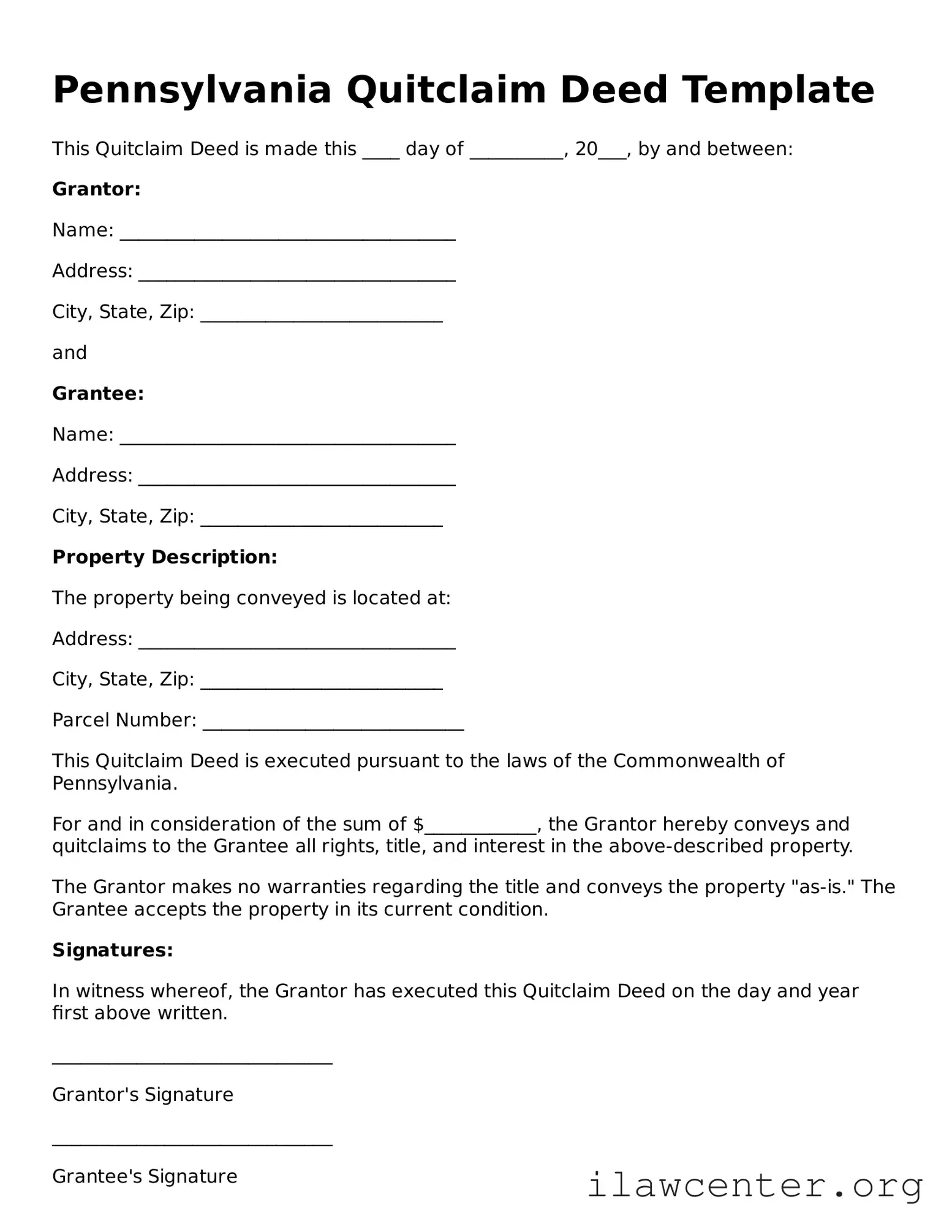
Pennsylvania Quitclaim Deed Preview

Pennsylvania Quitclaim Deed Template

This Quitclaim Deed is made this ____ day of __________, 20___, by and between:

Grantor:

Name: ____________________________________

Address: __________________________________

City, State, Zip: __________________________

and

Grantee:

Name: ____________________________________

Address: __________________________________

City, State, Zip: __________________________

Property Description:

The property being conveyed is located at:

Address: __________________________________

City, State, Zip: __________________________

Parcel Number: ____________________________

This Quitclaim Deed is executed pursuant to the laws of the Commonwealth of Pennsylvania.

For and in consideration of the sum of $____________, the Grantor hereby conveys and quitclaims to the Grantee all rights, title, and interest in the above-described property.

The Grantor makes no warranties regarding the title and conveys the property "as-is." The Grantee accepts the property in its current condition.

Signatures:

In witness whereof, the Grantor has executed this Quitclaim Deed on the day and year first above written.

______________________________

Grantor's Signature

______________________________

Grantee's Signature

Notary Public:

State of Pennsylvania

County of ___________________________

On this ____ day of __________, 20___, before me, a Notary Public, personally appeared ________________________, known to me (or satisfactorily proven) to be the person whose name is subscribed to the within instrument, and acknowledged that he/she executed the same for the purposes therein contained.

In witness whereof, I hereunto set my hand and official seal.

______________________________

Notary Public

My commission expires: ________________

PDF Form Characteristics

Fact Name Details
Definition A quitclaim deed is a legal document used to transfer ownership of real estate without any warranties about the title.
Governing Law The Pennsylvania Uniform Conveyancing Act governs quitclaim deeds in Pennsylvania.
Usage Commonly used among family members, in divorce settlements, or to clear up title issues.
Requirements Must be signed by the grantor and notarized. The grantee's name and the property description must be included.
Recording To be effective against third parties, the deed should be recorded in the county where the property is located.
Consideration While consideration (payment) is not required, it is customary to include a nominal amount.
Limitations The quitclaim deed does not guarantee that the grantor has the legal right to transfer the property or that the title is free of defects.

Instructions on Utilizing Pennsylvania Quitclaim Deed

After obtaining the Pennsylvania Quitclaim Deed form, you will need to complete it accurately before submitting it to the appropriate county office. This process involves providing specific information about the property and the parties involved in the transaction.

  1. Begin by entering the date at the top of the form.
  2. Fill in the grantor's name (the person transferring the property) in the designated area.
  3. Provide the grantor's address below their name.
  4. Next, enter the grantee's name (the person receiving the property) in the appropriate section.
  5. Include the grantee's address following their name.
  6. In the section for property description, provide a clear and accurate description of the property. This may include the address and any legal descriptions necessary.
  7. Sign the form in the area designated for the grantor's signature.
  8. Have the signature witnessed by a notary public. The notary will need to complete their section of the form.
  9. Finally, submit the completed form to the appropriate county office for recording.

Important Facts about Pennsylvania Quitclaim Deed

What is a Quitclaim Deed in Pennsylvania?

A Quitclaim Deed is a legal document used to transfer ownership of real estate from one party to another without any guarantees about the title. In Pennsylvania, this type of deed is often used among family members or in situations where the parties know each other well. It effectively conveys whatever interest the seller has in the property, but it does not provide any warranties regarding the property's title. This means that if there are any issues with the title, the new owner may not have recourse against the seller.

When should I use a Quitclaim Deed?

There are several scenarios where a Quitclaim Deed may be appropriate. Common situations include transferring property between family members, adding or removing a spouse from the title after marriage or divorce, or clarifying ownership interests among co-owners. It is important to note that because a Quitclaim Deed does not guarantee the title, it is generally not recommended for transactions involving strangers or when significant value is at stake.

How do I complete a Quitclaim Deed in Pennsylvania?

Completing a Quitclaim Deed in Pennsylvania involves several steps. First, you will need to obtain the appropriate form, which can often be found online or at local government offices. Fill out the form by including the names of the grantor (the person transferring the property) and the grantee (the person receiving the property), along with a description of the property. After completing the form, it must be signed by the grantor in the presence of a notary public. Finally, the deed should be filed with the county recorder of deeds to make the transfer official.

Are there any fees associated with filing a Quitclaim Deed?

Yes, there are fees associated with filing a Quitclaim Deed in Pennsylvania. These fees can vary by county, so it is wise to check with your local recorder of deeds for specific amounts. In addition to filing fees, there may be costs for notarization. While the process can be relatively inexpensive, it is essential to budget for these expenses to ensure a smooth transfer of property ownership.

Do I need an attorney to create a Quitclaim Deed?

While it is not legally required to have an attorney draft a Quitclaim Deed, seeking legal advice can be beneficial. An attorney can help ensure that the deed is filled out correctly and that all necessary legal requirements are met. This can prevent potential issues down the line, particularly if the property has complicated ownership or title issues. If you feel uncertain about the process or the implications of the transfer, consulting with a legal professional is a wise choice.

What happens after I file a Quitclaim Deed?

After filing a Quitclaim Deed, the transfer of ownership is officially recorded in the county's public records. This means that the grantee's ownership interest in the property is now recognized by the state. It is advisable for the grantee to keep a copy of the recorded deed for their records. If there are any disputes regarding the property in the future, having this documentation can be crucial. Additionally, the grantee may want to update their homeowner's insurance policy to reflect the change in ownership.

Common mistakes

Filling out a Pennsylvania Quitclaim Deed form can seem straightforward, but many individuals make common mistakes that can lead to complications down the line. Understanding these pitfalls can save time, money, and frustration. One frequent error occurs when the grantor and grantee's names are not clearly stated. It’s essential to ensure that both parties’ full legal names are included to avoid any ambiguity.

Another mistake often seen is the failure to provide a complete legal description of the property. This description must be precise, detailing the boundaries and location. Without this information, the deed may be deemed invalid, leaving ownership in question. Additionally, people sometimes overlook the need for signatures. Both the grantor and the grantee must sign the document for it to be legally binding.

In Pennsylvania, the acknowledgment of the deed is crucial. Many individuals neglect this step, which requires a notary public to witness the signatures. Without this acknowledgment, the deed may not be accepted by the county recorder of deeds. Another common oversight involves the date of the transaction. Failing to include the date can create confusion about when the transfer of ownership took place.

Property tax implications are also often misunderstood. Some individuals do not consider whether the deed will trigger a reassessment of property taxes. It’s wise to consult with a tax professional to understand the financial ramifications of transferring property. Furthermore, people sometimes forget to check for any existing liens on the property. A quitclaim deed does not clear liens; it merely transfers the ownership interest.

Lastly, many individuals fail to file the deed with the appropriate county office after completion. This step is critical, as it officially records the change in ownership. Without this filing, the transfer may not be recognized legally. By being aware of these common mistakes, individuals can navigate the process of completing a Quitclaim Deed in Pennsylvania more effectively and ensure that their property transfer goes smoothly.

Documents used along the form

When transferring property in Pennsylvania, a Quitclaim Deed is often accompanied by several other important documents. Each of these documents serves a specific purpose in the property transfer process, ensuring that all legal requirements are met and that both parties are protected.

  • Property Title Search: This document verifies the legal ownership of the property and checks for any liens or encumbrances that may affect the transfer.
  • Affidavit of Residence: This statement confirms the residency status of the property owner, which can be important for tax purposes.
  • Real Estate Transfer Tax Form: This form is required to report the transfer of property and calculate any applicable taxes owed to the state or local government.
  • Settlement Statement: This document outlines the financial details of the transaction, including the purchase price and any closing costs associated with the transfer.
  • Title Insurance Policy: This insurance protects the buyer against any future claims or disputes over the property’s title that may arise after the transfer.
  • Power of Attorney: If one party cannot be present for the signing, this document allows another person to act on their behalf during the transaction.
  • Notice of Transfer: This document informs local authorities of the change in property ownership, which is necessary for updating tax records.
  • Property Deed of Trust: In cases where financing is involved, this document secures the loan by placing a lien on the property until the debt is repaid.

Understanding these accompanying documents is crucial for anyone involved in a property transfer in Pennsylvania. Each plays a vital role in ensuring a smooth and legally sound transaction.

Similar forms

  • Warranty Deed: This document provides a guarantee from the seller that they hold clear title to the property and have the right to sell it. Unlike a quitclaim deed, it includes warranties against future claims.
  • Grant Deed: Similar to a warranty deed, a grant deed transfers ownership but offers fewer guarantees. It assures that the property has not been sold to anyone else and that there are no undisclosed encumbrances.
  • Special Warranty Deed: This type of deed transfers property with a limited warranty. The seller guarantees that they have not caused any title issues during their ownership, unlike a quitclaim deed which offers no guarantees.
  • Deed of Trust: This document secures a loan with real property as collateral. While it does not transfer ownership outright, it involves a similar process of documenting interests in property.
  • Mortgage: A mortgage is a legal agreement in which a borrower pledges real property as security for a loan. It shares similarities with a quitclaim deed in that both involve property interests, but a mortgage creates a debt obligation.
  • Bill of Sale: This document transfers ownership of personal property. While it is not a real estate document, it serves a similar purpose of transferring ownership from one party to another.
  • Power of Attorney: This legal document allows one person to act on behalf of another. In real estate transactions, it can authorize someone to sign a quitclaim deed on behalf of the property owner.
  • Affidavit of Heirship: This document establishes the heirs of a deceased person's estate. It can be used to transfer property interests similarly to a quitclaim deed, particularly when no will exists.

Dos and Don'ts

When filling out the Pennsylvania Quitclaim Deed form, there are several important considerations to keep in mind. Here’s a list of things you should and shouldn’t do:

  • Do ensure that the form is properly titled as a Quitclaim Deed.
  • Do provide the correct names of both the grantor (seller) and grantee (buyer).
  • Do include a complete legal description of the property being transferred.
  • Do check that the form is signed in the presence of a notary public.
  • Do make sure to include the date of the transfer.
  • Don't leave any sections blank; all required fields must be filled out.
  • Don't use vague terms to describe the property; clarity is crucial.
  • Don't forget to include the county where the property is located.
  • Don't overlook the need for any additional documentation that may be required.
  • Don't submit the form without first reviewing it for accuracy.

By following these guidelines, you can help ensure that your Quitclaim Deed is completed correctly and is legally binding. Proper attention to detail can save you time and potential legal issues in the future.

Misconceptions

Understanding the Pennsylvania Quitclaim Deed can help property owners navigate real estate transactions more effectively. However, several misconceptions often cloud the true nature of this document. Here are ten common misunderstandings:

  1. It transfers ownership completely. Many believe that a quitclaim deed transfers full ownership of a property. In reality, it only conveys whatever interest the grantor has at the time of signing, which may not be complete ownership.
  2. It guarantees a clear title. Some think that using a quitclaim deed ensures a clear title to the property. This is incorrect; the deed does not provide any warranties or guarantees about the title's status.
  3. It is only for family transfers. While quitclaim deeds are often used among family members, they can be used in various situations, including sales between strangers or to clear up title issues.
  4. It’s the same as a warranty deed. A warranty deed offers protections and guarantees about the property title, while a quitclaim deed does not provide any such assurances. They serve different purposes.
  5. It can’t be used to transfer property between businesses. Some people think quitclaim deeds are only for personal transactions. However, businesses can also use them to transfer property interests.
  6. It’s a complicated legal document. Many assume that quitclaim deeds are difficult to understand. In fact, they are relatively straightforward and can often be filled out without legal assistance.
  7. It must be notarized. While notarization is recommended for validity, it is not strictly required in Pennsylvania. However, having it notarized can help prevent disputes later.
  8. It can’t be revoked. Once a quitclaim deed is executed, some believe it cannot be undone. In truth, the grantor may be able to revoke it under certain conditions, such as mutual agreement.
  9. It’s only for real estate. Although quitclaim deeds are most commonly associated with real estate, they can also be used for other types of property interests, such as personal property.
  10. It’s only valid if filed with the county. While filing a quitclaim deed with the county is essential for public record, the deed is still valid even if it is not filed. However, filing is crucial for protecting rights against third parties.

Being aware of these misconceptions can help individuals make informed decisions when dealing with property transfers in Pennsylvania. Always consider consulting a professional for personalized advice.

Key takeaways

Filling out and using the Pennsylvania Quitclaim Deed form can be straightforward if you keep a few important points in mind. Here are some key takeaways:

  • Understand the purpose: A quitclaim deed transfers ownership of property without guaranteeing that the title is clear.
  • Identify the parties: Clearly list the grantor (the person transferring the property) and the grantee (the person receiving the property).
  • Provide a legal description: Include a precise legal description of the property. This is crucial for ensuring the deed is valid.
  • Include consideration: Mention the amount of money or value exchanged for the property, even if it is nominal.
  • Signatures are essential: Both the grantor and any witnesses must sign the deed for it to be legally binding.
  • Notarization required: The deed must be notarized to verify the identities of the signers and their willingness to sign.
  • File with the county: After signing and notarizing, file the quitclaim deed with the appropriate county office to make it official.
  • Consider tax implications: Be aware of any potential tax consequences that may arise from the property transfer.
  • Seek legal advice: If unsure about any part of the process, consult with a legal professional for guidance.

These steps can help ensure a smooth transfer of property ownership in Pennsylvania.