Attorney-Verified  Residential Lease Agreement Document for Pennsylvania

Attorney-Verified Residential Lease Agreement Document for Pennsylvania

The Pennsylvania Residential Lease Agreement is a legal document that outlines the terms and conditions between a landlord and tenant for renting residential property. This form helps protect the rights of both parties and ensures clarity in the rental arrangement. To get started on your lease agreement, click the button below.

Article Guide

The Pennsylvania Residential Lease Agreement form serves as a crucial document for both landlords and tenants entering into a rental arrangement. This form outlines the terms and conditions of the lease, ensuring that both parties understand their rights and responsibilities. Key aspects of the agreement include the duration of the lease, the rental amount, and the payment schedule. It also specifies security deposit requirements, maintenance responsibilities, and rules regarding pets and subletting. Additionally, the form addresses procedures for lease termination and the resolution of disputes. By clearly delineating these elements, the agreement helps to prevent misunderstandings and provides a framework for a successful landlord-tenant relationship.

Pennsylvania Residential Lease Agreement Preview

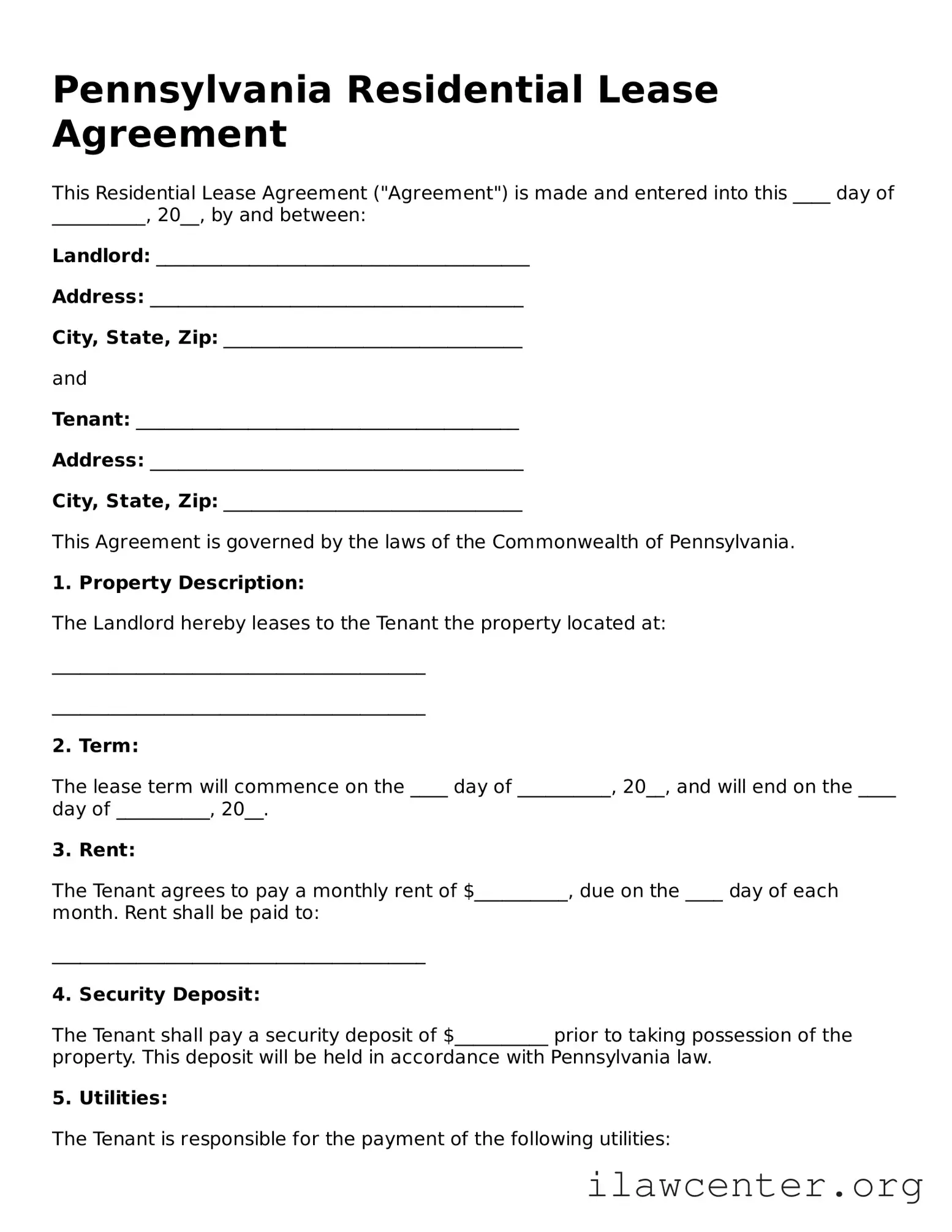
Pennsylvania Residential Lease Agreement

This Residential Lease Agreement ("Agreement") is made and entered into this ____ day of __________, 20__, by and between:

Landlord: ________________________________________

Address: ________________________________________

City, State, Zip: ________________________________

and

Tenant: _________________________________________

Address: ________________________________________

City, State, Zip: ________________________________

This Agreement is governed by the laws of the Commonwealth of Pennsylvania.

1. Property Description:

The Landlord hereby leases to the Tenant the property located at:

________________________________________

________________________________________

2. Term:

The lease term will commence on the ____ day of __________, 20__, and will end on the ____ day of __________, 20__.

3. Rent:

The Tenant agrees to pay a monthly rent of $__________, due on the ____ day of each month. Rent shall be paid to:

________________________________________

4. Security Deposit:

The Tenant shall pay a security deposit of $__________ prior to taking possession of the property. This deposit will be held in accordance with Pennsylvania law.

5. Utilities:

The Tenant is responsible for the payment of the following utilities:

  • Electricity
  • Gas
  • Water
  • Sewer
  • Trash Removal

6. Maintenance and Repairs:

The Tenant agrees to maintain the property in good condition and to promptly notify the Landlord of any necessary repairs.

7. Termination:

Either party may terminate this Agreement by providing written notice at least ____ days prior to the desired termination date.

8. Governing Law:

This Agreement shall be governed by the laws of the Commonwealth of Pennsylvania.

9. Signatures:

By signing below, both parties agree to the terms and conditions set forth in this Agreement.

Landlord Signature: _____________________________ Date: __________

Tenant Signature: ______________________________ Date: __________

PDF Form Characteristics

Fact Name Description
Purpose The Pennsylvania Residential Lease Agreement outlines the terms and conditions for renting a residential property.
Governing Law This lease agreement is governed by the Pennsylvania Uniform Residential Landlord and Tenant Act.
Parties Involved The agreement typically includes the landlord and the tenant as the primary parties.
Duration The lease can be for a fixed term, such as one year, or it may be month-to-month.
Security Deposit Landlords may require a security deposit, which is usually capped at two months' rent.
Rent Payment The lease specifies the amount of rent, payment due date, and acceptable payment methods.
Maintenance Responsibilities The agreement outlines the responsibilities of both the landlord and tenant regarding property maintenance.
Termination Clause The lease includes terms for termination, including notice periods required by both parties.
Additional Provisions It may include provisions for pets, smoking, and other specific rules relevant to the rental property.

Instructions on Utilizing Pennsylvania Residential Lease Agreement

Filling out the Pennsylvania Residential Lease Agreement form is an important step in establishing a rental relationship. This document outlines the terms and conditions of the lease, ensuring that both the landlord and tenant understand their rights and responsibilities. Follow the steps below to complete the form accurately.

  1. Obtain the Form: Start by downloading or printing the Pennsylvania Residential Lease Agreement form from a reliable source.
  2. Fill in the Date: Write the date on which the lease is being executed at the top of the form.
  3. Identify the Parties: Enter the names and addresses of both the landlord and the tenant. Make sure to include any co-tenants if applicable.
  4. Describe the Property: Clearly specify the address of the rental property. Include any unit number if it’s part of a larger complex.
  5. Lease Term: Indicate the duration of the lease. Specify the start date and end date of the lease period.
  6. Rent Amount: Write down the monthly rent amount. Include details about when and how the rent should be paid.
  7. Security Deposit: State the amount of the security deposit required and the conditions under which it will be returned.
  8. Utilities and Maintenance: Specify which utilities are included in the rent and outline the responsibilities for maintenance and repairs.
  9. Signatures: Ensure that both the landlord and tenant sign and date the form. This step is crucial as it indicates agreement to the terms outlined in the lease.

Once you have completed the form, keep a copy for your records and provide a copy to the other party. This ensures that both parties have a clear understanding of the lease terms moving forward.

Important Facts about Pennsylvania Residential Lease Agreement

What is a Pennsylvania Residential Lease Agreement?

A Pennsylvania Residential Lease Agreement is a legally binding contract between a landlord and a tenant. This document outlines the terms and conditions under which a tenant agrees to rent a residential property. It includes important details such as the rental amount, payment due dates, lease duration, and responsibilities of both parties. Understanding this agreement is crucial for ensuring a smooth rental experience.

What key terms should be included in the lease agreement?

Several key terms should be included in the lease agreement to protect both the landlord and tenant. These include the rental amount, security deposit details, duration of the lease, maintenance responsibilities, and rules regarding pets. Additionally, it is essential to outline procedures for handling late payments and the process for terminating the lease. Clear communication of these terms helps prevent misunderstandings later on.

How can a tenant terminate the lease early?

Terminating a lease early can be a complex process. Generally, a tenant must provide written notice to the landlord, adhering to the notice period specified in the lease agreement. Some leases may allow for early termination under certain conditions, such as job relocation or health issues. It is advisable for tenants to review their lease carefully and consult with a legal professional if they are considering this option.

What happens if a tenant fails to pay rent on time?

If a tenant fails to pay rent on time, the landlord typically has the right to charge late fees as specified in the lease agreement. After a certain period, often defined by state law, the landlord may initiate eviction proceedings if the rent remains unpaid. It is crucial for tenants to communicate with their landlord if they anticipate any issues with timely payment. Open dialogue can often lead to solutions that benefit both parties.

Common mistakes

Filling out the Pennsylvania Residential Lease Agreement can be a straightforward process, but mistakes are common. One frequent error is neglecting to include all necessary personal information. Both landlords and tenants must provide their full names, contact details, and any relevant identification numbers. Omitting this information can lead to confusion or disputes later on.

Another mistake often made is failing to specify the lease term clearly. The lease should state whether it is a month-to-month agreement or for a fixed term, such as one year. If the duration is not clearly defined, it can create uncertainty for both parties regarding their rights and responsibilities.

Additionally, many people overlook the importance of detailing the security deposit terms. The agreement should specify the amount of the deposit, the conditions for its return, and any deductions that may be made. Without these details, misunderstandings can arise when it comes time to reclaim the deposit at the end of the lease.

Lastly, individuals frequently forget to include any additional rules or policies that may apply. For example, pet policies, maintenance responsibilities, and rules regarding alterations to the property should all be clearly stated in the lease. Failing to include these provisions can lead to conflicts and dissatisfaction for both landlords and tenants.

Documents used along the form

When entering into a rental agreement in Pennsylvania, it is essential to have a clear understanding of various documents that accompany the Residential Lease Agreement. These forms help clarify responsibilities, outline terms, and protect the rights of both landlords and tenants. Below is a list of commonly used documents that often accompany the lease agreement.

  • Rental Application: This document is typically filled out by prospective tenants. It provides landlords with necessary information such as employment history, rental history, and personal references to assess the suitability of the applicant.
  • Move-In/Move-Out Checklist: This checklist is used to document the condition of the property before the tenant moves in and after they move out. It helps protect both parties by providing a record of any existing damages or issues.
  • Security Deposit Receipt: This receipt acknowledges the amount of the security deposit paid by the tenant. It is crucial for both parties to keep a record of this transaction, as it outlines the conditions under which the deposit may be withheld or returned.
  • Pet Agreement: If pets are allowed in the rental property, this agreement outlines specific rules and regulations regarding pet ownership. It may include pet deposits, restrictions on types of pets, and responsibilities for pet-related damages.
  • Lease Addendum: This document serves as an addition to the original lease agreement. It can address specific issues or modifications, such as changes in rent or rules about common areas, ensuring that all parties are on the same page.
  • Notice of Entry: This form is used by landlords to inform tenants of their intent to enter the rental property for inspections, repairs, or other reasons. It ensures that tenants are aware of when they can expect the landlord to be present.
  • Termination Notice: Should either party wish to terminate the lease, this document provides the necessary notice. It outlines the required time frame for termination and ensures that both parties are informed of the decision.

Understanding these documents can help facilitate a smoother rental experience. They not only protect the rights of both landlords and tenants but also promote clear communication and expectations throughout the lease term.

Similar forms

  • Rental Agreement: Similar to a Residential Lease Agreement, a rental agreement outlines the terms under which a tenant may occupy a property. It typically covers duration, rent amount, and responsibilities of both parties.
  • Commercial Lease Agreement: This document is used for leasing commercial properties. Like a residential lease, it specifies terms, but it also addresses business-related considerations such as zoning and permitted use of the space.
  • Month-to-Month Lease: A month-to-month lease allows tenants to rent a property on a monthly basis. It shares similarities with a Residential Lease Agreement but offers more flexibility in terms of duration and termination.
  • Sublease Agreement: A sublease agreement permits a tenant to rent out a portion or all of the leased property to another person. This document maintains many of the same terms as the original lease but includes additional details about the subtenant's responsibilities.
  • Lease Option Agreement: This type of agreement gives a tenant the option to purchase the property at a later date. It includes terms similar to a Residential Lease Agreement but adds clauses regarding the purchase price and conditions for exercising the option.
  • Lease Purchase Agreement: A lease purchase agreement combines a lease with a purchase agreement. It allows tenants to rent the property with the intention of buying it later, incorporating elements from both lease and purchase documents.
  • Roommate Agreement: This document is used when multiple tenants share a rental property. It establishes the rights and responsibilities of each roommate, similar to a Residential Lease Agreement, but focuses on shared living arrangements.

Dos and Don'ts

When filling out the Pennsylvania Residential Lease Agreement form, it's important to be thorough and accurate. Here are some key dos and don'ts to keep in mind:

  • Do read the entire lease agreement carefully before filling it out.
  • Do provide accurate information for all parties involved, including names and contact details.
  • Don't leave any sections blank. If a section doesn't apply, mark it as "N/A."
  • Don't rush through the process. Take your time to ensure everything is correct.

Misconceptions

Understanding the Pennsylvania Residential Lease Agreement form is crucial for both landlords and tenants. However, several misconceptions can lead to confusion. Here are six common misunderstandings about this important document:

  1. All lease agreements are the same.

    Many people believe that all lease agreements follow the same structure and terms. In reality, each lease can vary significantly based on the specific needs of the landlord and tenant, as well as local laws.

  2. Oral agreements are sufficient.

    Some individuals think that verbal agreements are just as binding as written ones. However, without a written lease, it becomes challenging to enforce terms or resolve disputes.

  3. Tenants have no rights.

    A common misconception is that tenants have no rights under a lease agreement. In Pennsylvania, tenants have various rights that protect them, including the right to a habitable living environment and protection against unlawful eviction.

  4. Landlords can change lease terms at any time.

    Some landlords may believe they can modify lease terms whenever they wish. However, changes to a lease typically require mutual agreement and should be documented in writing.

  5. Security deposits are non-refundable.

    Many tenants fear that their security deposits will never be returned. In Pennsylvania, landlords must return the deposit within a specific timeframe after the lease ends, provided there are no damages beyond normal wear and tear.

  6. Lease agreements do not need to be reviewed.

    Some tenants assume that they can sign a lease without reading it. It is essential to review the entire document to understand rights, responsibilities, and any potential pitfalls before signing.

Key takeaways

Understanding the Pennsylvania Residential Lease Agreement is essential for both landlords and tenants. Below are key takeaways to consider when filling out and using this form:

  • Complete Information: Ensure that all parties' names, addresses, and contact information are accurately filled in.
  • Property Details: Clearly specify the address and description of the rental property to avoid confusion.
  • Lease Term: Define the duration of the lease, including start and end dates, to establish clear expectations.
  • Rent Amount: Clearly state the monthly rent amount and the due date to ensure timely payments.
  • Security Deposit: Indicate the amount of the security deposit and the conditions under which it will be returned.
  • Utilities: Specify which utilities are included in the rent and which are the tenant's responsibility.
  • Maintenance Responsibilities: Outline the maintenance obligations of both the landlord and tenant to prevent disputes.
  • Pet Policy: Clearly state whether pets are allowed and any associated fees or restrictions.
  • Termination Clause: Include the process for terminating the lease, including notice requirements.
  • Signatures: Ensure that all parties sign and date the agreement to make it legally binding.

By paying attention to these details, both landlords and tenants can foster a positive rental experience and reduce the likelihood of misunderstandings.