Attorney-Verified  Small Estate Affidavit Document for Pennsylvania

Attorney-Verified Small Estate Affidavit Document for Pennsylvania

The Pennsylvania Small Estate Affidavit is a legal document that allows individuals to settle the estate of a deceased person without the need for formal probate proceedings, provided the estate meets certain criteria. This form simplifies the process for heirs and beneficiaries, enabling them to claim assets quickly and efficiently. To begin the process of filling out the form, please click the button below.

Article Guide

In Pennsylvania, managing the affairs of a deceased loved one can often be a daunting task, especially when it comes to settling their estate. The Small Estate Affidavit form serves as a valuable tool for individuals navigating this process, particularly when the estate's total value does not exceed a certain threshold. This form allows heirs or beneficiaries to collect assets without the need for formal probate proceedings, streamlining what can otherwise be a lengthy and complicated process. By providing essential information about the deceased, including their assets and liabilities, the Small Estate Affidavit facilitates the transfer of property to rightful heirs efficiently. Additionally, it requires the signature of the affiant, who must affirm that they are entitled to the assets and that the estate qualifies for this simplified procedure. Understanding how to properly complete and submit this form can save time and reduce stress during an already challenging period.

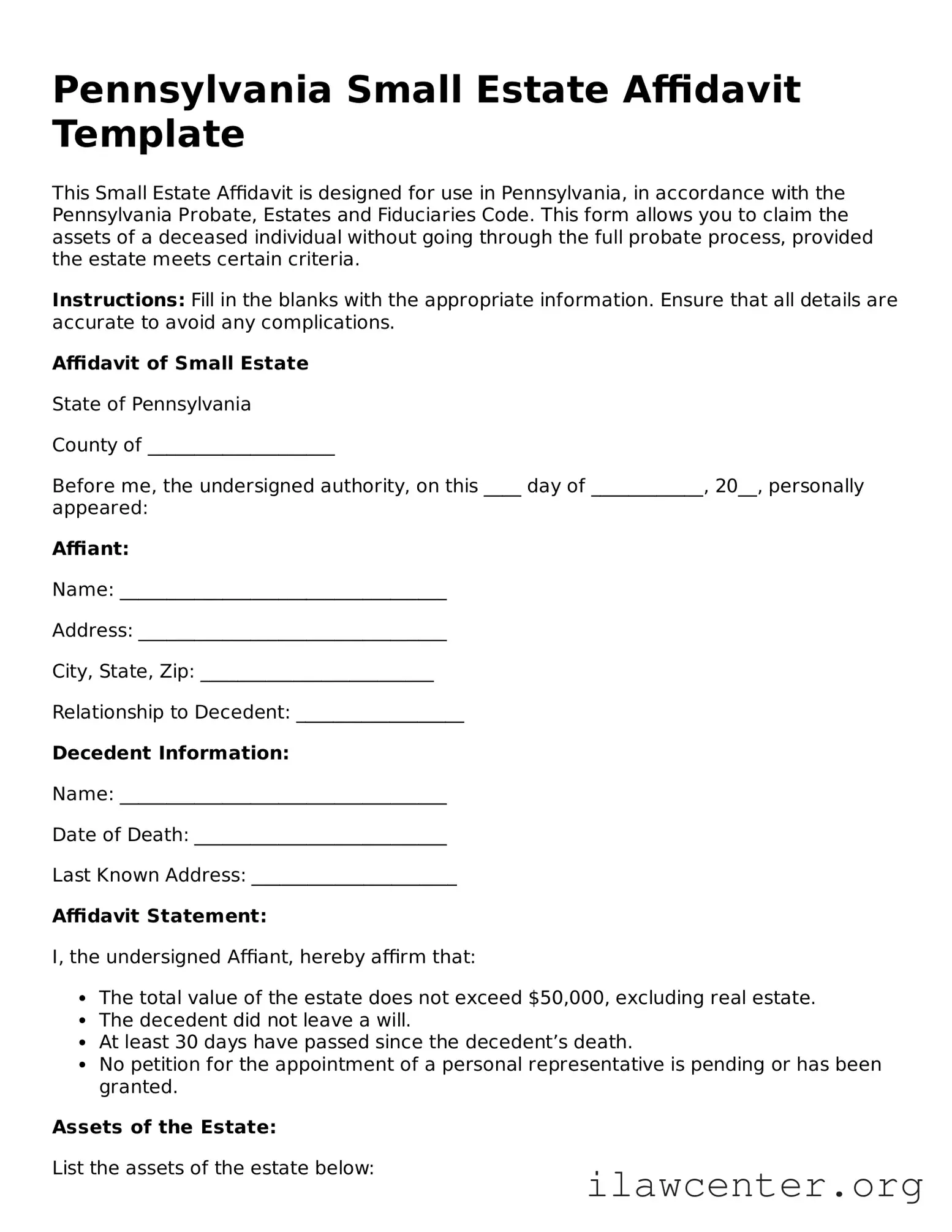
Pennsylvania Small Estate Affidavit Preview

Pennsylvania Small Estate Affidavit Template

This Small Estate Affidavit is designed for use in Pennsylvania, in accordance with the Pennsylvania Probate, Estates and Fiduciaries Code. This form allows you to claim the assets of a deceased individual without going through the full probate process, provided the estate meets certain criteria.

Instructions: Fill in the blanks with the appropriate information. Ensure that all details are accurate to avoid any complications.

Affidavit of Small Estate

State of Pennsylvania

County of ____________________

Before me, the undersigned authority, on this ____ day of ____________, 20__, personally appeared:

Affiant:

Name: ___________________________________

Address: _________________________________

City, State, Zip: _________________________

Relationship to Decedent: __________________

Decedent Information:

Name: ___________________________________

Date of Death: ___________________________

Last Known Address: ______________________

Affidavit Statement:

I, the undersigned Affiant, hereby affirm that:

  • The total value of the estate does not exceed $50,000, excluding real estate.
  • The decedent did not leave a will.
  • At least 30 days have passed since the decedent’s death.
  • No petition for the appointment of a personal representative is pending or has been granted.

Assets of the Estate:

List the assets of the estate below:

  1. Asset 1: _______________________________ (Value: $_________)
  2. Asset 2: _______________________________ (Value: $_________)
  3. Asset 3: _______________________________ (Value: $_________)
  4. Asset 4: _______________________________ (Value: $_________)

By signing below, I declare under penalty of perjury that the foregoing is true and correct.

______________________________

Signature of Affiant

______________________________

Date

Notary Public:

State of Pennsylvania

County of ____________________

Subscribed and sworn to before me on this ____ day of ____________, 20__.

______________________________

Notary Public Signature

My commission expires: ________________

PDF Form Characteristics

Fact Name Description
Eligibility The Pennsylvania Small Estate Affidavit can be used if the total value of the estate is $50,000 or less, excluding real estate.
Governing Law This form is governed by the Pennsylvania Consolidated Statutes, Title 20, Chapter 31.
Use of the Form Heirs or beneficiaries can use the affidavit to claim assets without going through formal probate.
Filing Requirements The completed affidavit must be filed with the Register of Wills in the county where the deceased resided.

Instructions on Utilizing Pennsylvania Small Estate Affidavit

After gathering the necessary information and documents, you will proceed to fill out the Pennsylvania Small Estate Affidavit form. This form allows individuals to claim assets from a deceased person's estate without going through the full probate process. Ensure that all details are accurate and complete to facilitate the process.

  1. Obtain the Pennsylvania Small Estate Affidavit form. This can be downloaded from the official state website or obtained from a local courthouse.
  2. Fill in the decedent's full name and date of death in the designated sections of the form.
  3. Provide your full name and address, as the affiant, in the appropriate fields.
  4. List the names and addresses of all heirs and beneficiaries who are entitled to inherit from the estate.
  5. Detail the assets of the estate, including bank accounts, real estate, and personal property, ensuring to include their estimated values.
  6. Indicate any debts or liabilities of the estate, if applicable, and provide an estimate of the total amount owed.
  7. Sign and date the affidavit in the presence of a notary public. The notary will verify your identity and witness your signature.
  8. Make copies of the completed affidavit and any supporting documents for your records.
  9. Submit the original affidavit to the appropriate court or institution holding the decedent's assets.

Important Facts about Pennsylvania Small Estate Affidavit

What is a Pennsylvania Small Estate Affidavit?

The Pennsylvania Small Estate Affidavit is a legal document that allows individuals to claim the assets of a deceased person without going through the formal probate process. This form is typically used when the total value of the deceased's estate is below a certain threshold, which is currently set at $50,000 for estates without real estate. By using this affidavit, heirs can simplify the transfer of assets, making it quicker and less costly.

Who is eligible to use the Small Estate Affidavit?

To use the Small Estate Affidavit, you must be an heir or a beneficiary of the deceased person's estate. You should also ensure that the estate's total value does not exceed the $50,000 limit, excluding any real estate. Additionally, you must be able to provide a valid identification and proof of your relationship to the deceased. It’s essential to confirm that no other probate proceedings are ongoing for the estate.

How do I complete the Small Estate Affidavit?

Completing the Small Estate Affidavit involves filling out the form with accurate information about the deceased, including their name, date of death, and the details of their assets. You will also need to list the names and relationships of all heirs. After filling out the form, it must be signed in front of a notary public. Make sure to keep copies of the completed affidavit and any supporting documents for your records.

What happens after I submit the Small Estate Affidavit?

Once you submit the Small Estate Affidavit to the institutions holding the deceased's assets, such as banks or financial institutions, they will review the document. If everything is in order, they will release the assets to you or the other heirs as specified in the affidavit. It’s important to note that some institutions may have their own requirements, so be prepared to provide additional documentation if requested.

Common mistakes

Filling out the Pennsylvania Small Estate Affidavit form can be a straightforward process, but several common mistakes can lead to delays or complications. One frequent error is providing inaccurate or incomplete information about the deceased. It is essential to ensure that the name, date of birth, and date of death are correct. Any discrepancies can cause confusion and may require additional documentation to resolve.

Another mistake often made is failing to list all assets owned by the deceased. The Small Estate Affidavit is designed to address estates with limited assets, but it is crucial to include every relevant item. Omitting an asset can not only delay the process but may also result in legal challenges later on. Ensure that all bank accounts, real estate, and personal property are accounted for in the affidavit.

People sometimes overlook the requirement for signatures. The affidavit must be signed by the person claiming the estate, and it may also require notarization. Neglecting to have the document properly signed and notarized can lead to immediate rejection by the court. Always double-check that all necessary signatures are present before submission.

Lastly, some individuals fail to understand the implications of submitting the affidavit. It's important to recognize that filing this document does not transfer ownership of the assets automatically. There may be additional steps required to finalize the transfer. Being aware of the entire process can help prevent misunderstandings and ensure a smoother transition of the estate.

Documents used along the form

The Pennsylvania Small Estate Affidavit is a useful tool for settling the affairs of a deceased person's estate when the total value is under a specific threshold. When utilizing this form, there are several other documents that may be required to ensure a smooth process. Below is a list of common forms and documents that are often used in conjunction with the Small Estate Affidavit.

  • Death Certificate: This official document certifies the date and cause of death. It is essential for verifying the passing of the individual whose estate is being settled.
  • Will: If the deceased left a will, it may need to be submitted along with the Small Estate Affidavit. The will outlines the deceased’s wishes regarding the distribution of their assets.
  • List of Assets: A detailed inventory of the deceased's assets is often required. This list helps to establish the total value of the estate and ensures that all assets are accounted for.
  • Proof of Identity: Identification documents for the person filing the affidavit may be necessary. This can include a driver’s license or other forms of ID to verify the individual’s identity.
  • Affidavit of Heirship: In some cases, this document may be needed to establish the rightful heirs to the estate. It provides legal confirmation of the relationship between the heirs and the deceased.
  • Court Filing Fee Receipt: If the Small Estate Affidavit is filed with the court, proof of payment for any required fees may be necessary. This receipt confirms that all financial obligations have been met.
  • Tax Clearance Certificate: This document shows that all taxes owed by the deceased have been paid. It is often required before the estate can be fully distributed to the heirs.

These documents, when gathered and submitted correctly, can facilitate the efficient handling of a small estate in Pennsylvania. Being well-prepared can help ease the emotional burden during this challenging time.

Similar forms

  • Will: A will outlines how a person's assets should be distributed after their death. Like a Small Estate Affidavit, it provides a legal framework for asset transfer but is typically more comprehensive.
  • Trust: A trust allows a person to manage their assets during their lifetime and specify how they should be distributed after death. Both documents serve to transfer assets, but a trust can be more complex and can avoid probate entirely.
  • Probate Petition: A probate petition initiates the legal process to validate a will and administer an estate. While a Small Estate Affidavit can simplify the process for smaller estates, a probate petition is necessary for larger estates.
  • Letters of Administration: These documents are issued by a court to appoint an administrator for an estate when there is no will. Like the Small Estate Affidavit, they help in managing and distributing assets, but they require court involvement.
  • Power of Attorney: This document allows someone to make decisions on behalf of another person, especially regarding financial matters. Both documents enable asset management, but a Power of Attorney is effective during a person’s lifetime.
  • Affidavit of Heirship: This document is used to establish the heirs of a deceased person when there is no will. Similar to the Small Estate Affidavit, it helps in transferring property but focuses specifically on proving heirship.
  • Transfer on Death Deed: This deed allows property to pass directly to a beneficiary upon death, avoiding probate. It serves a similar purpose to the Small Estate Affidavit but is specific to real estate.
  • Community Property Agreement: This agreement allows spouses to designate their community property to pass to the surviving spouse upon death. Both documents facilitate asset transfer but are specific to marital property.
  • Declaration of Trust: This document outlines the terms of a trust and the responsibilities of the trustee. Similar to a Small Estate Affidavit, it aids in asset distribution but is typically more detailed and formal.
  • Living Will: A living will specifies a person’s wishes regarding medical treatment at the end of life. While not directly related to asset distribution, it complements the Small Estate Affidavit by addressing end-of-life decisions.

Dos and Don'ts

When filling out the Pennsylvania Small Estate Affidavit form, it is important to follow specific guidelines to ensure the process goes smoothly. Here are some essential dos and don'ts to keep in mind:

  • Do provide accurate information about the deceased and their estate.
  • Do include all required signatures and dates on the form.
  • Do verify that the total value of the estate does not exceed the state limit for small estates.
  • Do keep copies of the completed affidavit for your records.
  • Don't omit any necessary documentation, such as death certificates or proof of assets.
  • Don't sign the affidavit until you are sure all information is correct.

By adhering to these guidelines, you can help facilitate a smoother process in settling the estate.

Misconceptions

The Pennsylvania Small Estate Affidavit is a useful tool for settling estates with minimal assets. However, several misconceptions can lead to confusion. Here are nine common misunderstandings:

  1. Only estates under $50,000 qualify.

    Many believe that the limit is strictly $50,000. In fact, this amount applies to the value of the estate excluding certain assets, such as real estate.

  2. All debts must be paid before using the affidavit.

    While debts should be addressed, the affidavit allows for the transfer of assets even if some debts remain unpaid, as long as the estate can cover them.

  3. The affidavit can be used for any type of asset.

    Not all assets qualify. For example, real estate and certain financial accounts may require different legal processes.

  4. Only heirs can file the affidavit.

    While heirs typically file, other interested parties, such as beneficiaries, may also have the right to submit the affidavit.

  5. The process is quick and simple.

    Although the affidavit streamlines the process, it still requires careful preparation and may involve court approval in some cases.

  6. Once filed, the affidavit cannot be changed.

    Corrections can be made if necessary. However, it is important to address any errors promptly to avoid complications.

  7. Anyone can access the affidavit once filed.

    While it is a public document, access may be restricted depending on the circumstances and the nature of the estate.

  8. The affidavit eliminates the need for a will.

    The Small Estate Affidavit does not replace a will. It is intended for specific situations where a will may not be necessary.

  9. Legal representation is not needed.

    While individuals can file without an attorney, legal guidance can help navigate complexities and ensure compliance with all requirements.

Understanding these misconceptions is crucial for effectively using the Pennsylvania Small Estate Affidavit. Clarity can prevent delays and ensure a smoother process for settling estates.

Key takeaways

Filling out and using the Pennsylvania Small Estate Affidavit form can simplify the process of settling a deceased person's estate when the total value is below a certain threshold. Here are some key takeaways to consider:

  • Eligibility Requirements: The estate must not exceed $50,000 in value, excluding real estate. Ensure that you meet this criterion before proceeding.
  • Affidavit Completeness: All sections of the affidavit must be filled out accurately. Missing information can lead to delays or rejection.
  • Signature Requirement: The affidavit must be signed by the person claiming the estate, typically an heir or a designated representative. Notarization is also necessary.
  • Asset Identification: Clearly list all assets included in the estate. This may encompass bank accounts, personal property, and other valuables.
  • Filing Procedure: Once completed, the affidavit should be filed with the Register of Wills in the county where the deceased lived. Follow local procedures for submission.

Understanding these key points can help streamline the process and ensure compliance with Pennsylvania law when handling small estates.