Fillable Personal Guarantee Document

Fillable Personal Guarantee Document

A Personal Guarantee form is a legal document in which an individual agrees to be responsible for the debt or obligations of another party, typically a business. This form provides assurance to lenders or creditors that they can seek repayment from the guarantor if the primary borrower defaults. Understanding its implications is crucial for anyone considering signing such a document.

Ready to take the next step? Fill out the Personal Guarantee form by clicking the button below.

Article Guide

When entering into a business agreement, especially when loans or credit are involved, a Personal Guarantee form often plays a crucial role. This document serves as a promise made by an individual to take personal responsibility for a business's debts. It is commonly used by lenders to secure their interests, ensuring that if the business fails to repay its obligations, the lender can seek repayment from the individual who signed the guarantee. The form typically includes essential details such as the names of the parties involved, the amount guaranteed, and the specific obligations covered. Understanding the implications of signing a Personal Guarantee is vital, as it can affect personal finances and credit. By clearly outlining the terms and conditions, this form helps to establish accountability and provides a layer of security for lenders, making it an important tool in the realm of business finance.

Personal Guarantee Preview

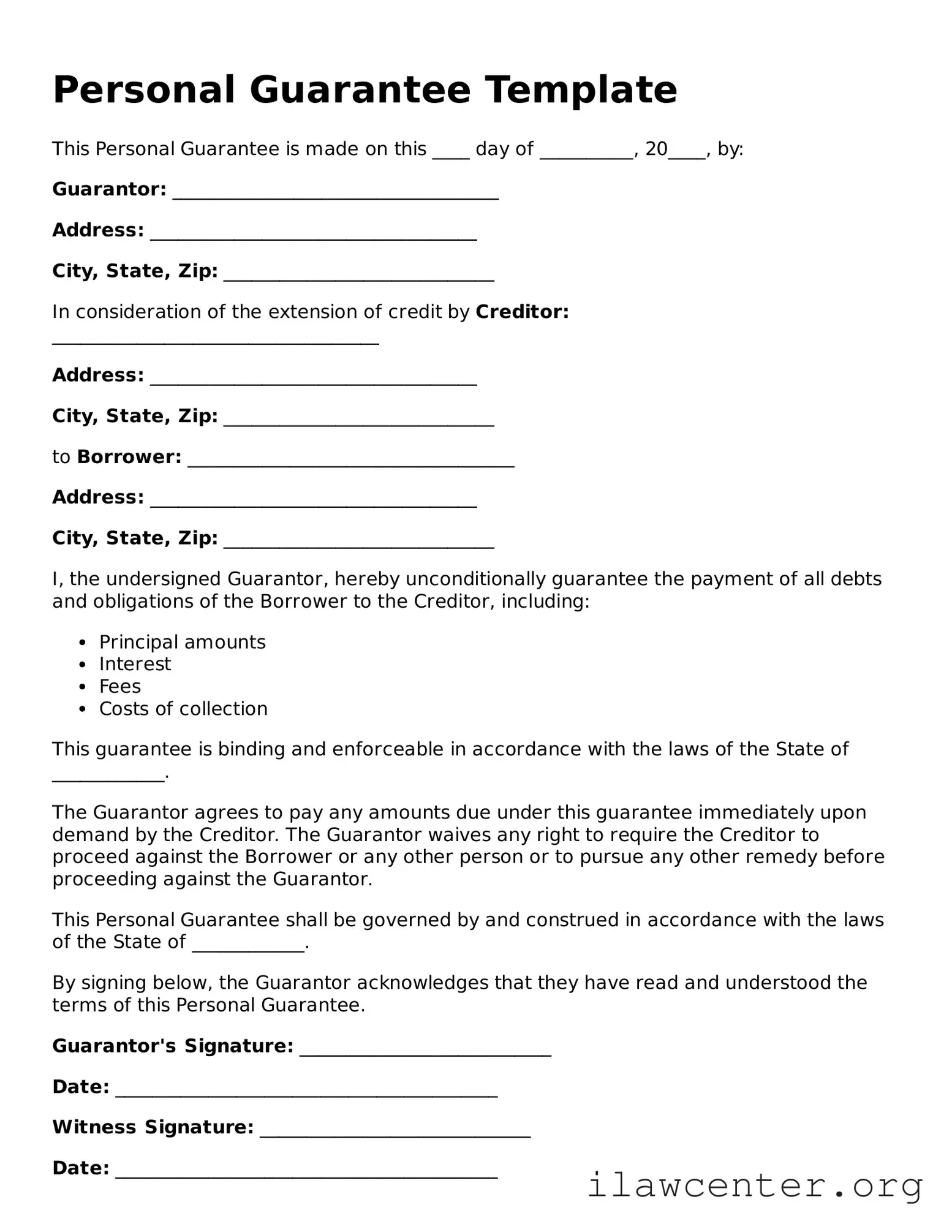
Personal Guarantee Template

This Personal Guarantee is made on this ____ day of __________, 20____, by:

Guarantor: ___________________________________

Address: ___________________________________

City, State, Zip: _____________________________

In consideration of the extension of credit by Creditor: ___________________________________

Address: ___________________________________

City, State, Zip: _____________________________

to Borrower: ___________________________________

Address: ___________________________________

City, State, Zip: _____________________________

I, the undersigned Guarantor, hereby unconditionally guarantee the payment of all debts and obligations of the Borrower to the Creditor, including:

  • Principal amounts
  • Interest
  • Fees
  • Costs of collection

This guarantee is binding and enforceable in accordance with the laws of the State of ____________.

The Guarantor agrees to pay any amounts due under this guarantee immediately upon demand by the Creditor. The Guarantor waives any right to require the Creditor to proceed against the Borrower or any other person or to pursue any other remedy before proceeding against the Guarantor.

This Personal Guarantee shall be governed by and construed in accordance with the laws of the State of ____________.

By signing below, the Guarantor acknowledges that they have read and understood the terms of this Personal Guarantee.

Guarantor's Signature: ___________________________

Date: _________________________________________

Witness Signature: _____________________________

Date: _________________________________________

PDF Form Characteristics

Fact Name Description
Definition A personal guarantee is a legal commitment made by an individual to repay a debt or obligation if the primary borrower fails to do so.
Common Use Often used in business loans, leases, and credit agreements, personal guarantees provide lenders with additional security.
State-Specific Forms Many states require specific formats for personal guarantee forms, which can vary by jurisdiction.
Governing Law The laws governing personal guarantees can differ by state. For example, California's laws are outlined in the California Civil Code.
Enforceability For a personal guarantee to be enforceable, it typically must be in writing and signed by the guarantor.
Risks Signing a personal guarantee exposes individuals to personal liability, which can affect personal assets if the debt is not repaid.

Instructions on Utilizing Personal Guarantee

Filling out a Personal Guarantee form is an important step that requires careful attention to detail. Once you complete the form, it will be submitted for review, and you may be contacted for any necessary clarifications. Ensure that all information is accurate to avoid delays in processing.

  1. Begin by reading the instructions carefully to understand what information is required.
  2. Enter your full name in the designated field. Ensure that it matches the name on your official identification.
  3. Provide your current address. Include the street, city, state, and zip code.
  4. List your contact information, including your phone number and email address.
  5. Fill in your date of birth. This helps verify your identity.
  6. Indicate your Social Security Number (SSN) if required. Be cautious with this sensitive information.
  7. Complete the section regarding your employment status. Include your employer's name and your job title.
  8. Provide details about your financial situation, including income and any other relevant financial information.
  9. Read through the terms and conditions carefully. Make sure you understand your obligations.
  10. Sign and date the form at the bottom. Your signature indicates your agreement to the terms.
  11. Double-check all the information for accuracy before submitting the form.

Important Facts about Personal Guarantee

What is a Personal Guarantee form?

A Personal Guarantee form is a legal document that an individual signs to personally guarantee the obligations of a business or another individual. This means that if the business fails to meet its financial obligations, the individual who signed the guarantee agrees to cover those debts personally. It is commonly used in business loans, leases, and credit agreements.

Who typically needs to sign a Personal Guarantee?

Typically, owners or key stakeholders of a business are required to sign a Personal Guarantee. Lenders and landlords often request this to reduce their risk. If the business cannot pay its debts, the guarantor becomes personally liable, which means their personal assets could be at risk.

What are the risks associated with signing a Personal Guarantee?

Signing a Personal Guarantee carries significant risks. If the business defaults on its obligations, the guarantor may have to use personal assets to satisfy the debt. This could include savings, property, or other valuables. It is crucial to understand the extent of liability before signing.

Can a Personal Guarantee be revoked or canceled?

Generally, a Personal Guarantee cannot be revoked unilaterally. Once signed, it remains in effect until the obligation is fulfilled or the lender agrees to release the guarantor from the agreement. It is important to review the terms carefully and seek legal advice if needed.

Are there different types of Personal Guarantees?

Yes, there are several types of Personal Guarantees. The most common are unlimited and limited guarantees. An unlimited guarantee makes the guarantor responsible for the entire amount of the debt, while a limited guarantee specifies a maximum amount for which the guarantor is liable.

How does a Personal Guarantee affect credit scores?

A Personal Guarantee can impact an individual's credit score. If the business defaults and the guarantor is required to pay, this can lead to missed payments or increased debt, negatively affecting credit. Lenders may also consider the guarantee when evaluating the individual's creditworthiness for future loans.

Is legal advice recommended before signing a Personal Guarantee?

Yes, seeking legal advice is highly recommended before signing a Personal Guarantee. An attorney can help clarify the terms, potential liabilities, and implications of the agreement. Understanding the full scope of the commitment is essential for making an informed decision.

What should be included in a Personal Guarantee form?

A Personal Guarantee form should include the names of the parties involved, a clear statement of the obligations being guaranteed, the extent of the liability, and any specific terms or conditions. It should also be signed and dated by the guarantor to be legally binding.

Can a Personal Guarantee be enforced in court?

Yes, a Personal Guarantee can be enforced in court. If the business fails to meet its obligations, the lender can pursue the guarantor for repayment. This could lead to legal action, including lawsuits to recover the owed amount, making it critical for guarantors to understand their responsibilities.
Common mistakes

When filling out a Personal Guarantee form, many people unknowingly make mistakes that can have significant consequences. One common error is failing to read the entire document carefully. It’s essential to understand what you are signing, as this agreement holds you personally responsible for the debts of a business or individual. Skimming through the details can lead to misunderstandings about your obligations.

Another frequent mistake is not providing accurate personal information. This includes your name, address, and Social Security number. Inaccurate details can create issues later on, especially if a creditor needs to contact you or if there’s a dispute regarding the guarantee.

Some individuals overlook the importance of including all necessary signatures. A Personal Guarantee often requires more than just the guarantor's signature; it may also need to be signed by witnesses or co-guarantors. Missing a signature can render the document invalid.

Many people also fail to understand the implications of the guarantee. They might not realize that signing the form means they are putting their personal assets at risk. This lack of awareness can lead to financial difficulties down the line.

Another mistake is not considering the duration of the guarantee. Some forms may have a specific term, while others might be indefinite. Not clarifying this aspect can lead to unexpected liabilities in the future.

Some individuals neglect to consult with a financial advisor or legal professional before signing. This oversight can be costly, as these experts can provide valuable insights into the risks involved and help you make an informed decision.

Inadequate documentation is also a common issue. People sometimes fail to attach necessary supporting documents, such as financial statements or proof of income, which may be required by the lender. Without these, the guarantee may not be taken seriously.

Another mistake involves not keeping a copy of the signed Personal Guarantee. It’s crucial to retain a copy for your records. Having this document on hand can be vital if any disputes arise in the future.

Some individuals may also rush through the process, thinking that a quick signature will suffice. Taking your time to ensure everything is filled out correctly can save you from potential headaches later.

Finally, many people forget to ask questions if they are unsure about any part of the form. Whether it’s about specific terms or the implications of the guarantee, seeking clarification can prevent misunderstandings and protect your interests.

Documents used along the form

A Personal Guarantee form is often used in various financial and legal transactions to ensure that an individual takes personal responsibility for a debt or obligation. Alongside this form, several other documents may be required to provide clarity and security in the agreement. Below is a list of common forms and documents that are frequently used with a Personal Guarantee.

  • Loan Agreement: This document outlines the terms of the loan, including the amount borrowed, interest rate, repayment schedule, and any collateral involved.
  • Promissory Note: A written promise to pay a specified amount of money to a designated party at a certain time or on demand.
  • Business License: This document proves that a business is legally allowed to operate in a specific jurisdiction and is often required for business loans.
  • Financial Statement: A summary of an individual's or business's financial status, including assets, liabilities, income, and expenses, which helps assess creditworthiness.
  • Credit Application: A form used to request credit from a lender, providing personal and financial information to evaluate the applicant's ability to repay.
  • Security Agreement: This document details the collateral pledged by the borrower to secure a loan, outlining the lender's rights in case of default.
  • Certificate of Incorporation: A legal document that establishes a corporation's existence, often required for business loans and guarantees.
  • Operating Agreement: For LLCs, this document outlines the management structure and operating procedures, which can be relevant in guaranteeing loans.
  • Resolution of the Board: A formal document from a company's board of directors approving the guarantee and outlining the authority of the signatory.
  • Disclosure Statement: A document that provides important information about the terms and conditions of a loan, ensuring transparency for the borrower.

Having these documents prepared and understood can help facilitate a smoother transaction process. Always ensure that you have the necessary paperwork in order to protect your interests and fulfill your obligations effectively.

Similar forms

  • Co-Signer Agreement: This document involves a second party agreeing to take on the responsibility of a loan or lease if the primary borrower defaults. Like a personal guarantee, it provides additional security to the lender.
  • Corporate Guarantee: A corporate guarantee is issued by a company to back the obligations of another entity. This is similar to a personal guarantee but involves a business rather than an individual, offering assurance to creditors.
  • Letter of Credit: A letter of credit is a financial document issued by a bank guaranteeing payment. It acts as a safety net for sellers, ensuring they receive payment, much like a personal guarantee protects lenders.
  • Indemnity Agreement: An indemnity agreement provides protection against financial loss. It is similar to a personal guarantee in that it holds one party responsible for the obligations of another, ensuring compensation for potential losses.
  • Loan Agreement: A loan agreement outlines the terms of a loan, including repayment conditions. While it primarily focuses on the borrower, it may include personal guarantees to secure the lender's interests.
  • Lease Agreement: A lease agreement details the terms under which one party rents property from another. It can include personal guarantees to ensure that the lessee meets their obligations, providing extra security for the lessor.

Dos and Don'ts

When filling out the Personal Guarantee form, it’s important to approach the task with care. Here are some guidelines to help you navigate the process effectively.

  • Do read the entire form carefully before you begin. Understanding each section will help you provide accurate information.
  • Do provide your full legal name as it appears on official documents. This ensures that your guarantee is valid.
  • Do check for any specific instructions or requirements outlined in the form. Following these can prevent delays.
  • Do sign and date the form where indicated. Your signature is essential for the guarantee to be enforceable.
  • Do keep a copy of the completed form for your records. This can be useful for future reference.
  • Don't rush through the form. Taking your time reduces the risk of making mistakes.
  • Don't leave any required fields blank. Incomplete forms may be rejected.
  • Don't use nicknames or abbreviations for your name. Always use your full legal name.
  • Don't forget to review your information before submitting. Errors can lead to complications.
  • Don't ignore the deadline for submission. Late forms may not be accepted.

Misconceptions

Understanding the Personal Guarantee form is essential for both individuals and businesses. However, several misconceptions can lead to confusion. Here are seven common misconceptions explained:

  1. Personal Guarantees are only for businesses.

    Many believe that only business owners need to sign a Personal Guarantee. In reality, individuals may also be required to provide a Personal Guarantee when applying for loans or credit.

  2. Signing a Personal Guarantee means unlimited liability.

    While a Personal Guarantee does expose you to liability, it does not necessarily mean you are liable for all debts. The terms of the guarantee will specify the extent of your liability.

  3. Personal Guarantees are always enforceable.

    Not all Personal Guarantees are enforceable. Factors such as the clarity of the document and whether it was signed under duress can affect its validity.

  4. You cannot negotiate the terms of a Personal Guarantee.

    Some individuals think that the terms are set in stone. However, it is often possible to negotiate terms before signing, especially for larger agreements.

  5. A Personal Guarantee is the same as a co-signer.

    While both involve taking on liability for another's debt, a Personal Guarantee typically applies to business debts, whereas a co-signer is usually associated with personal loans.

  6. Once signed, a Personal Guarantee cannot be revoked.

    In certain circumstances, it may be possible to revoke a Personal Guarantee. This often requires a formal agreement with the lender or creditor.

  7. Personal Guarantees are only necessary for large loans.

    People often assume that Personal Guarantees are only required for significant amounts. However, lenders may request them for smaller loans as well, depending on the risk assessment.

Being informed about these misconceptions can help you make better decisions regarding Personal Guarantees and their implications.

Key takeaways

Filling out and using a Personal Guarantee form can be a critical step in securing a loan or credit for your business. Understanding the nuances of this form can help you navigate the process with confidence. Here are some key takeaways to keep in mind:

  1. Understand Your Commitment: A Personal Guarantee means you are personally responsible for the debt if your business cannot pay. This commitment can impact your personal finances.
  2. Review the Terms Carefully: Before signing, read the entire form. Ensure you understand the terms and conditions, including any potential liabilities.
  3. Provide Accurate Information: Fill out the form with precise and truthful details. Inaccuracies can lead to complications or even legal issues down the line.
  4. Consider the Risks: Weigh the risks of signing the guarantee. If your business fails, your personal assets may be at stake.
  5. Seek Professional Advice: If you have concerns or questions, consult with a financial advisor or legal expert. Their guidance can provide clarity and peace of mind.

Being informed about the Personal Guarantee form can empower you to make better financial decisions for your business. Take the time to understand its implications fully.