Fillable Personal Recommendation Letter Document

Fillable Personal Recommendation Letter Document

The Personal Recommendation Letter form is a document used to gather insights and endorsements from individuals who can vouch for a person's character, skills, and experiences. This form plays a crucial role in various applications, such as job searches, college admissions, or professional opportunities. To get started, fill out the form by clicking the button below.

Article Guide

When seeking a personal recommendation, understanding the structure and purpose of the Personal Recommendation Letter form can be incredibly helpful. This form typically serves as a guide for the person writing the recommendation, ensuring that they include all the necessary information to support the individual seeking the recommendation. Key aspects often covered in this form include the relationship between the recommender and the applicant, specific examples of the applicant's skills and achievements, and the recommender’s overall assessment of the applicant's character and potential. By providing a clear framework, the form helps the recommender articulate their thoughts in a way that is both organized and impactful. Additionally, it often prompts the inclusion of contact information, allowing for follow-up if needed. Understanding these components can make the process smoother for both the recommender and the person requesting the letter, ultimately leading to a more compelling and personalized recommendation.

Personal Recommendation Letter Preview

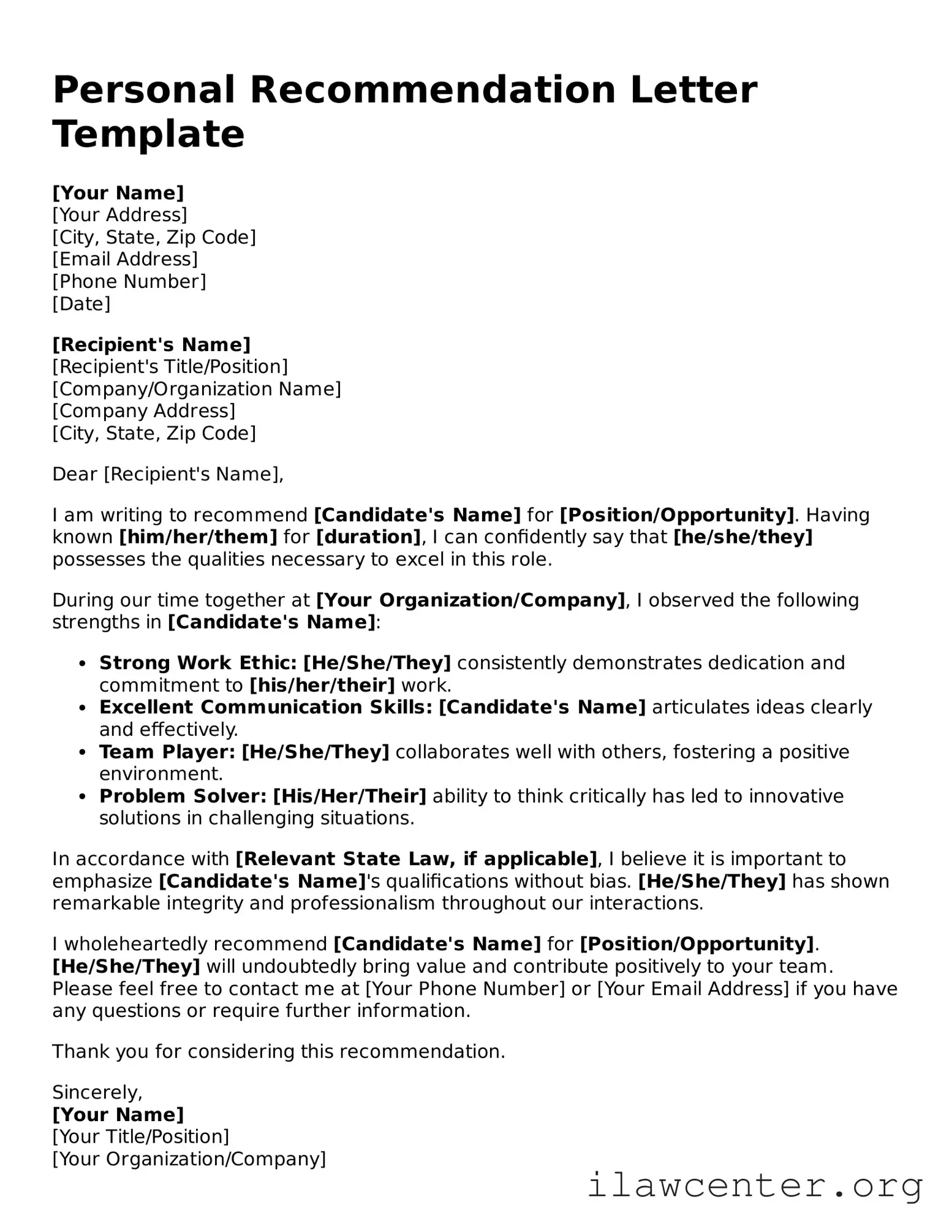
Personal Recommendation Letter Template

[Your Name]
[Your Address]
[City, State, Zip Code]
[Email Address]
[Phone Number]
[Date]

[Recipient's Name]
[Recipient's Title/Position]
[Company/Organization Name]
[Company Address]
[City, State, Zip Code]

Dear [Recipient's Name],

I am writing to recommend [Candidate's Name] for [Position/Opportunity]. Having known [him/her/them] for [duration], I can confidently say that [he/she/they] possesses the qualities necessary to excel in this role.

During our time together at [Your Organization/Company], I observed the following strengths in [Candidate's Name]:

  • Strong Work Ethic: [He/She/They] consistently demonstrates dedication and commitment to [his/her/their] work.
  • Excellent Communication Skills: [Candidate's Name] articulates ideas clearly and effectively.
  • Team Player: [He/She/They] collaborates well with others, fostering a positive environment.
  • Problem Solver: [His/Her/Their] ability to think critically has led to innovative solutions in challenging situations.

In accordance with [Relevant State Law, if applicable], I believe it is important to emphasize [Candidate's Name]'s qualifications without bias. [He/She/They] has shown remarkable integrity and professionalism throughout our interactions.

I wholeheartedly recommend [Candidate's Name] for [Position/Opportunity]. [He/She/They] will undoubtedly bring value and contribute positively to your team. Please feel free to contact me at [Your Phone Number] or [Your Email Address] if you have any questions or require further information.

Thank you for considering this recommendation.

Sincerely,
[Your Name]
[Your Title/Position]
[Your Organization/Company]

PDF Form Characteristics

Fact Name Description
Purpose A Personal Recommendation Letter is used to provide a reference for an individual, highlighting their skills and character.
Format The letter should be formatted professionally, typically including the writer's contact information, date, and the recipient's details.
State-Specific Requirements Some states may have specific guidelines for recommendation letters, especially in professional or academic contexts.
Governing Laws In California, for example, Civil Code Section 47 protects individuals from liability for statements made in a recommendation letter.
Confidentiality It is important to consider confidentiality. The writer should ensure that sensitive information is not disclosed without consent.

Instructions on Utilizing Personal Recommendation Letter

After obtaining the Personal Recommendation Letter form, you will need to complete it accurately to ensure that all necessary information is provided. Follow the steps below to fill out the form correctly.

  1. Begin by entering your name in the designated field at the top of the form.
  2. Next, provide your contact information, including your phone number and email address.
  3. Fill in the name of the person you are recommending.
  4. Include the relationship you have with the individual being recommended. Be specific about your connection.
  5. Describe the individual's qualifications and strengths in the provided section. Use clear and concise language.
  6. Provide specific examples of the individual's achievements or contributions that support your recommendation.
  7. Complete the section requesting your signature and date. This confirms the authenticity of the recommendation.

Once you have filled out the form, review all entries for accuracy before submitting it to the appropriate recipient.

Important Facts about Personal Recommendation Letter

What is a Personal Recommendation Letter form?

A Personal Recommendation Letter form is a document that allows individuals to request a letter of recommendation from someone who can vouch for their character, skills, or accomplishments. This form typically includes sections for both the requester and the recommender to provide relevant information, ensuring that the recommendation is tailored to the individual's needs.

Who should I ask to write my recommendation letter?

Choosing the right person to write your recommendation letter is crucial. Ideally, you should ask someone who knows you well and can speak positively about your strengths and experiences. This could be a teacher, employer, mentor, or colleague. Consider their familiarity with your work ethic and personal qualities, as well as their ability to provide specific examples that highlight your abilities.

What information do I need to provide on the form?

The Personal Recommendation Letter form usually requires you to fill out your personal details, such as your name, contact information, and the purpose of the recommendation. Additionally, you may need to provide details about your relationship with the recommender and any specific points you would like them to address in the letter.

How do I approach someone to write my recommendation letter?

When asking someone to write your recommendation letter, approach them politely and express your request clearly. It’s helpful to explain why you are seeking their recommendation and provide context about the opportunity you are pursuing. Consider scheduling a time to discuss this in person or over the phone, as this can create a more personal connection and allow for a more in-depth conversation.

Can I provide a draft or outline for the letter?

Yes, providing a draft or outline can be very helpful for the person writing your recommendation. This can guide them in highlighting specific experiences or qualities you would like emphasized. Just be sure to express that it is a suggestion and that they are welcome to modify it as they see fit to ensure authenticity in their voice.

How long should the recommendation letter be?

While there is no strict rule regarding the length of a recommendation letter, a well-crafted letter typically ranges from one to two pages. The key is to ensure that the letter is concise yet comprehensive, effectively covering your strengths and relevant experiences without unnecessary filler.

Is there a specific format I should follow for the letter?

While there is no universally required format, a standard recommendation letter generally includes a header with the recommender's contact information, a salutation, an introduction, body paragraphs detailing your qualifications, and a closing statement. The tone should be professional yet personal, reflecting the recommender's genuine support for you.

How should I follow up after requesting a recommendation letter?

Following up is important, but it should be done thoughtfully. After a week or two, send a polite email or make a brief phone call to check in. Thank the recommender again for their willingness to help and inquire if they need any additional information. This shows respect for their time and reinforces your appreciation.

What if my recommender is unable to write the letter?

If your chosen recommender feels unable to write a strong letter for any reason, it’s best to respect their decision. Thank them for their honesty and consider seeking another individual who may be more comfortable or enthusiastic about providing a recommendation. It’s essential to have someone who can genuinely advocate for you.

How do I submit the completed recommendation letter?

The submission process for a recommendation letter can vary depending on the requirements of the institution or organization. Often, the recommender will submit the letter directly on your behalf, either electronically or via mail. Be sure to provide clear instructions and deadlines to your recommender to ensure timely submission.
Common mistakes

Filling out a Personal Recommendation Letter form can seem straightforward, but many individuals make common mistakes that can undermine the effectiveness of the letter. One frequent error is providing vague or generic information. When a recommender writes a letter, they should include specific examples that illustrate the individual's strengths and achievements. Instead of stating that someone is a "hard worker," it is far more impactful to mention a particular project where their dedication led to success.

Another common mistake is failing to tailor the recommendation to the specific opportunity. Each application, whether for a job, school, or scholarship, has unique requirements and expectations. A one-size-fits-all approach can diminish the letter's relevance. Personalizing the content to align with the goals of the position or program can make a significant difference in how the letter is perceived.

Additionally, some people overlook the importance of formatting and clarity. A recommendation letter should be easy to read and well-organized. Poor grammar, spelling errors, or a cluttered layout can distract from the message. Taking the time to proofread and ensure that the letter is visually appealing demonstrates professionalism and respect for the recipient.

Lastly, another mistake is neglecting to include contact information. A recommendation letter is more credible when the recommender provides their details for follow-up. This allows the recipient to reach out for further clarification or additional insights. Omitting this information can leave the letter feeling incomplete and may hinder the applicant's chances.

Documents used along the form

In addition to the Personal Recommendation Letter form, several other documents may be utilized to provide a comprehensive view of an individual's qualifications and character. Each document serves a unique purpose and can enhance the overall application or evaluation process.

  • Resume or Curriculum Vitae (CV): This document outlines an individual's work history, education, skills, and accomplishments. It provides a detailed overview of professional experience and qualifications, making it a critical component of job applications or academic pursuits.
  • Cover Letter: A cover letter accompanies a resume and introduces the applicant to the potential employer. It highlights specific experiences and skills relevant to the position, allowing the applicant to present their case in a personalized manner.
  • Transcripts: Academic transcripts are official records from educational institutions that detail the courses taken and grades received. They provide evidence of an individual's academic performance and can be essential for college admissions or job applications in certain fields.
  • Portfolio: A portfolio is a collection of work samples that showcases an individual's skills and accomplishments. It is particularly useful in creative fields, as it allows applicants to demonstrate their capabilities through tangible examples of their work.

Each of these documents plays a vital role in presenting a well-rounded picture of an individual’s qualifications. Together with the Personal Recommendation Letter form, they can significantly enhance the strength of an application or evaluation.

Similar forms

The Personal Recommendation Letter form shares similarities with several other documents. Each serves a unique purpose but maintains a common goal of providing insight into an individual's character, skills, or qualifications. Below is a list of eight documents that are similar in nature:

  • Reference Letter: This document is written by someone who knows the individual well and can speak to their abilities and character, similar to a personal recommendation letter.
  • Letter of Recommendation: Often requested for academic or professional purposes, this letter highlights an individual’s qualifications and experiences, much like a personal recommendation.
  • Character Reference: This type of letter focuses on the personal qualities of an individual, providing a perspective on their character and integrity.
  • Employment Verification Letter: While primarily confirming employment, this letter can also include insights into an employee’s work ethic and contributions, akin to a recommendation.
  • Academic Transcript: This document provides an overview of a student’s academic performance and can include remarks from educators, similar to a recommendation letter in an academic context.
  • Performance Review: Conducted by employers, this document assesses an employee’s work performance and can serve as a recommendation for future roles.
  • Personal Statement: Often required for college applications, this statement allows individuals to express their goals and motivations, similar to the narrative found in a recommendation letter.
  • Cover Letter: Typically submitted with a job application, a cover letter introduces the applicant and outlines their qualifications, paralleling the intent of a personal recommendation letter.

Dos and Don'ts

When filling out the Personal Recommendation Letter form, it is essential to follow certain guidelines to ensure the process goes smoothly. Here are four key things to do and avoid:

  • Do: Provide accurate and truthful information about the candidate.
  • Do: Use clear and concise language to describe the candidate's strengths.
  • Don't: Include irrelevant personal information that does not pertain to the recommendation.
  • Don't: Rush through the form; take your time to ensure all sections are completed thoroughly.

Misconceptions

Misconceptions about the Personal Recommendation Letter form can lead to confusion and misinformation. Below are eight common misconceptions explained.

  1. Only academic references are acceptable.

    Many believe that only teachers or professors can provide a recommendation. In reality, employers, mentors, or community leaders can also offer valuable insights.

  2. The letter must be lengthy.

    Some think that longer letters carry more weight. However, a concise and focused letter can be just as effective, provided it contains relevant information.

  3. Recommendations are only needed for college applications.

    This form is often associated with college admissions, but it is also used for job applications, internships, and professional opportunities.

  4. All recommendation letters must be written by someone in a supervisory role.

    While supervisors can provide strong recommendations, peers or colleagues can also give valuable perspectives on a candidate's abilities and character.

  5. The letter must be typed and printed.

    Some individuals believe that handwritten letters are unacceptable. However, many organizations accept digital submissions, which can be more convenient.

  6. Personal Recommendation Letters are the same as reference lists.

    A recommendation letter is typically more detailed and personalized than a simple reference list, which may only include names and contact information.

  7. Once submitted, the letter cannot be changed.

    In some cases, recommenders can update or revise their letters if new information or achievements arise, as long as the request is made in a timely manner.

  8. All recommendation letters are confidential.

    While some organizations require confidential letters, others allow candidates to view them. It varies by institution or employer.

Key takeaways

Filling out and using a Personal Recommendation Letter form can significantly impact your application process. Here are some key takeaways to keep in mind:

  • Choose the Right Person: Select someone who knows you well and can speak positively about your skills and character.
  • Be Clear and Specific: Provide your recommender with details about the position or opportunity you are applying for, along with any specific qualities or experiences you would like them to highlight.
  • Follow Up: After submitting the form, check in with your recommender to ensure they received it and to express your gratitude for their support.
  • Proofread: Before sending the form, double-check for any errors or missing information to ensure professionalism.

These steps can help ensure that your recommendation letter is effective and makes a strong impression.